From 12:00 noon Japan time on Thursday, October 1, 2026 to 12:00 noon Japan time on Wednesday, October 28, 2026
2. This is a “Pre-order” page.
Please select the product you would like to reserve, click the “Add to Cart” button, and proceed to the payment page.
If you order Shimekazari during the reservation period above, you will receive a 5% discount on all Shimekazari items as a special pre-order benefit.
Add the Shimekazari items to your shopping cart and proceed to the payment page. The 5% discounted price will be displayed there.
3. Payment is required in advance. Please pay for the product when you make your reservation, not when the product is delivered.
You can use various payment methods, except Cash on Delivery.
If you select Cash on Delivery, we will change the payment method to a bank transfer to Japan Post Bank and contact you again with the payment details.
4. We cannot accept cancellations after payment has been made.
Please do not cancel your reservation after payment has been made.
5. You can also order regular items together with Shimekazari pre-order items.
If you order and pay for Shimekazari pre-order items and regular items at the same time, regular items will be shipped within 3–7 business days, and Shimekazari will be delivered from late November onward.
As the items will be shipped at different times, shipping fees would normally be charged twice. However, as a special benefit for ordering pre-order items and regular items together, the shipping fee for the regular items will be free of charge.
Please feel free to take advantage of this offer.
※You will only be charged one shipping fee for the Shimekazari pre-order items.
※This benefit is available for domestic shipping within Japan only. For overseas deliveries, we will charge shipping fees for two shipments.
6. The products listed here will be shipped in order from late November.
<Delivery in Japan only> We only accept time-specific requests. We do not accept date-specific requests.
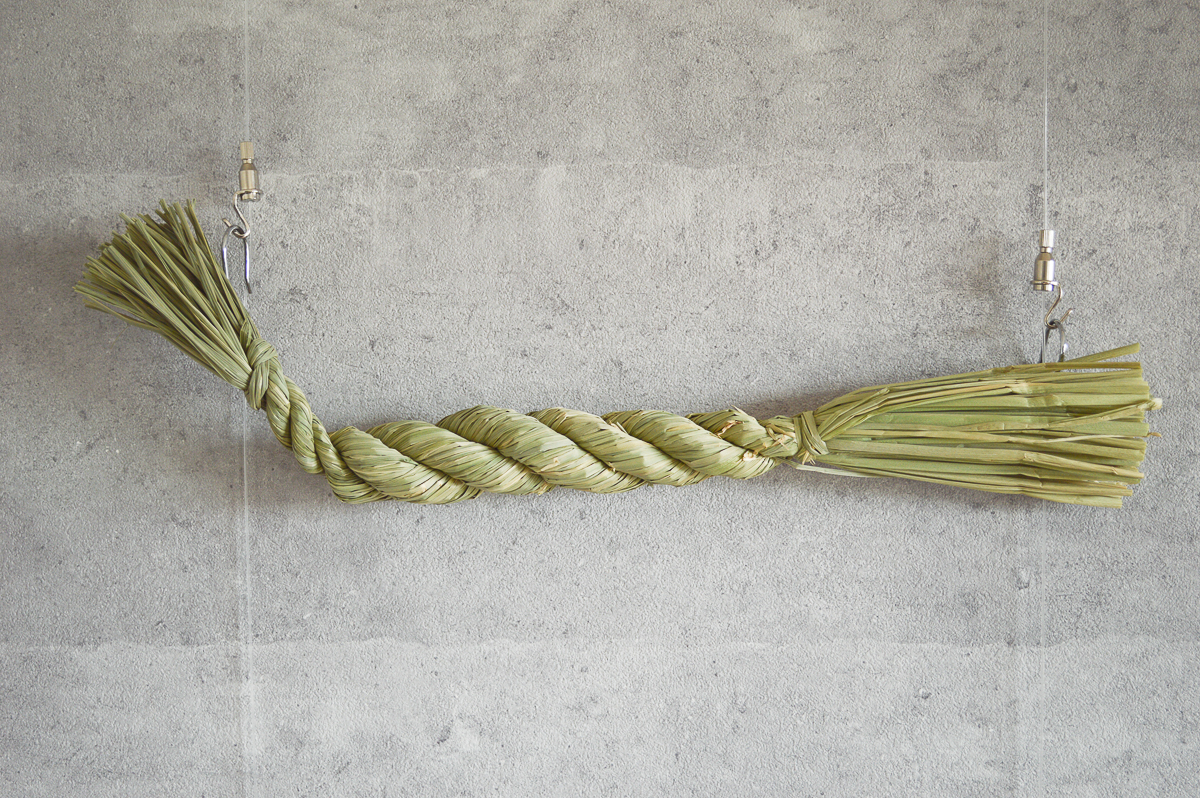
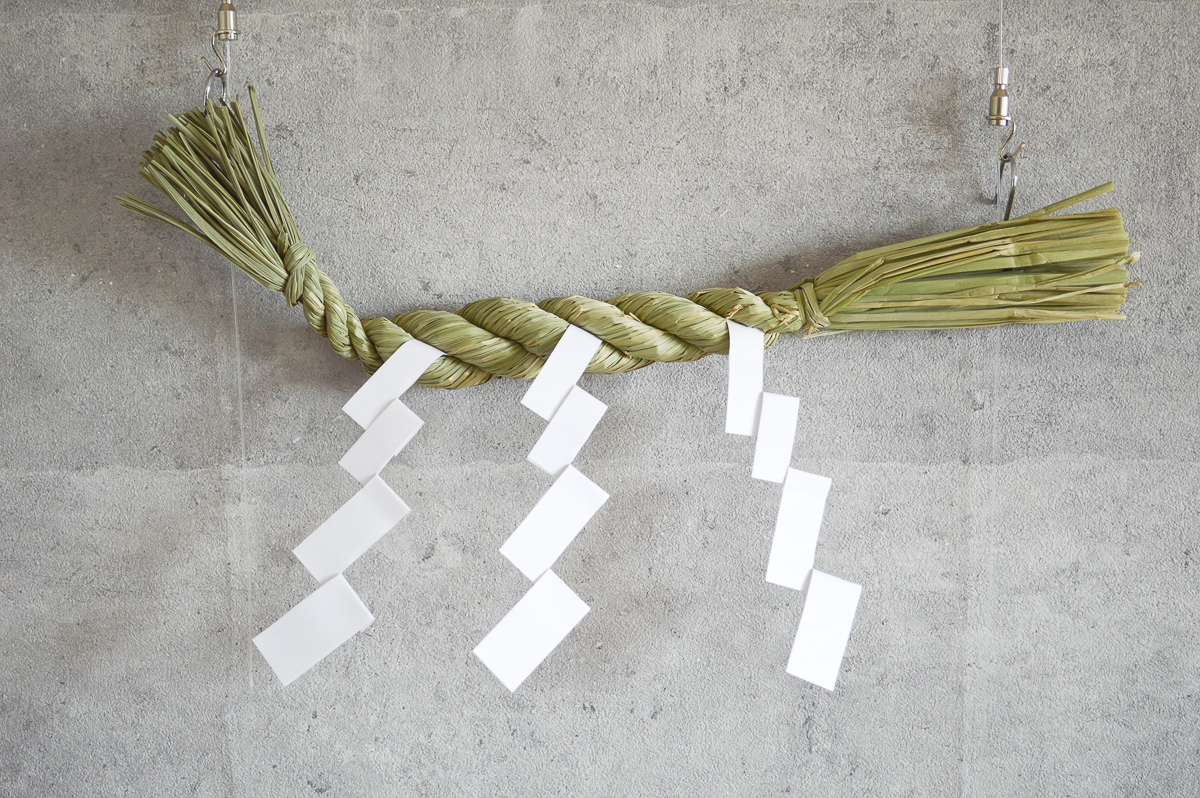
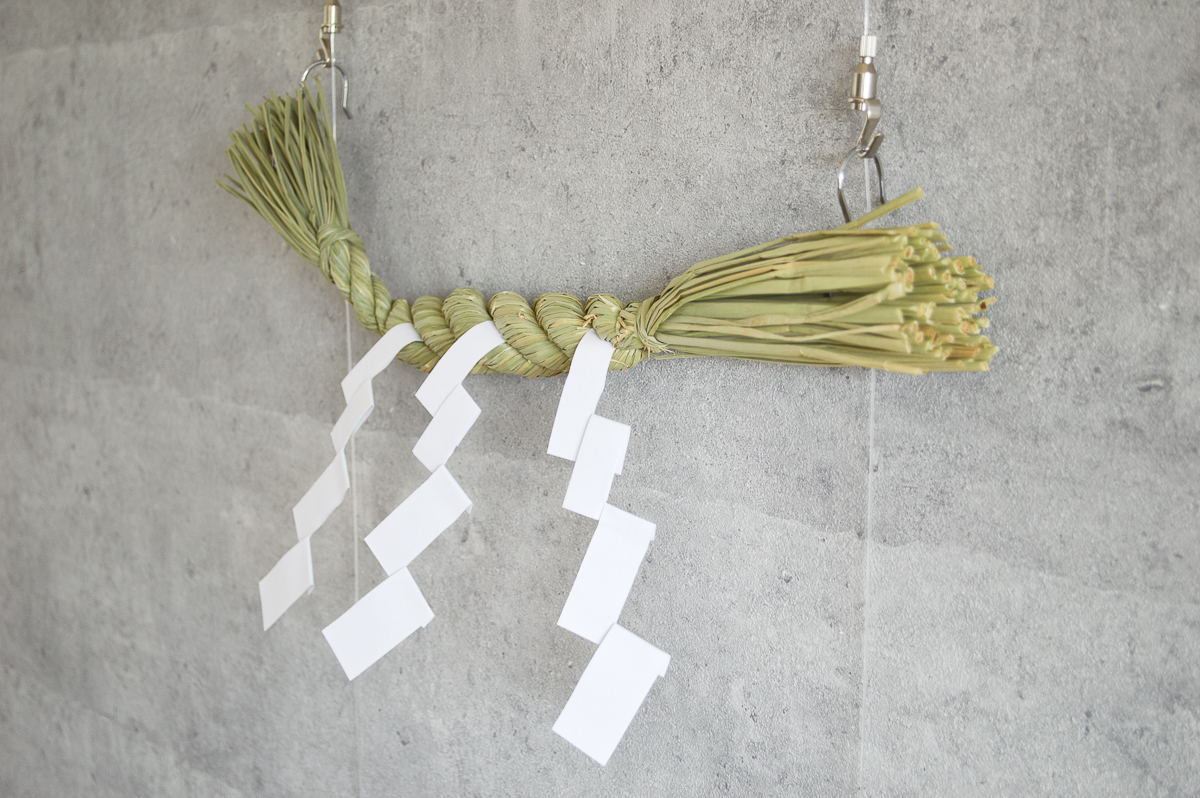
This is a Shimekazari known as a “Kōjin” decoration.
It is based on Gobō-jime, in which rice straw is twisted into a straight rope of even thickness. It is traditionally displayed as an offering to Kōjin-sama, a deity associated with the kitchen.
The makers themselves are not certain why one end is turned sharply upward. Since it is similar in both size and construction to a small Gobō-jime, they believe this shape may have developed as a way to distinguish the two.
They also note that some imported Kōjin decorations do not have this raised end, as the shape can make them more difficult to pack.
Small Gobō-jime are also commonly displayed on kamidana aboard boats, and the makers receive many orders for this use.
A Shimekazari is a traditional New Year’s ornament made of rice straw, displayed indoors or outdoors to welcome the Toshigami deity at the start of the year.
The Shimekazari introduced here is crafted mainly in Edogawa, Tokyo, using rice straw harvested in the surrounding regions, including Tsukuba in Ibaraki and Narita in Chiba Prefecture.
The rice straw used is harvested before the grains have fully ripened.
The harvest takes place around August, during the height of summer.
Since it becomes too hot to work during the day, the process begins early in the morning while it is still cool.
The cut rice straw is then carefully dried over time and stored in a cool, shaded place.
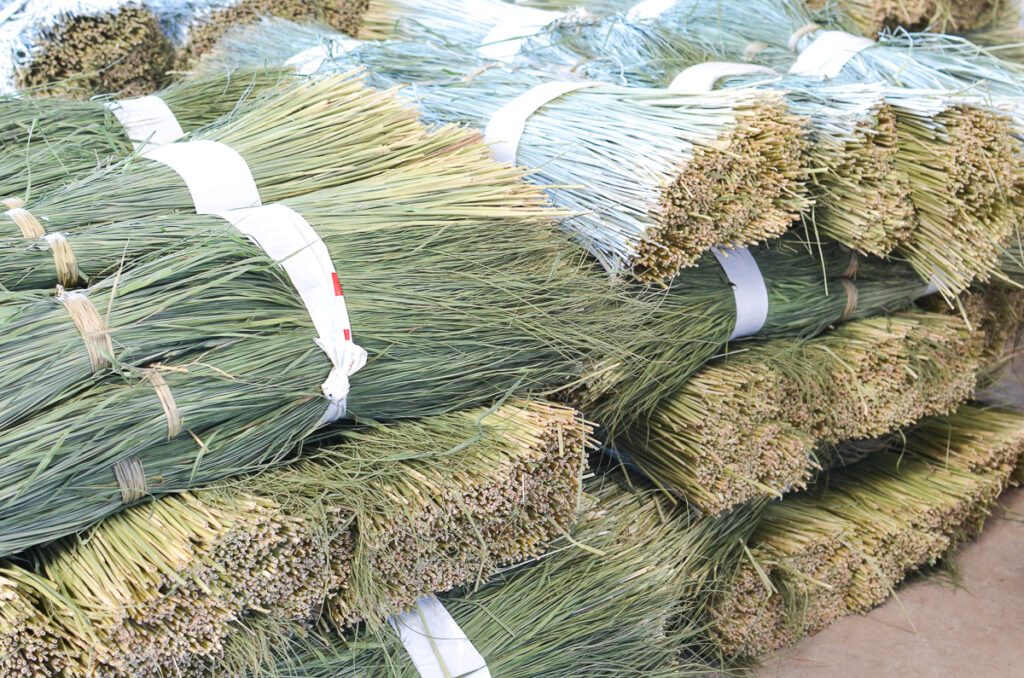
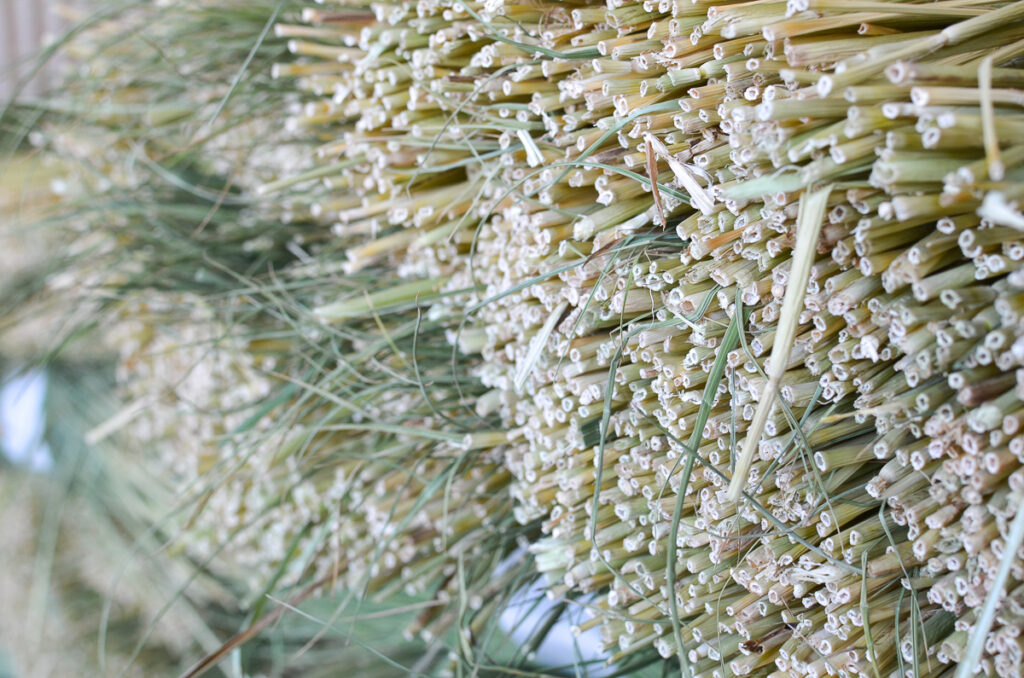
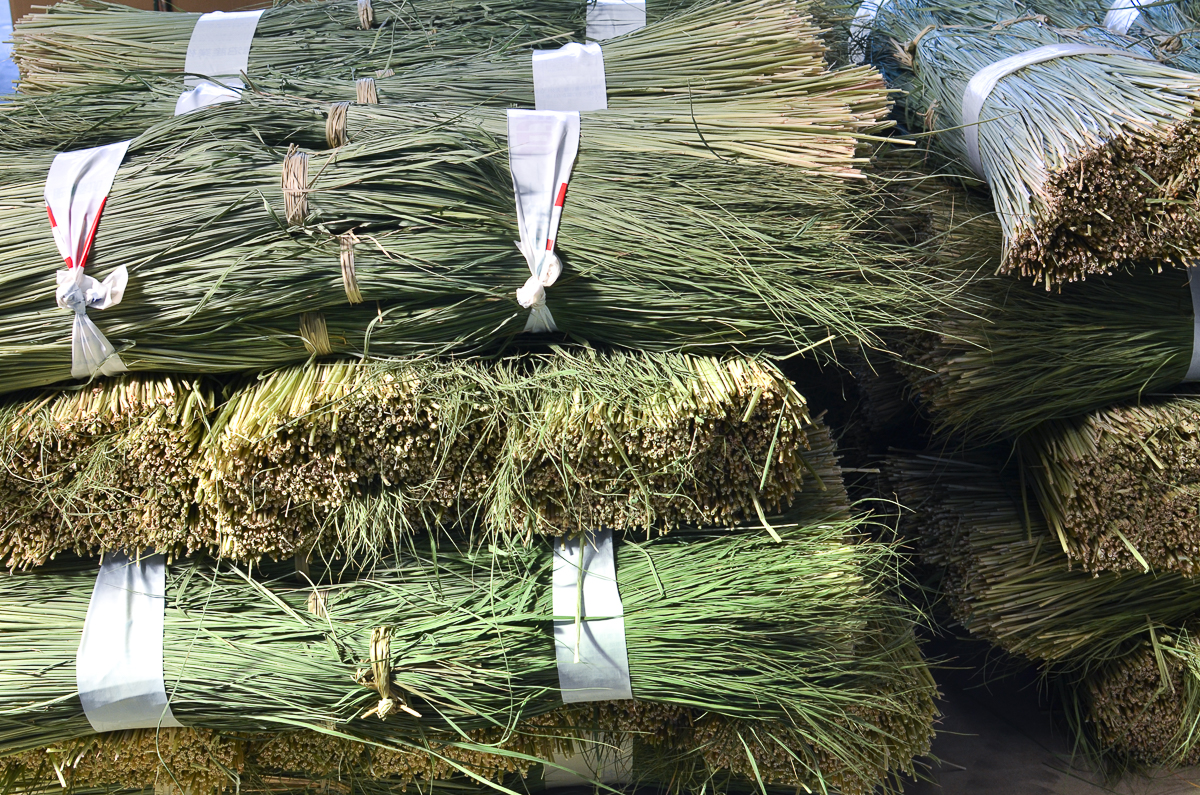
The harvested rice straw is stacked in a cooled storage room, waiting for its turn to be crafted. Even just looking at the material itself, one can feel a sense of life, strength, and vitality.
The Shimekazari introduced here features beautifully uniform and powerful hand-twisted straw rope.
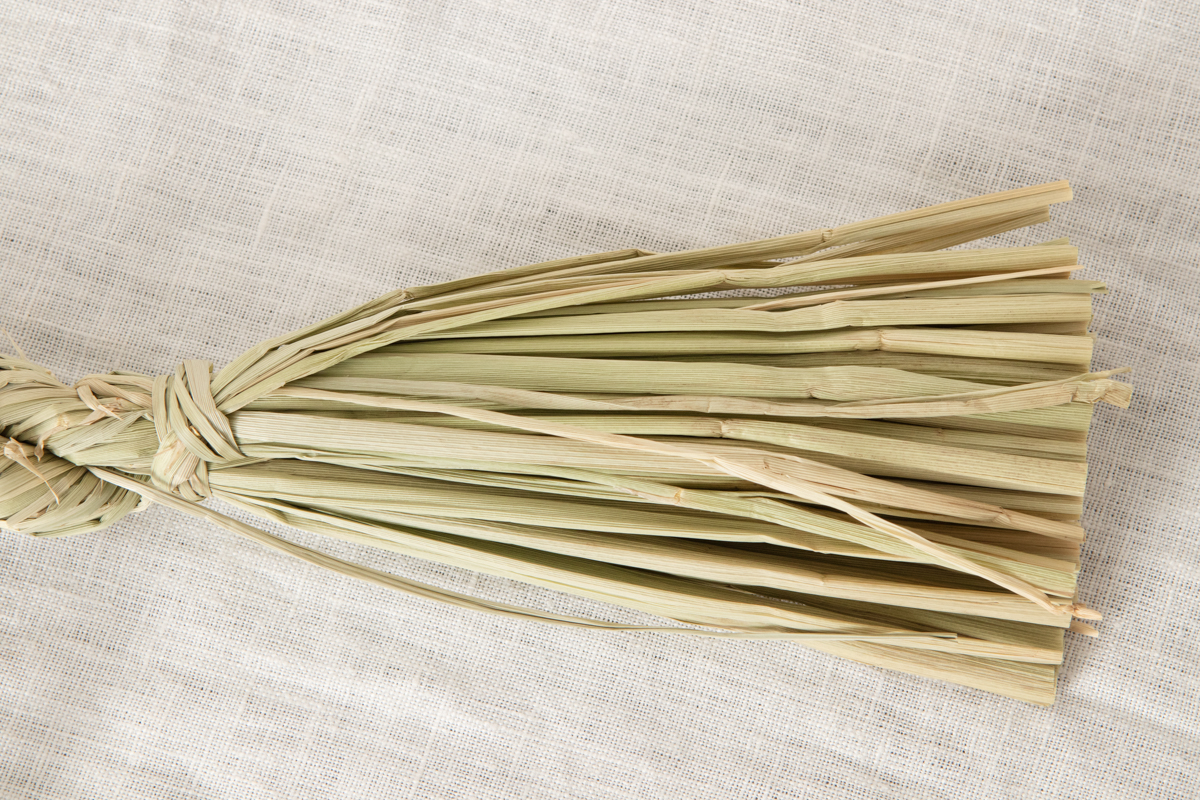
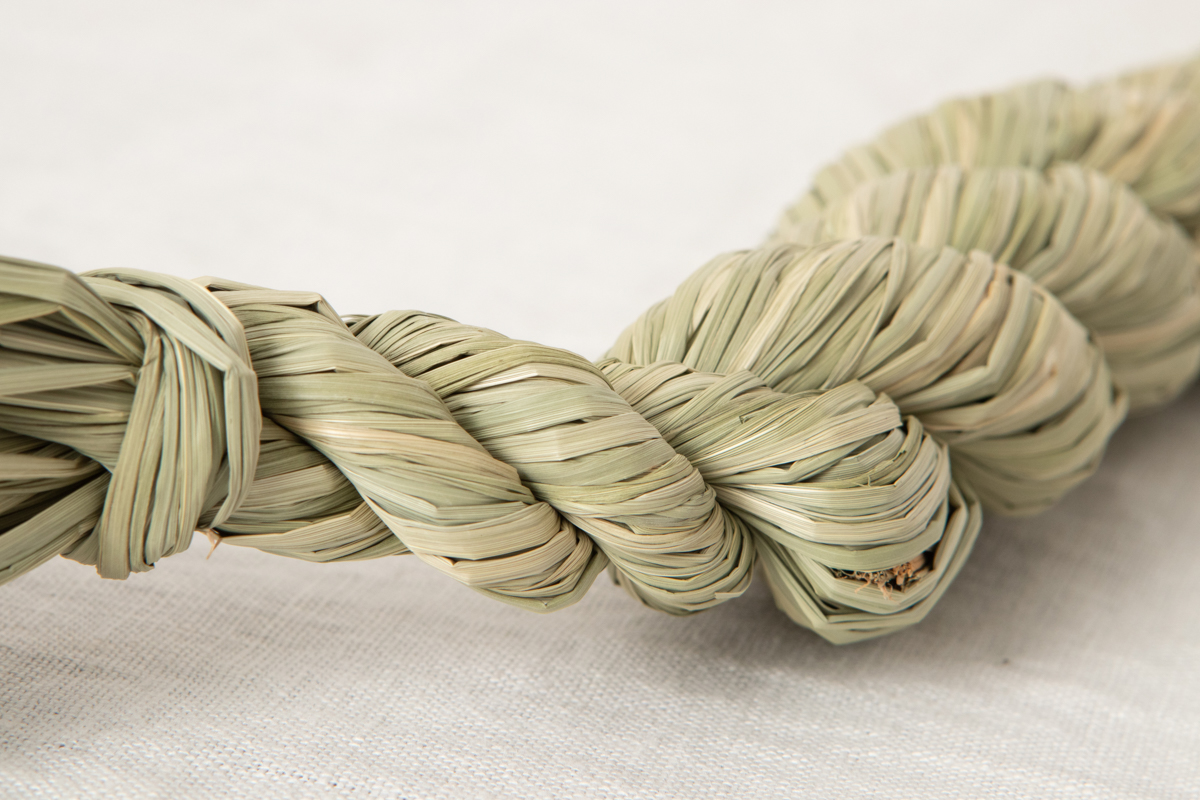
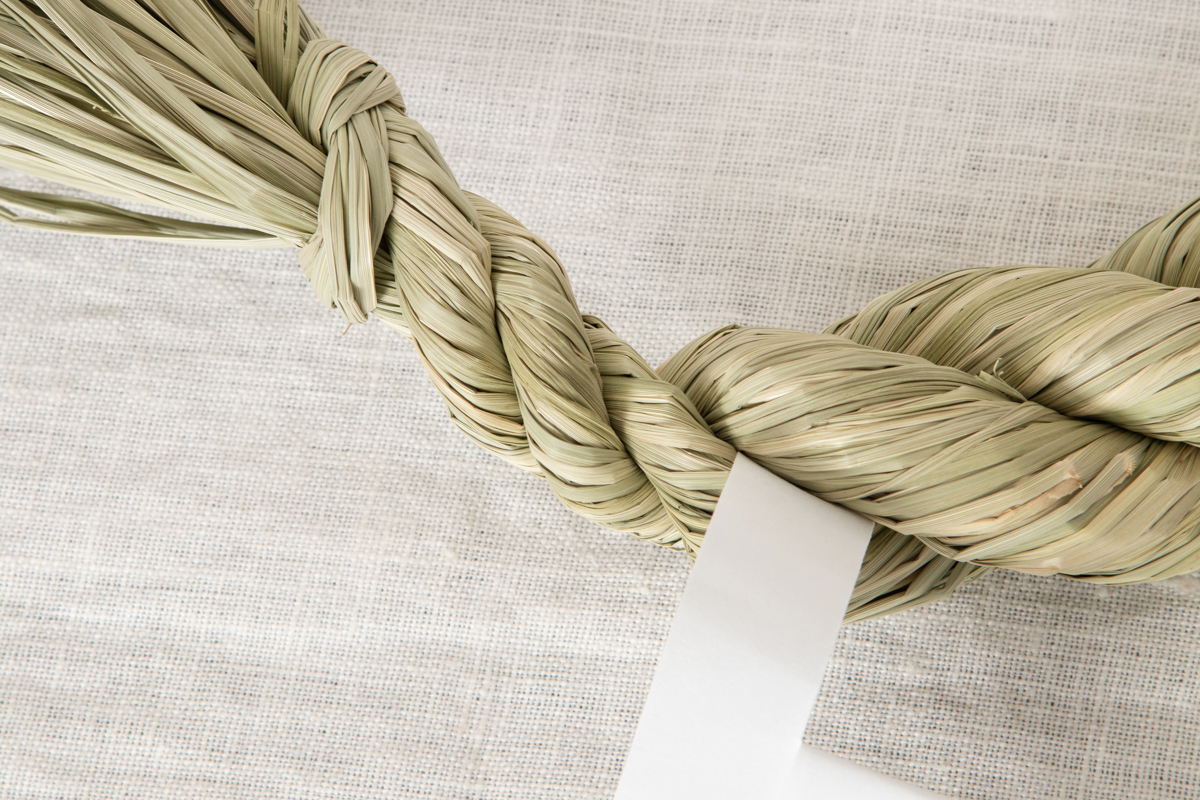
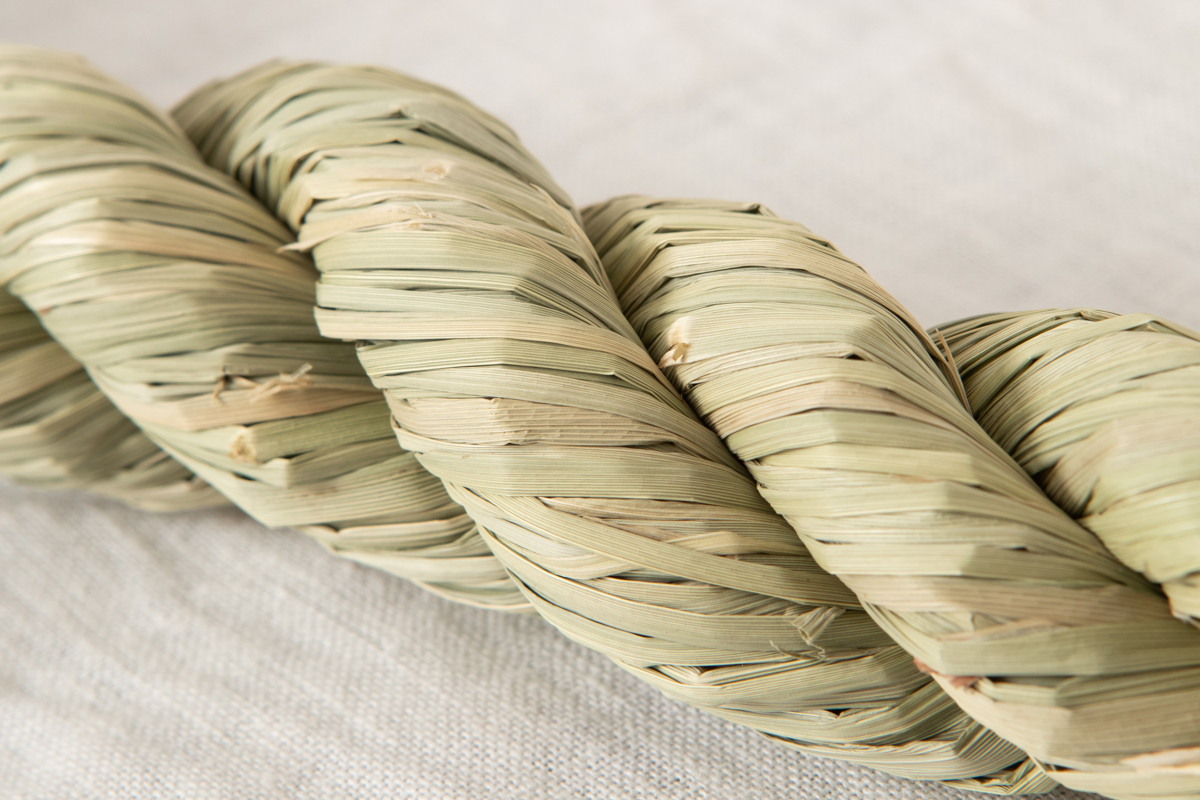
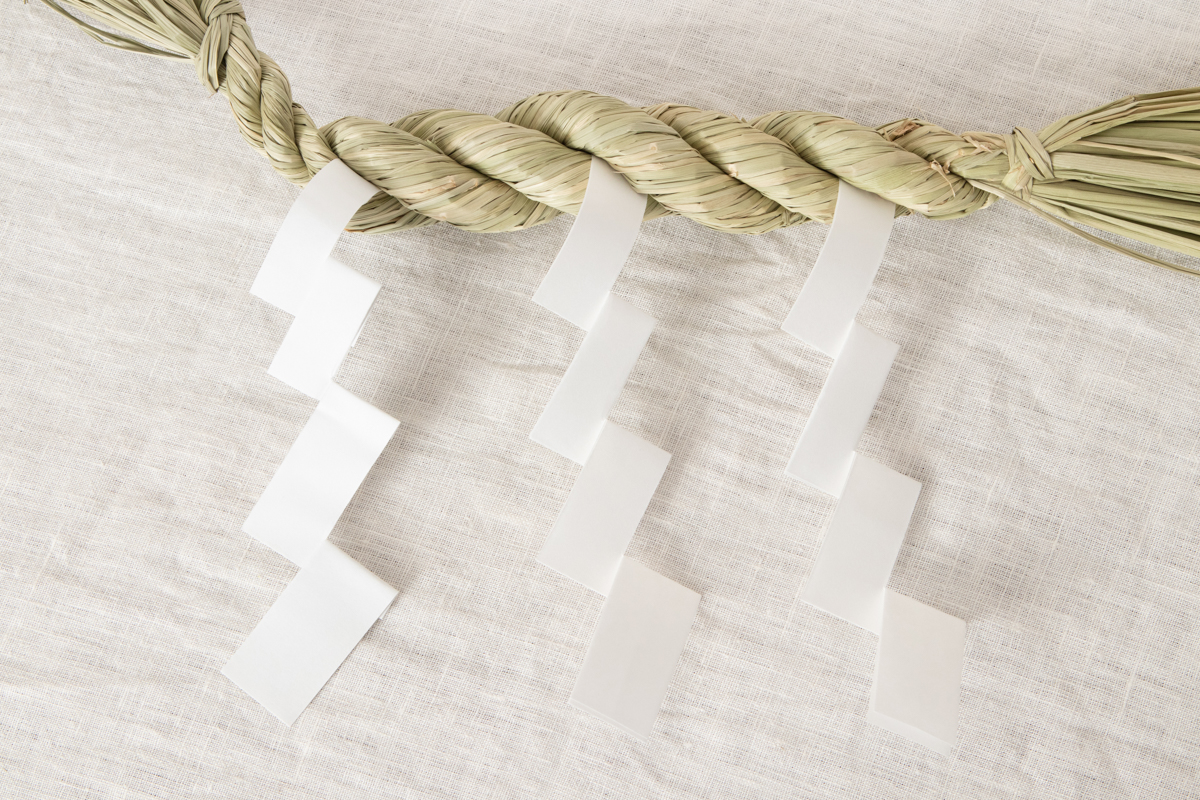
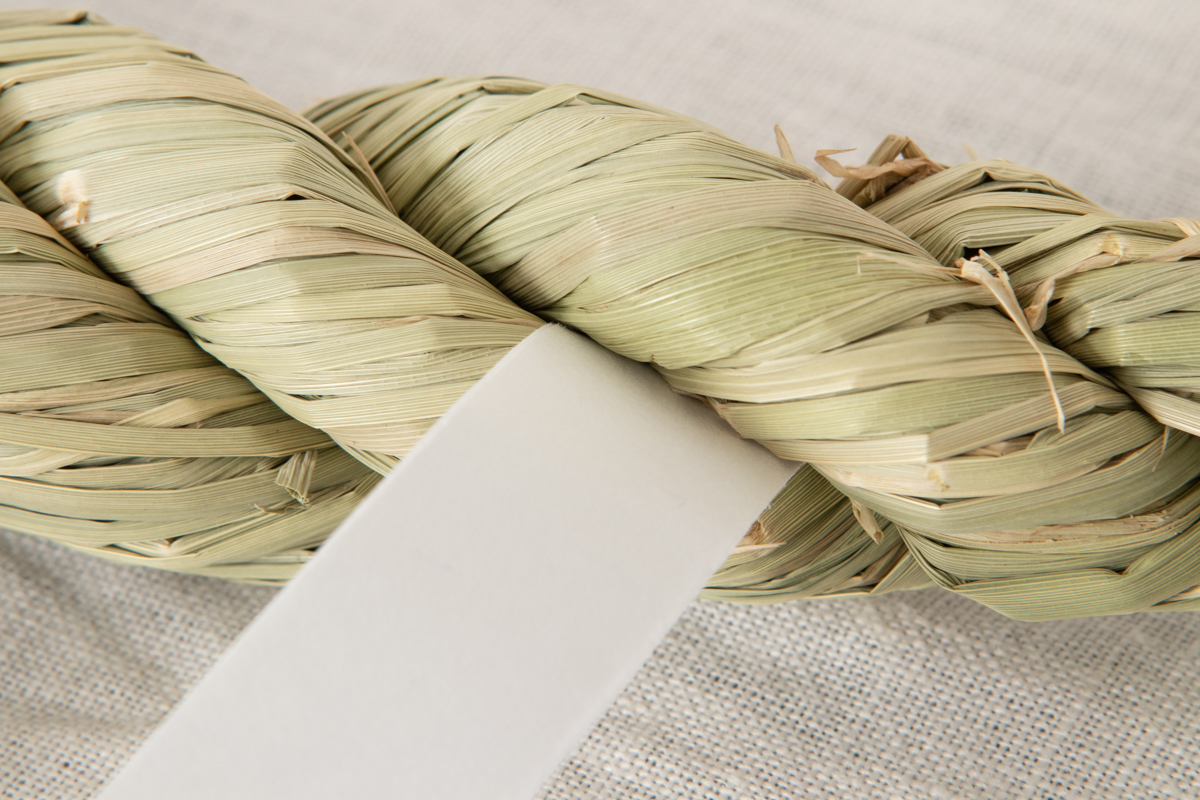
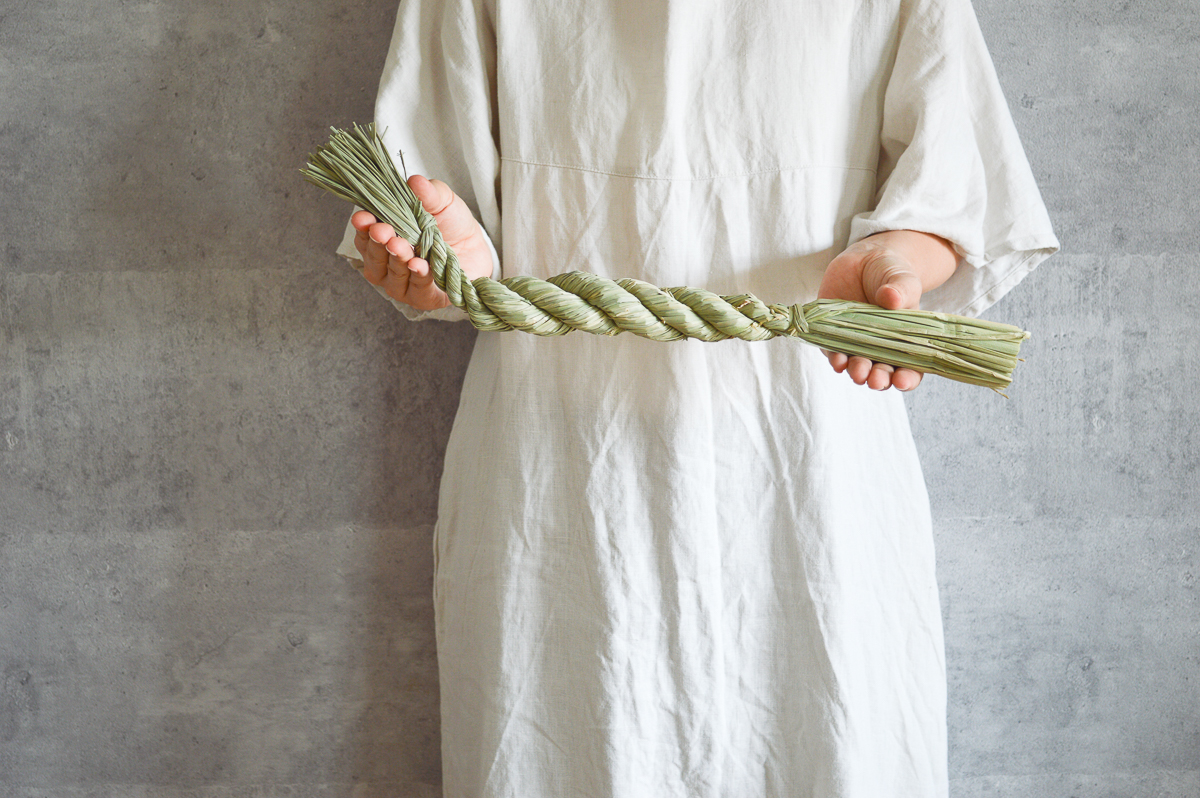
When exposed to sunlight, the straw quickly loses its green color. When stored away from direct sunlight, it retains its fresh green appearance, as shown here.Like Gobō-jime, Kōjin decorations have two sections called the “Moto” and the “Ura.” This part is called the “Moto,” the base area where the straw begins. It is generally displayed with the Moto positioned on the right when facing it, although this may vary by region or household.This is the “Ura” side, the tip end of the straw.The section near the Ura is particularly difficult to shape, as it needs to be turned sharply upward.The makers say this is one of the areas that requires particular care to achieve a clean, well-balanced shape.This thicker section is called the “Nami,” or “wave.” There are two directions for twisting straw rope: right-twist and left-twist, and this one is left-twisted. Shimenawa used for sacred or ritual purposes are traditionally made with a left-twist, although right-twisted ropes may also be used depending on the region or the maker.Four shide paper streamers are included. Kōjin decorations are often displayed with three shide, so you can keep the remaining one as a spare.Open the Nami section gently with your fingers and insert the shide between the strands of the rope. Please see the video below for how to attach it.Many Kōjin decorations are displayed with paper streamers called shide. It is said that the straw rope represents clouds, while the shide represents lightning. Because lightning often appears during the season when rice ripens, it has long been regarded as sacred.
Please see this video for instructions on how to attach the shide.
To keep your Shimekazari in good condition, please open the package promptly upon arrival and do not leave it stored inside the cardboard box.
If you are not going to display it right away, store it indoors in a cool place away from direct sunlight.
After use, it may be taken to a Shinto shrine for disposal, or treated as burnable household waste. If disposing as waste, please be sure to follow your local municipality’s guidelines.
A Shimekazari traditionally displayed in the kitchen. Welcome the New Year with a Kōjin decoration.
**Please read the following information carefully before making your reservation.**
Shimekazari reserved through this page will be shipped in order from late November.
Shimekazari cannot be returned or exchanged for any reason, except in the case of defective items.
“Defective items” refers to items that are clearly damaged when they arrive. We take great care when inspecting each item before shipping, but in the unlikely event that you receive a defective item, please contact us within 3 days of delivery.
We will replace defective items whenever possible. However, depending on the availability of materials or the circumstances of the maker, we may not be able to provide a replacement.
We are also unable to accept returns or exchanges if you contact us 4 days or more after delivery. Please be aware of this in advance.
Please note: This item ships from Japan. As the buyer, you are responsible for any import duties, customs fees, or local taxes that may be charged in your country. These costs are not included in the item price or shipping cost. Please check with your local customs authority if you are unsure about any potential charges before placing your order.
***Please read 1–6 before ordering***
1. Reservation Period
From 12:00 noon Japan time on Thursday, October 1, 2026 to 12:00 noon Japan time on Wednesday, October 28, 2026
2. This is a “Pre-order” page.
Please select the product you would like to reserve, click the “Add to Cart” button, and proceed to the payment page.
If you order Shimekazari during the reservation period above, you will receive a 5% discount on all Shimekazari items as a special pre-order benefit.
Add the Shimekazari items to your shopping cart and proceed to the payment page. The 5% discounted price will be displayed there.
3. Payment is required in advance. Please pay for the product when you make your reservation, not when the product is delivered.
You can use various payment methods, except Cash on Delivery.
If you select Cash on Delivery, we will change the payment method to a bank transfer to Japan Post Bank and contact you again with the payment details.
4. We cannot accept cancellations after payment has been made.
Please do not cancel your reservation after payment has been made.
5. You can also order regular items together with Shimekazari pre-order items.
If you order and pay for Shimekazari pre-order items and regular items at the same time, regular items will be shipped within 3–7 business days, and Shimekazari will be delivered from late November onward.
As the items will be shipped at different times, shipping fees would normally be charged twice. However, as a special benefit for ordering pre-order items and regular items together, the shipping fee for the regular items will be free of charge.
Please feel free to take advantage of this offer.
※You will only be charged one shipping fee for the Shimekazari pre-order items.
※This benefit is available for domestic shipping within Japan only. For overseas deliveries, we will charge shipping fees for two shipments.
6. The products listed here will be shipped in order from late November.
<Delivery in Japan only> We only accept time-specific requests. We do not accept date-specific requests.
This is a Shimekazari known as a “Kōjin” decoration.
It is based on Gobō-jime, in which rice straw is twisted into a straight rope of even thickness. It is traditionally displayed as an offering to Kōjin-sama, a deity associated with the kitchen.
The makers themselves are not certain why one end is turned sharply upward. Since it is similar in both size and construction to a small Gobō-jime, they believe this shape may have developed as a way to distinguish the two.
They also note that some imported Kōjin decorations do not have this raised end, as the shape can make them more difficult to pack.
Small Gobō-jime are also commonly displayed on kamidana aboard boats, and the makers receive many orders for this use.
A Shimekazari is a traditional New Year’s ornament made of rice straw, displayed indoors or outdoors to welcome the Toshigami deity at the start of the year.
The Shimekazari introduced here is crafted mainly in Edogawa, Tokyo, using rice straw harvested in the surrounding regions, including Tsukuba in Ibaraki and Narita in Chiba Prefecture.
The rice straw used is harvested before the grains have fully ripened.
The harvest takes place around August, during the height of summer.
Since it becomes too hot to work during the day, the process begins early in the morning while it is still cool.
The cut rice straw is then carefully dried over time and stored in a cool, shaded place.
The harvested rice straw is stacked in a cooled storage room, waiting for its turn to be crafted. Even just looking at the material itself, one can feel a sense of life, strength, and vitality.
The Shimekazari introduced here features beautifully uniform and powerful hand-twisted straw rope.
When exposed to sunlight, the straw quickly loses its green color. When stored away from direct sunlight, it retains its fresh green appearance, as shown here.Like Gobō-jime, Kōjin decorations have two sections called the “Moto” and the “Ura.” This part is called the “Moto,” the base area where the straw begins. It is generally displayed with the Moto positioned on the right when facing it, although this may vary by region or household.This is the “Ura” side, the tip end of the straw.The section near the Ura is particularly difficult to shape, as it needs to be turned sharply upward.The makers say this is one of the areas that requires particular care to achieve a clean, well-balanced shape.This thicker section is called the “Nami,” or “wave.” There are two directions for twisting straw rope: right-twist and left-twist, and this one is left-twisted. Shimenawa used for sacred or ritual purposes are traditionally made with a left-twist, although right-twisted ropes may also be used depending on the region or the maker.Four shide paper streamers are included. Kōjin decorations are often displayed with three shide, so you can keep the remaining one as a spare.Open the Nami section gently with your fingers and insert the shide between the strands of the rope. Please see the video below for how to attach it.Many Kōjin decorations are displayed with paper streamers called shide. It is said that the straw rope represents clouds, while the shide represents lightning. Because lightning often appears during the season when rice ripens, it has long been regarded as sacred.
Please see this video for instructions on how to attach the shide.
To keep your Shimekazari in good condition, please open the package promptly upon arrival and do not leave it stored inside the cardboard box.
If you are not going to display it right away, store it indoors in a cool place away from direct sunlight.
After use, it may be taken to a Shinto shrine for disposal, or treated as burnable household waste. If disposing as waste, please be sure to follow your local municipality’s guidelines.
A Shimekazari traditionally displayed in the kitchen. Welcome the New Year with a Kōjin decoration.
**Please read the following information carefully before making your reservation.**
Shimekazari reserved through this page will be shipped in order from late November.
Shimekazari cannot be returned or exchanged for any reason, except in the case of defective items.
“Defective items” refers to items that are clearly damaged when they arrive. We take great care when inspecting each item before shipping, but in the unlikely event that you receive a defective item, please contact us within 3 days of delivery.
We will replace defective items whenever possible. However, depending on the availability of materials or the circumstances of the maker, we may not be able to provide a replacement.
We are also unable to accept returns or exchanges if you contact us 4 days or more after delivery. Please be aware of this in advance.
Please note: This item ships from Japan. As the buyer, you are responsible for any import duties, customs fees, or local taxes that may be charged in your country. These costs are not included in the item price or shipping cost. Please check with your local customs authority if you are unsure about any potential charges before placing your order.
***Please read 1–6 before ordering***
1. Reservation Period
From 12:00 noon Japan time on Thursday, October 1, 2026 to 12:00 noon Japan time on Wednesday, October 28, 2026
2. This is a “Pre-order” page.
Please select the product you would like to reserve, click the “Add to Cart” button, and proceed to the payment page.
If you order Shimekazari during the reservation period above, you will receive a 5% discount on all Shimekazari items as a special pre-order benefit.
Add the Shimekazari items to your shopping cart and proceed to the payment page. The 5% discounted price will be displayed there.
3. Payment is required in advance. Please pay for the product when you make your reservation, not when the product is delivered.
You can use various payment methods, except Cash on Delivery.
If you select Cash on Delivery, we will change the payment method to a bank transfer to Japan Post Bank and contact you again with the payment details.
4. We cannot accept cancellations after payment has been made.
Please do not cancel your reservation after payment has been made.
5. You can also order regular items together with Shimekazari pre-order items.
If you order and pay for Shimekazari pre-order items and regular items at the same time, regular items will be shipped within 3–7 business days, and Shimekazari will be delivered from late November onward.
As the items will be shipped at different times, shipping fees would normally be charged twice. However, as a special benefit for ordering pre-order items and regular items together, the shipping fee for the regular items will be free of charge.
Please feel free to take advantage of this offer.
※You will only be charged one shipping fee for the Shimekazari pre-order items.
※This benefit is available for domestic shipping within Japan only. For overseas deliveries, we will charge shipping fees for two shipments.
6. The products listed here will be shipped in order from late November.
<Delivery in Japan only> We only accept time-specific requests. We do not accept date-specific requests.
This is a Shimekazari known as a “Kōjin” decoration.
It is based on Gobō-jime, in which rice straw is twisted into a straight rope of even thickness. It is traditionally displayed as an offering to Kōjin-sama, a deity associated with the kitchen.
The makers themselves are not certain why one end is turned sharply upward. Since it is similar in both size and construction to a small Gobō-jime, they believe this shape may have developed as a way to distinguish the two.
They also note that some imported Kōjin decorations do not have this raised end, as the shape can make them more difficult to pack.
Small Gobō-jime are also commonly displayed on kamidana aboard boats, and the makers receive many orders for this use.
A Shimekazari is a traditional New Year’s ornament made of rice straw, displayed indoors or outdoors to welcome the Toshigami deity at the start of the year.
The Shimekazari introduced here is crafted mainly in Edogawa, Tokyo, using rice straw harvested in the surrounding regions, including Tsukuba in Ibaraki and Narita in Chiba Prefecture.
The rice straw used is harvested before the grains have fully ripened.
The harvest takes place around August, during the height of summer.
Since it becomes too hot to work during the day, the process begins early in the morning while it is still cool.
The cut rice straw is then carefully dried over time and stored in a cool, shaded place.
The harvested rice straw is stacked in a cooled storage room, waiting for its turn to be crafted. Even just looking at the material itself, one can feel a sense of life, strength, and vitality.
The Shimekazari introduced here features beautifully uniform and powerful hand-twisted straw rope.
When exposed to sunlight, the straw quickly loses its green color. When stored away from direct sunlight, it retains its fresh green appearance, as shown here.Like Gobō-jime, Kōjin decorations have two sections called the “Moto” and the “Ura.” This part is called the “Moto,” the base area where the straw begins. It is generally displayed with the Moto positioned on the right when facing it, although this may vary by region or household.This is the “Ura” side, the tip end of the straw.The section near the Ura is particularly difficult to shape, as it needs to be turned sharply upward.The makers say this is one of the areas that requires particular care to achieve a clean, well-balanced shape.This thicker section is called the “Nami,” or “wave.” There are two directions for twisting straw rope: right-twist and left-twist, and this one is left-twisted. Shimenawa used for sacred or ritual purposes are traditionally made with a left-twist, although right-twisted ropes may also be used depending on the region or the maker.Four shide paper streamers are included. Kōjin decorations are often displayed with three shide, so you can keep the remaining one as a spare.Open the Nami section gently with your fingers and insert the shide between the strands of the rope. Please see the video below for how to attach it.Many Kōjin decorations are displayed with paper streamers called shide. It is said that the straw rope represents clouds, while the shide represents lightning. Because lightning often appears during the season when rice ripens, it has long been regarded as sacred.
Please see this video for instructions on how to attach the shide.
To keep your Shimekazari in good condition, please open the package promptly upon arrival and do not leave it stored inside the cardboard box.
If you are not going to display it right away, store it indoors in a cool place away from direct sunlight.
After use, it may be taken to a Shinto shrine for disposal, or treated as burnable household waste. If disposing as waste, please be sure to follow your local municipality’s guidelines.
A Shimekazari traditionally displayed in the kitchen. Welcome the New Year with a Kōjin decoration.
**Please read the following information carefully before making your reservation.**
Shimekazari reserved through this page will be shipped in order from late November.
Shimekazari cannot be returned or exchanged for any reason, except in the case of defective items.
“Defective items” refers to items that are clearly damaged when they arrive. We take great care when inspecting each item before shipping, but in the unlikely event that you receive a defective item, please contact us within 3 days of delivery.
We will replace defective items whenever possible. However, depending on the availability of materials or the circumstances of the maker, we may not be able to provide a replacement.
We are also unable to accept returns or exchanges if you contact us 4 days or more after delivery. Please be aware of this in advance.
Please note: This item ships from Japan. As the buyer, you are responsible for any import duties, customs fees, or local taxes that may be charged in your country. These costs are not included in the item price or shipping cost. Please check with your local customs authority if you are unsure about any potential charges before placing your order.