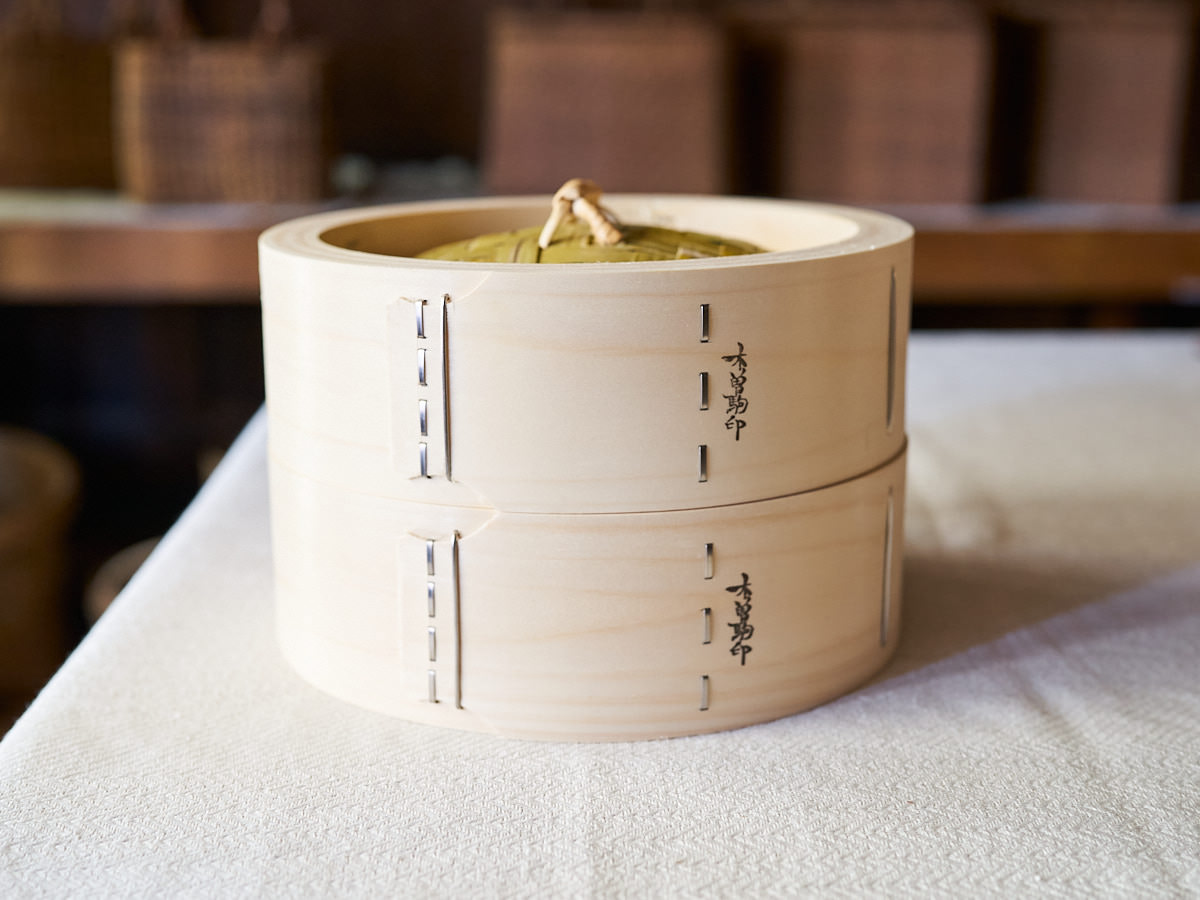
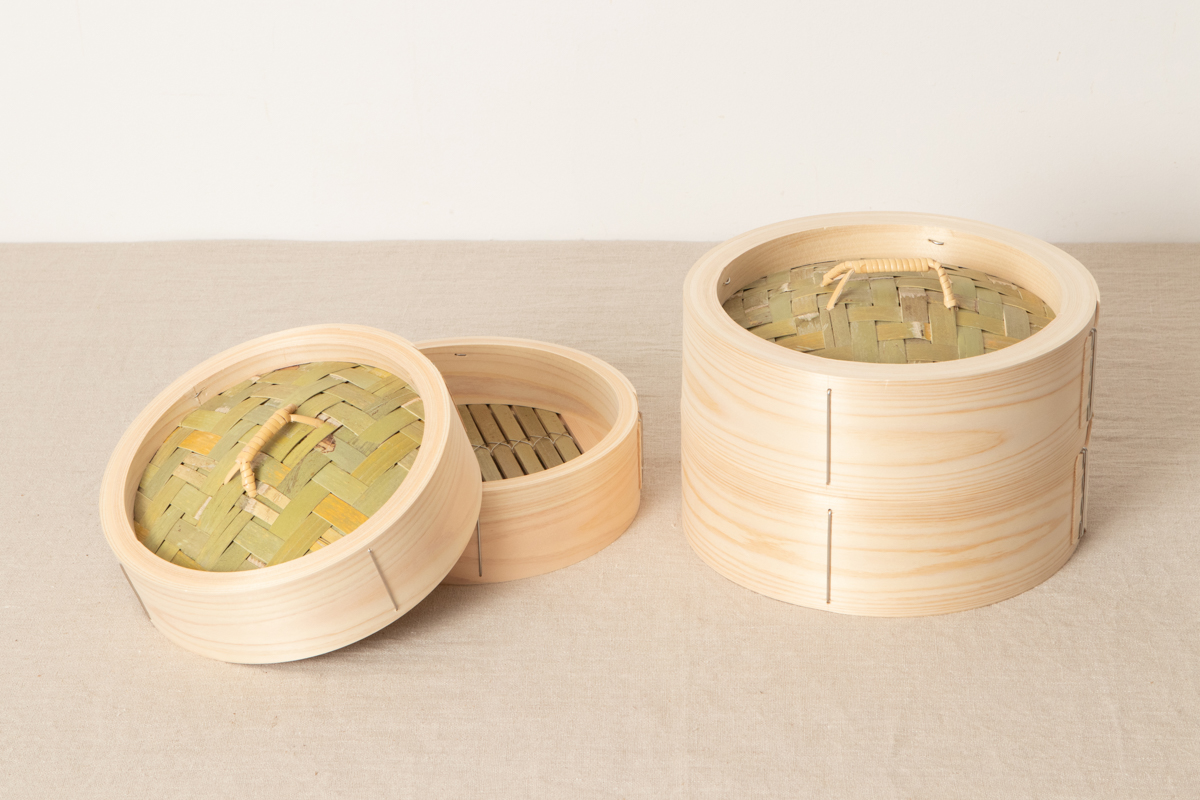
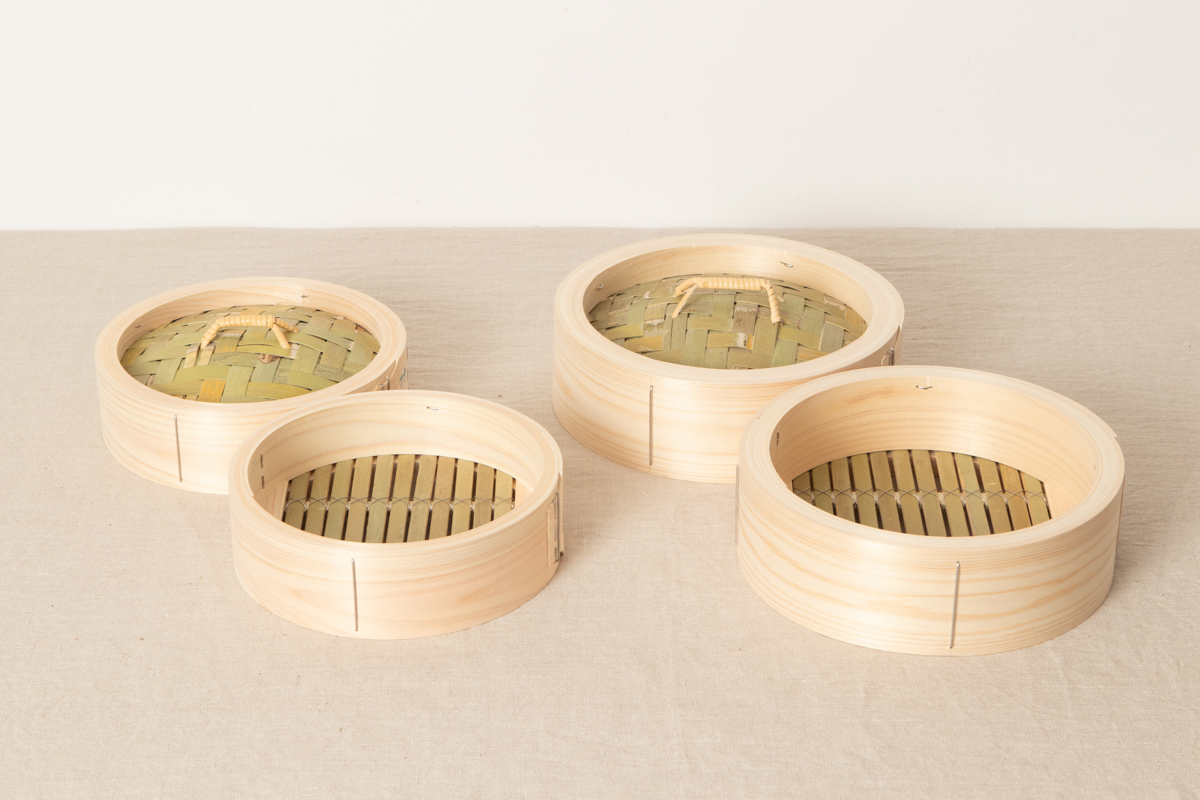
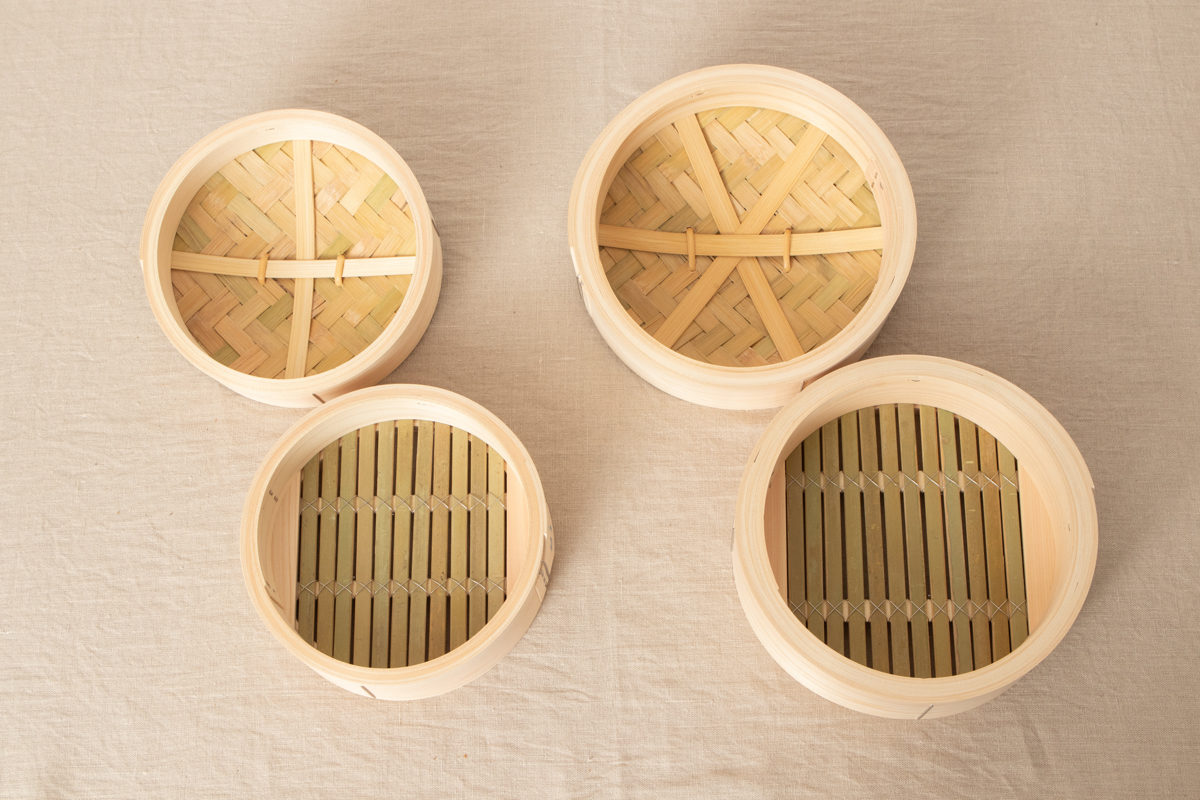
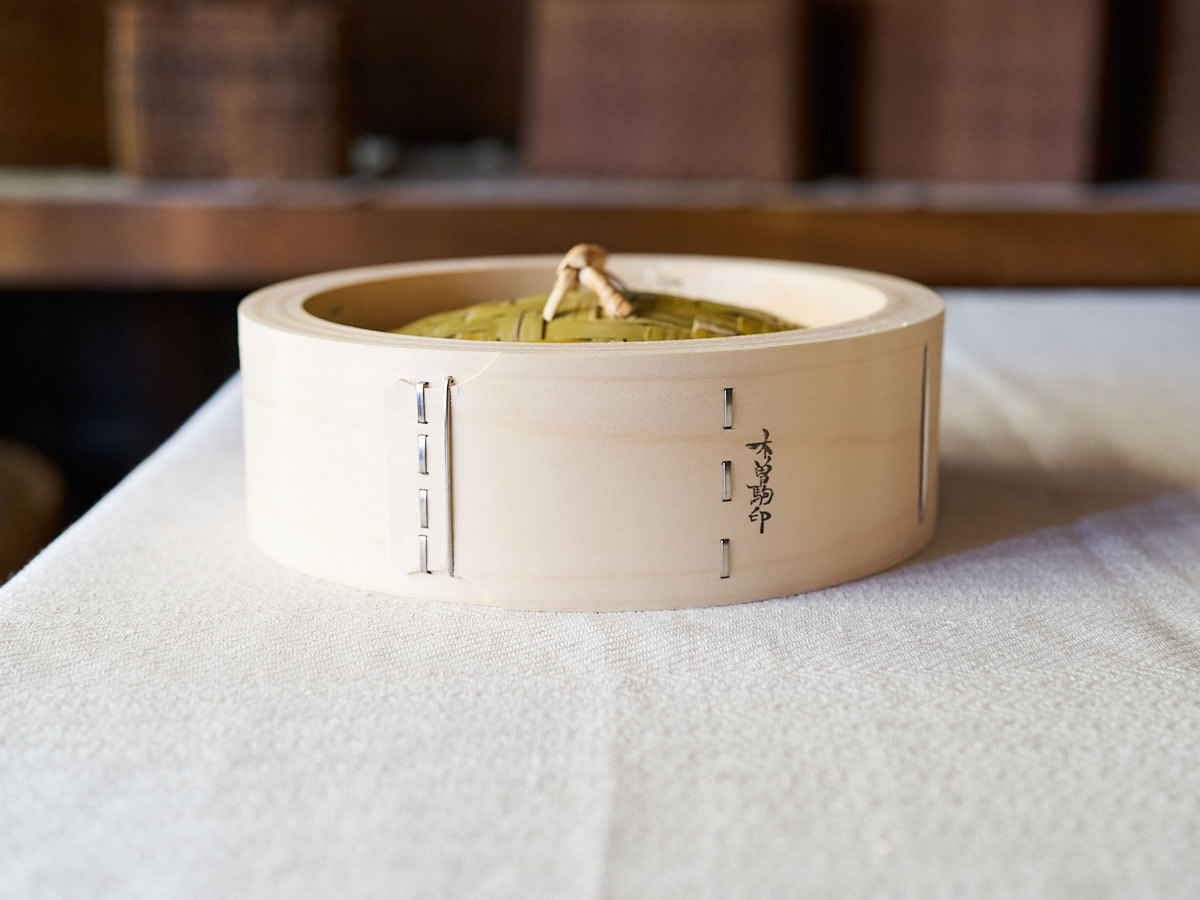
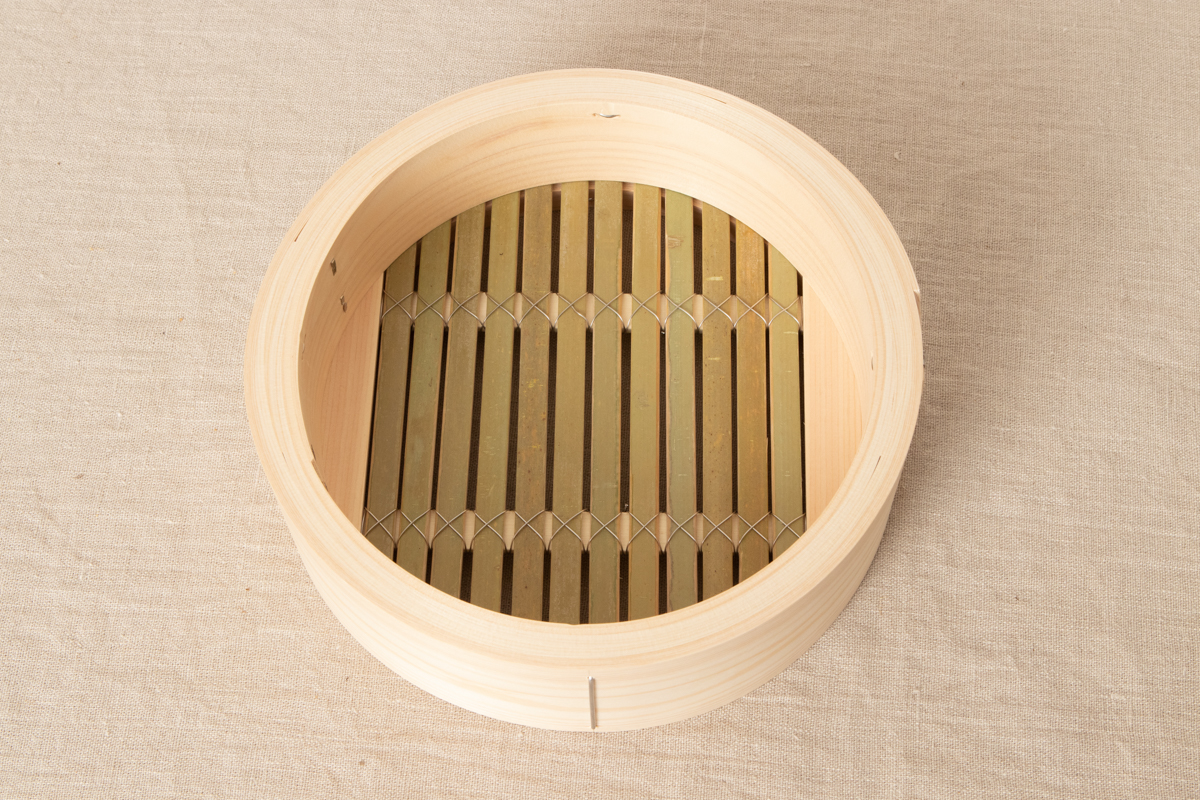
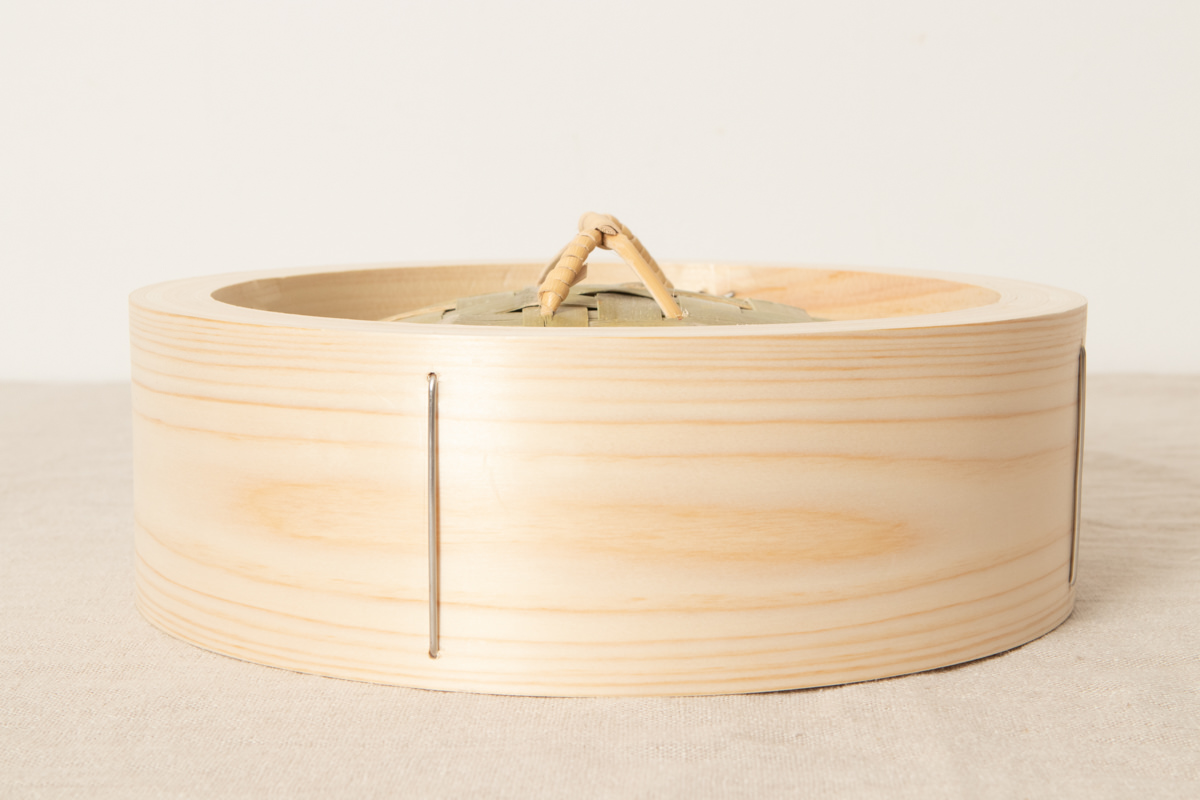
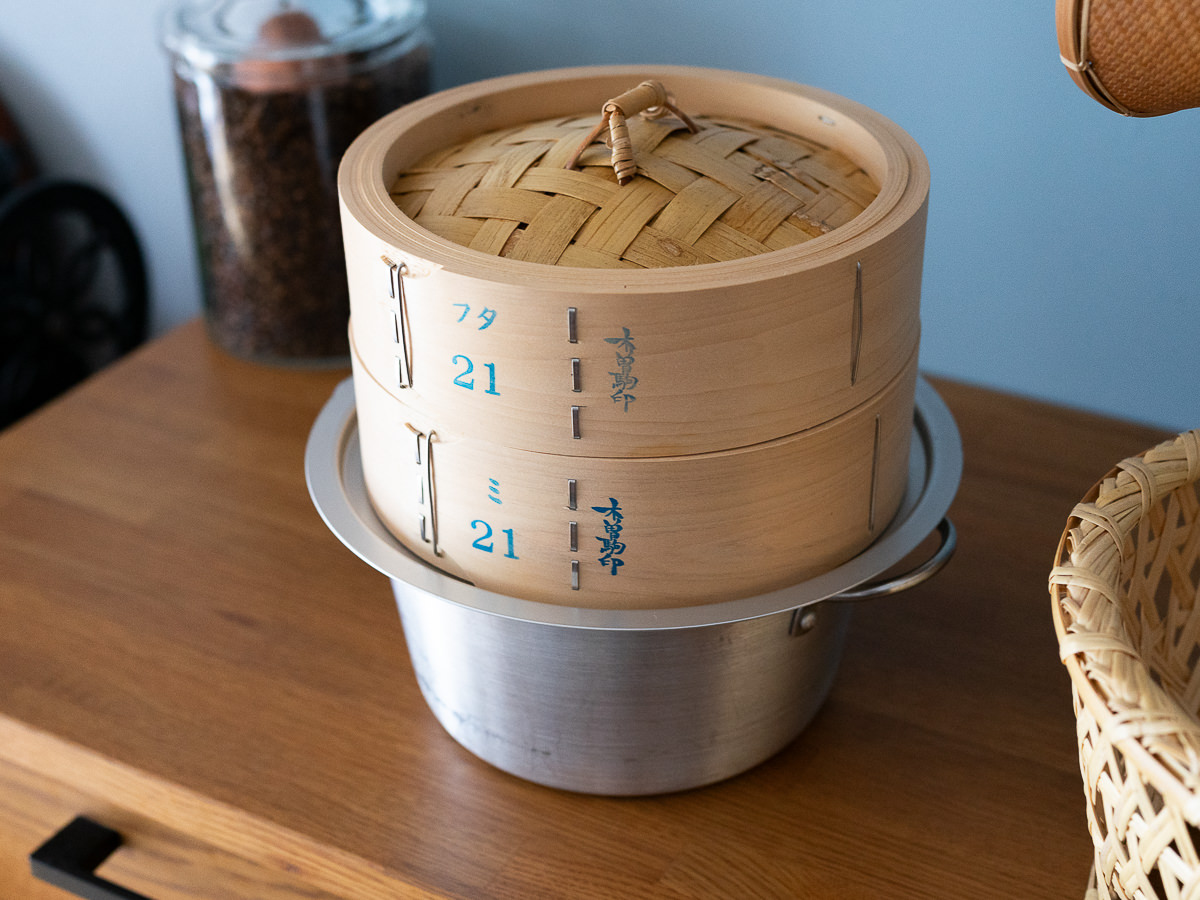
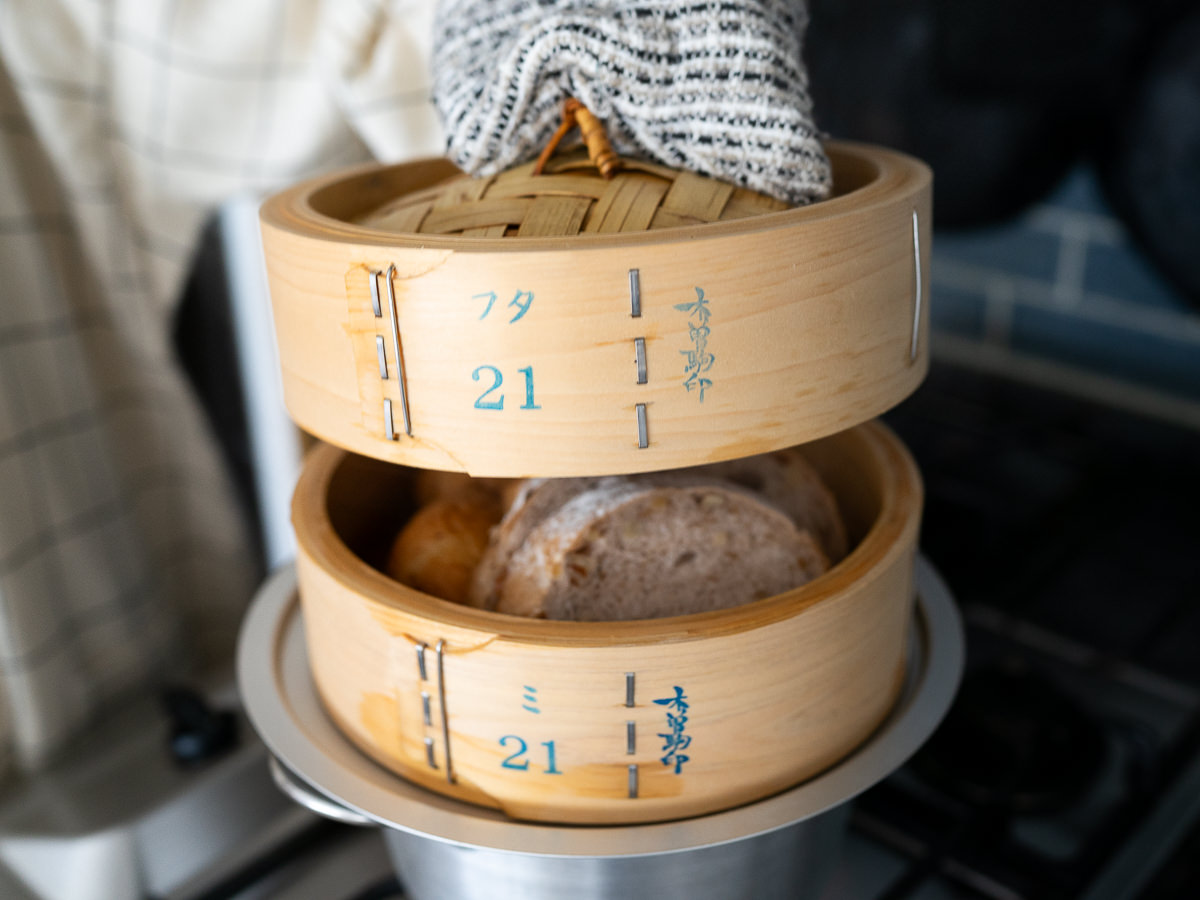
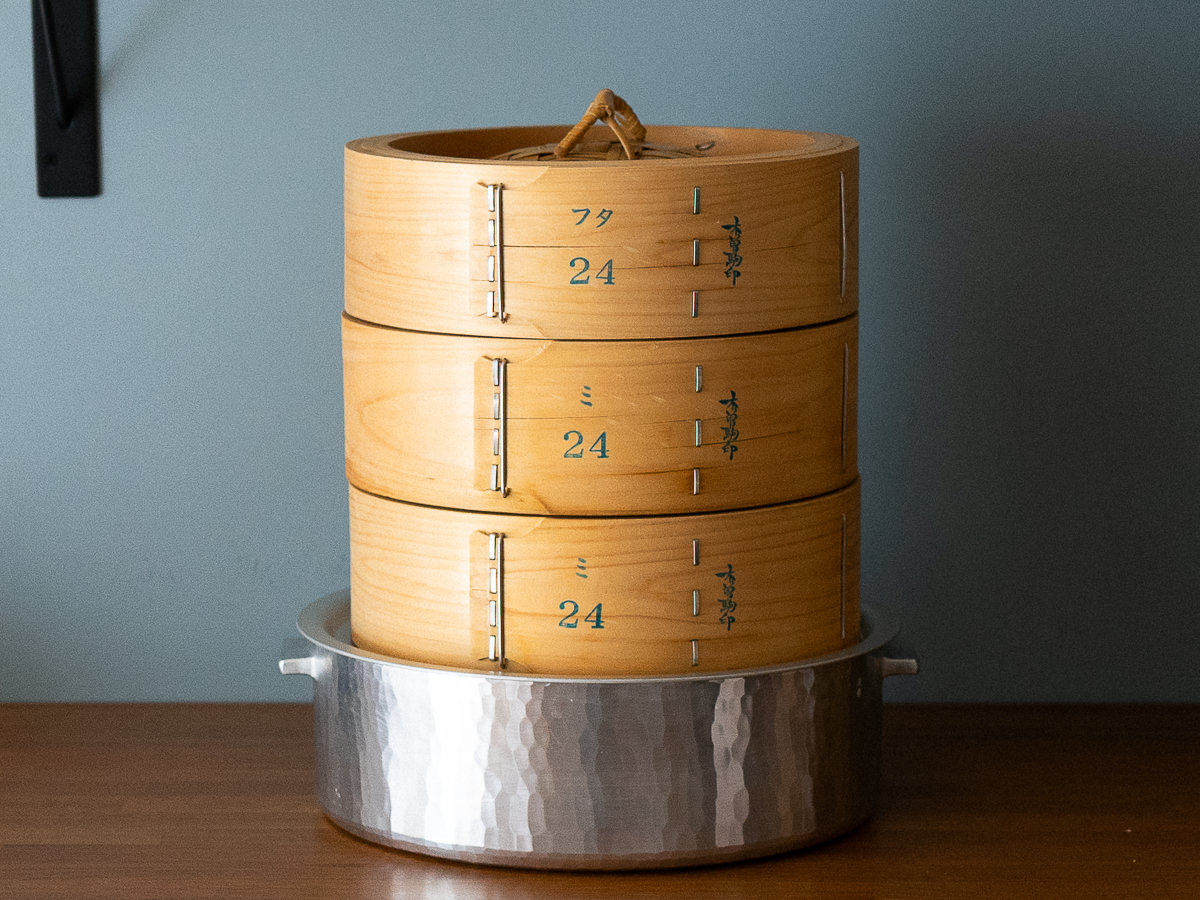
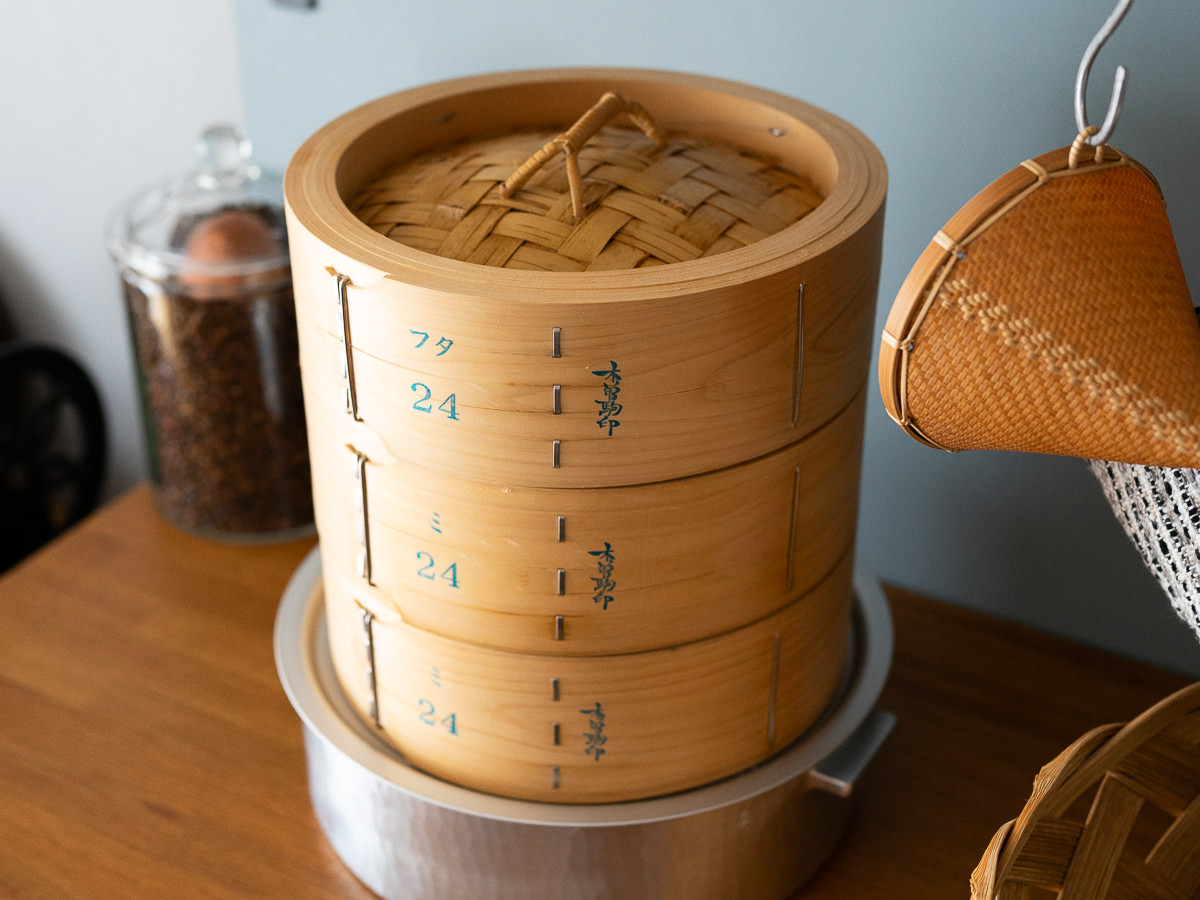
This is a convenient Chinese steamer, perfect for preparing steamed dishes. It is a cooking tool used together with your existing pot.
Although it is a “Chinese-style” steamer, it is made in Japan using domestically grown hinoki cypress, and crafted in Gifu Prefecture.
High-quality hinoki cypress from the Tōnō region of Gifu Prefecture (also known as “Ura-Kiso”) is mainly used. “Ura-Kiso hinoki” is a type of “Kiso hinoki,” whose natural forests are counted among Japan’s three most beautiful forests.
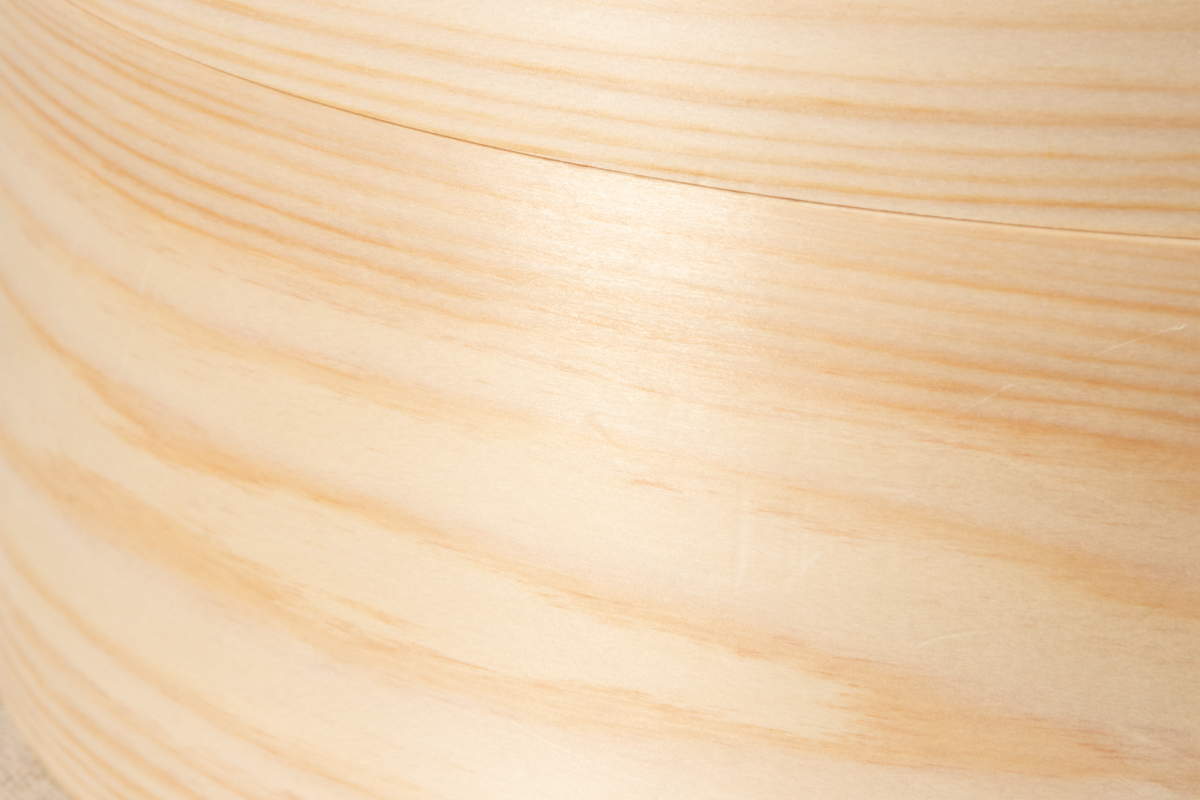
This wood is supple, contains natural oils, and shows a clean, bright white tone with a soft pink hue in the reddish parts. It is glossy, knot-free, and pleasantly aromatic.
When Ura-Kiso hinoki is not available, other fine-quality cypress such as Kiso hinoki from Nagano or Yoshino hinoki from Nara may also be used.
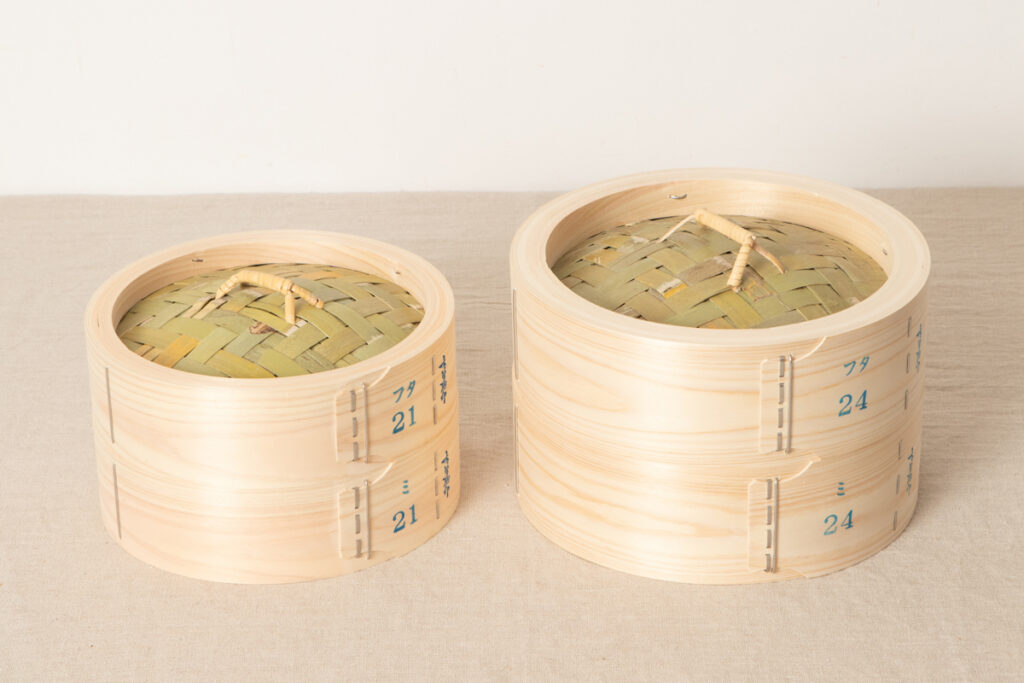
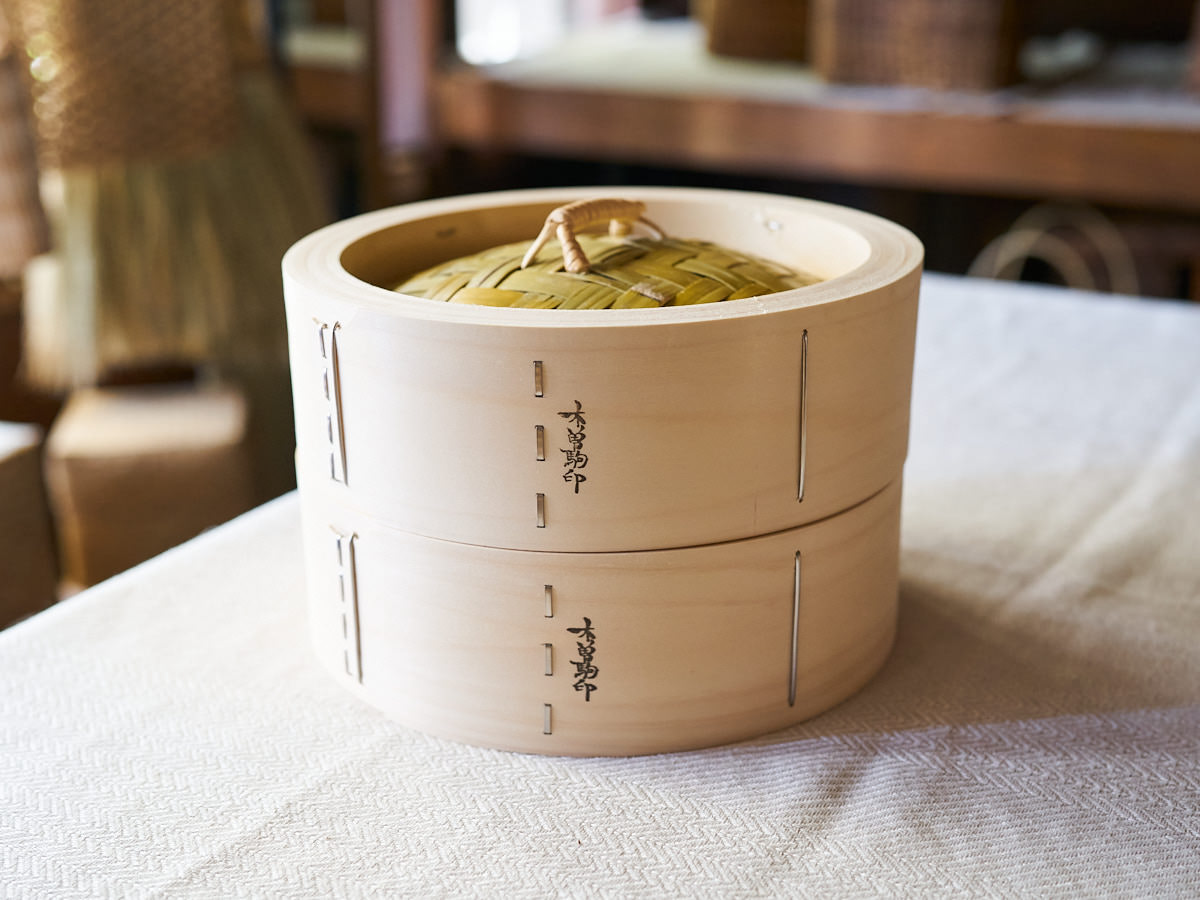
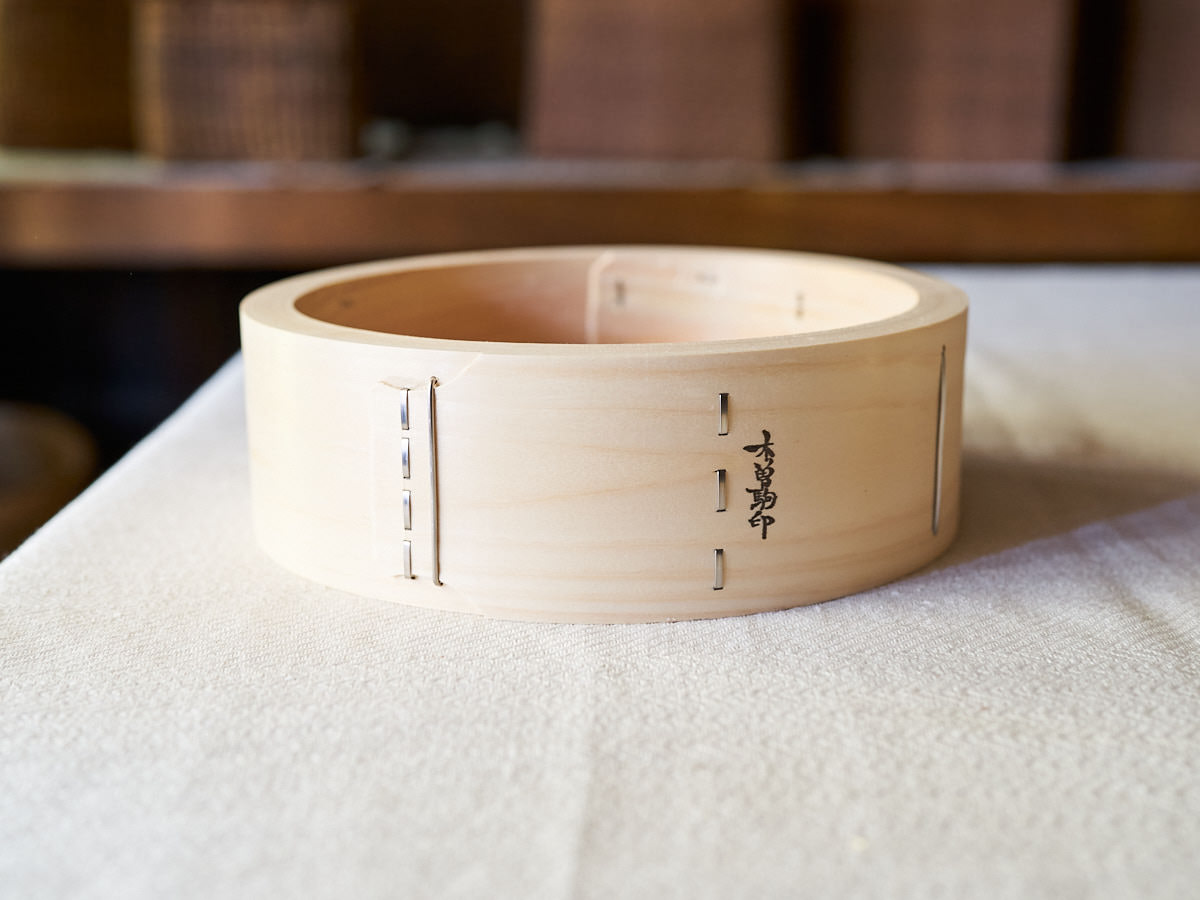
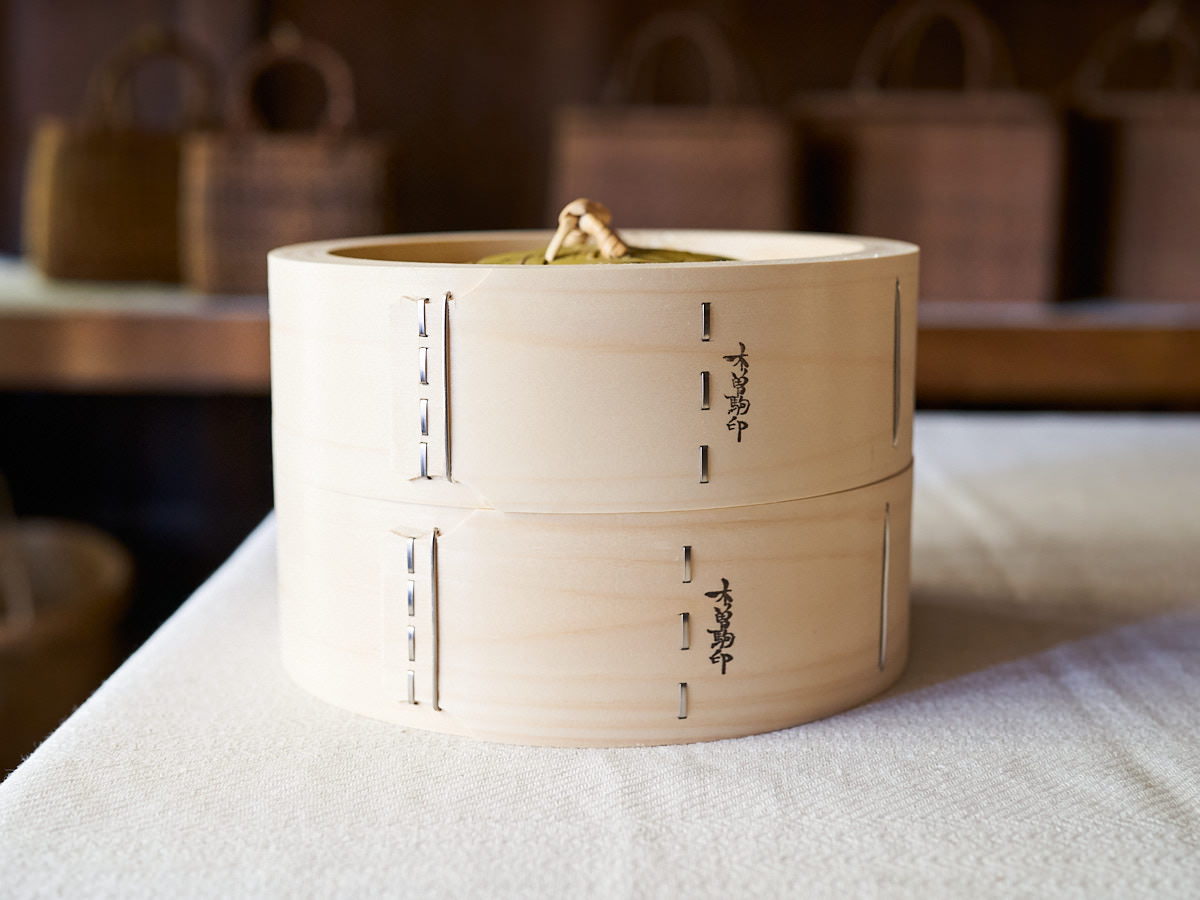
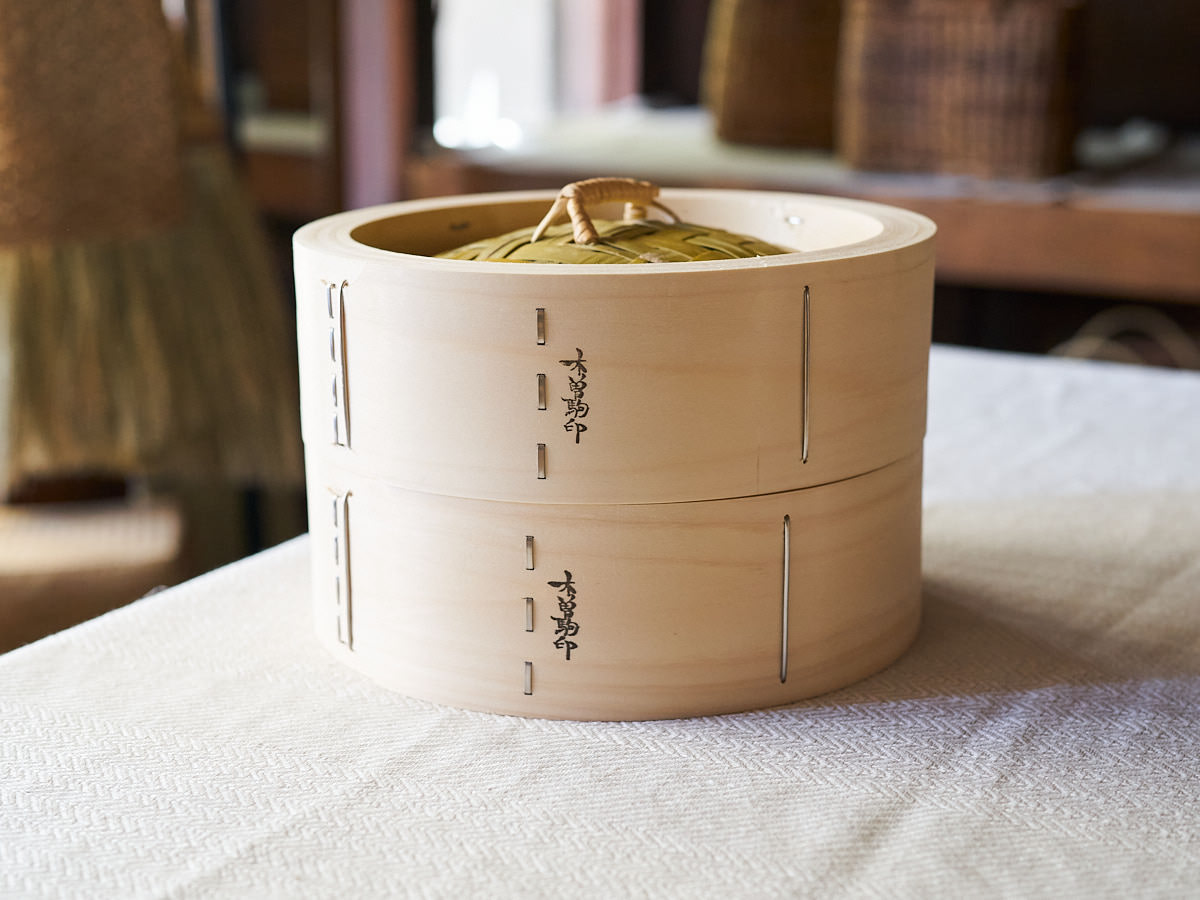
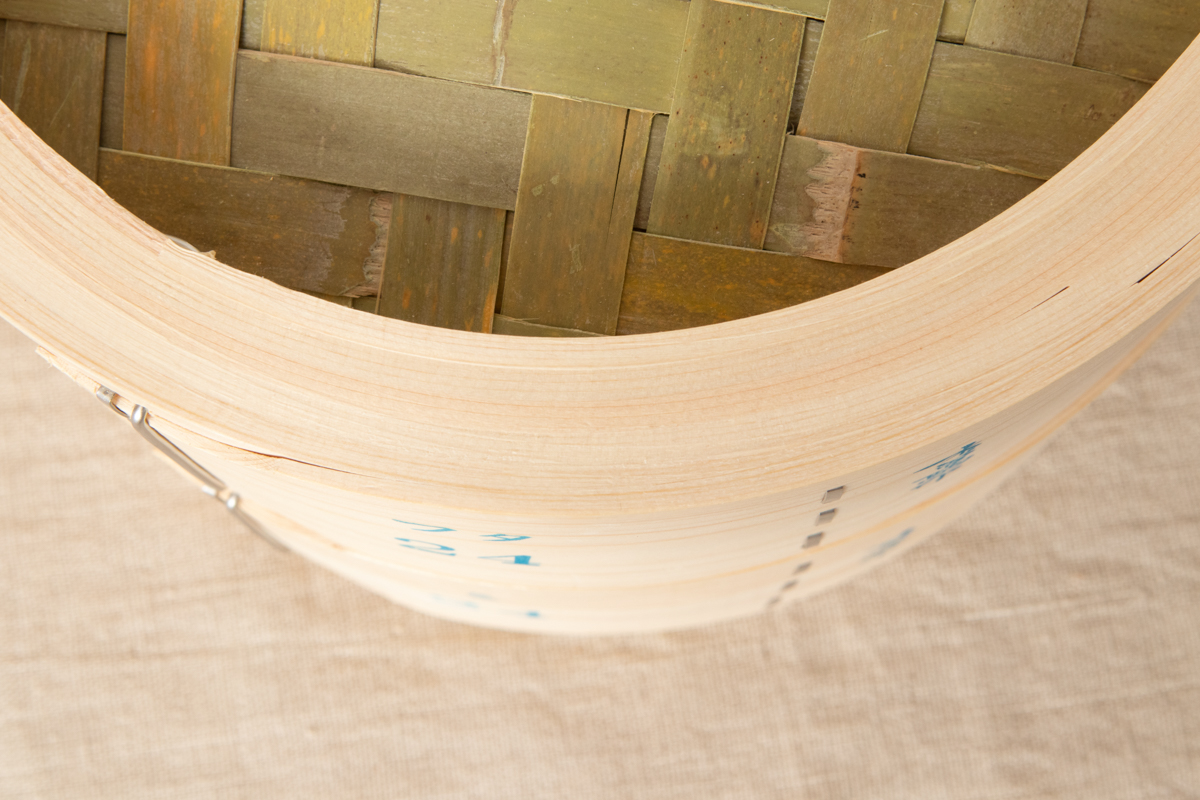
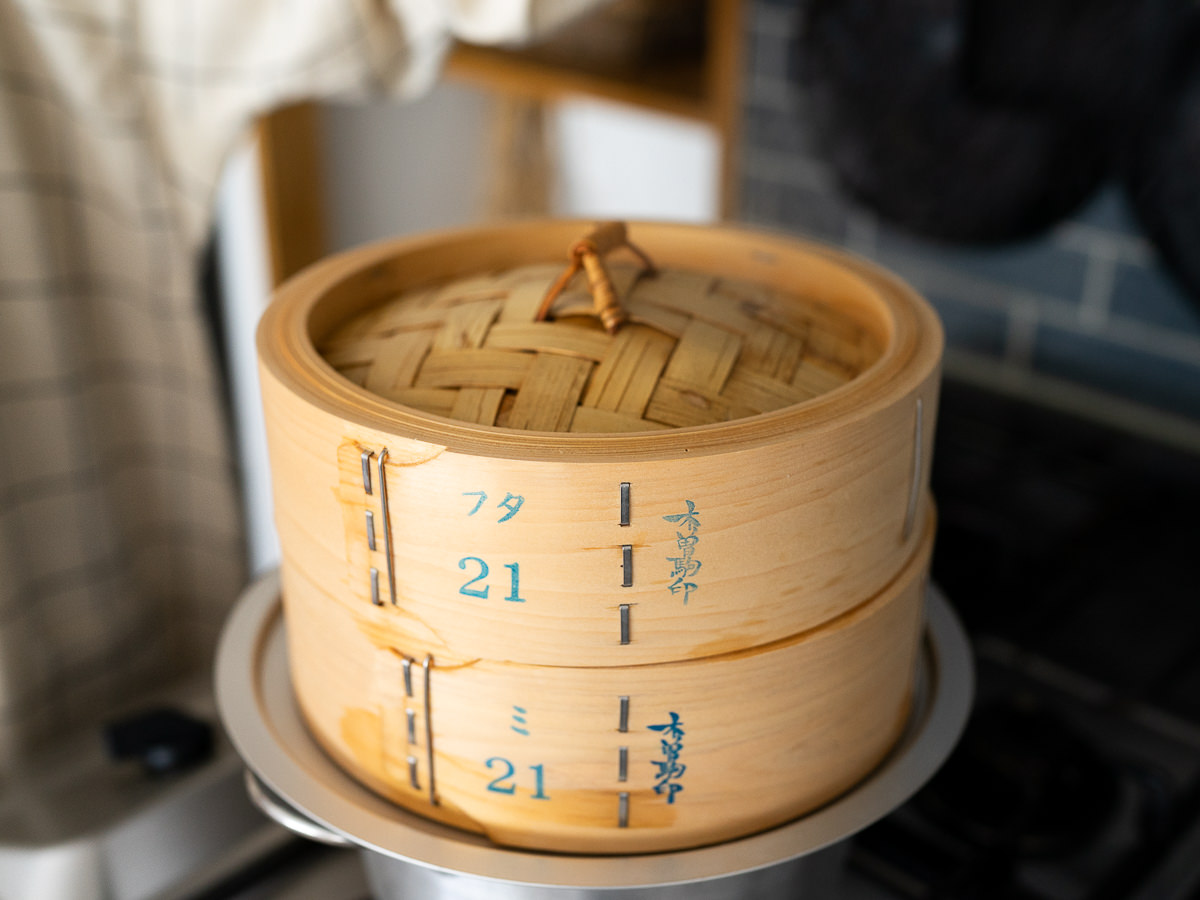
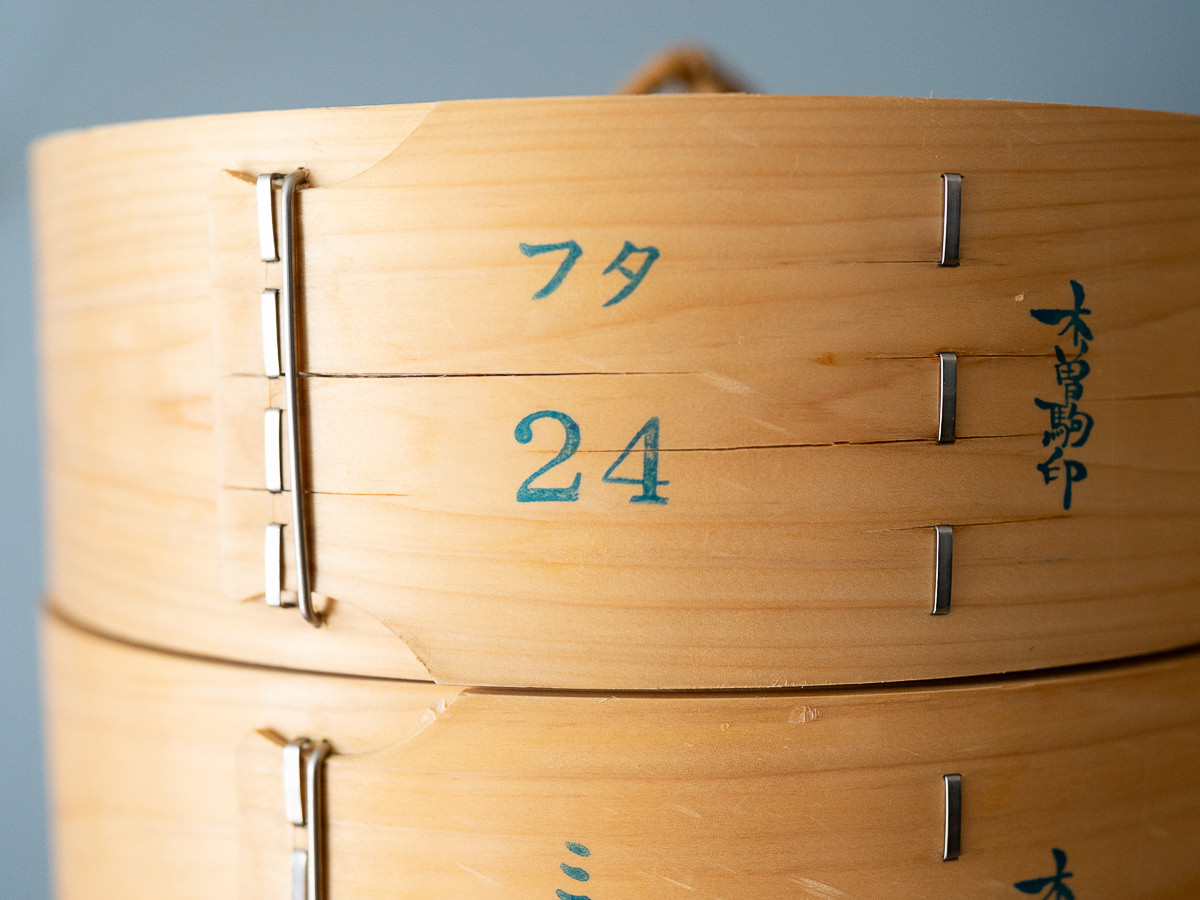
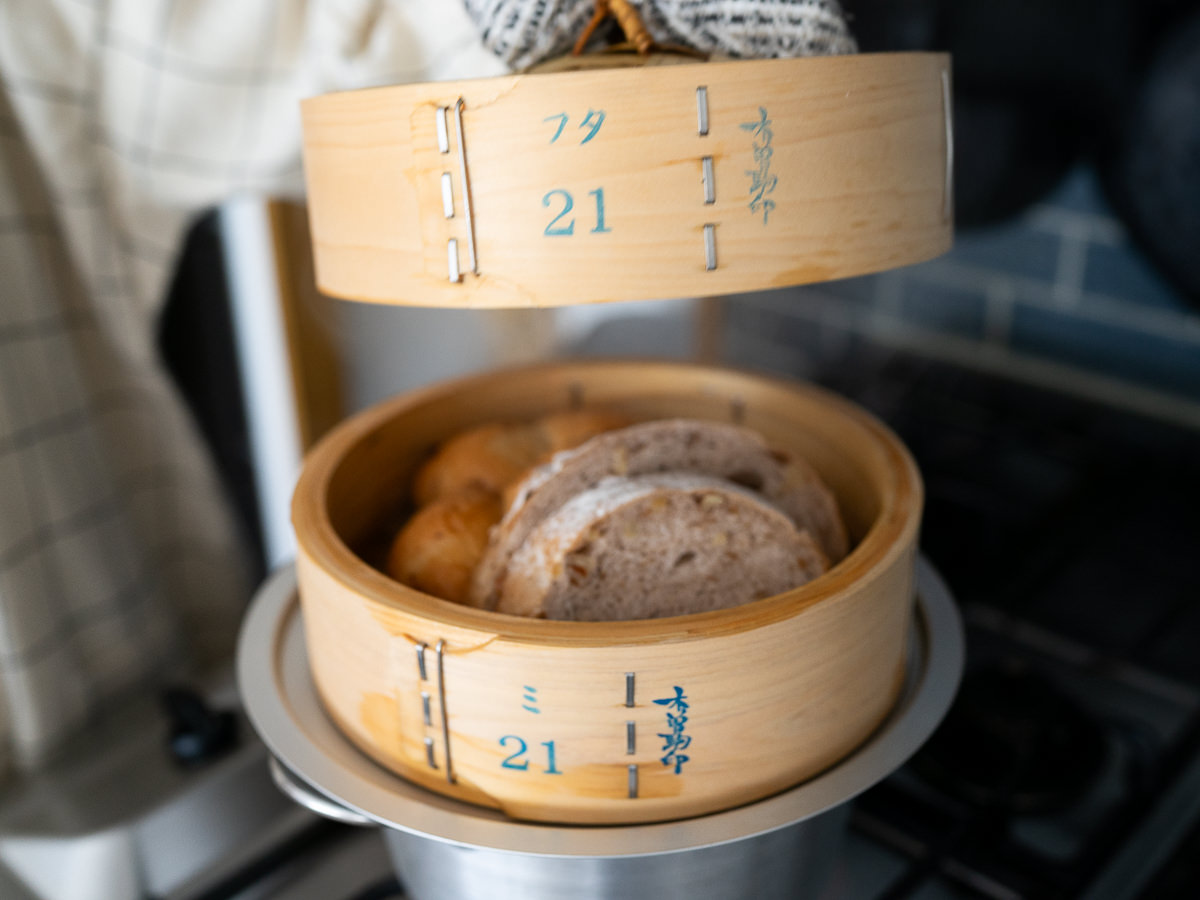
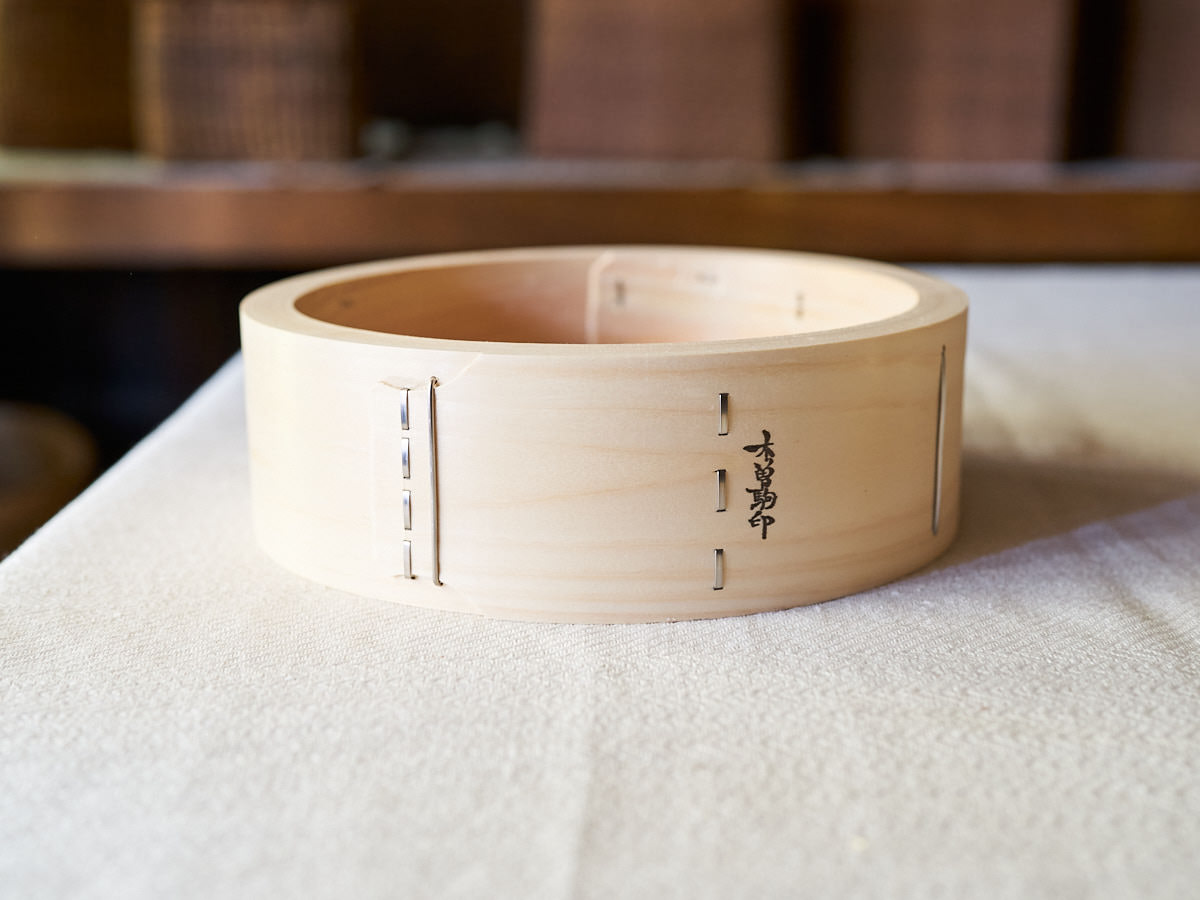
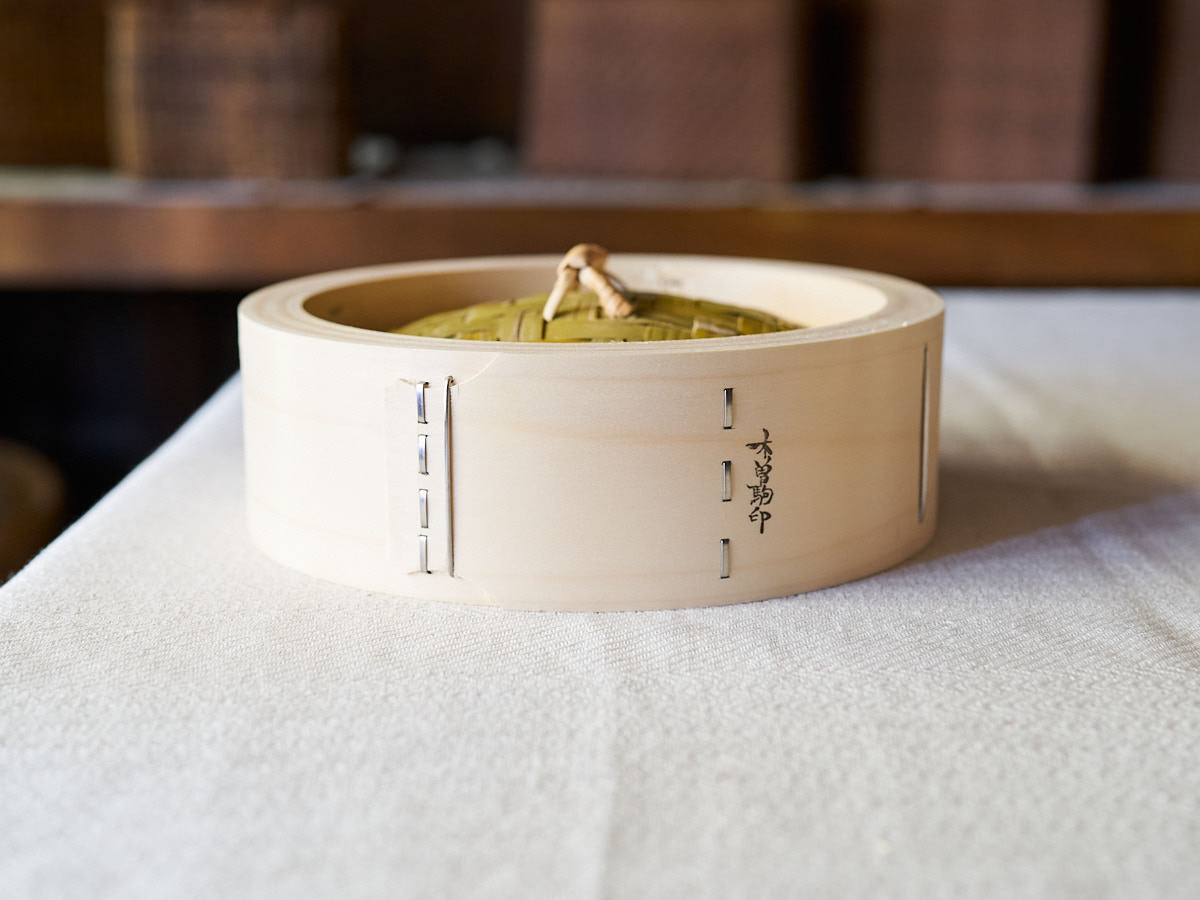
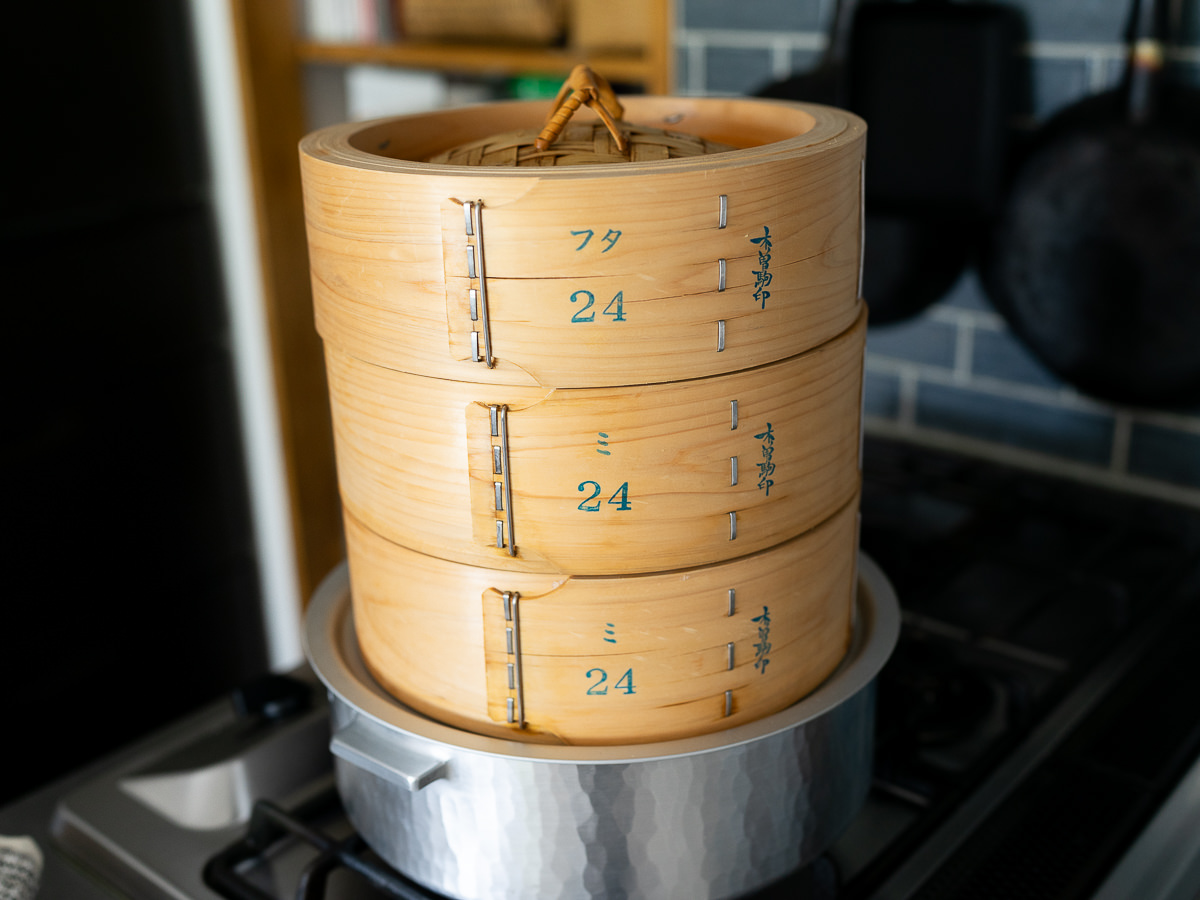
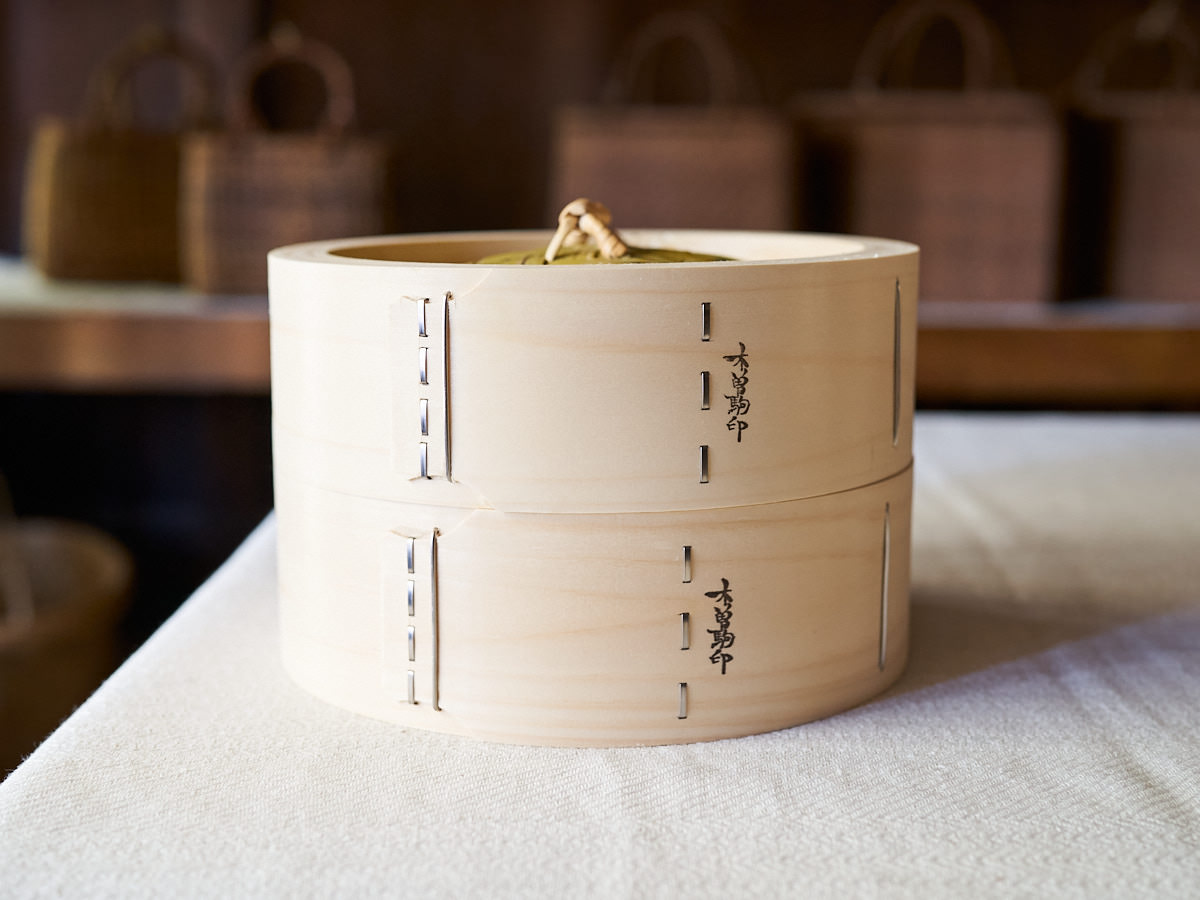
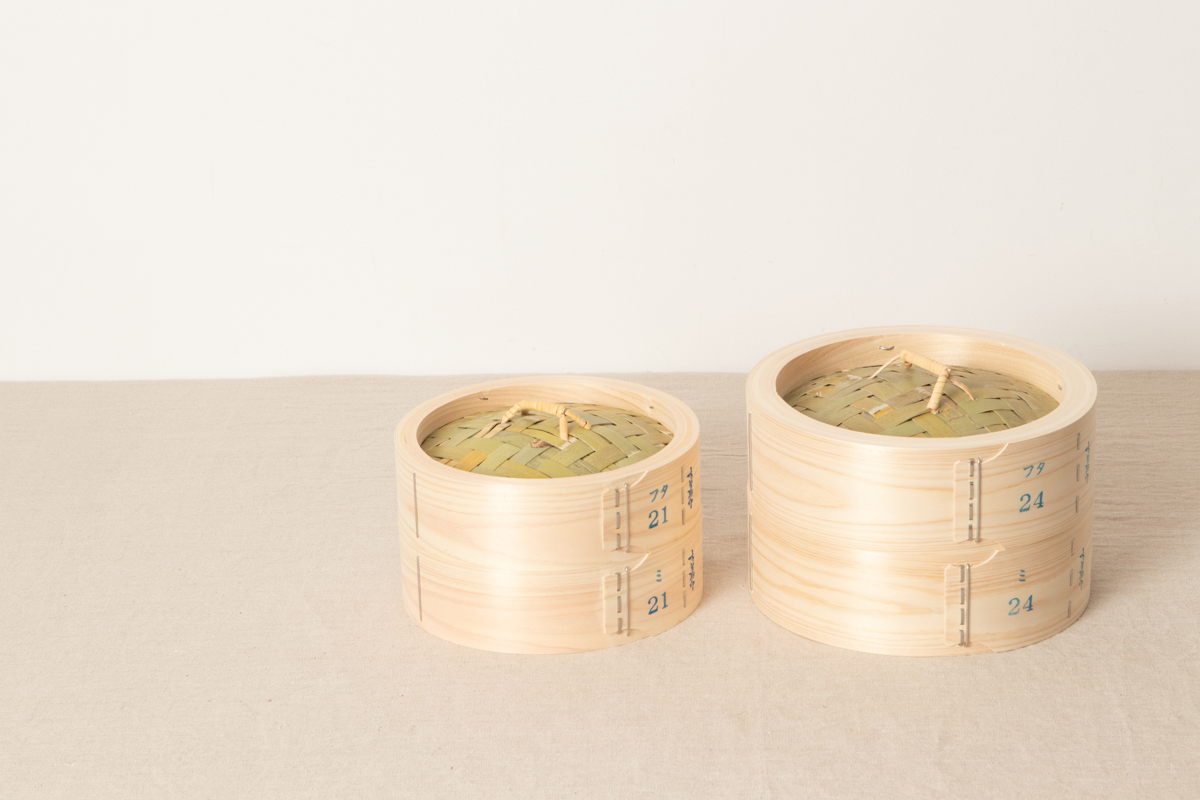
*The manufacturer has changed the stamp design for stock received from October 2026 onward. The stamps previously used, such as “ミ,” “フタ,” “21,” and “24,” are no longer applied. Currently, only the “Kisokoma Mark” (木曽駒印) is stamped in black. This page also includes photos of the previous specifications, but the item you receive will have the new specifications, with only the “Kisokoma Mark” stamped on it, as shown in the photo above. We are unable to accept returns or exchanges due to this change in the stamp design. Please be aware of this before placing your order.
For the steamer, “side boards” are used— these are the planks left after cutting posts from a hinoki log. The barked edges are planed smooth, adjusted to a uniform thickness and length, and prepared as material for the steamer.
The steamer is also a form of “mage-mono,” or bentwood craft. Bentwood refers to a vessel made by bending thin boards—such as hinoki— into a circular shape and fastening the ends together. However, this steamer uses thicker boards, requiring considerable strength to bend.
Several thin boards that have been bent are laminated to add thickness, then shaped under heat and pressure to form the frame of the steamer.
A highly durable Chinese steamer.
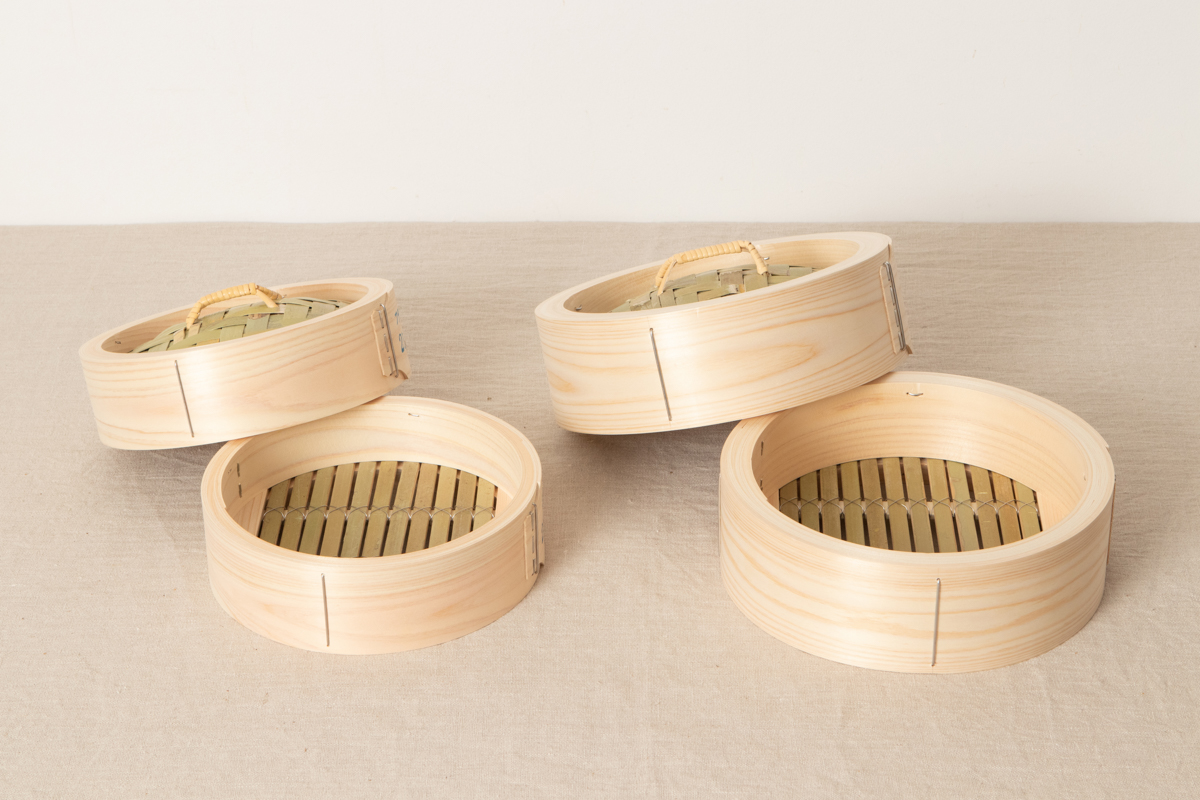
This page introduces two sizes—21 cm (8.27″) and 24 cm (9.45″)—and two types: body and lid.
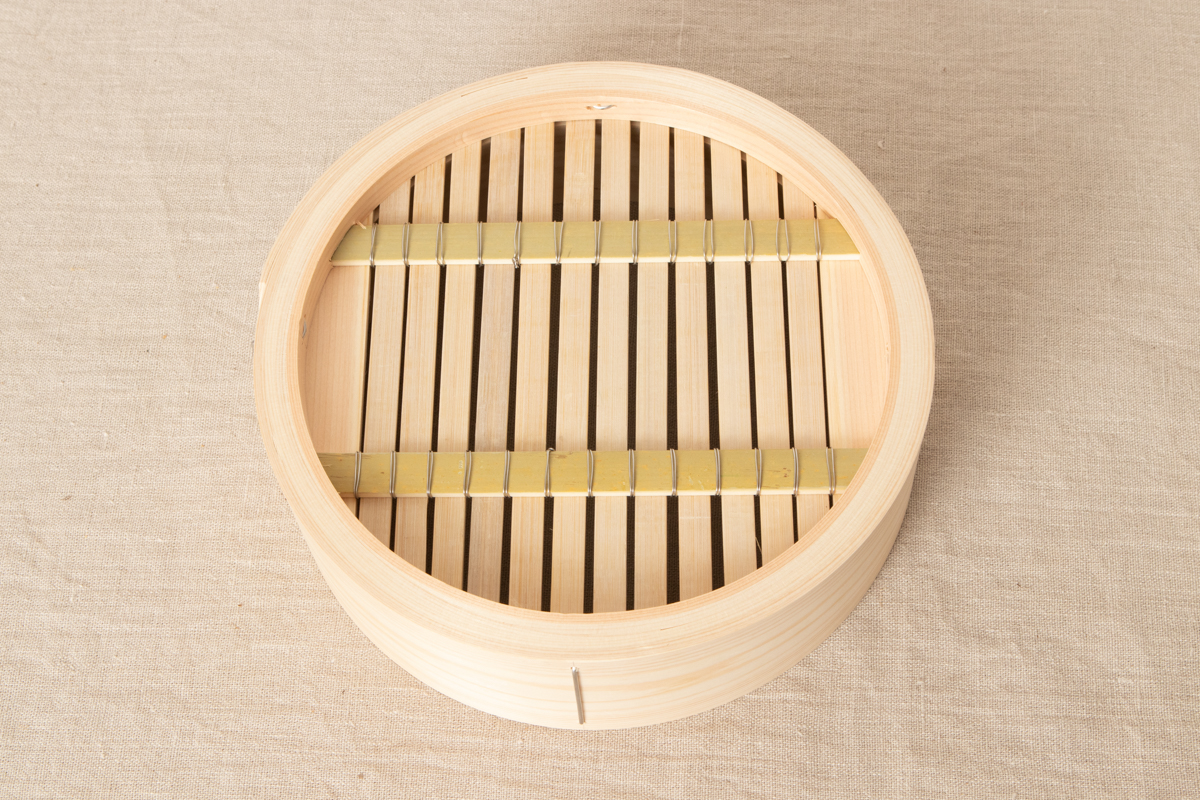
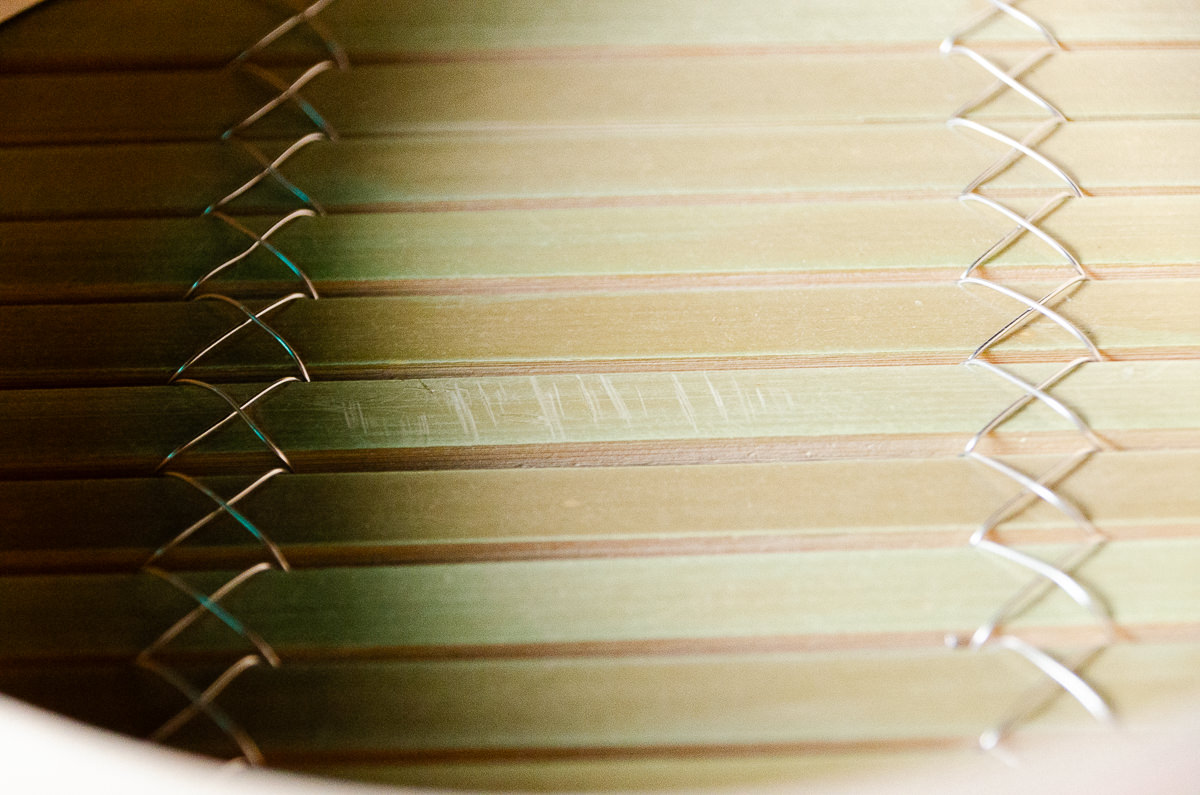
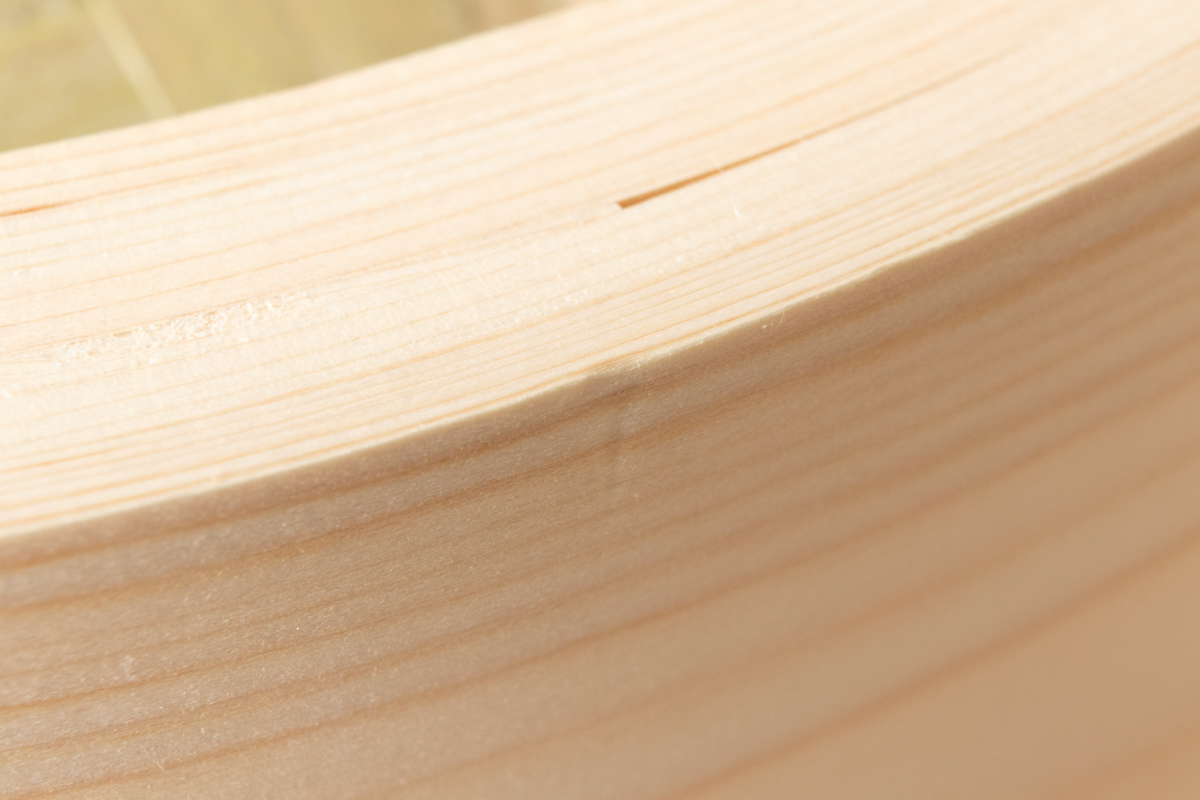
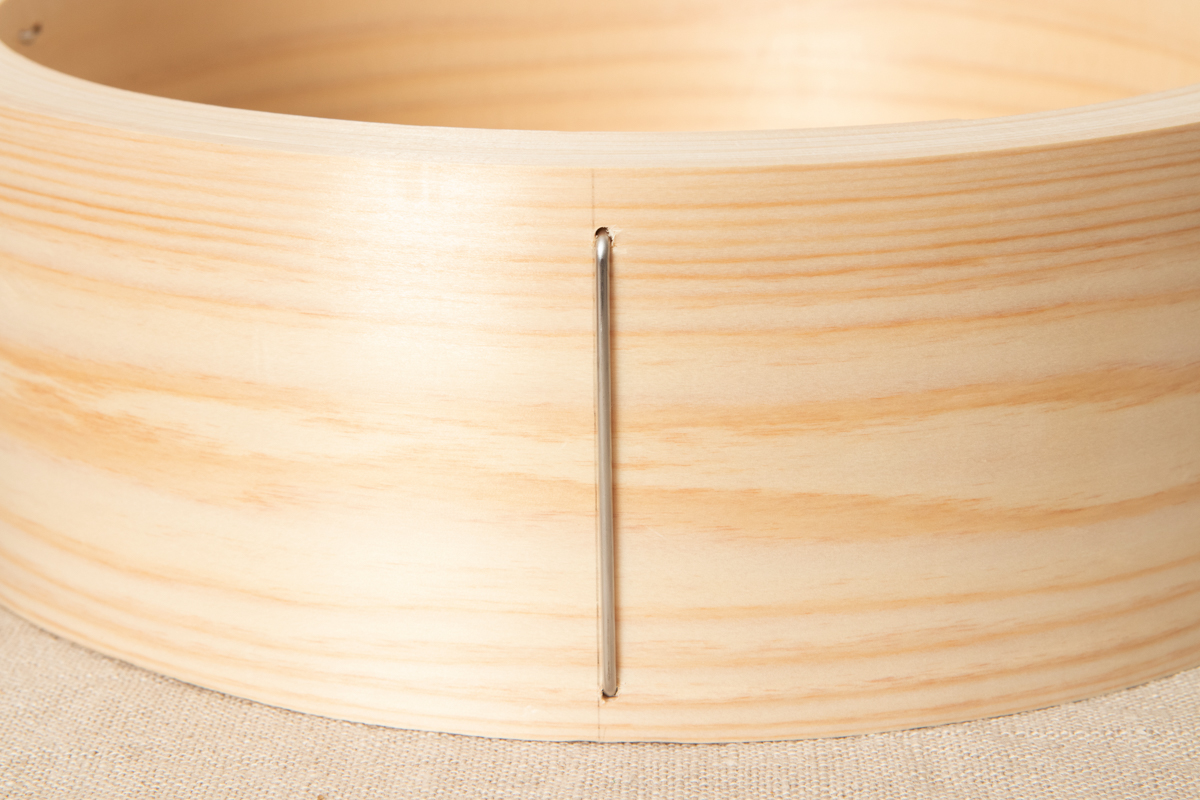
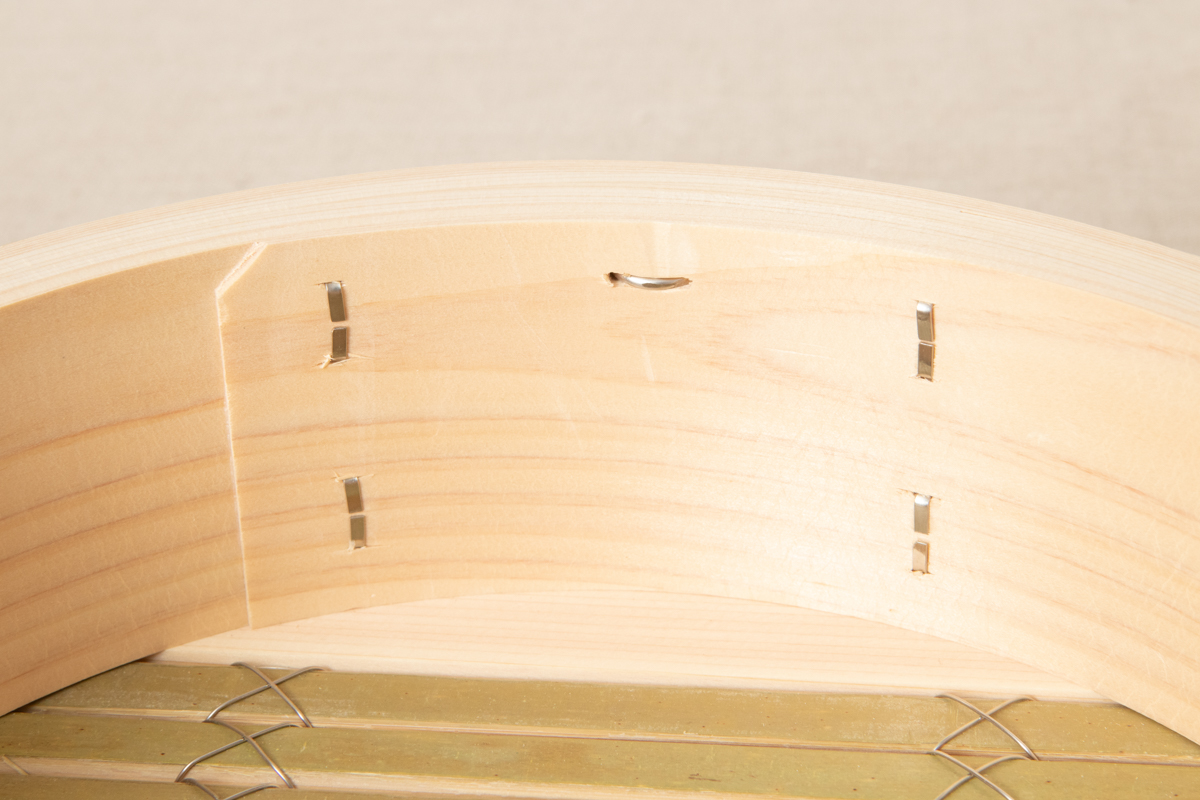
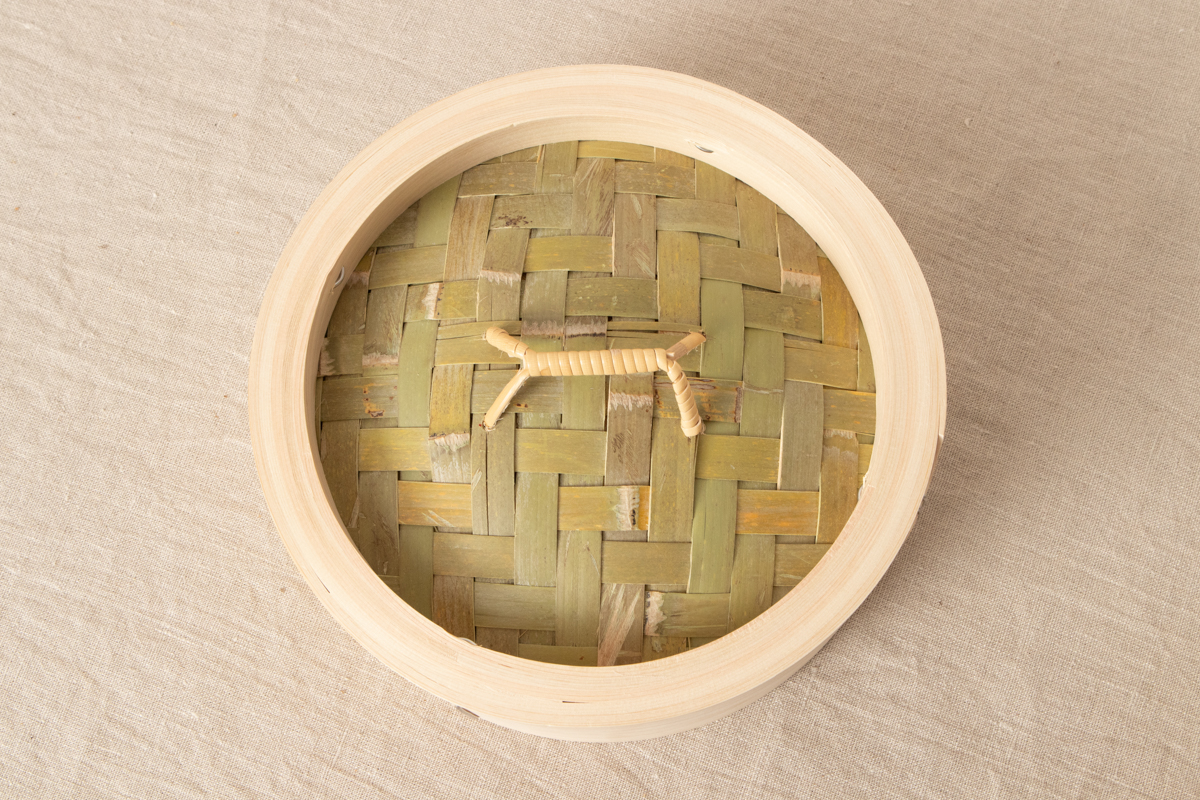
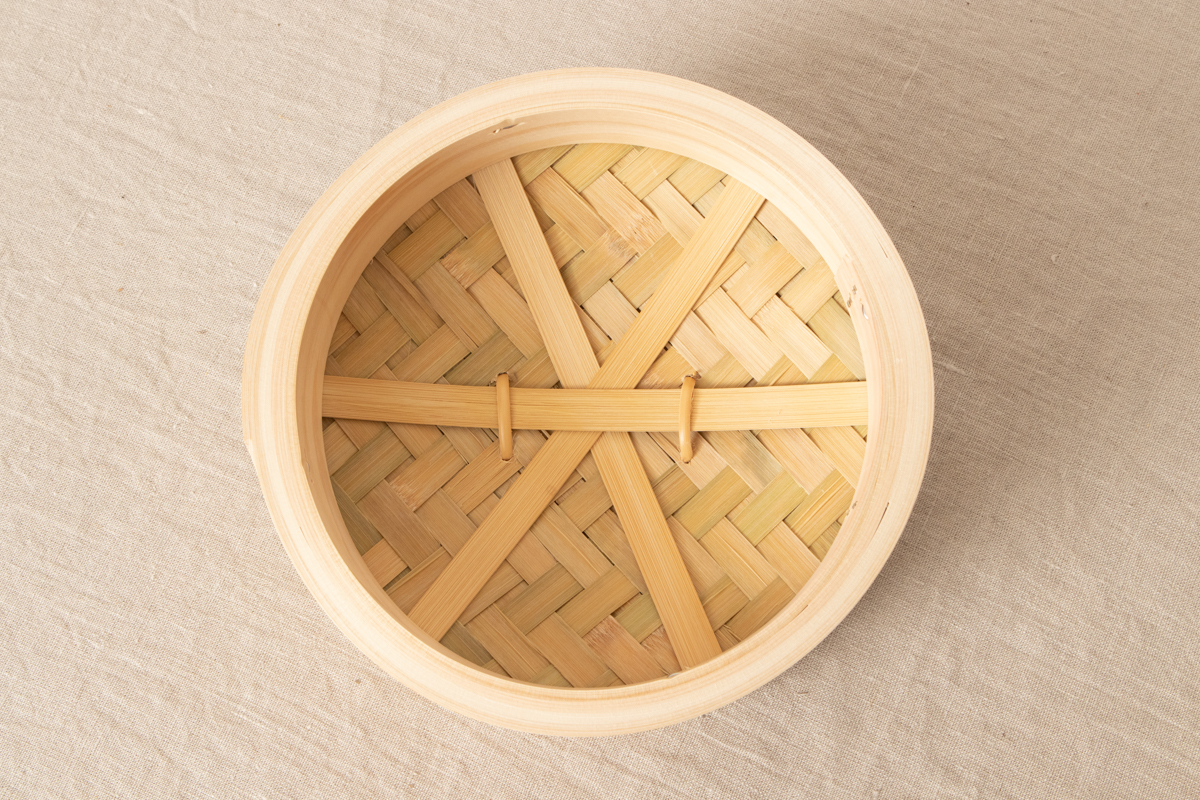
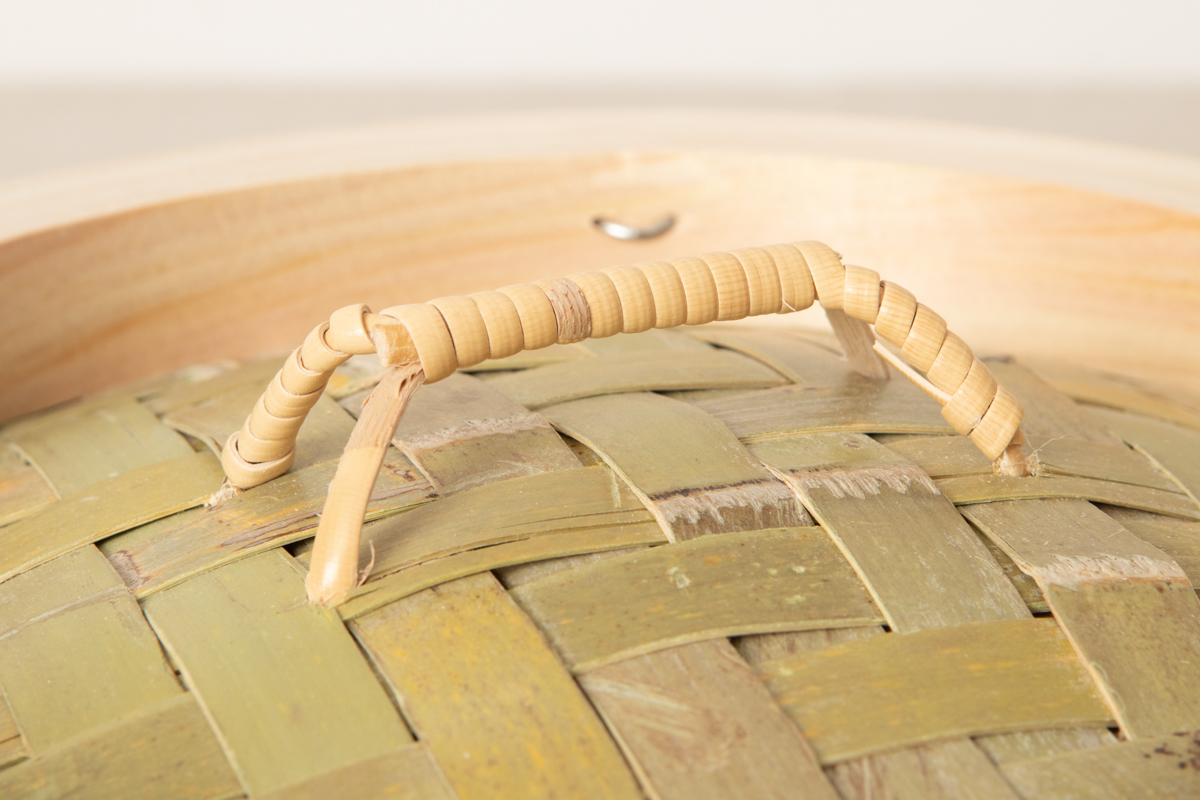
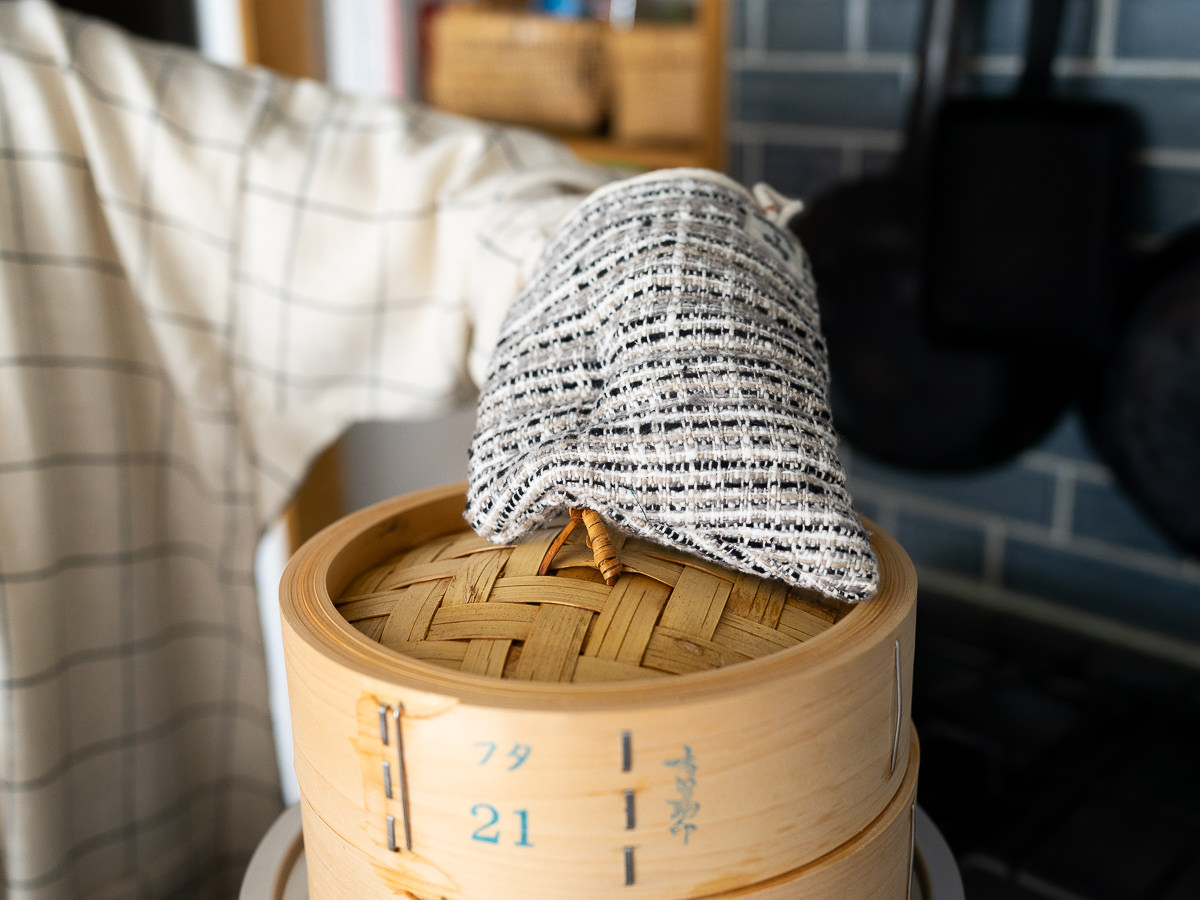
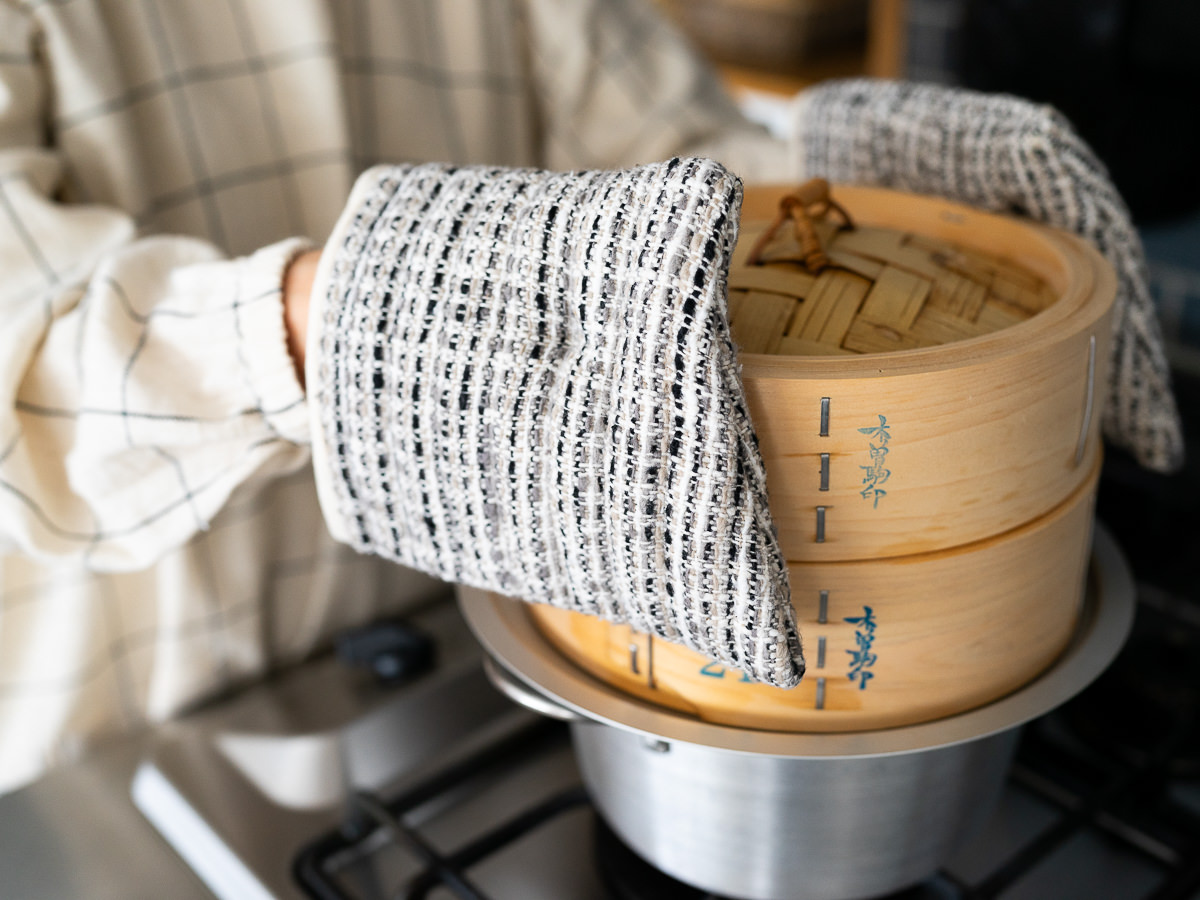
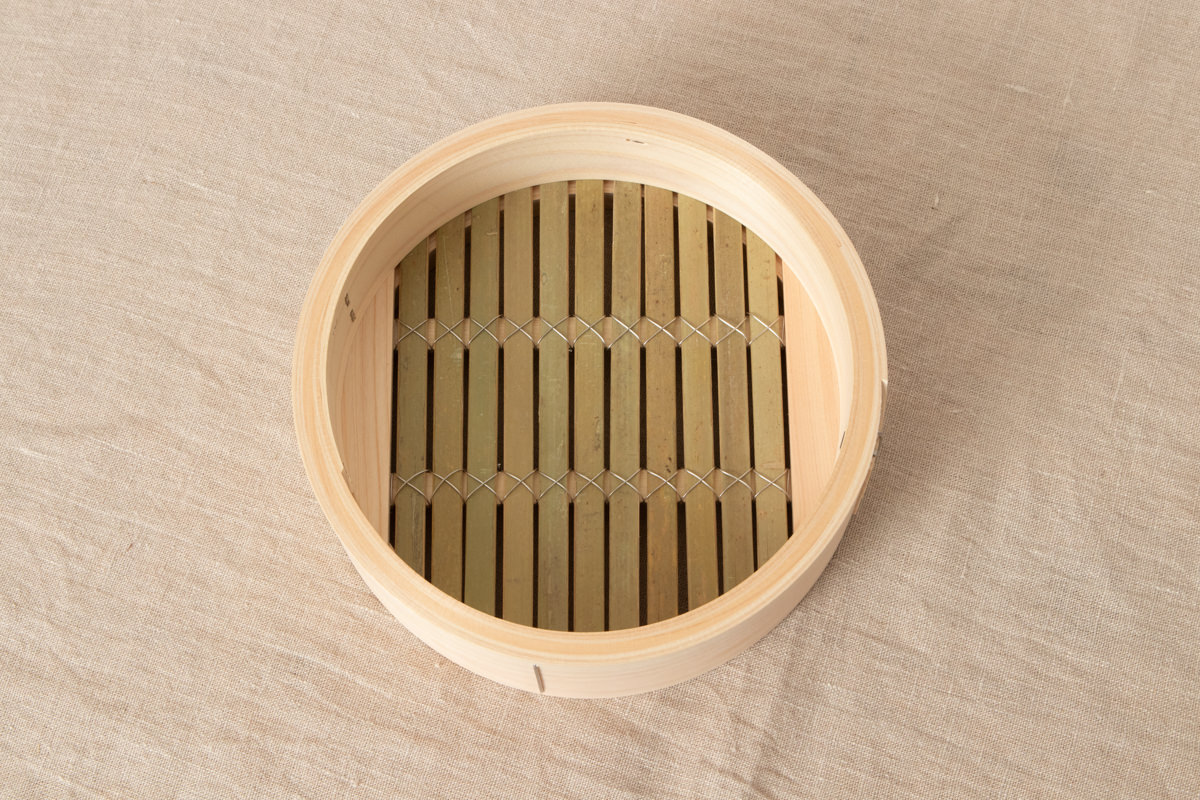
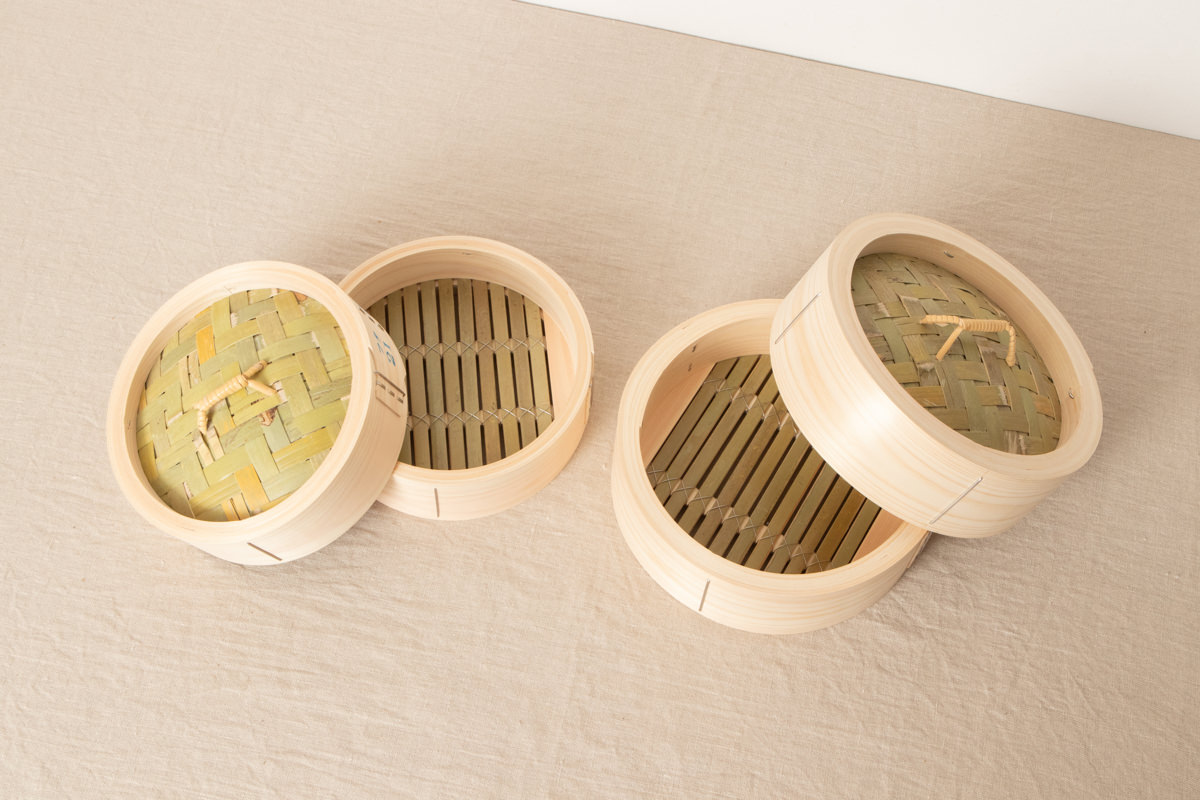
The body and lid are sold separately. If you are purchasing for the first time, please add both the body and lid to your cart.We recommend using one lid together with two or three bodies stacked for efficient steaming.Both the body and the lid are stamped in black with the “Kisokoma Mark” (木曽駒印) trademark.This trademark is also said to indicate that the hinoki Chinese steamers are made in Japan. (Several types of wood are used for steamers, including cedar.)The steamer frames are made by bending thin hinoki boards and layering them together. As the steamers are handmade from natural materials, they are not perfectly round, and there are slight differences in diameter even between a body and lid of the same size.For this reason, the diameters of the body and lid may not match exactly when stacked. However, the lid still covers the body securely, so this does not affect use. The body and lid are not designed to fit into each other. Instead, the lid rests on top, with their rims overlapping.The bottom of the body has a fixed bamboo slatted base that allows plenty of steam to pass through.The bamboo slats and reinforcing bamboo on the underside are secured with stainless steel wire. Stainless steel is rust-resistant, and using it gives the steamer a sturdy construction that can withstand many years of use.During production, slight scuff marks may appear on the bamboo surface, and small cracks may form along the natural fibers. These do not affect use and are not considered defects.You may also notice small scratches on the rimor side surface of the steamer—these are part of the handmade process and do not affect quality.Both the body and lid are reinforced with stainless-steel fasteners at four points, as shown here.Inside as well, stainless-steel staples are securely fixed in place. There may be marks left by the hammer used to drive in the staples, but these are part of the normal product specifications and are not considered defects.The frame of the steamer is made thick and solid, helping retain the heat of the steam rising from the boiling water below.The lid frame is also made of hinoki cypress and has a sturdy thickness.At the center of the lid, woven bamboo is used. The bamboo material is not domestic but made in China.The weave of the lid allows steam to pass through. Steam from the boiling water rises through the body and escapes upward through the bamboo weave at the top.A rattan handle is attached to the lid. Although the steamer becomes very hot during use, rattan does not conduct heat easily, making it comfortable to hold.That said, steam escaping through the bamboo weave can still be unexpectedly hot.When lifting or opening the lid, it is best to use a cloth or oven mitt to protect your hands.
Now, let us look at each size.
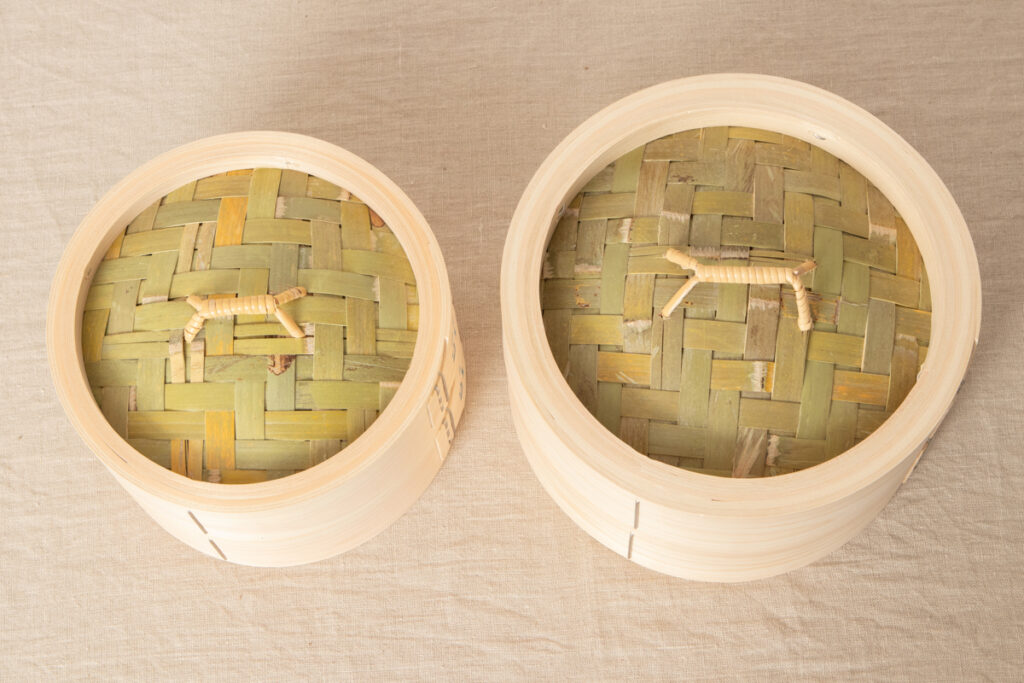
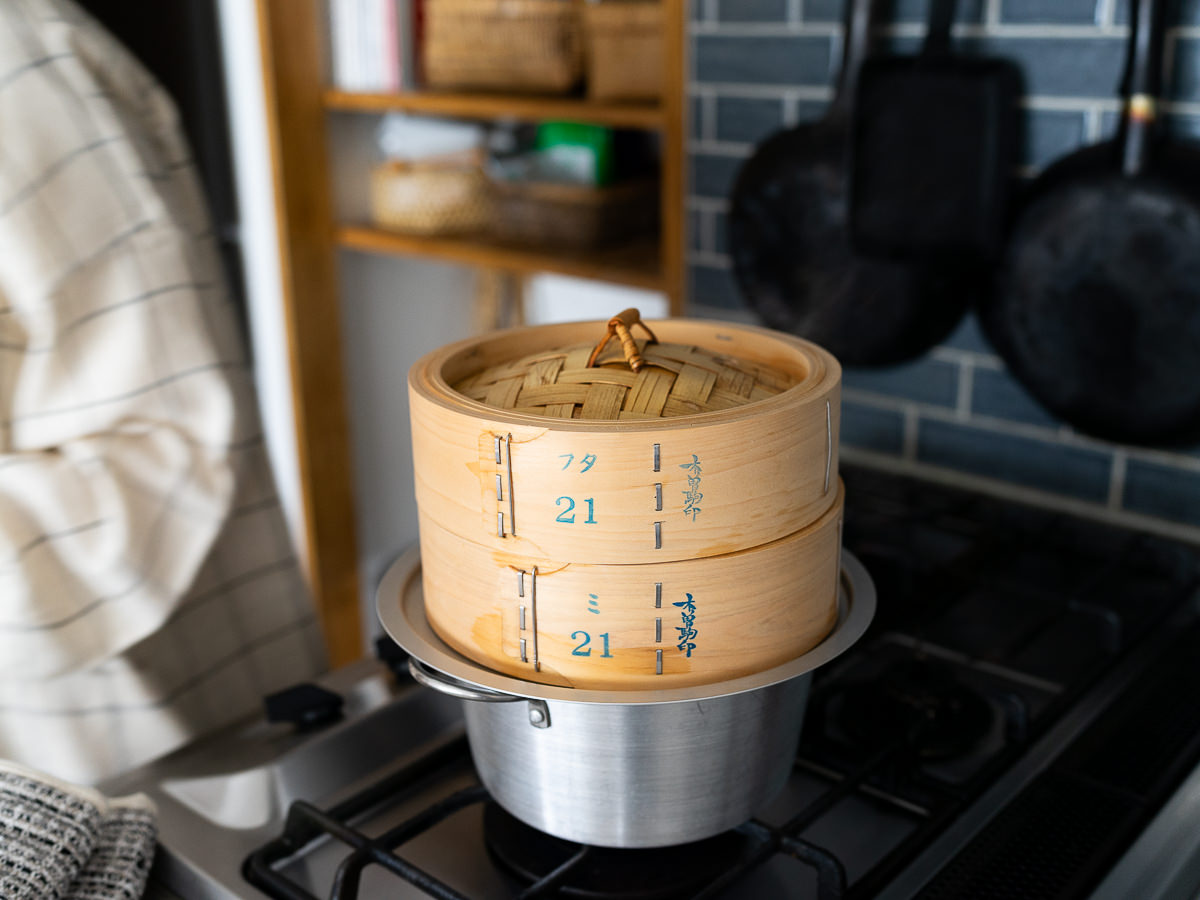
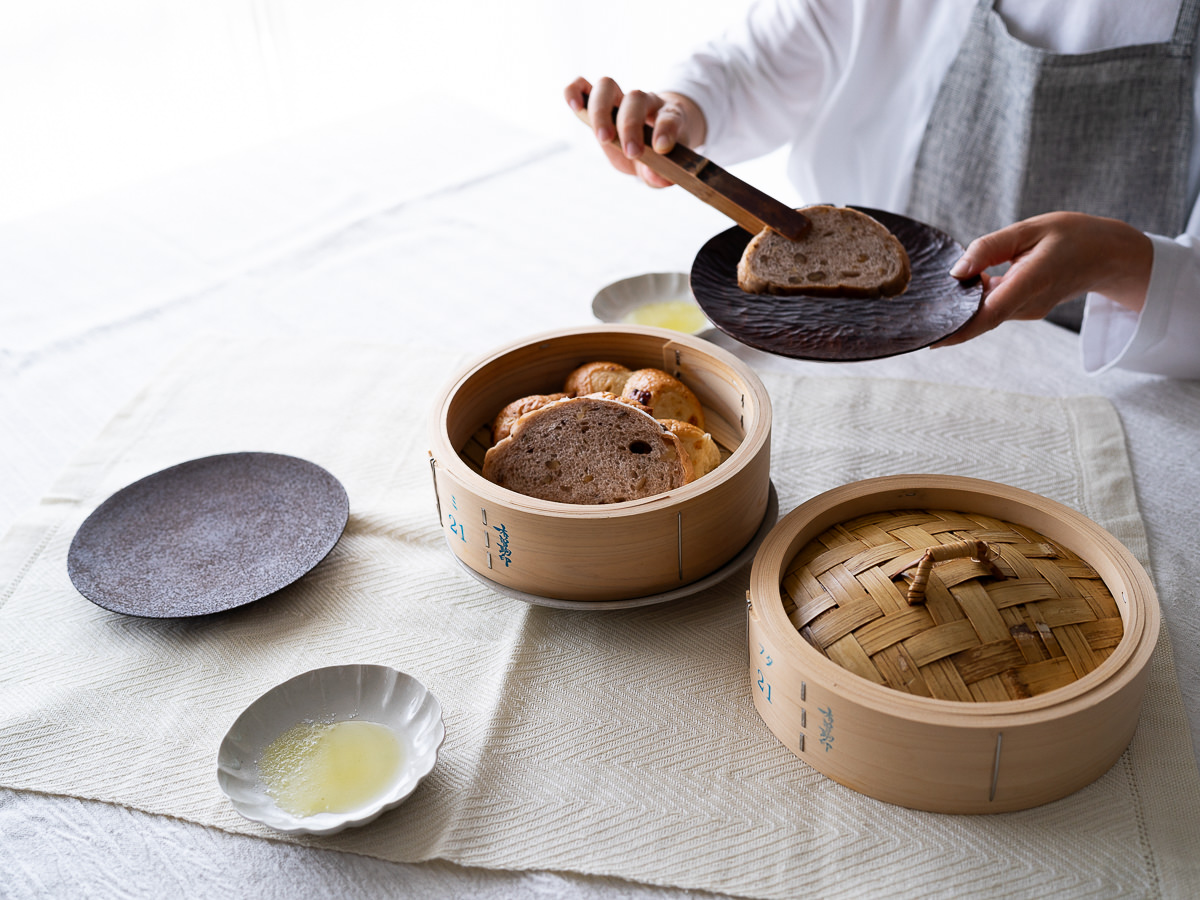
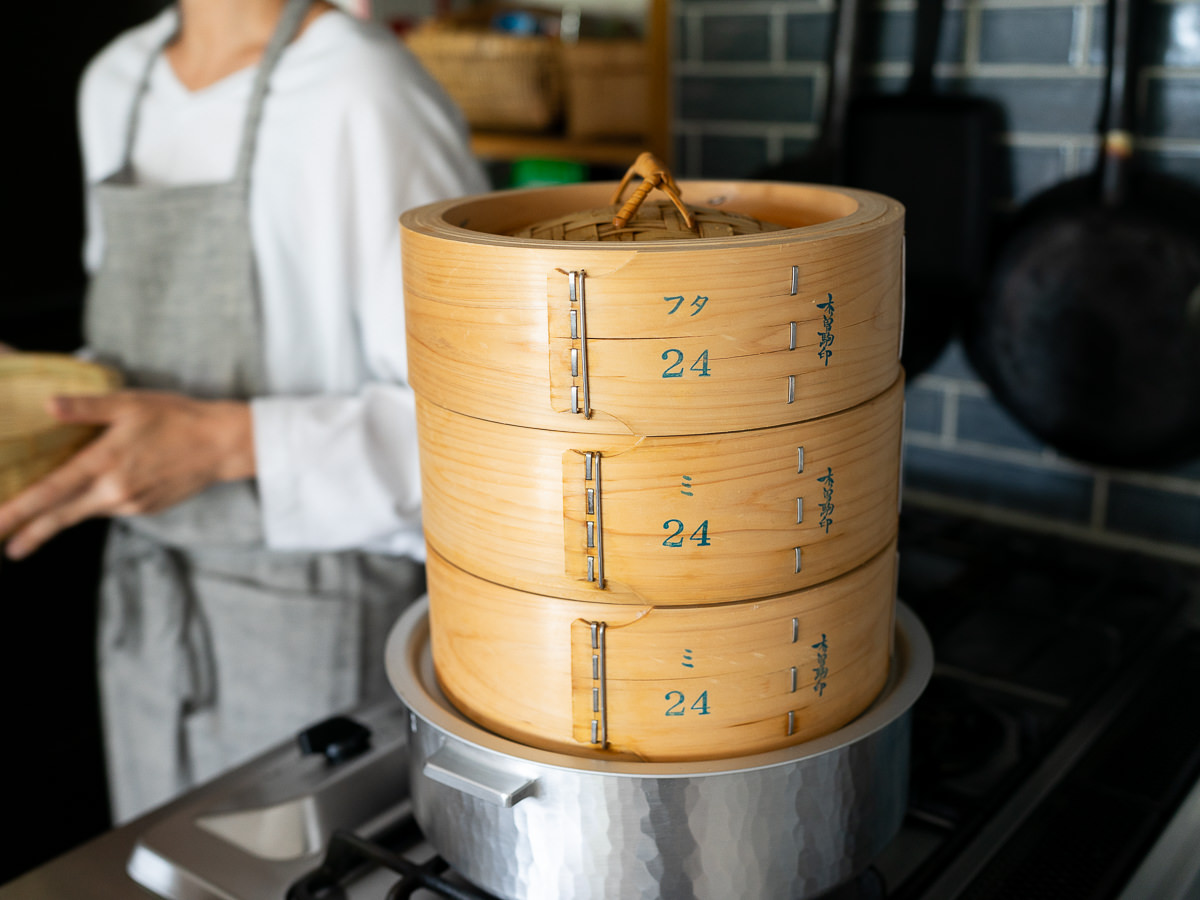
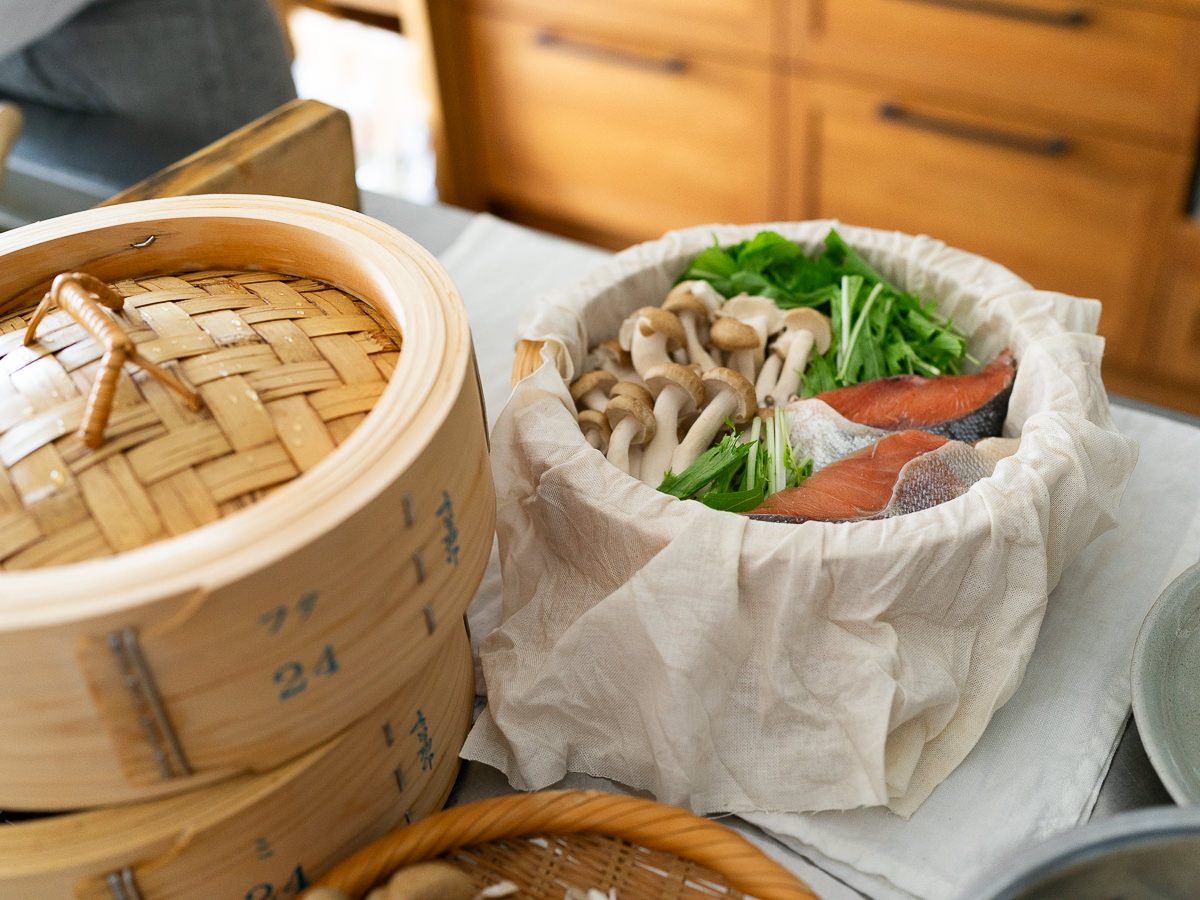
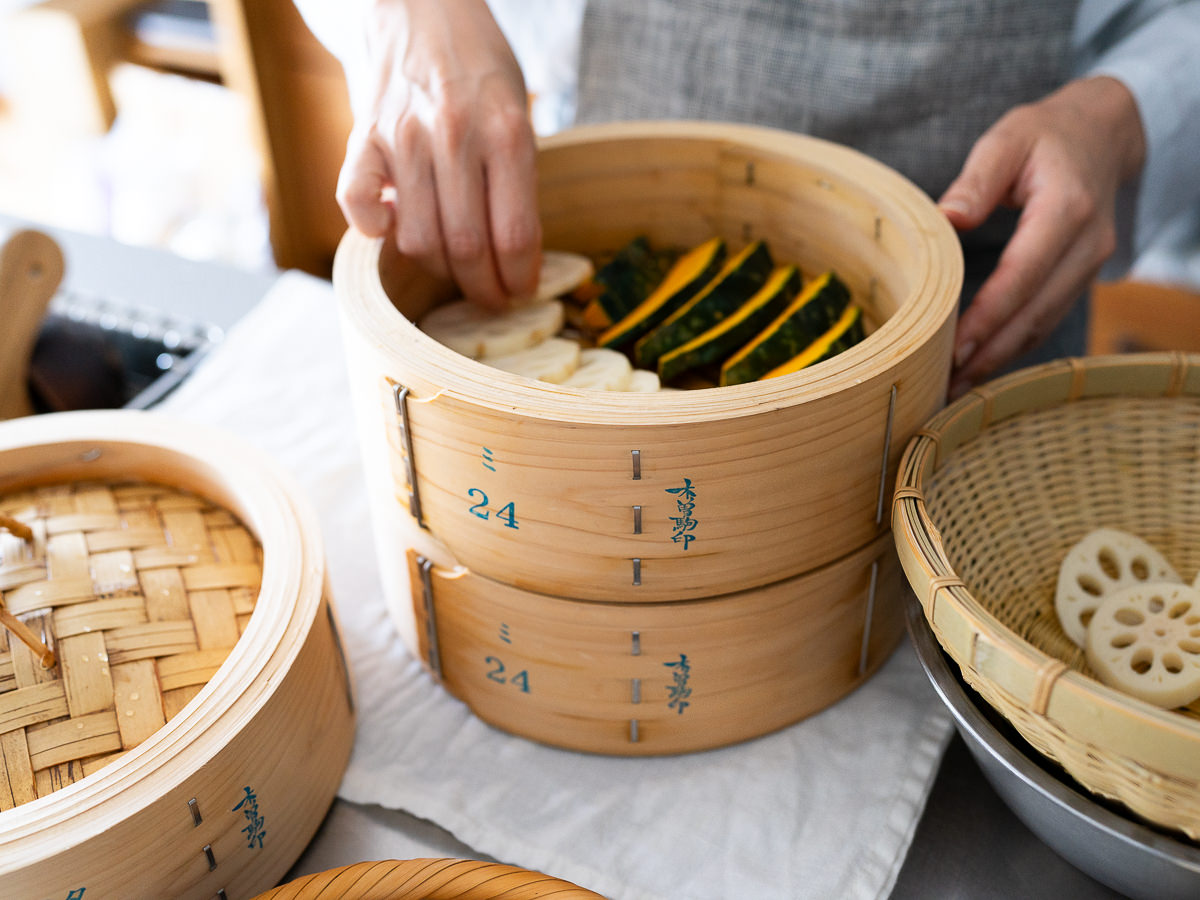
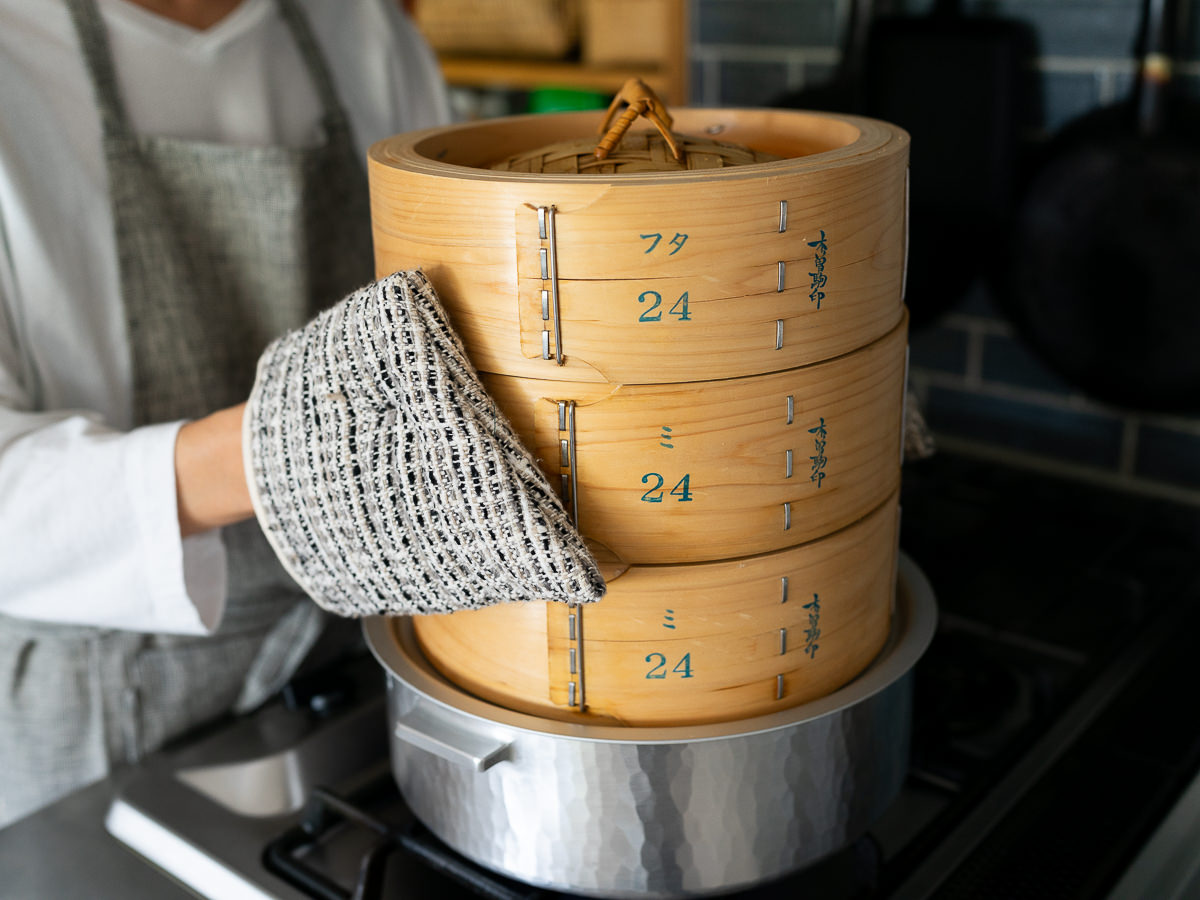
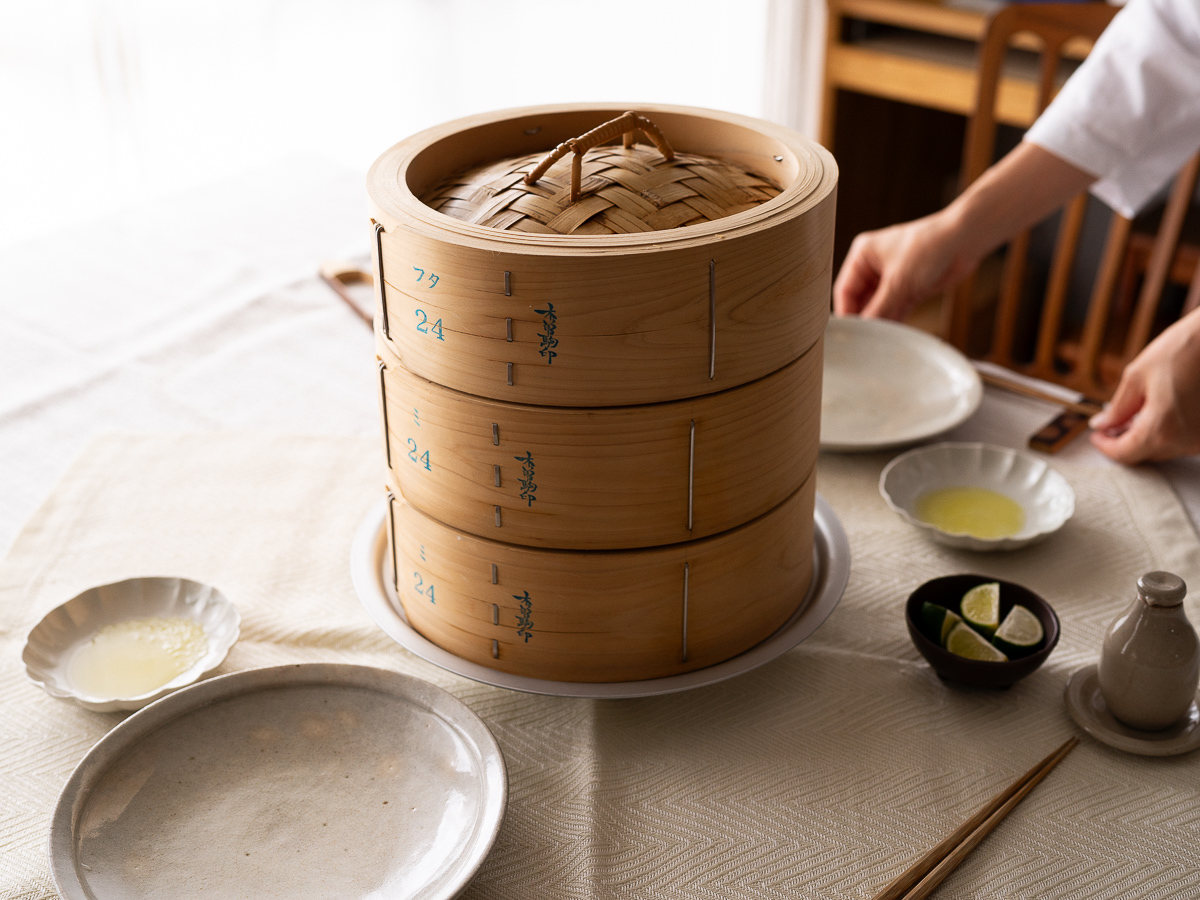
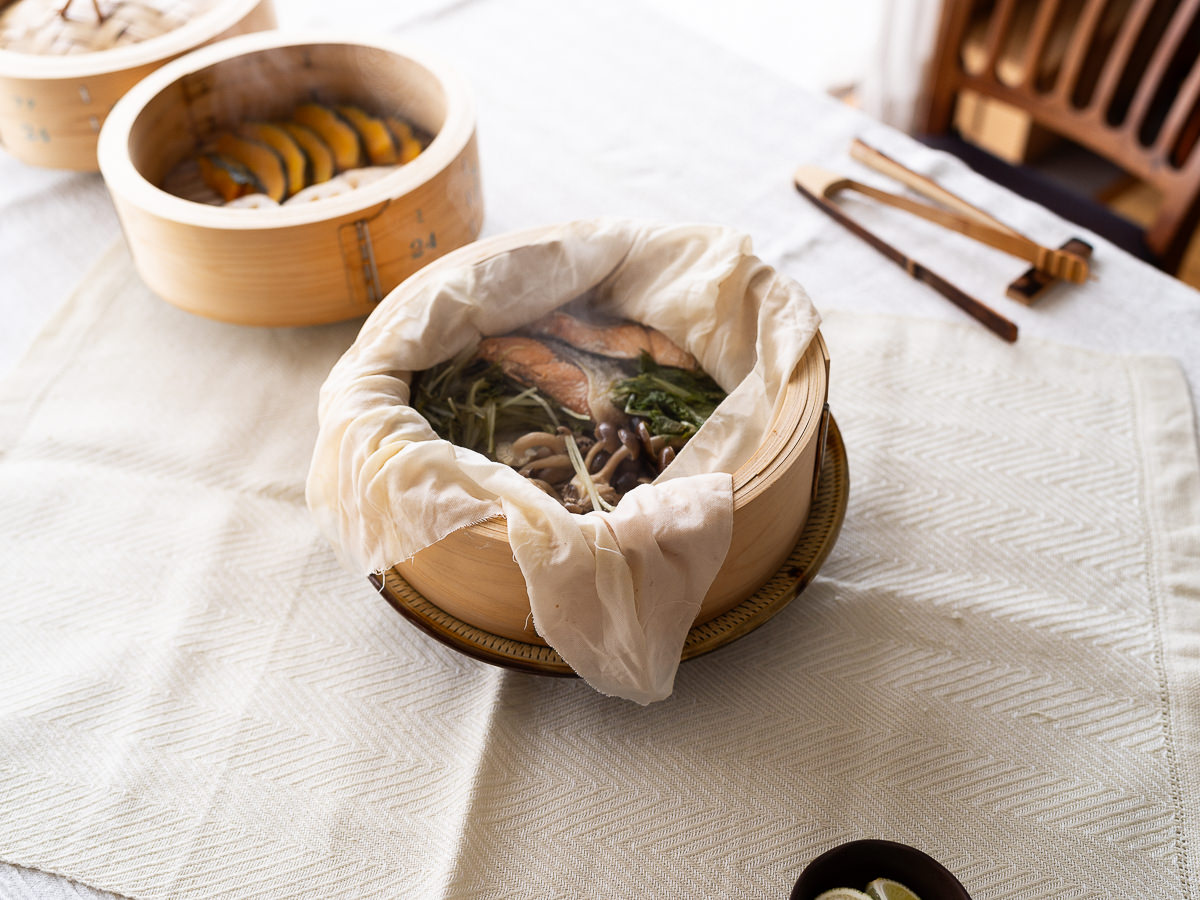
This is the 21 cm (8.27″) body, viewed from above. It can hold about four small steamed buns—enough to cook portions for one or two people.This is the 21 cm (8.27″) lid. With continued use, both the hinoki wood and the bamboo gradually deepen in color, developing a warm amber tone.Here, a 21 cm (8.27″) steamer is placed on a 24 cm (9.45″) steaming plate set over a 20 cm (7.87″) double-handled pot.It’s also perfect for warming bread. Fill the pot with plenty of water and bring it to a boil. Meanwhile, moisten the steamer and place the food inside.When you see steady steam rising, place the steaming plate and steamer on top. Before use, be sure to soak both the body and lid—especially the bottom of the body—for 10 to 15 minutes so the wood absorbs enough moisture.When heating on the stove, make sure the flame does not extend beyond the bottom of the pot. Direct flames may scorch the steamer and leave dark marks—though these do not affect its use.Over time, small cracks may appear on the frame, as shown in the photos. This is a natural characteristic of the wood and does not affect durability or usability.When steaming bread, two to three minutes is usually enough.Even slightly hardened bread becomes soft, moist, and pleasantly chewy when steamed.Next, this is the 24 cm (9.45″) body. It can hold about six small steamed buns and is suitable for preparing portions for two to three people.This is the 24 cm (9.45″) lid. It also has a sturdy rattan handle.Because the Chinese steamer has a shallow body and its slatted bamboo base and bamboo lid allow steam to pass through easily, heat spreads quickly throughout the steamer. This allows you to cook several ingredients at once using one lid with up to three stacked bodies.In the photo, two bodies and one lid are used. A 24 cm (9.45″) steamer is placed on a 27 cm (10.63″) steaming plate set over a 27 cm (10.63″) double-handled pot filled with boiling water.In the lower tier, a damp cotton cloth (sarashi) is laid down, topped with salmon, mizuna greens, and shimeji mushrooms. Using a cloth or cooking paper helps prevent the steamer from staining and allows you to lift the food out easily together with the sheet.In the upper tier are slices of lotus root and pumpkin, placed directly on the bamboo base. You can also line it with lettuce or cabbage leaves, or use a heat-resistant plate to hold the ingredients if preferred.Once the water boils and steam rises steadily, place the steaming plate and steamer on top and steam for about 10 minutes. Maintaining a consistent heat level helps the ingredients cook evenly. Try not to open the lid during steaming, as this can cause uneven heating.One of the good things about a steamer is that you can bring freshly steamed, piping-hot food straight to the table. We bring the steamer to the table together with the steaming plate and place a large flat plate underneath.
Pumpkin, lotus root, shimeji mushrooms, mizuna greens, and salmon— even with just a touch of soy sauce and a squeeze of lemon, they taste wonderfully flavorful.
A bit of salt and olive oil is also lovely. Each ingredient retains its natural flavor, and the warmth of the steam seems to sink gently into the body.
Broccoli, bell peppers, onions, potatoes, sweet potatoes, mushrooms—just steam any vegetables. Add a bit of butter, or place meat or fish on top of the vegetables, and you have a complete, satisfying dish.
The steaming time, the natural moisture of the ingredients, and small adjustments— such as using a damp steaming cloth—can all change the texture of the finished dish, so it’s fun to experiment.
It is pleasing that, unlike boiling or deep-frying, steaming does not get too hot and nutrients are not lost, and that you can enjoy vegetables, seafood, and other ingredients with their natural flavors intact.
Steamed shumai and pork buns have skins that absorb just the right amount of moisture, resulting in a pleasantly chewy texture rather than a fluffy one.
Because steam escapes through the bamboo weave of the lid, moisture doesn’t collect inside the steamer, keeping the food perfectly cooked without becoming soggy.
Freshly steamed shumai, xiaolongbao, and buns—piping hot from the steamer— are incomparable in warmth, taste, and texture compared to when reheated in a microwave.
And even after cooling, the food remains delicious—a unique advantage of steamer cooking.
Simple yet profound, the Chinese steamer draws out the natural flavor, texture, and aroma of the ingredients using only heat and moisture.
It’s a trusted kitchen tool not only for the cold winter months but year-round— a dependable companion for busy days, letting you steam multiple dishes at once.
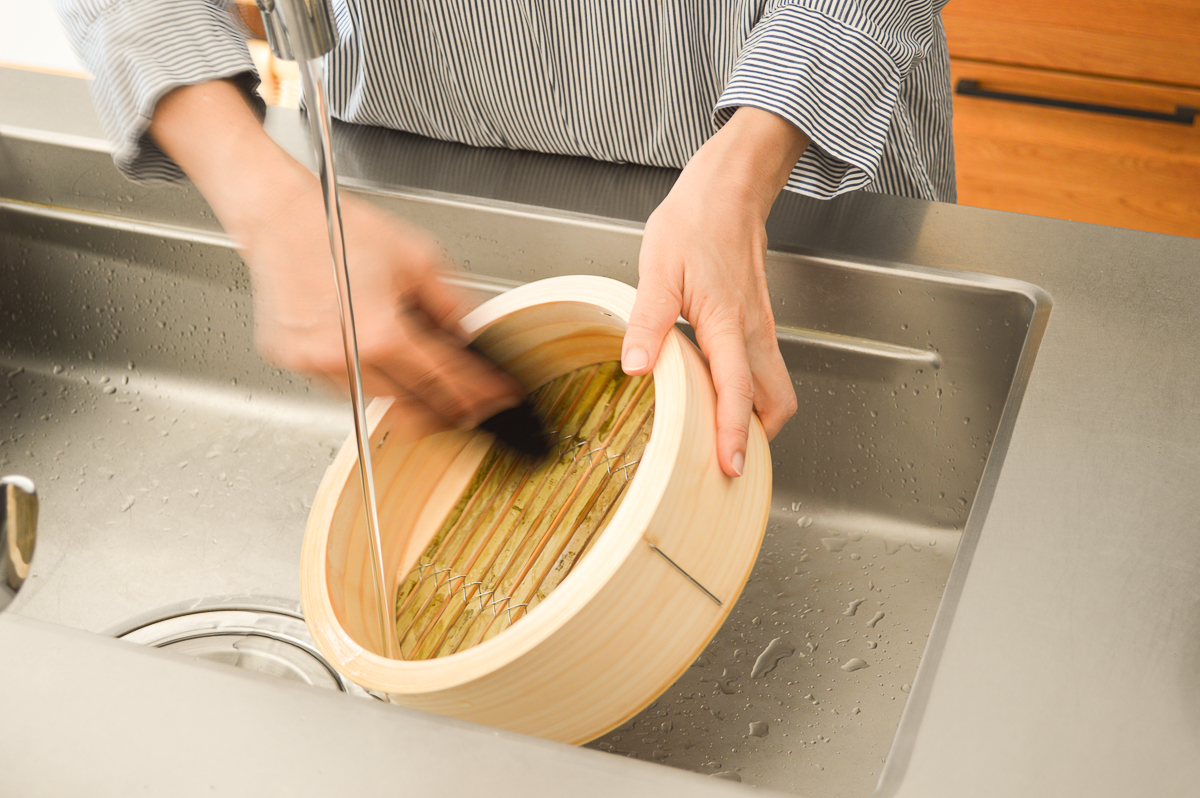
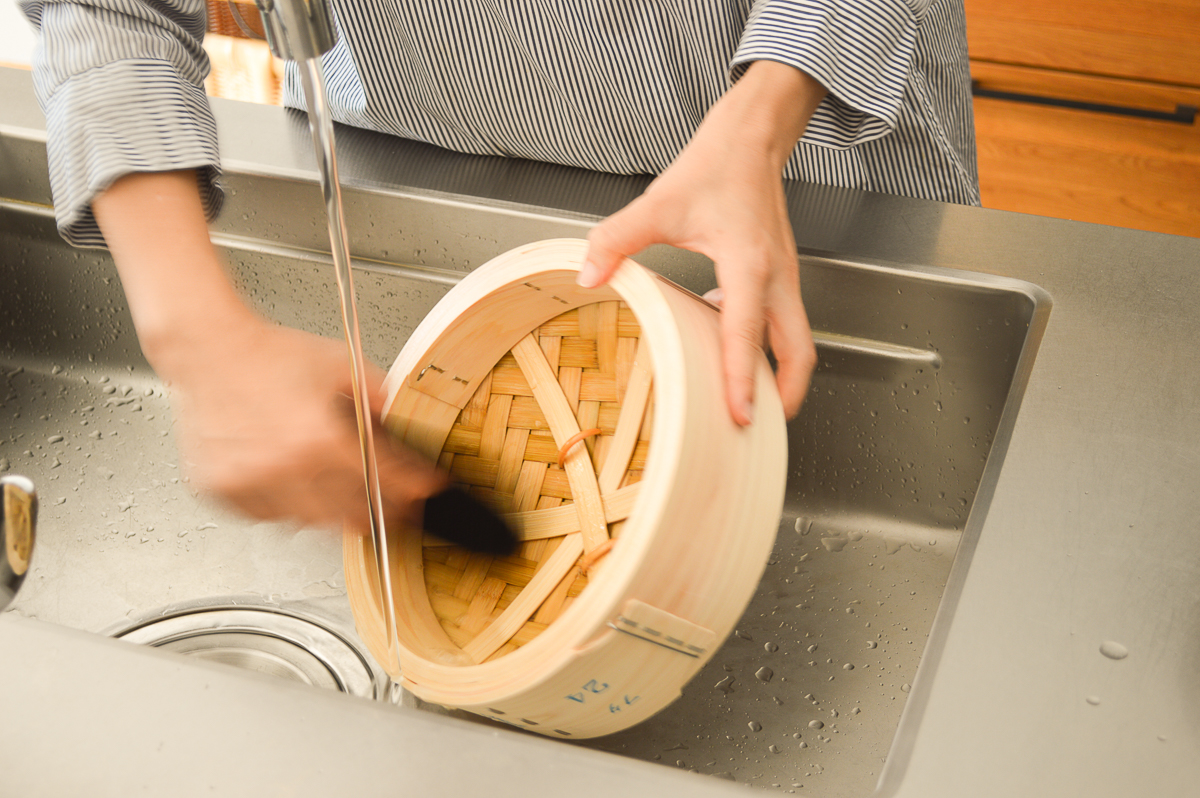
After using the steamer, wash it soon afterward with a scrubbing brush and remove any residue thoroughly.Wash the lid thoroughly in the same way. After draining off the water, wipe it dry with a cloth, then let it dry thoroughly in a well-ventilated, shaded place (such as near a kitchen window or an exhaust fan).
Once fully dried, store it in an airy place like an open shelf. If you won’t be using it for a while, wrap it in paper or keep it in a paper bag.
Because this steamer is made from hinoki cypress, it has a pleasant fragrance when first delivered. In the beginning, some of that scent may transfer to the food, but it will gradually fade with use.
This photo shows a steamer that has been used for about three years—it has developed a beautiful, rich color.
If you use a pot without an inner step or ridge, we recommend using it together with a “Steaming Plate (811109)”.
If the outer diameters of your pot and steamer fit neatly together and remain stable when placed, you can use them as they are. However, if the steamer extends beyond the pot, the bottom may burn and become unsafe. When using a pot that covers the steamer from below, choose a deeper, straight-sided pot whenever possible.
Even if the steamer fits snugly inside the pot, the wooden frame may expand slightly from the steam after cooking, making it difficult to remove—so please take care.
*The manufacturer has changed the stamp design for stock received from October 2026 onward. The stamps previously used, such as “ミ,” “フタ,” “21,” and “24,” are no longer applied. Currently, only the “Kisokoma Mark” (木曽駒印) is stamped in black. This page also includes photos of the previous specifications, but the item you receive will have the new specifications, with only the “Kisokoma Mark” stamped on it, as shown in the photo above. We are unable to accept returns or exchanges due to this change in the stamp design. Please be aware of this before placing your order.
Please note that the body and lid are sold separately and cannot be used alone. If you don’t already own a steamer, be sure to purchase both together, and add more bodies as needed.
If you’re new to using a steamer or have limited kitchen space, we recommend starting with the 21 cm (8.27″) body and lid.
Please note: This item ships from Japan. As the buyer, you are responsible for any import duties, customs fees, or local taxes that may be charged in your country. These costs are not included in the item price or shipping cost. Please check with your local customs authority if you are unsure about any potential charges before placing your order.
This is a convenient Chinese steamer, perfect for preparing steamed dishes. It is a cooking tool used together with your existing pot.
Although it is a “Chinese-style” steamer, it is made in Japan using domestically grown hinoki cypress, and crafted in Gifu Prefecture.
High-quality hinoki cypress from the Tōnō region of Gifu Prefecture (also known as “Ura-Kiso”) is mainly used. “Ura-Kiso hinoki” is a type of “Kiso hinoki,” whose natural forests are counted among Japan’s three most beautiful forests.
This wood is supple, contains natural oils, and shows a clean, bright white tone with a soft pink hue in the reddish parts. It is glossy, knot-free, and pleasantly aromatic.
When Ura-Kiso hinoki is not available, other fine-quality cypress such as Kiso hinoki from Nagano or Yoshino hinoki from Nara may also be used.
*The manufacturer has changed the stamp design for stock received from October 2026 onward. The stamps previously used, such as “ミ,” “フタ,” “21,” and “24,” are no longer applied. Currently, only the “Kisokoma Mark” (木曽駒印) is stamped in black. This page also includes photos of the previous specifications, but the item you receive will have the new specifications, with only the “Kisokoma Mark” stamped on it, as shown in the photo above. We are unable to accept returns or exchanges due to this change in the stamp design. Please be aware of this before placing your order.
For the steamer, “side boards” are used— these are the planks left after cutting posts from a hinoki log. The barked edges are planed smooth, adjusted to a uniform thickness and length, and prepared as material for the steamer.
The steamer is also a form of “mage-mono,” or bentwood craft. Bentwood refers to a vessel made by bending thin boards—such as hinoki— into a circular shape and fastening the ends together. However, this steamer uses thicker boards, requiring considerable strength to bend.
Several thin boards that have been bent are laminated to add thickness, then shaped under heat and pressure to form the frame of the steamer.
A highly durable Chinese steamer.
This page introduces two sizes—21 cm (8.27″) and 24 cm (9.45″)—and two types: body and lid.
The body and lid are sold separately. If you are purchasing for the first time, please add both the body and lid to your cart.We recommend using one lid together with two or three bodies stacked for efficient steaming.Both the body and the lid are stamped in black with the “Kisokoma Mark” (木曽駒印) trademark.This trademark is also said to indicate that the hinoki Chinese steamers are made in Japan. (Several types of wood are used for steamers, including cedar.)The steamer frames are made by bending thin hinoki boards and layering them together. As the steamers are handmade from natural materials, they are not perfectly round, and there are slight differences in diameter even between a body and lid of the same size.For this reason, the diameters of the body and lid may not match exactly when stacked. However, the lid still covers the body securely, so this does not affect use. The body and lid are not designed to fit into each other. Instead, the lid rests on top, with their rims overlapping.The bottom of the body has a fixed bamboo slatted base that allows plenty of steam to pass through.The bamboo slats and reinforcing bamboo on the underside are secured with stainless steel wire. Stainless steel is rust-resistant, and using it gives the steamer a sturdy construction that can withstand many years of use.During production, slight scuff marks may appear on the bamboo surface, and small cracks may form along the natural fibers. These do not affect use and are not considered defects.You may also notice small scratches on the rimor side surface of the steamer—these are part of the handmade process and do not affect quality.Both the body and lid are reinforced with stainless-steel fasteners at four points, as shown here.Inside as well, stainless-steel staples are securely fixed in place. There may be marks left by the hammer used to drive in the staples, but these are part of the normal product specifications and are not considered defects.The frame of the steamer is made thick and solid, helping retain the heat of the steam rising from the boiling water below.The lid frame is also made of hinoki cypress and has a sturdy thickness.At the center of the lid, woven bamboo is used. The bamboo material is not domestic but made in China.The weave of the lid allows steam to pass through. Steam from the boiling water rises through the body and escapes upward through the bamboo weave at the top.A rattan handle is attached to the lid. Although the steamer becomes very hot during use, rattan does not conduct heat easily, making it comfortable to hold.That said, steam escaping through the bamboo weave can still be unexpectedly hot.When lifting or opening the lid, it is best to use a cloth or oven mitt to protect your hands.
Now, let us look at each size.
This is the 21 cm (8.27″) body, viewed from above. It can hold about four small steamed buns—enough to cook portions for one or two people.This is the 21 cm (8.27″) lid. With continued use, both the hinoki wood and the bamboo gradually deepen in color, developing a warm amber tone.Here, a 21 cm (8.27″) steamer is placed on a 24 cm (9.45″) steaming plate set over a 20 cm (7.87″) double-handled pot.It’s also perfect for warming bread. Fill the pot with plenty of water and bring it to a boil. Meanwhile, moisten the steamer and place the food inside.When you see steady steam rising, place the steaming plate and steamer on top. Before use, be sure to soak both the body and lid—especially the bottom of the body—for 10 to 15 minutes so the wood absorbs enough moisture.When heating on the stove, make sure the flame does not extend beyond the bottom of the pot. Direct flames may scorch the steamer and leave dark marks—though these do not affect its use.Over time, small cracks may appear on the frame, as shown in the photos. This is a natural characteristic of the wood and does not affect durability or usability.When steaming bread, two to three minutes is usually enough.Even slightly hardened bread becomes soft, moist, and pleasantly chewy when steamed.Next, this is the 24 cm (9.45″) body. It can hold about six small steamed buns and is suitable for preparing portions for two to three people.This is the 24 cm (9.45″) lid. It also has a sturdy rattan handle.Because the Chinese steamer has a shallow body and its slatted bamboo base and bamboo lid allow steam to pass through easily, heat spreads quickly throughout the steamer. This allows you to cook several ingredients at once using one lid with up to three stacked bodies.In the photo, two bodies and one lid are used. A 24 cm (9.45″) steamer is placed on a 27 cm (10.63″) steaming plate set over a 27 cm (10.63″) double-handled pot filled with boiling water.In the lower tier, a damp cotton cloth (sarashi) is laid down, topped with salmon, mizuna greens, and shimeji mushrooms. Using a cloth or cooking paper helps prevent the steamer from staining and allows you to lift the food out easily together with the sheet.In the upper tier are slices of lotus root and pumpkin, placed directly on the bamboo base. You can also line it with lettuce or cabbage leaves, or use a heat-resistant plate to hold the ingredients if preferred.Once the water boils and steam rises steadily, place the steaming plate and steamer on top and steam for about 10 minutes. Maintaining a consistent heat level helps the ingredients cook evenly. Try not to open the lid during steaming, as this can cause uneven heating.One of the good things about a steamer is that you can bring freshly steamed, piping-hot food straight to the table. We bring the steamer to the table together with the steaming plate and place a large flat plate underneath.
Pumpkin, lotus root, shimeji mushrooms, mizuna greens, and salmon— even with just a touch of soy sauce and a squeeze of lemon, they taste wonderfully flavorful.
A bit of salt and olive oil is also lovely. Each ingredient retains its natural flavor, and the warmth of the steam seems to sink gently into the body.
Broccoli, bell peppers, onions, potatoes, sweet potatoes, mushrooms—just steam any vegetables. Add a bit of butter, or place meat or fish on top of the vegetables, and you have a complete, satisfying dish.
The steaming time, the natural moisture of the ingredients, and small adjustments— such as using a damp steaming cloth—can all change the texture of the finished dish, so it’s fun to experiment.
It is pleasing that, unlike boiling or deep-frying, steaming does not get too hot and nutrients are not lost, and that you can enjoy vegetables, seafood, and other ingredients with their natural flavors intact.
Steamed shumai and pork buns have skins that absorb just the right amount of moisture, resulting in a pleasantly chewy texture rather than a fluffy one.
Because steam escapes through the bamboo weave of the lid, moisture doesn’t collect inside the steamer, keeping the food perfectly cooked without becoming soggy.
Freshly steamed shumai, xiaolongbao, and buns—piping hot from the steamer— are incomparable in warmth, taste, and texture compared to when reheated in a microwave.
And even after cooling, the food remains delicious—a unique advantage of steamer cooking.
Simple yet profound, the Chinese steamer draws out the natural flavor, texture, and aroma of the ingredients using only heat and moisture.
It’s a trusted kitchen tool not only for the cold winter months but year-round— a dependable companion for busy days, letting you steam multiple dishes at once.
After using the steamer, wash it soon afterward with a scrubbing brush and remove any residue thoroughly.Wash the lid thoroughly in the same way. After draining off the water, wipe it dry with a cloth, then let it dry thoroughly in a well-ventilated, shaded place (such as near a kitchen window or an exhaust fan).
Once fully dried, store it in an airy place like an open shelf. If you won’t be using it for a while, wrap it in paper or keep it in a paper bag.
Because this steamer is made from hinoki cypress, it has a pleasant fragrance when first delivered. In the beginning, some of that scent may transfer to the food, but it will gradually fade with use.
This photo shows a steamer that has been used for about three years—it has developed a beautiful, rich color.
If you use a pot without an inner step or ridge, we recommend using it together with a “Steaming Plate (811109)”.
If the outer diameters of your pot and steamer fit neatly together and remain stable when placed, you can use them as they are. However, if the steamer extends beyond the pot, the bottom may burn and become unsafe. When using a pot that covers the steamer from below, choose a deeper, straight-sided pot whenever possible.
Even if the steamer fits snugly inside the pot, the wooden frame may expand slightly from the steam after cooking, making it difficult to remove—so please take care.
*The manufacturer has changed the stamp design for stock received from October 2026 onward. The stamps previously used, such as “ミ,” “フタ,” “21,” and “24,” are no longer applied. Currently, only the “Kisokoma Mark” (木曽駒印) is stamped in black. This page also includes photos of the previous specifications, but the item you receive will have the new specifications, with only the “Kisokoma Mark” stamped on it, as shown in the photo above. We are unable to accept returns or exchanges due to this change in the stamp design. Please be aware of this before placing your order.
Please note that the body and lid are sold separately and cannot be used alone. If you don’t already own a steamer, be sure to purchase both together, and add more bodies as needed.
If you’re new to using a steamer or have limited kitchen space, we recommend starting with the 21 cm (8.27″) body and lid.
Please note: This item ships from Japan. As the buyer, you are responsible for any import duties, customs fees, or local taxes that may be charged in your country. These costs are not included in the item price or shipping cost. Please check with your local customs authority if you are unsure about any potential charges before placing your order.
This is a convenient Chinese steamer, perfect for preparing steamed dishes. It is a cooking tool used together with your existing pot.
Although it is a “Chinese-style” steamer, it is made in Japan using domestically grown hinoki cypress, and crafted in Gifu Prefecture.
High-quality hinoki cypress from the Tōnō region of Gifu Prefecture (also known as “Ura-Kiso”) is mainly used. “Ura-Kiso hinoki” is a type of “Kiso hinoki,” whose natural forests are counted among Japan’s three most beautiful forests.
This wood is supple, contains natural oils, and shows a clean, bright white tone with a soft pink hue in the reddish parts. It is glossy, knot-free, and pleasantly aromatic.
When Ura-Kiso hinoki is not available, other fine-quality cypress such as Kiso hinoki from Nagano or Yoshino hinoki from Nara may also be used.
*The manufacturer has changed the stamp design for stock received from October 2026 onward. The stamps previously used, such as “ミ,” “フタ,” “21,” and “24,” are no longer applied. Currently, only the “Kisokoma Mark” (木曽駒印) is stamped in black. This page also includes photos of the previous specifications, but the item you receive will have the new specifications, with only the “Kisokoma Mark” stamped on it, as shown in the photo above. We are unable to accept returns or exchanges due to this change in the stamp design. Please be aware of this before placing your order.
For the steamer, “side boards” are used— these are the planks left after cutting posts from a hinoki log. The barked edges are planed smooth, adjusted to a uniform thickness and length, and prepared as material for the steamer.
The steamer is also a form of “mage-mono,” or bentwood craft. Bentwood refers to a vessel made by bending thin boards—such as hinoki— into a circular shape and fastening the ends together. However, this steamer uses thicker boards, requiring considerable strength to bend.
Several thin boards that have been bent are laminated to add thickness, then shaped under heat and pressure to form the frame of the steamer.
A highly durable Chinese steamer.
This page introduces two sizes—21 cm (8.27″) and 24 cm (9.45″)—and two types: body and lid.
The body and lid are sold separately. If you are purchasing for the first time, please add both the body and lid to your cart.We recommend using one lid together with two or three bodies stacked for efficient steaming.Both the body and the lid are stamped in black with the “Kisokoma Mark” (木曽駒印) trademark.This trademark is also said to indicate that the hinoki Chinese steamers are made in Japan. (Several types of wood are used for steamers, including cedar.)The steamer frames are made by bending thin hinoki boards and layering them together. As the steamers are handmade from natural materials, they are not perfectly round, and there are slight differences in diameter even between a body and lid of the same size.For this reason, the diameters of the body and lid may not match exactly when stacked. However, the lid still covers the body securely, so this does not affect use. The body and lid are not designed to fit into each other. Instead, the lid rests on top, with their rims overlapping.The bottom of the body has a fixed bamboo slatted base that allows plenty of steam to pass through.The bamboo slats and reinforcing bamboo on the underside are secured with stainless steel wire. Stainless steel is rust-resistant, and using it gives the steamer a sturdy construction that can withstand many years of use.During production, slight scuff marks may appear on the bamboo surface, and small cracks may form along the natural fibers. These do not affect use and are not considered defects.You may also notice small scratches on the rimor side surface of the steamer—these are part of the handmade process and do not affect quality.Both the body and lid are reinforced with stainless-steel fasteners at four points, as shown here.Inside as well, stainless-steel staples are securely fixed in place. There may be marks left by the hammer used to drive in the staples, but these are part of the normal product specifications and are not considered defects.The frame of the steamer is made thick and solid, helping retain the heat of the steam rising from the boiling water below.The lid frame is also made of hinoki cypress and has a sturdy thickness.At the center of the lid, woven bamboo is used. The bamboo material is not domestic but made in China.The weave of the lid allows steam to pass through. Steam from the boiling water rises through the body and escapes upward through the bamboo weave at the top.A rattan handle is attached to the lid. Although the steamer becomes very hot during use, rattan does not conduct heat easily, making it comfortable to hold.That said, steam escaping through the bamboo weave can still be unexpectedly hot.When lifting or opening the lid, it is best to use a cloth or oven mitt to protect your hands.
Now, let us look at each size.
This is the 21 cm (8.27″) body, viewed from above. It can hold about four small steamed buns—enough to cook portions for one or two people.This is the 21 cm (8.27″) lid. With continued use, both the hinoki wood and the bamboo gradually deepen in color, developing a warm amber tone.Here, a 21 cm (8.27″) steamer is placed on a 24 cm (9.45″) steaming plate set over a 20 cm (7.87″) double-handled pot.It’s also perfect for warming bread. Fill the pot with plenty of water and bring it to a boil. Meanwhile, moisten the steamer and place the food inside.When you see steady steam rising, place the steaming plate and steamer on top. Before use, be sure to soak both the body and lid—especially the bottom of the body—for 10 to 15 minutes so the wood absorbs enough moisture.When heating on the stove, make sure the flame does not extend beyond the bottom of the pot. Direct flames may scorch the steamer and leave dark marks—though these do not affect its use.Over time, small cracks may appear on the frame, as shown in the photos. This is a natural characteristic of the wood and does not affect durability or usability.When steaming bread, two to three minutes is usually enough.Even slightly hardened bread becomes soft, moist, and pleasantly chewy when steamed.Next, this is the 24 cm (9.45″) body. It can hold about six small steamed buns and is suitable for preparing portions for two to three people.This is the 24 cm (9.45″) lid. It also has a sturdy rattan handle.Because the Chinese steamer has a shallow body and its slatted bamboo base and bamboo lid allow steam to pass through easily, heat spreads quickly throughout the steamer. This allows you to cook several ingredients at once using one lid with up to three stacked bodies.In the photo, two bodies and one lid are used. A 24 cm (9.45″) steamer is placed on a 27 cm (10.63″) steaming plate set over a 27 cm (10.63″) double-handled pot filled with boiling water.In the lower tier, a damp cotton cloth (sarashi) is laid down, topped with salmon, mizuna greens, and shimeji mushrooms. Using a cloth or cooking paper helps prevent the steamer from staining and allows you to lift the food out easily together with the sheet.In the upper tier are slices of lotus root and pumpkin, placed directly on the bamboo base. You can also line it with lettuce or cabbage leaves, or use a heat-resistant plate to hold the ingredients if preferred.Once the water boils and steam rises steadily, place the steaming plate and steamer on top and steam for about 10 minutes. Maintaining a consistent heat level helps the ingredients cook evenly. Try not to open the lid during steaming, as this can cause uneven heating.One of the good things about a steamer is that you can bring freshly steamed, piping-hot food straight to the table. We bring the steamer to the table together with the steaming plate and place a large flat plate underneath.
Pumpkin, lotus root, shimeji mushrooms, mizuna greens, and salmon— even with just a touch of soy sauce and a squeeze of lemon, they taste wonderfully flavorful.
A bit of salt and olive oil is also lovely. Each ingredient retains its natural flavor, and the warmth of the steam seems to sink gently into the body.
Broccoli, bell peppers, onions, potatoes, sweet potatoes, mushrooms—just steam any vegetables. Add a bit of butter, or place meat or fish on top of the vegetables, and you have a complete, satisfying dish.
The steaming time, the natural moisture of the ingredients, and small adjustments— such as using a damp steaming cloth—can all change the texture of the finished dish, so it’s fun to experiment.
It is pleasing that, unlike boiling or deep-frying, steaming does not get too hot and nutrients are not lost, and that you can enjoy vegetables, seafood, and other ingredients with their natural flavors intact.
Steamed shumai and pork buns have skins that absorb just the right amount of moisture, resulting in a pleasantly chewy texture rather than a fluffy one.
Because steam escapes through the bamboo weave of the lid, moisture doesn’t collect inside the steamer, keeping the food perfectly cooked without becoming soggy.
Freshly steamed shumai, xiaolongbao, and buns—piping hot from the steamer— are incomparable in warmth, taste, and texture compared to when reheated in a microwave.
And even after cooling, the food remains delicious—a unique advantage of steamer cooking.
Simple yet profound, the Chinese steamer draws out the natural flavor, texture, and aroma of the ingredients using only heat and moisture.
It’s a trusted kitchen tool not only for the cold winter months but year-round— a dependable companion for busy days, letting you steam multiple dishes at once.
After using the steamer, wash it soon afterward with a scrubbing brush and remove any residue thoroughly.Wash the lid thoroughly in the same way. After draining off the water, wipe it dry with a cloth, then let it dry thoroughly in a well-ventilated, shaded place (such as near a kitchen window or an exhaust fan).
Once fully dried, store it in an airy place like an open shelf. If you won’t be using it for a while, wrap it in paper or keep it in a paper bag.
Because this steamer is made from hinoki cypress, it has a pleasant fragrance when first delivered. In the beginning, some of that scent may transfer to the food, but it will gradually fade with use.
This photo shows a steamer that has been used for about three years—it has developed a beautiful, rich color.
If you use a pot without an inner step or ridge, we recommend using it together with a “Steaming Plate (811109)”.
If the outer diameters of your pot and steamer fit neatly together and remain stable when placed, you can use them as they are. However, if the steamer extends beyond the pot, the bottom may burn and become unsafe. When using a pot that covers the steamer from below, choose a deeper, straight-sided pot whenever possible.
Even if the steamer fits snugly inside the pot, the wooden frame may expand slightly from the steam after cooking, making it difficult to remove—so please take care.
*The manufacturer has changed the stamp design for stock received from October 2026 onward. The stamps previously used, such as “ミ,” “フタ,” “21,” and “24,” are no longer applied. Currently, only the “Kisokoma Mark” (木曽駒印) is stamped in black. This page also includes photos of the previous specifications, but the item you receive will have the new specifications, with only the “Kisokoma Mark” stamped on it, as shown in the photo above. We are unable to accept returns or exchanges due to this change in the stamp design. Please be aware of this before placing your order.
Please note that the body and lid are sold separately and cannot be used alone. If you don’t already own a steamer, be sure to purchase both together, and add more bodies as needed.
If you’re new to using a steamer or have limited kitchen space, we recommend starting with the 21 cm (8.27″) body and lid.
Please note: This item ships from Japan. As the buyer, you are responsible for any import duties, customs fees, or local taxes that may be charged in your country. These costs are not included in the item price or shipping cost. Please check with your local customs authority if you are unsure about any potential charges before placing your order.