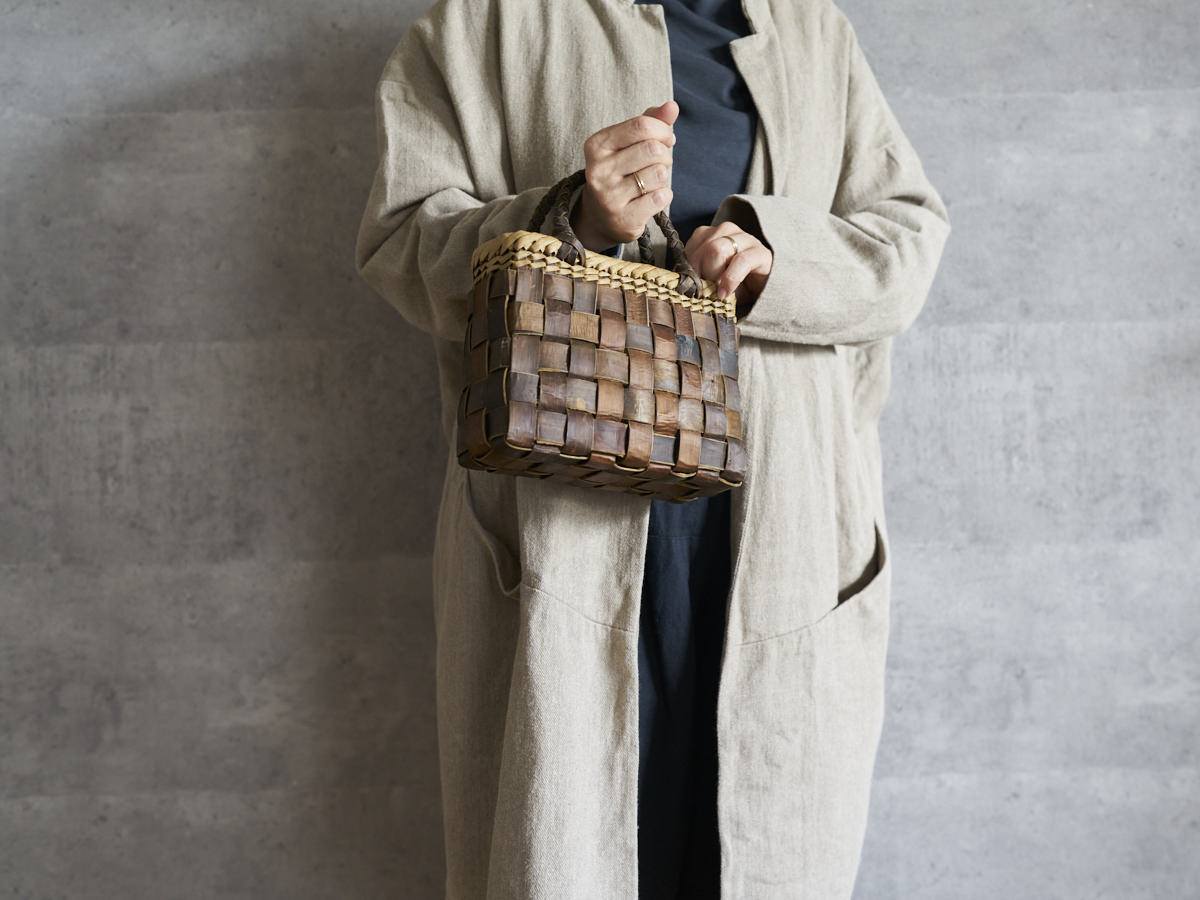
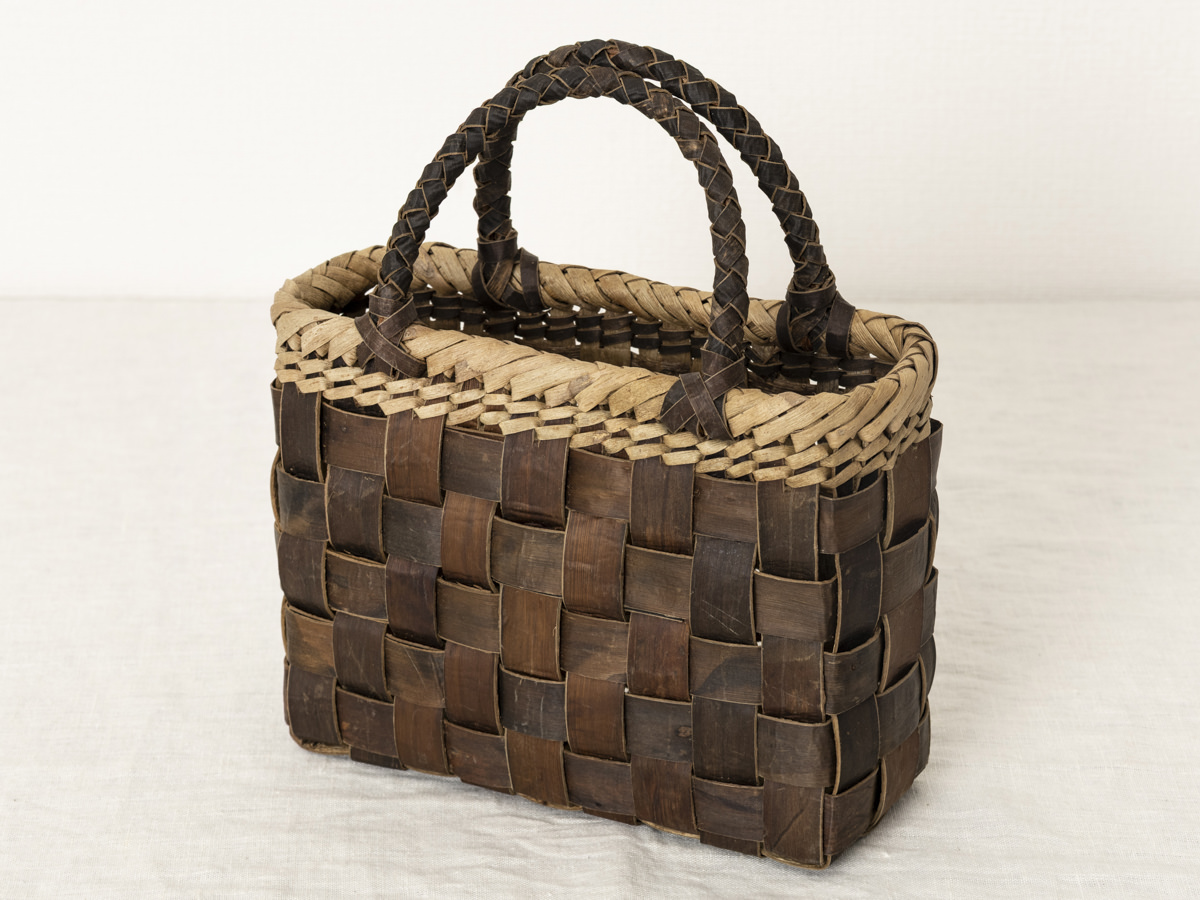
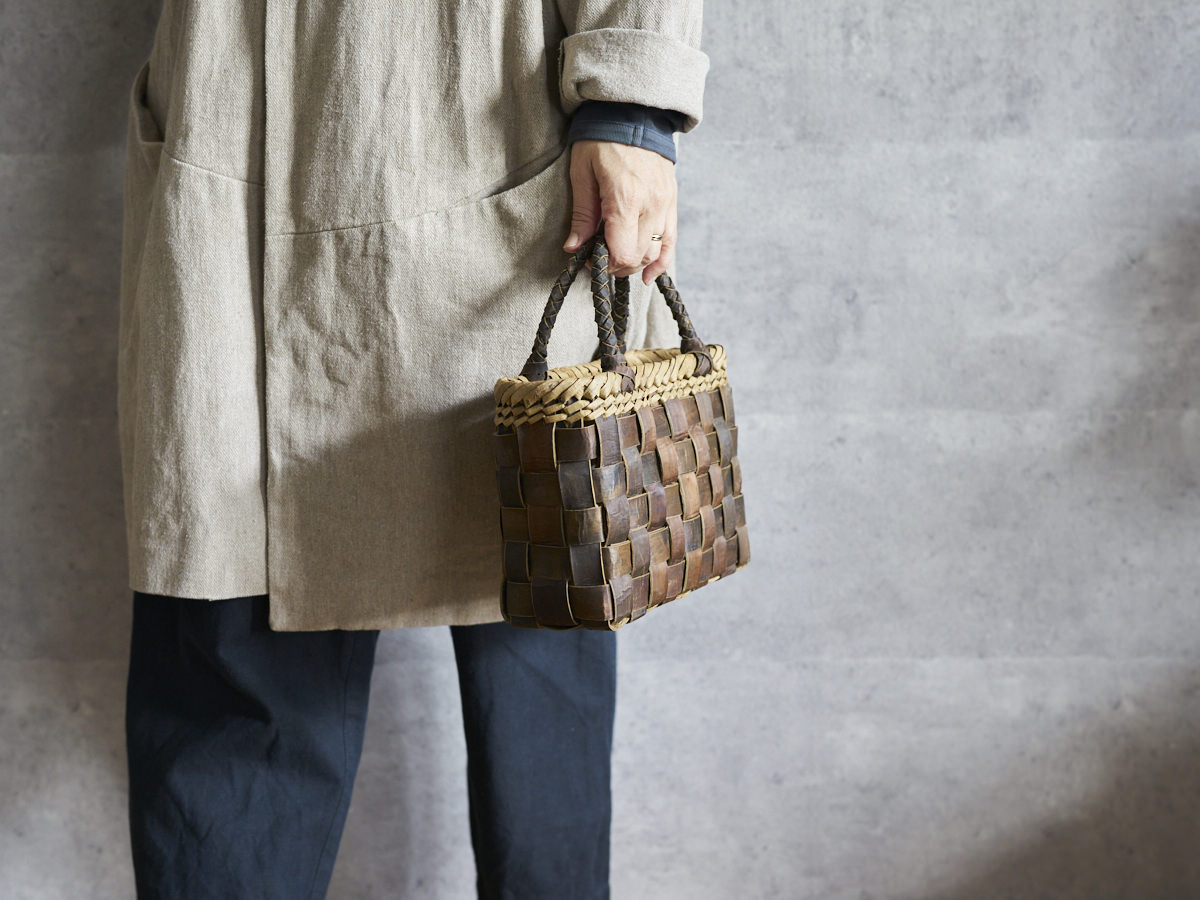
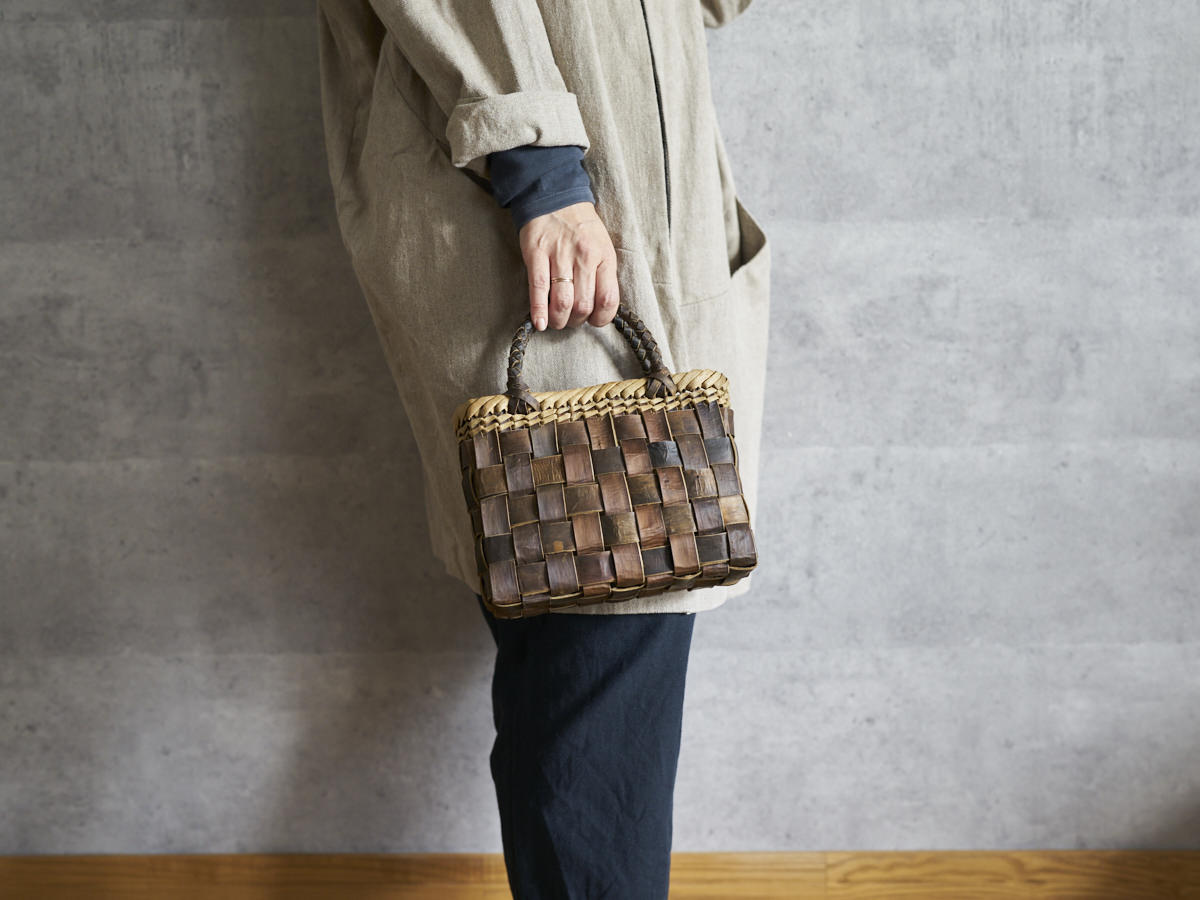
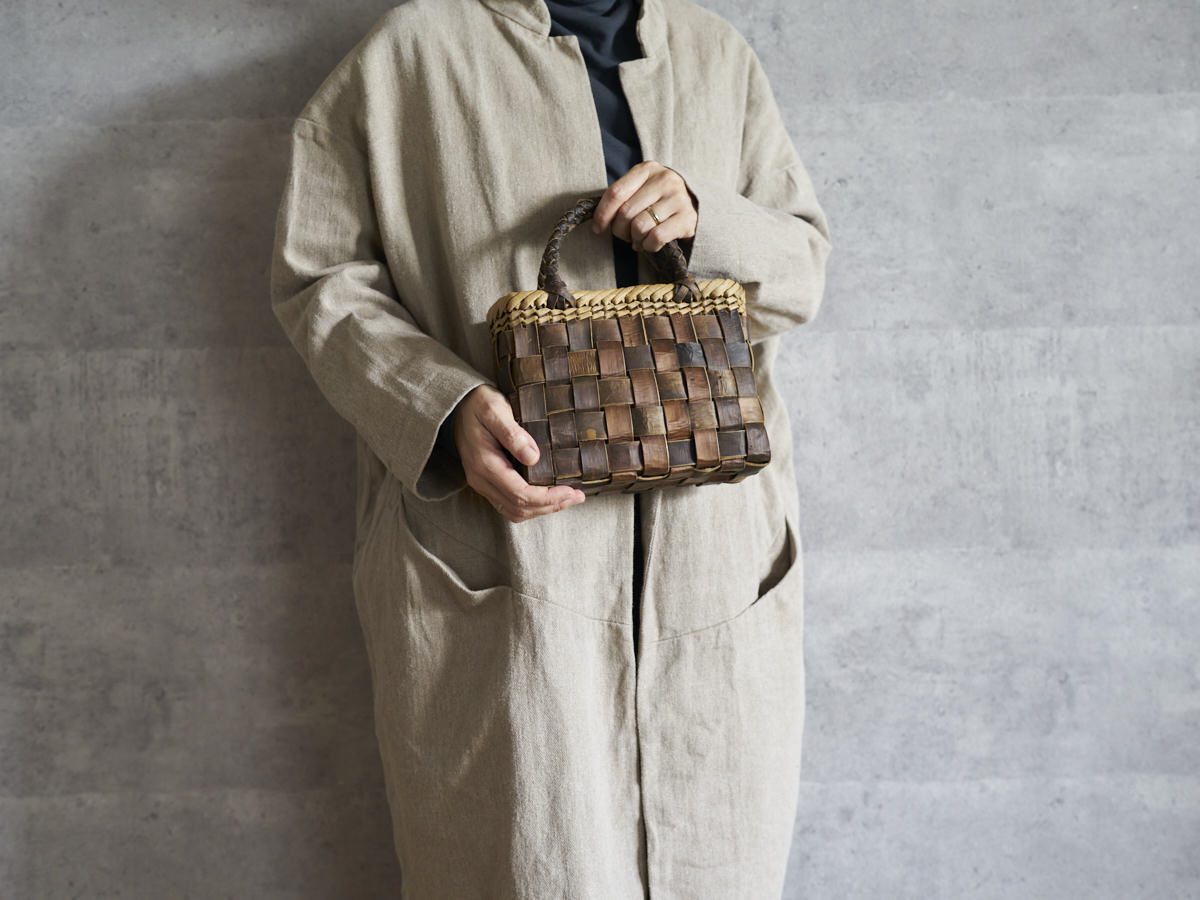
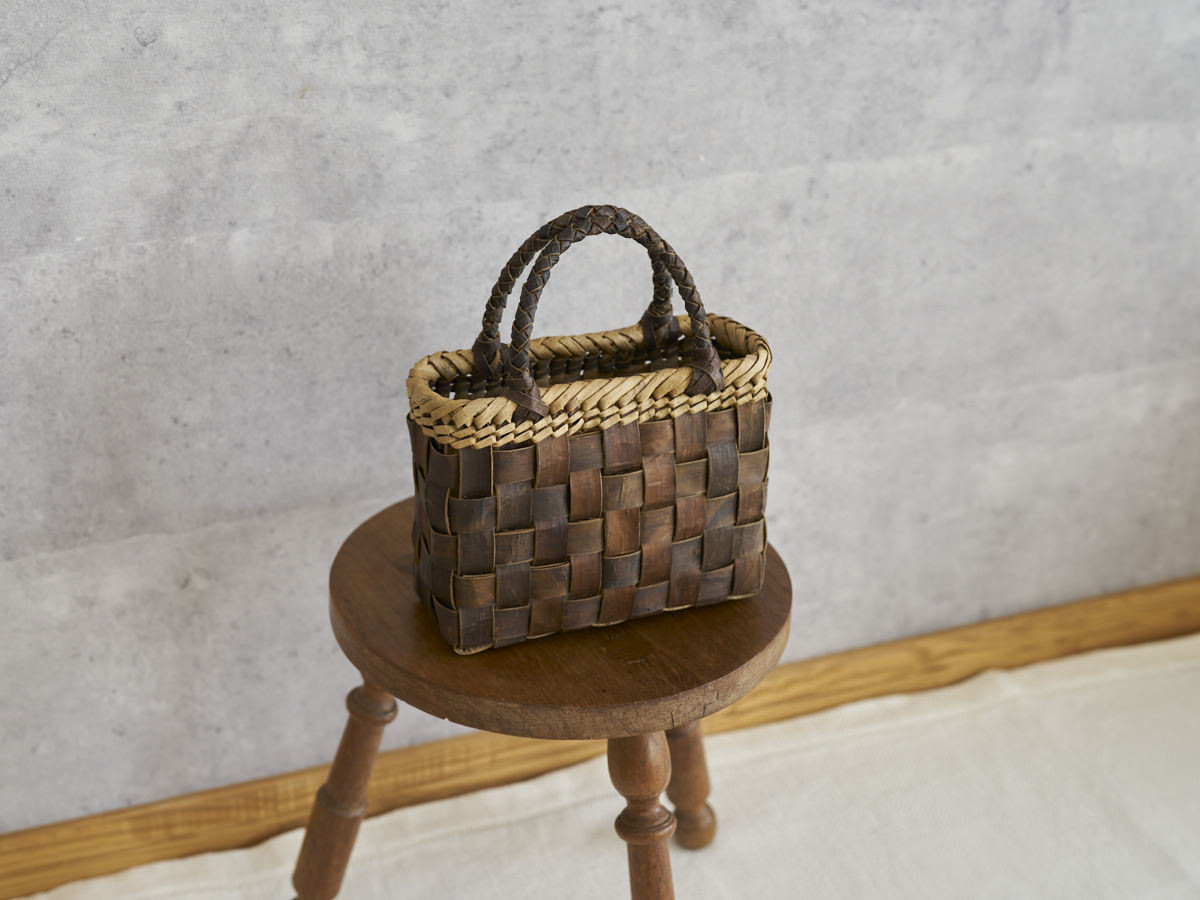
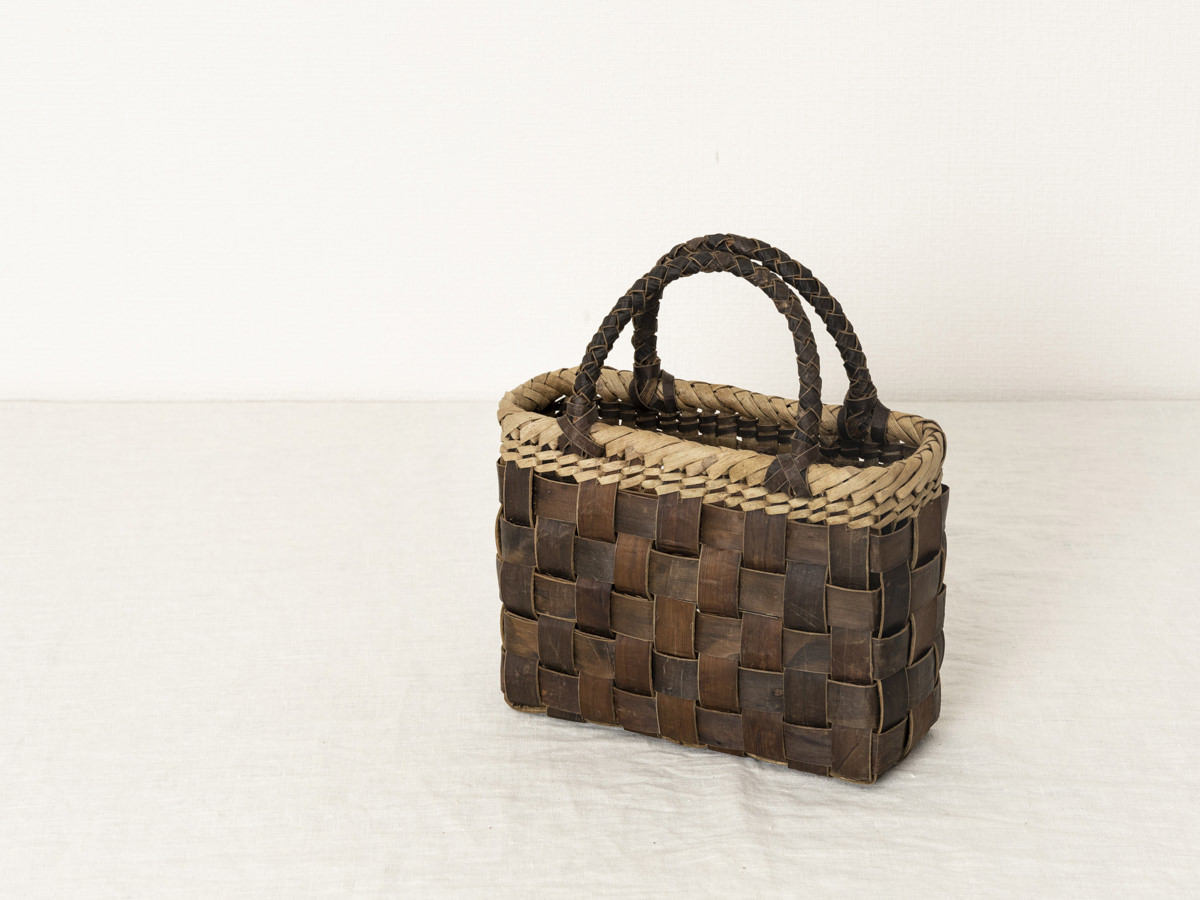
This handheld basket is woven using the bark of sawagurumi (Japanese walnut).
The bark of walnut trees is harvested at its peak from spring through the rainy season, when the material is rich with moisture.
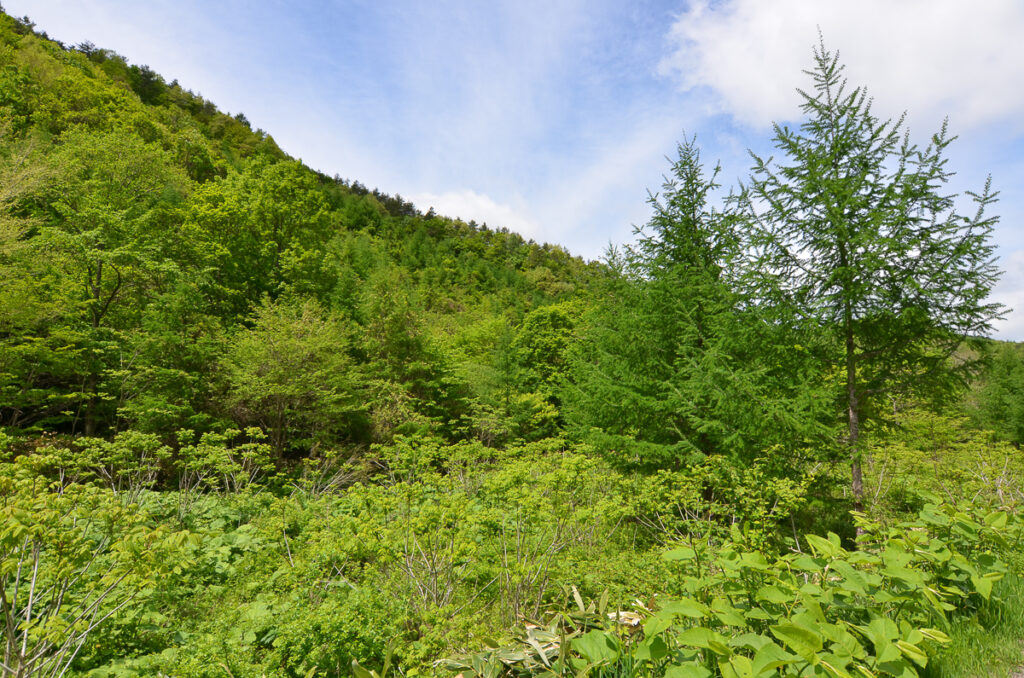
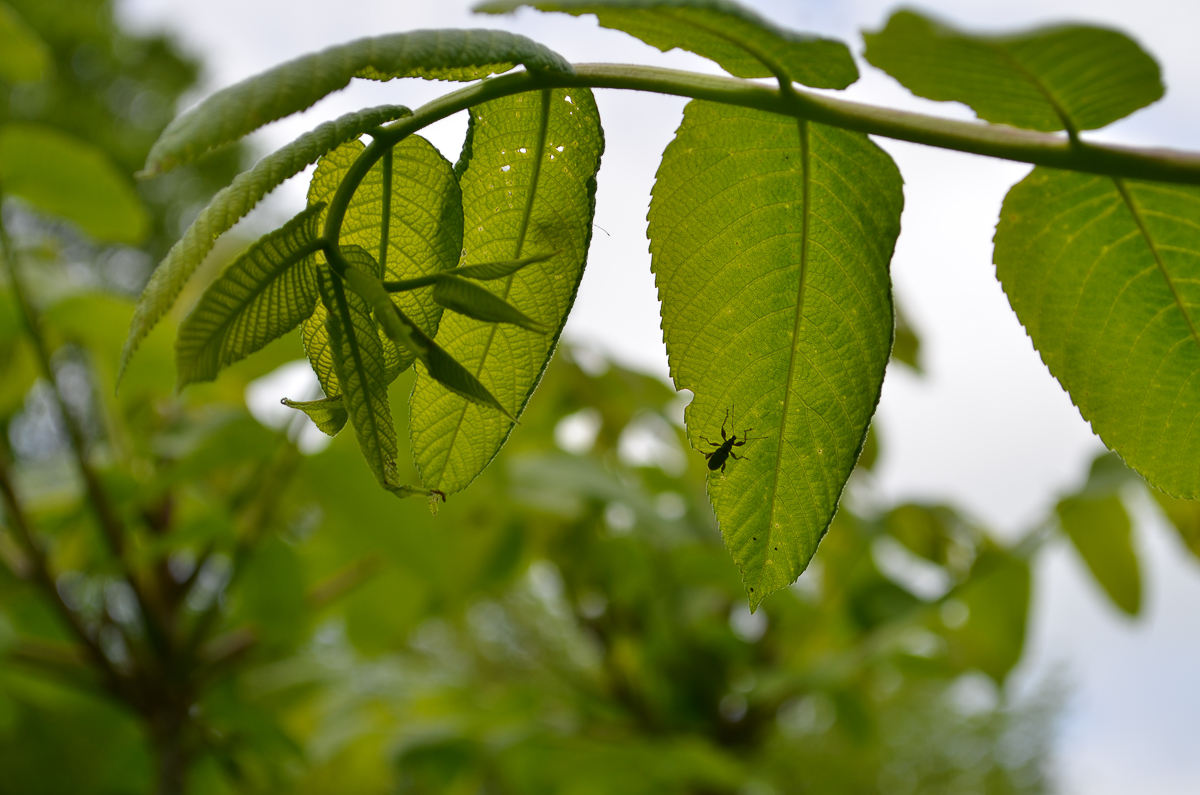
Sawagurumi, as its name suggests, is a species of walnut that grows naturally along mountain streams and shallow valleys.
Unlike yamagurumi, which grows in the mountains, the nuts of sawagurumi are not used for food. Instead, the tree has the characteristic of letting its seeds travel downstream, carried away by the flow of nearby streams.
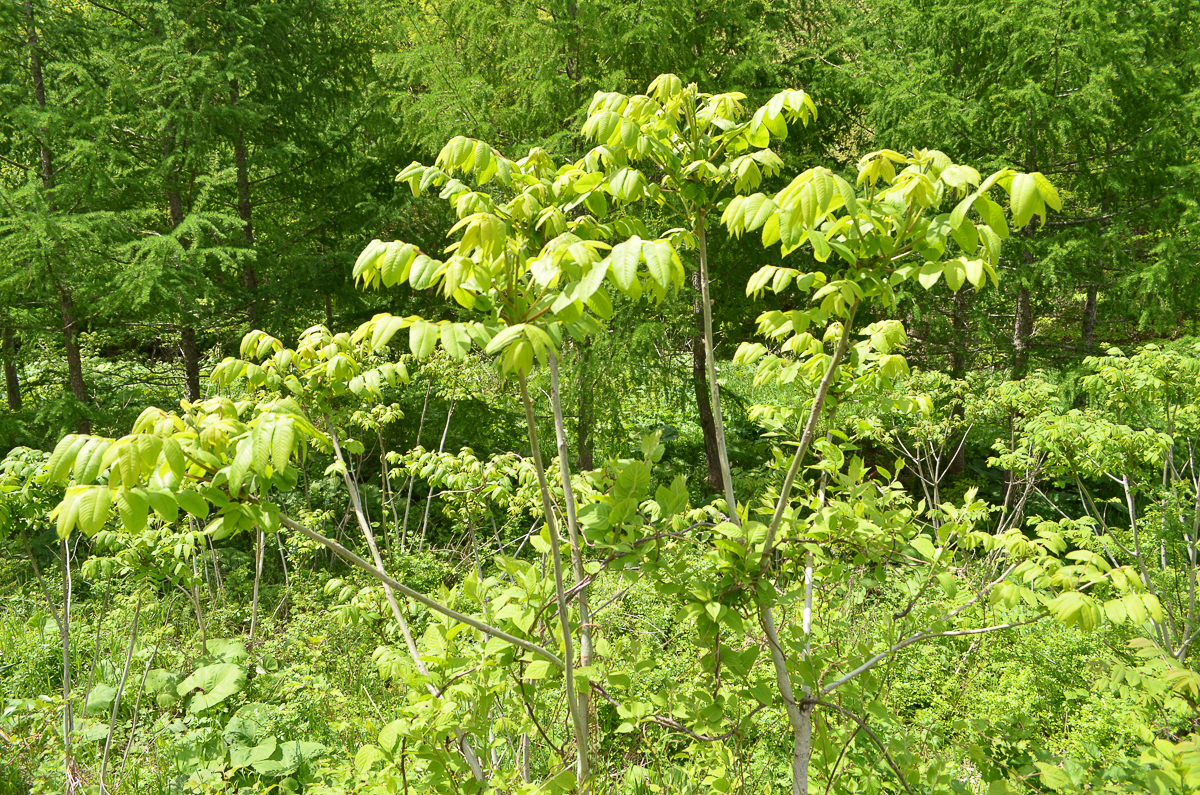
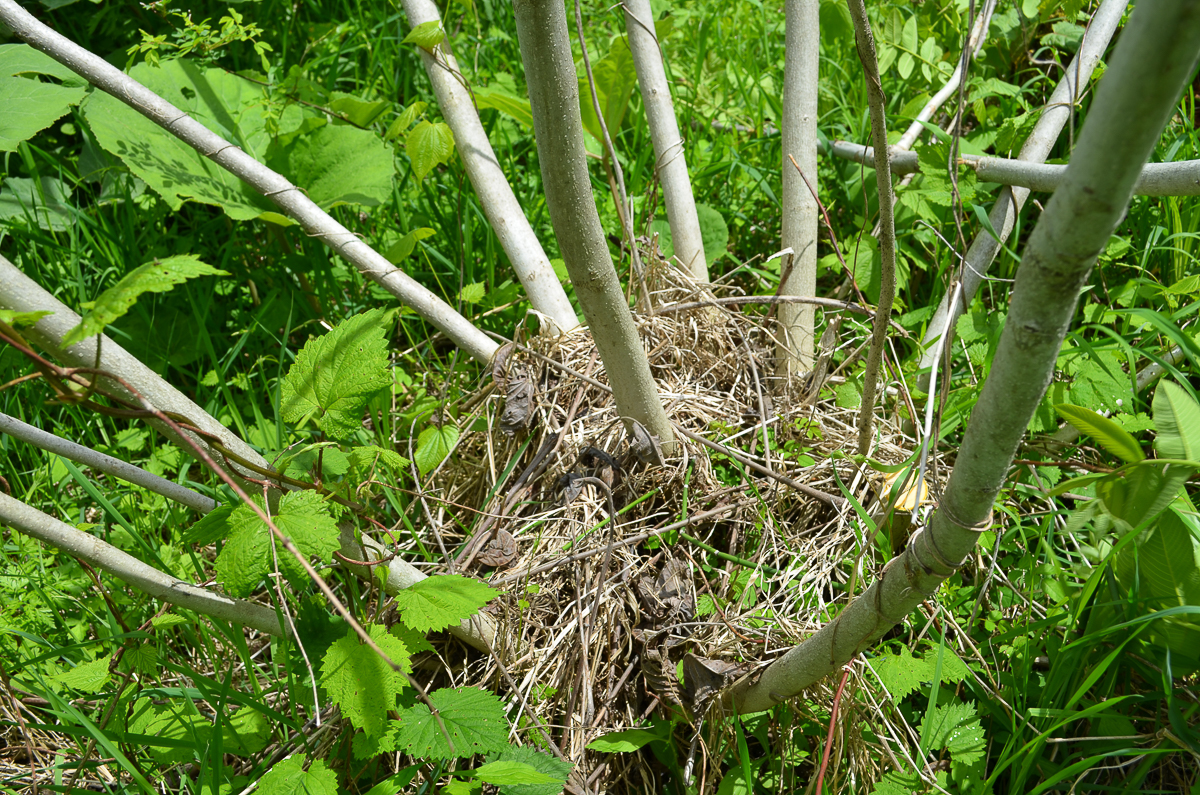
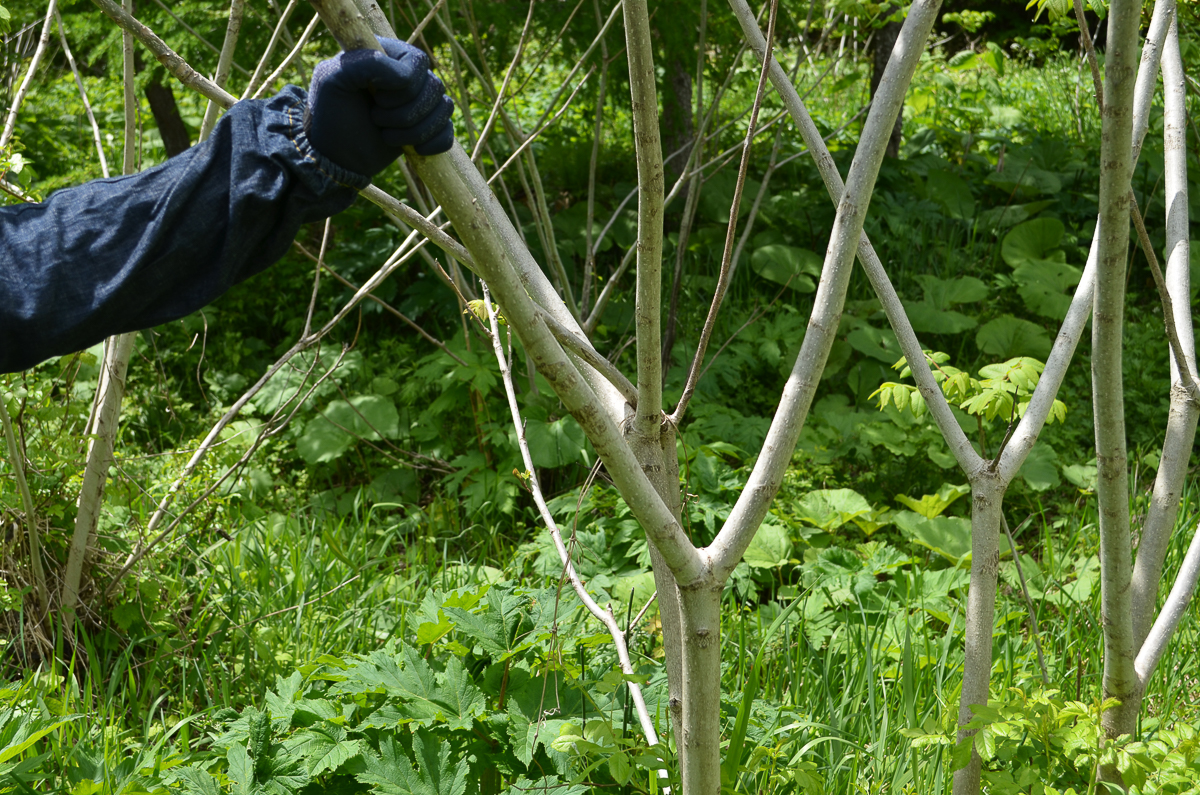
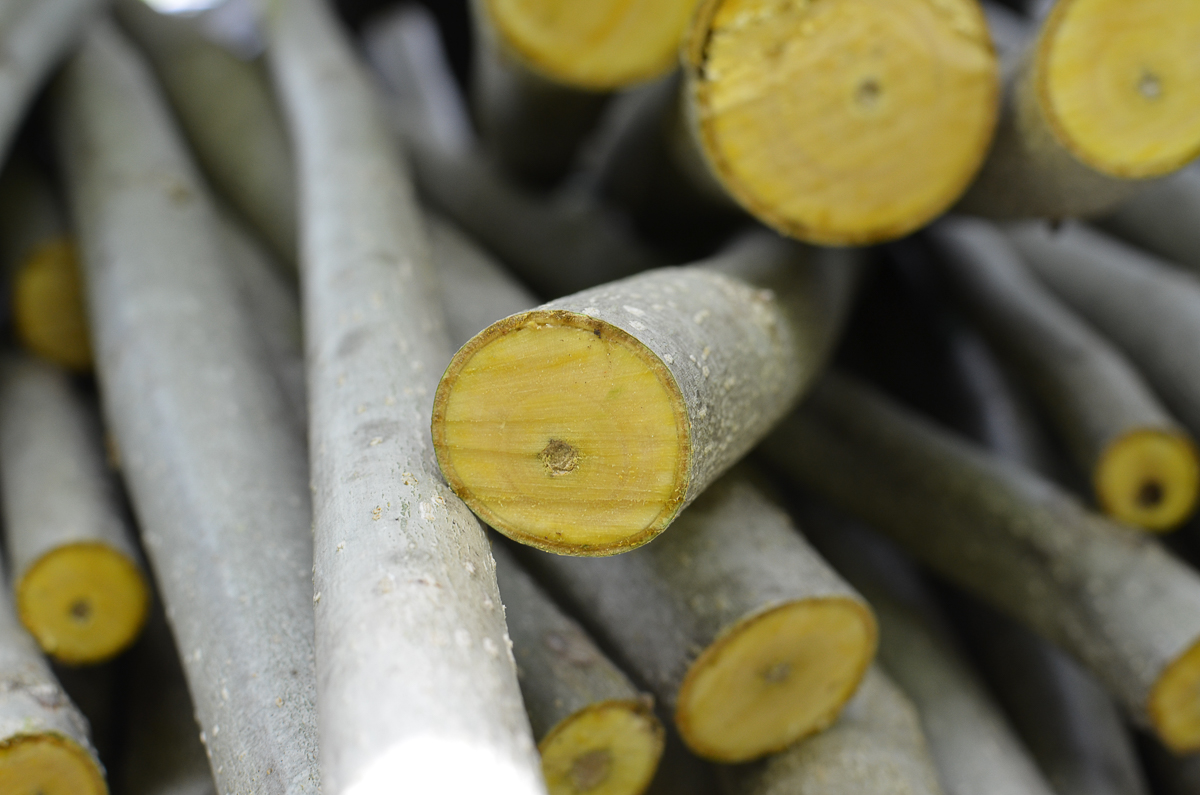
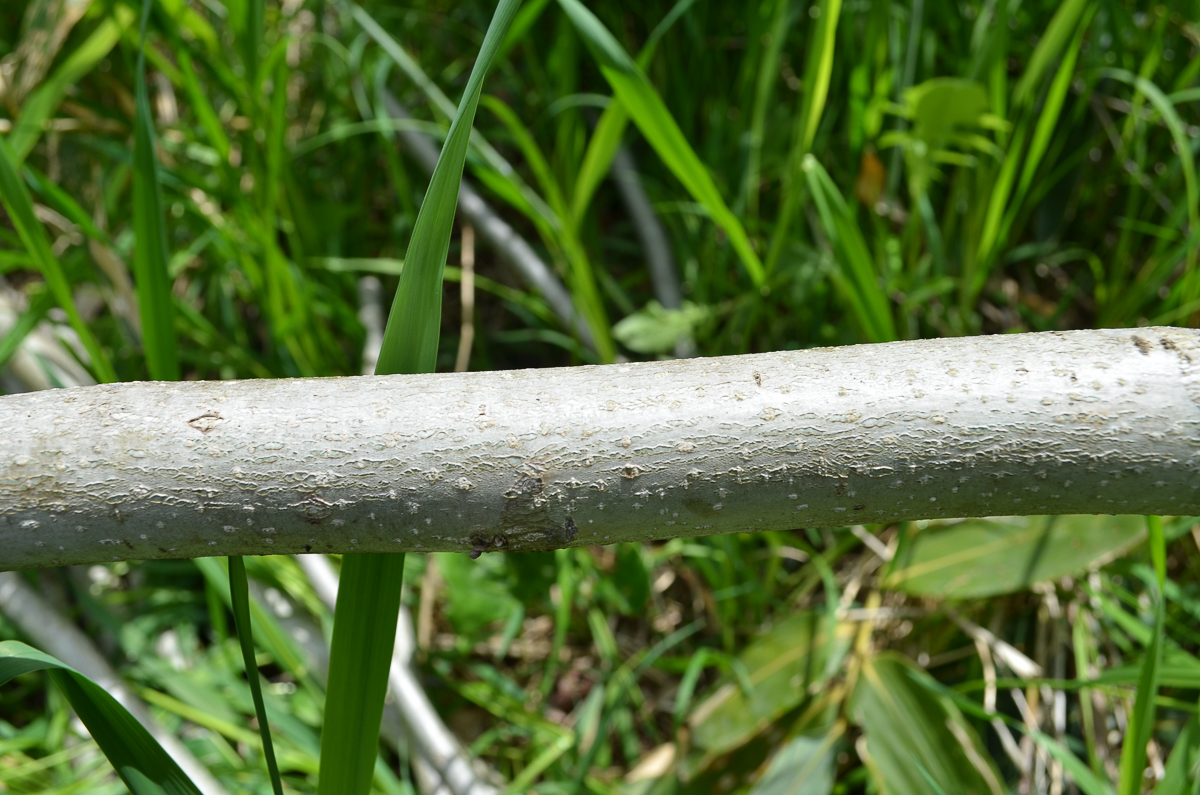
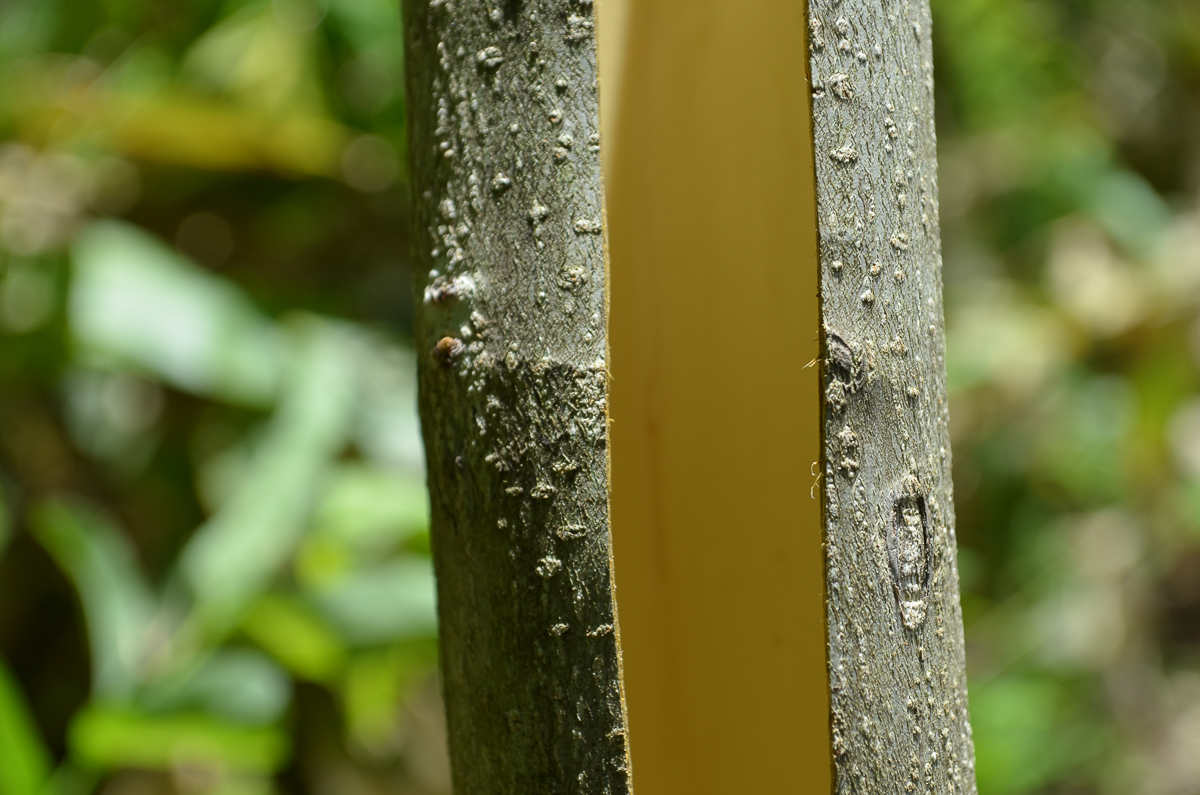
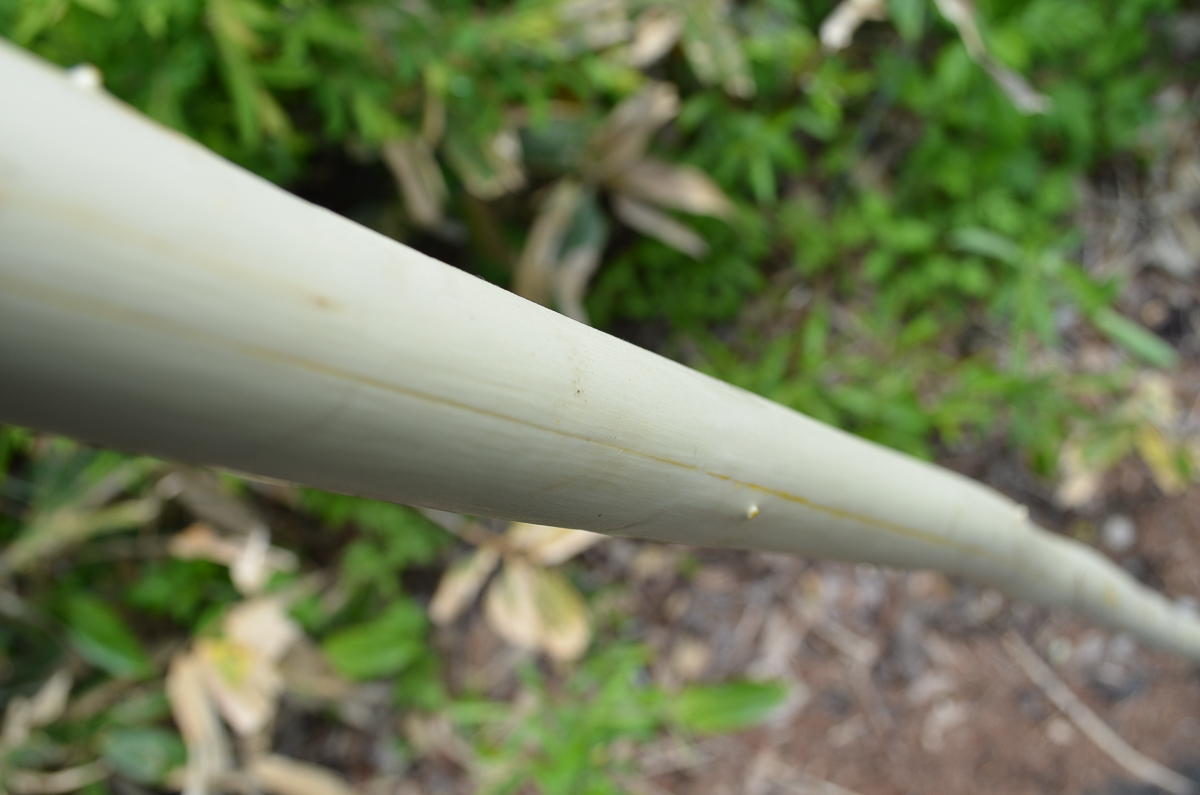
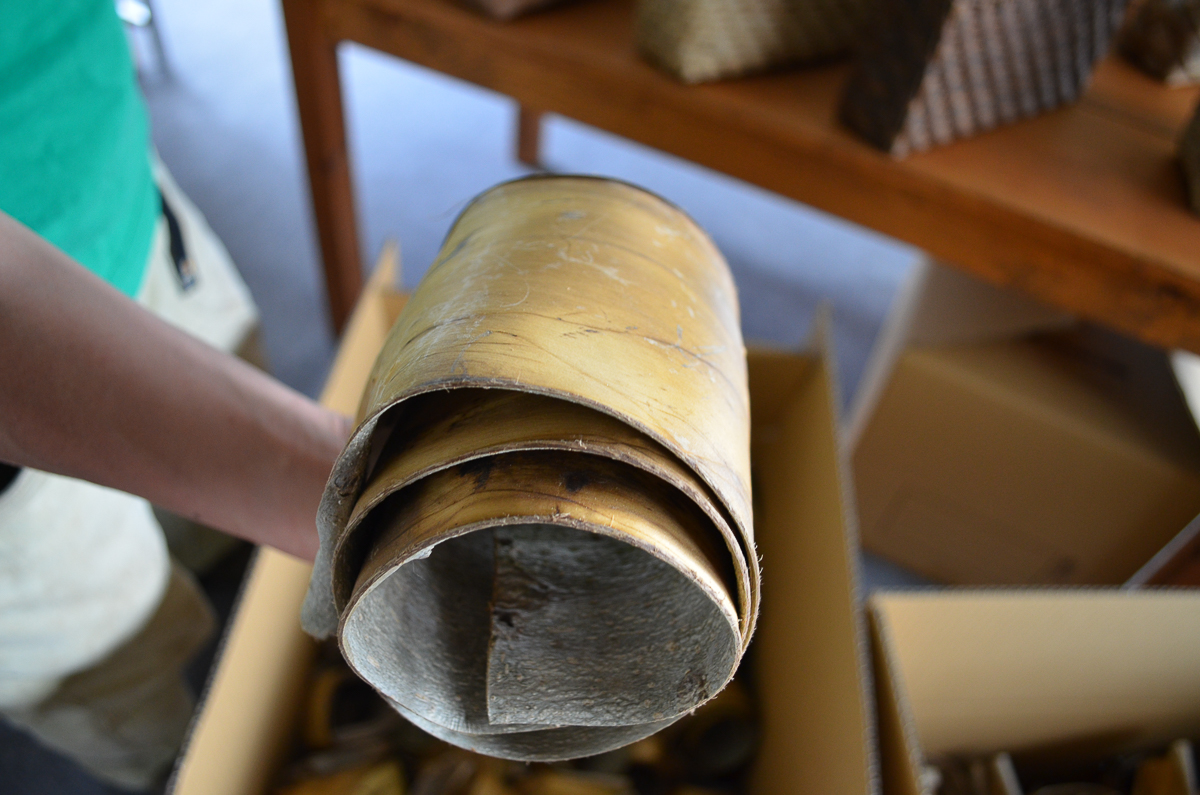
For basketry, young trees that are two to three years old are used.Sawagurumi grows in clusters like this, sprouting multiple stems from the base.Further up, the stems branch out in this way.Not all of the clustered stems are cut; only two or three are selected and harvested.Freshly cut stems glisten with a silvery sheen when touched by the sunlight.A small cut is made in the bark of the freshly cut stem, and the bark is peeled away from the core. This is the sawagurumi bark right after peeling. The inner surface begins as a fresh, creamy color, but over time it deepens into a rich, dark brown.The core left after peeling is returned to the mountains. After about a year, it breaks down into a soft, crumbly state, preparing to return to the soil.This bark has been left for some time after peeling. The inner layer visible on the surface has begun to take on a warm brown tone, and its color will continue to deepen as it ages.
Here, we would like to introduce a handheld basket crafted from walnut bark.
This handheld basket is part of the maker’s “tiny” series — the slimmest, most compact style among their creations. Crafted mainly with the deep, cocoa-brown inner bark, it has a quietly sophisticated, tasteful finish.
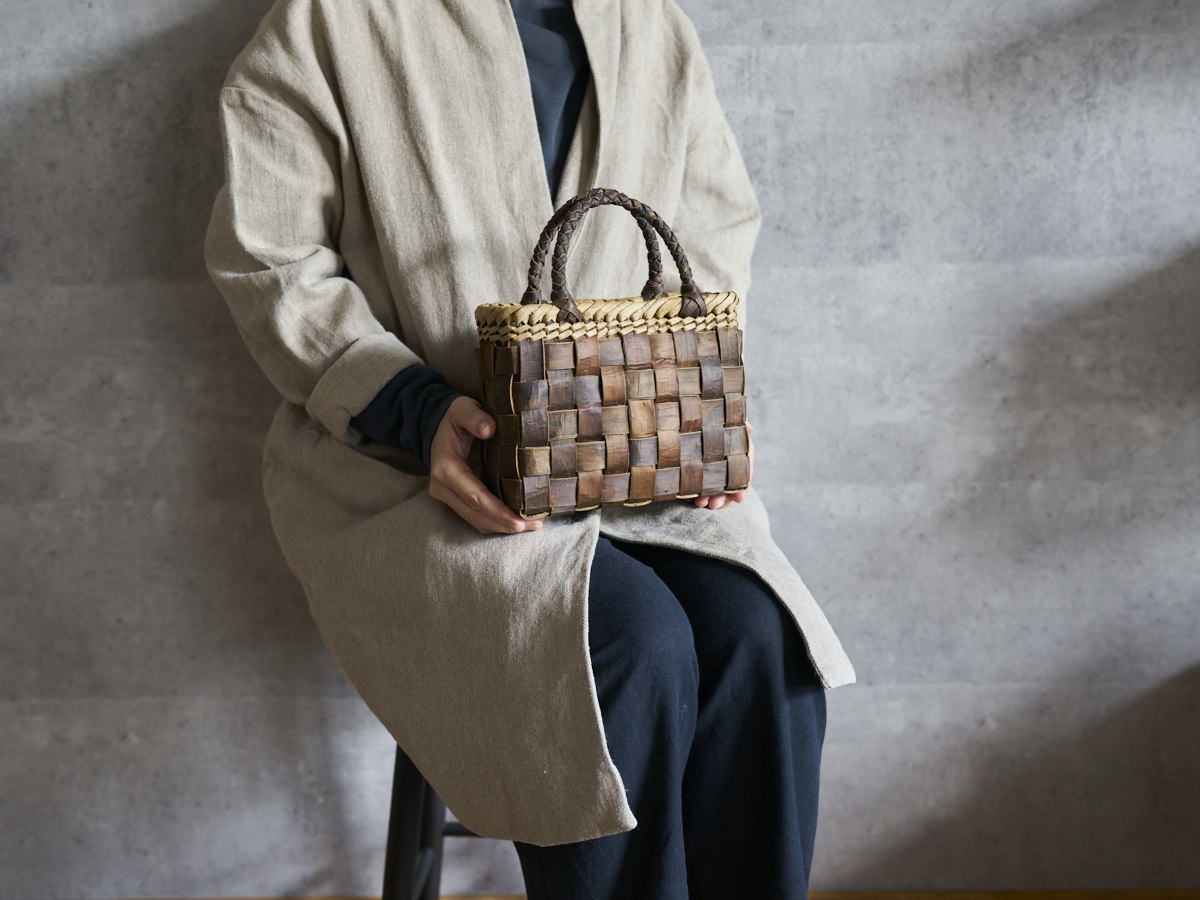
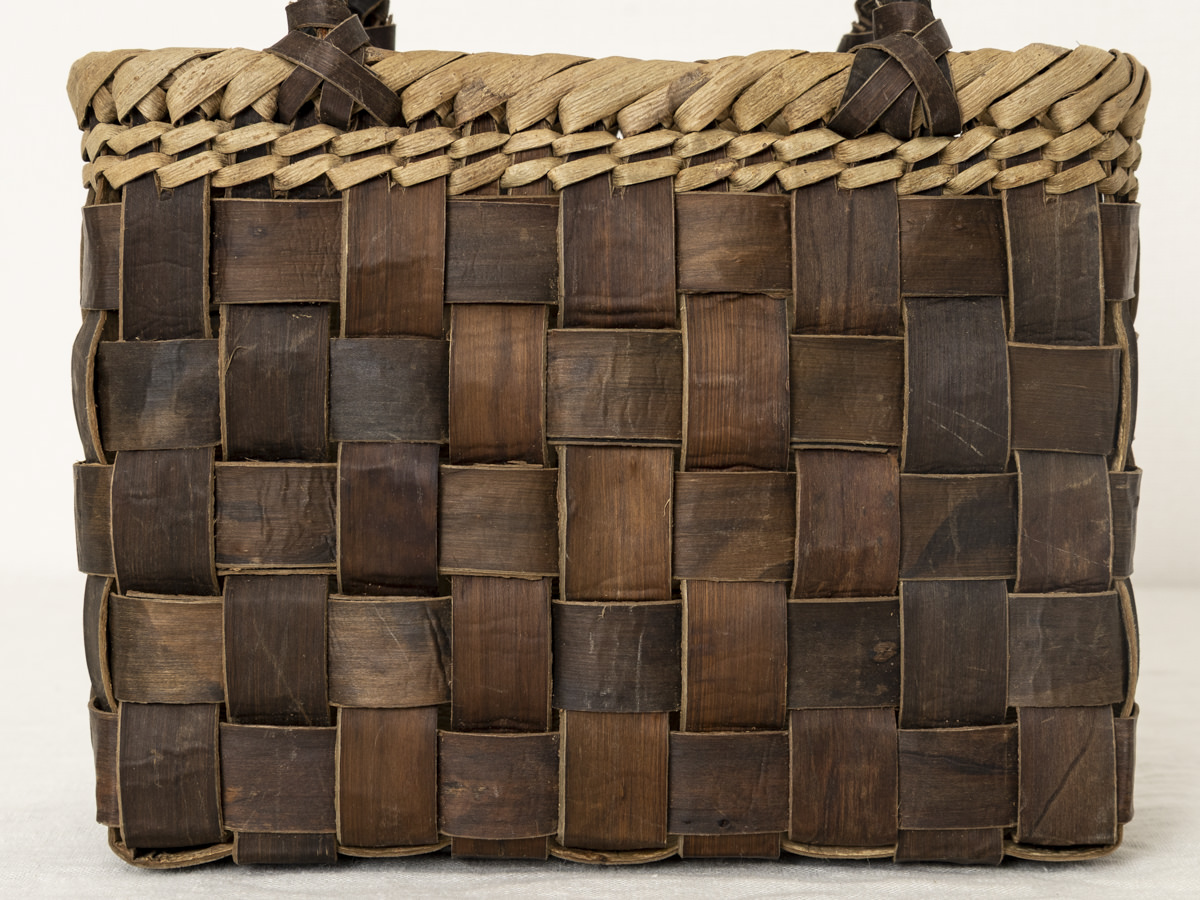
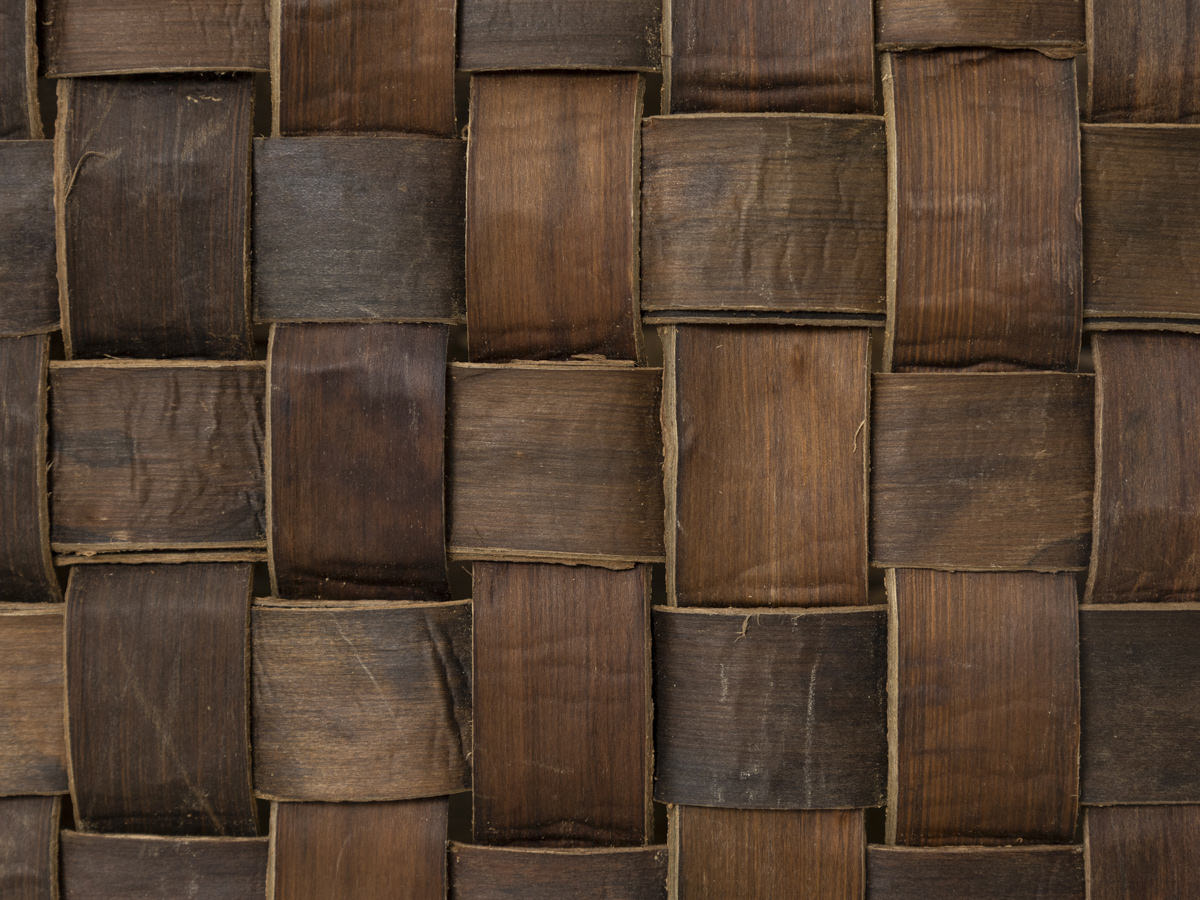
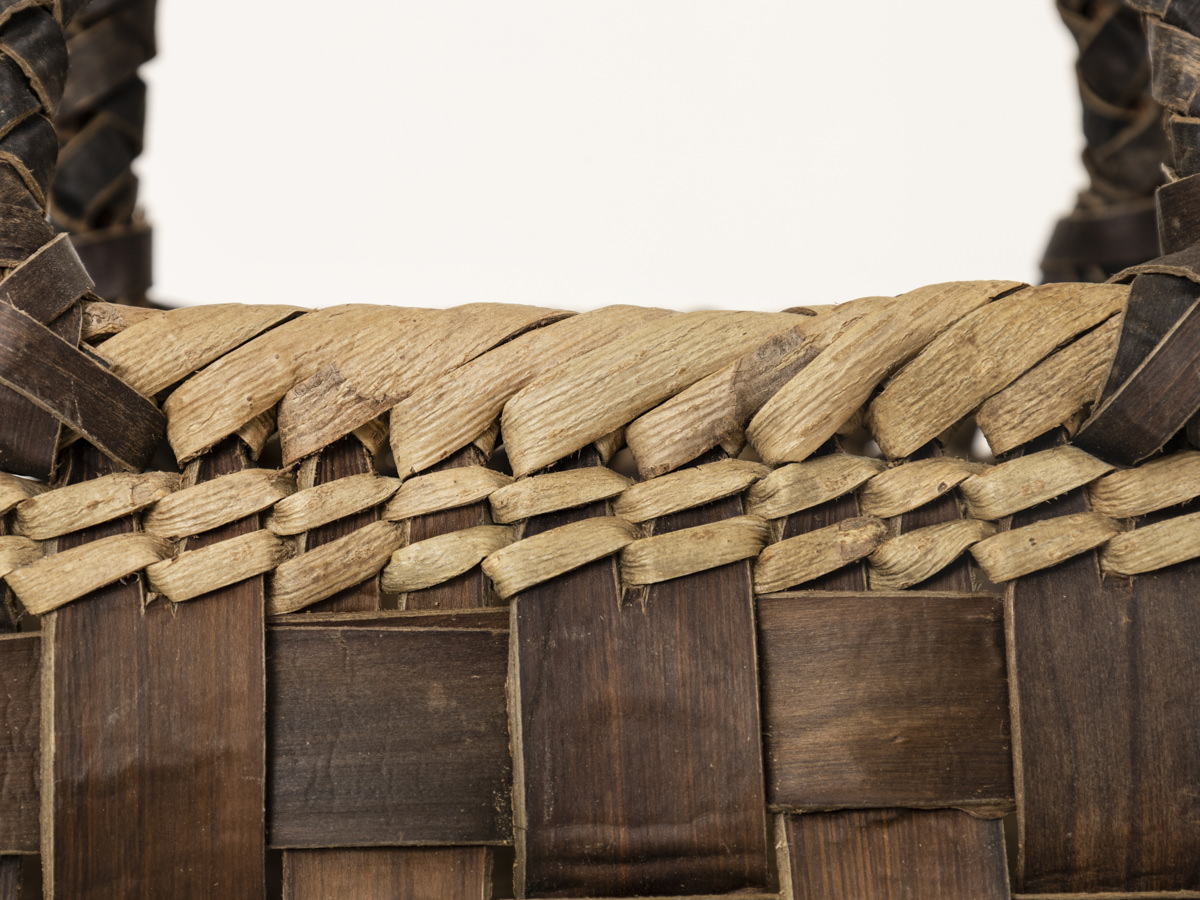
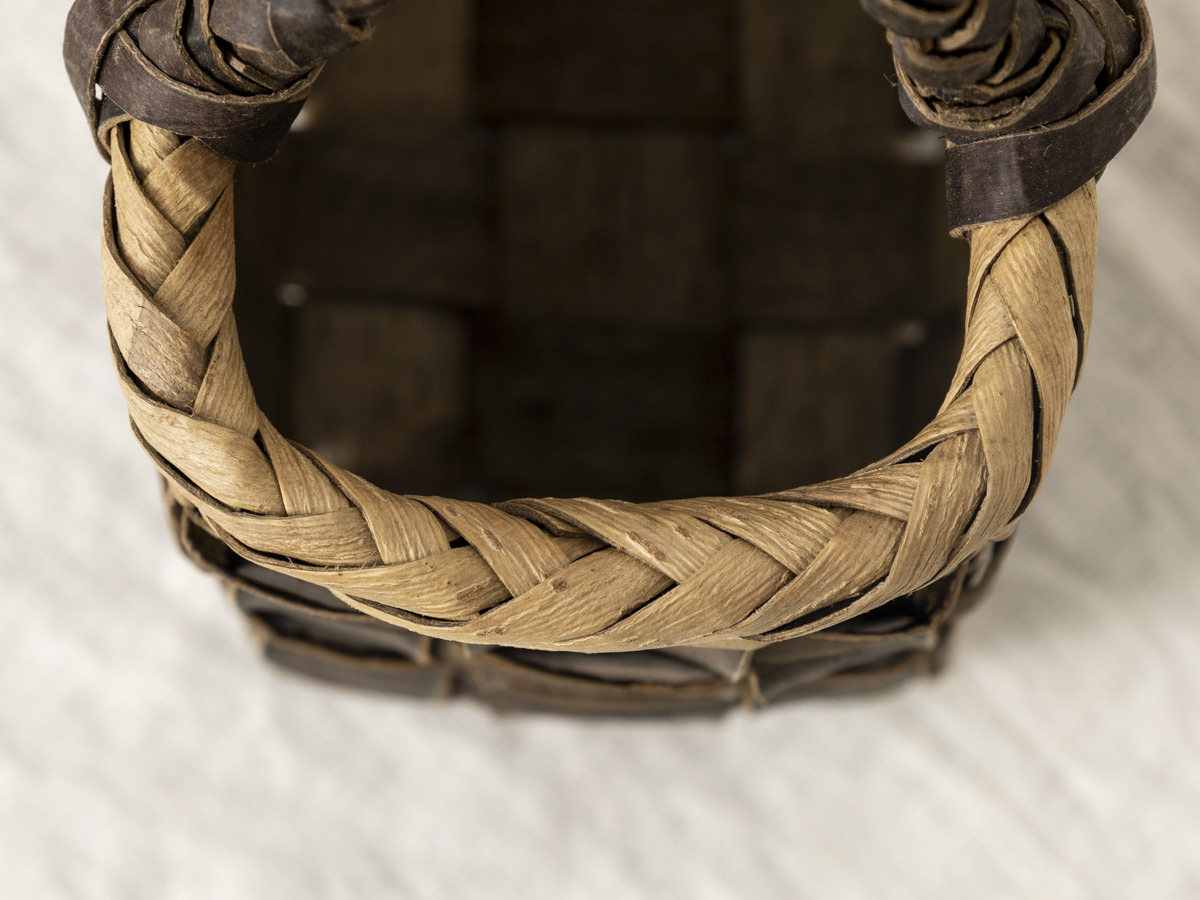
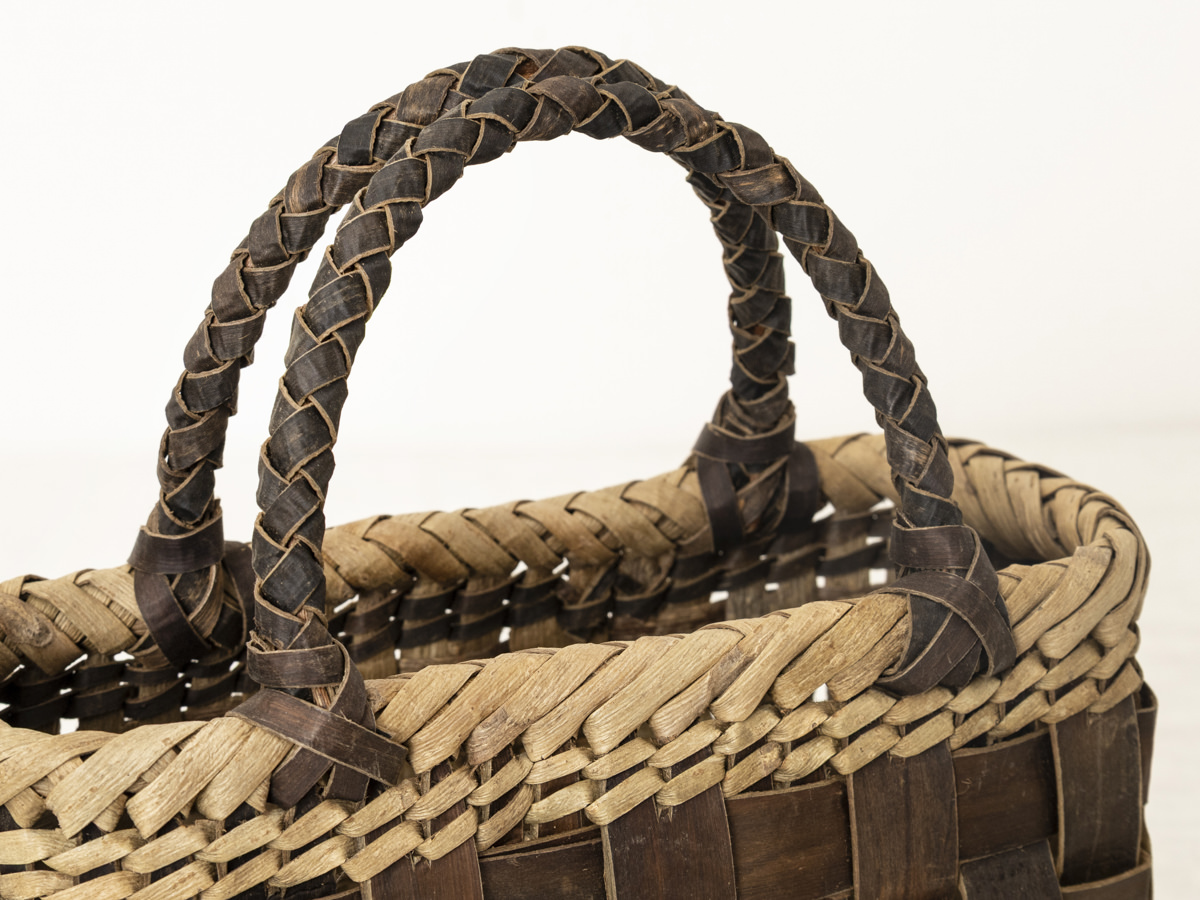
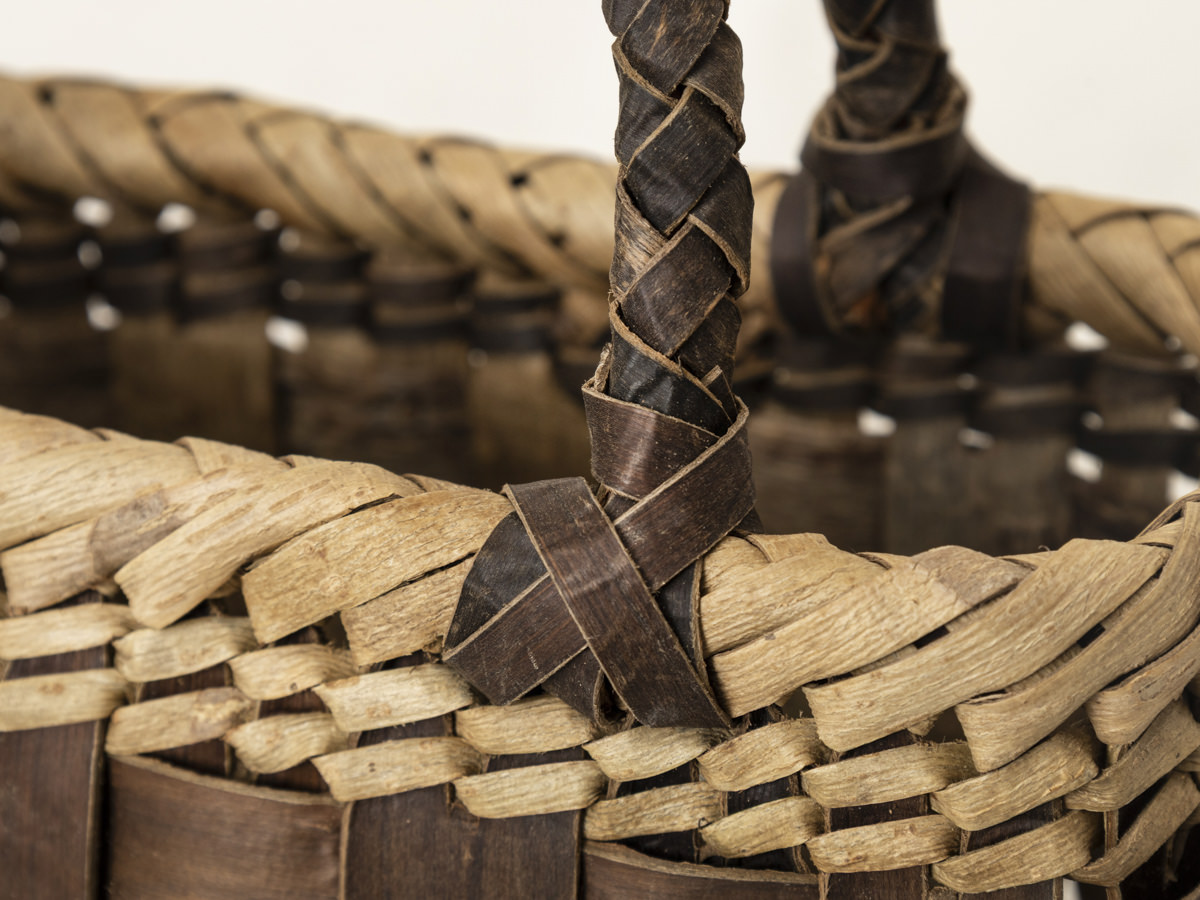
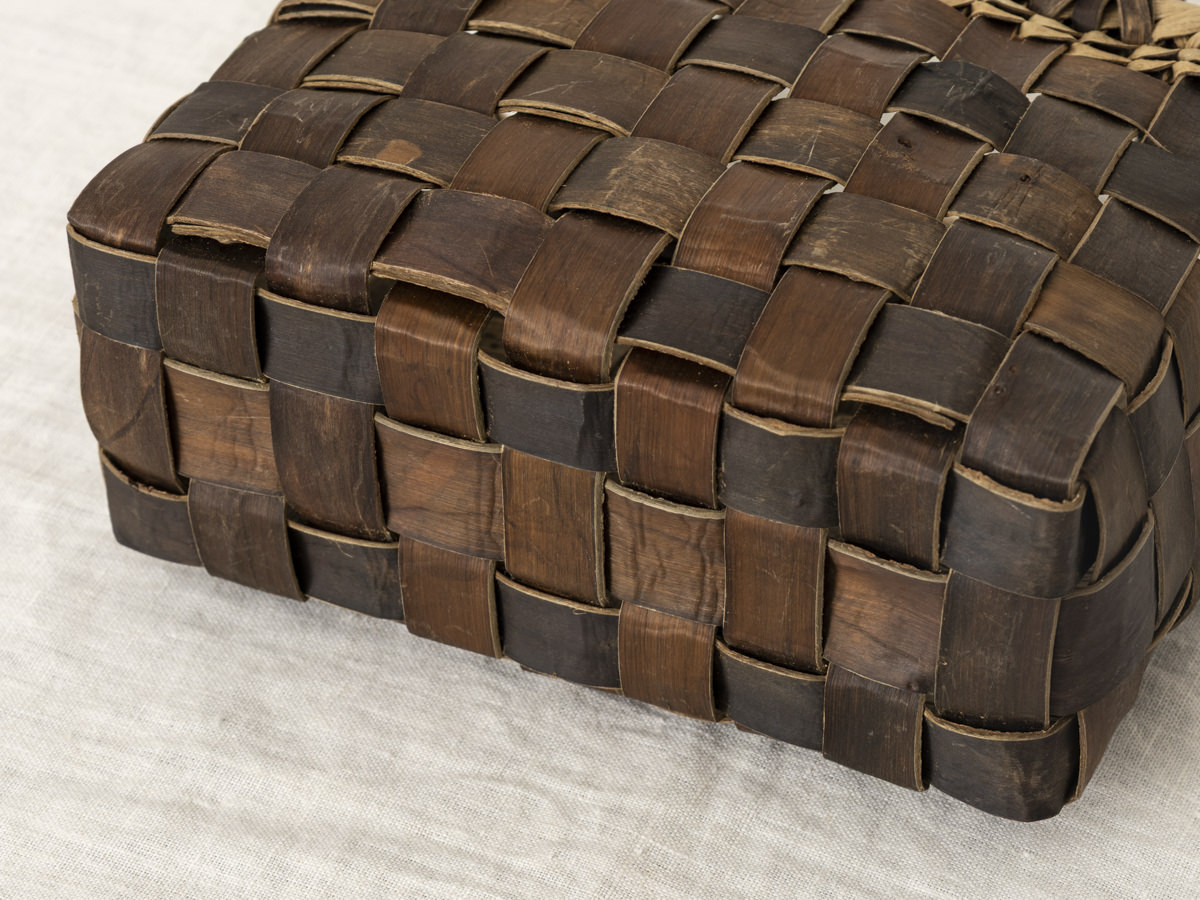
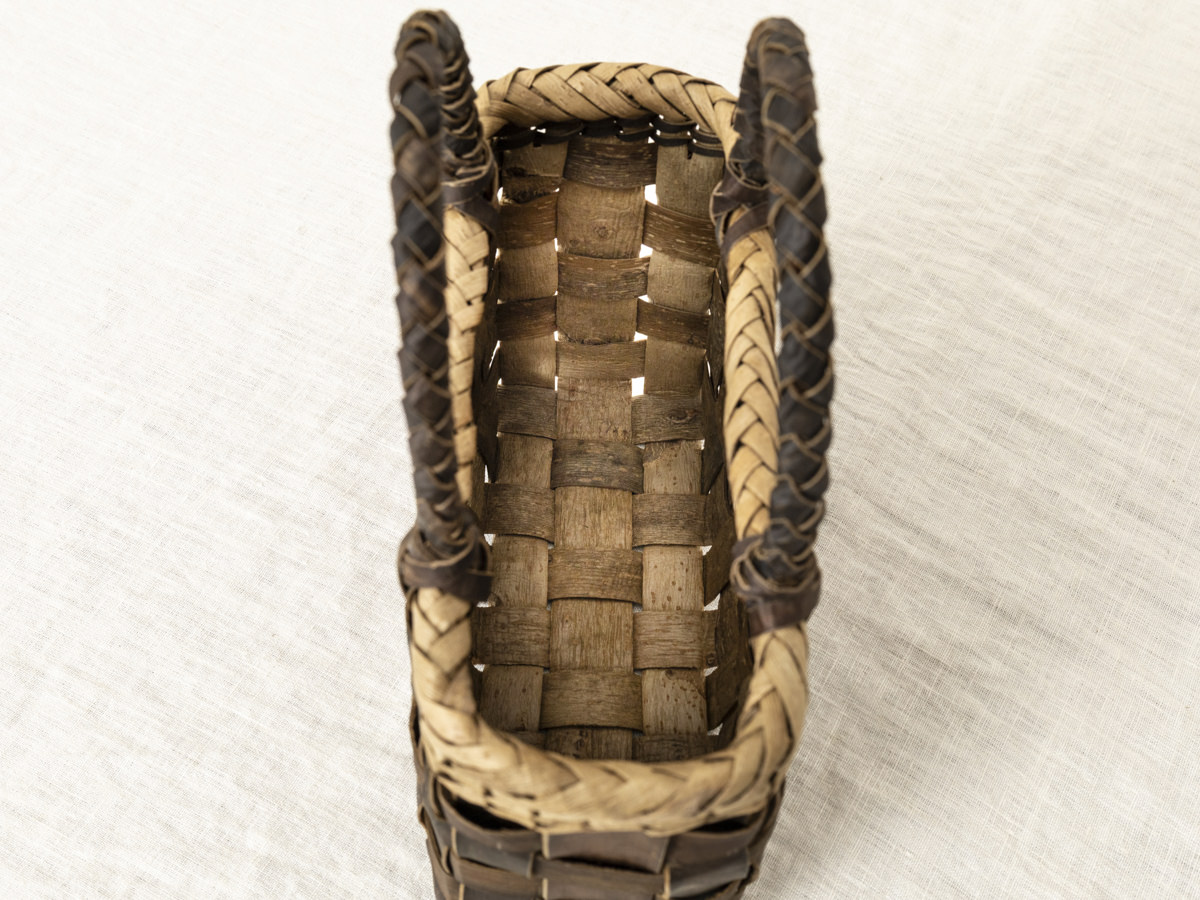
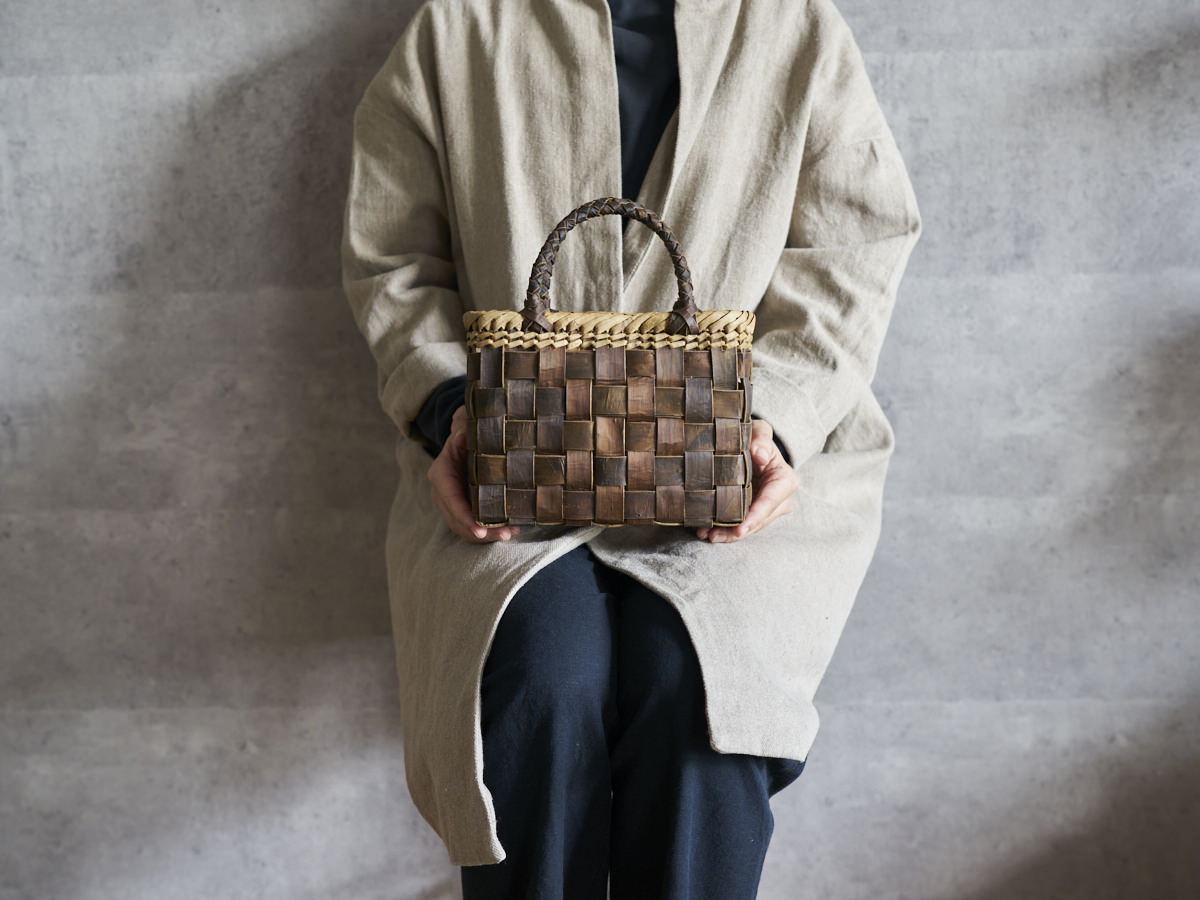
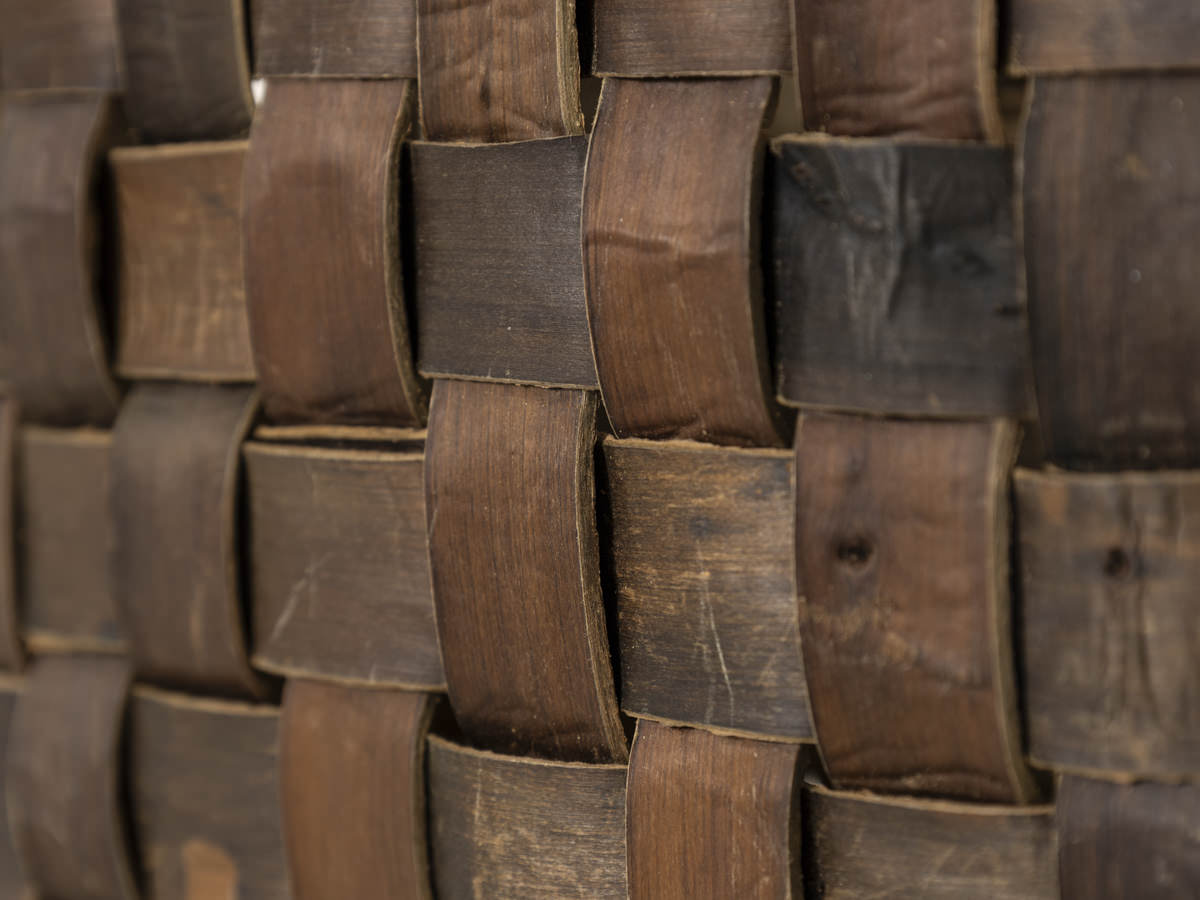
It is woven so that the dark, cocoa-brown inner bark of walnut forms the exterior. The entire basket is constructed in a simple plain weave, with the strips interlaced vertically and horizontally.Its broad walnut inner-bark strips create a surface with a rich, tactile character, allowing you to fully appreciate the natural feel of the material.Just below the rim, two rows of outer-bark stitching run around the basket.This is the view of the rim from above. The rim is woven so that the pale outer bark is visible, giving the piece a quietly refined finish. The weaving is secured firmly from both the outside and the inside.Just below the rim, two rows of outer-bark stitching run around the basket.Akebi vine is used as the core inside the handle. The core is wrapped with walnut bark and then securely attached to the body of the basket.This is the bottom of the basket. It is woven in a plain weave, creating a firm and sturdy finish.Inside the basket, the color arrangement appears as the reverse of the outside. When you look inside during everyday use, the pale outer bark spreads softly across the interior. In the tiny series, the gusset is slimmer, giving it an especially compact profile.It is sized to hold your minimal essentials—such as a wallet, a small pouch, a mobile phone, and a key case.For added privacy, you can place a favorite scarf or handkerchief over your belongings. Thanks to the lighter tones, brightly colored fabrics pair beautifully with it.Among walnut-bark baskets, this piece is remarkably lightweight — so light that you can carry it all day with hardly any sense of fatigue.Its compact size makes it easy to use even on trains, buses, or in crowded areas without worry.
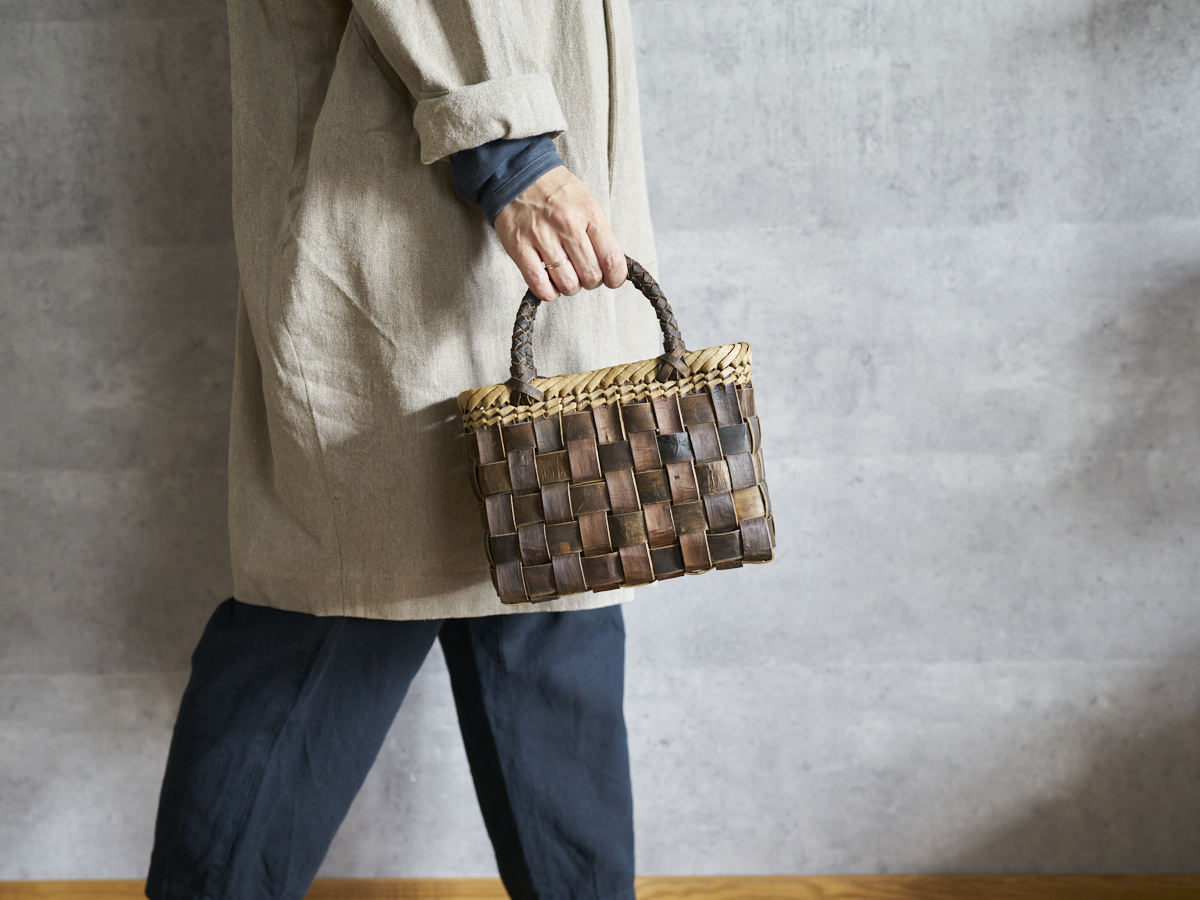
In autumn and winter, and even on chilly spring mornings and evenings, it pairs beautifully with a stole or muffler. This sawagurumi basket is one you can enjoy throughout the year.
The materials are carefully prepared, so there is no roughness — the surface feels smooth, clean, and pleasantly light to the touch.
Each walnut-bark strip has its own subtle tone and texture, and together they give the basket a sense of depth and character.
Bring the basket close and you can enjoy the rich, natural aroma of walnut. And the more you gently run your hand over the surface, the more luster the basket develops as it absorbs the natural oils from your skin.
With the lighter tones of the outer bark appearing along the rim and just beneath it, the basket takes on a bright and uplifting look. Though compact in size, the wide walnut strips give it a strong and confident presence.
This tiny-style handheld basket is one that seems to make everyday use a little more enjoyable. We hope you will begin using it casually and make it part of your daily routines.
Original and uniquely crafted barkwork from Iwate.
In this region blessed with abundant nature, these artisans create their work using materials such as walnut bark and wild grapevine.
Their pieces are rich in variety—both in design and in proportion—and always bring a sense of delight when we encounter them.
They walk the mountains of Iwate themselves, selecting and harvesting only the finest materials. The care they put into preparing each piece of bark, and the time they devote before the weaving even begins, set their work apart. From their distinctive approach to design to the way each basket is brought to life, their craft is truly unlike any other.
This handheld basket is woven using the bark of sawagurumi (Japanese walnut).
The bark of walnut trees is harvested at its peak from spring through the rainy season, when the material is rich with moisture.
Sawagurumi, as its name suggests, is a species of walnut that grows naturally along mountain streams and shallow valleys.
Unlike yamagurumi, which grows in the mountains, the nuts of sawagurumi are not used for food. Instead, the tree has the characteristic of letting its seeds travel downstream, carried away by the flow of nearby streams.
For basketry, young trees that are two to three years old are used.Sawagurumi grows in clusters like this, sprouting multiple stems from the base.Further up, the stems branch out in this way.Not all of the clustered stems are cut; only two or three are selected and harvested.Freshly cut stems glisten with a silvery sheen when touched by the sunlight.A small cut is made in the bark of the freshly cut stem, and the bark is peeled away from the core. This is the sawagurumi bark right after peeling. The inner surface begins as a fresh, creamy color, but over time it deepens into a rich, dark brown.The core left after peeling is returned to the mountains. After about a year, it breaks down into a soft, crumbly state, preparing to return to the soil.This bark has been left for some time after peeling. The inner layer visible on the surface has begun to take on a warm brown tone, and its color will continue to deepen as it ages.
Here, we would like to introduce a handheld basket crafted from walnut bark.
This handheld basket is part of the maker’s “tiny” series — the slimmest, most compact style among their creations. Crafted mainly with the deep, cocoa-brown inner bark, it has a quietly sophisticated, tasteful finish.
It is woven so that the dark, cocoa-brown inner bark of walnut forms the exterior. The entire basket is constructed in a simple plain weave, with the strips interlaced vertically and horizontally.Its broad walnut inner-bark strips create a surface with a rich, tactile character, allowing you to fully appreciate the natural feel of the material.Just below the rim, two rows of outer-bark stitching run around the basket.This is the view of the rim from above. The rim is woven so that the pale outer bark is visible, giving the piece a quietly refined finish. The weaving is secured firmly from both the outside and the inside.Just below the rim, two rows of outer-bark stitching run around the basket.Akebi vine is used as the core inside the handle. The core is wrapped with walnut bark and then securely attached to the body of the basket.This is the bottom of the basket. It is woven in a plain weave, creating a firm and sturdy finish.Inside the basket, the color arrangement appears as the reverse of the outside. When you look inside during everyday use, the pale outer bark spreads softly across the interior. In the tiny series, the gusset is slimmer, giving it an especially compact profile.It is sized to hold your minimal essentials—such as a wallet, a small pouch, a mobile phone, and a key case.For added privacy, you can place a favorite scarf or handkerchief over your belongings. Thanks to the lighter tones, brightly colored fabrics pair beautifully with it.Among walnut-bark baskets, this piece is remarkably lightweight — so light that you can carry it all day with hardly any sense of fatigue.Its compact size makes it easy to use even on trains, buses, or in crowded areas without worry.
In autumn and winter, and even on chilly spring mornings and evenings, it pairs beautifully with a stole or muffler. This sawagurumi basket is one you can enjoy throughout the year.
The materials are carefully prepared, so there is no roughness — the surface feels smooth, clean, and pleasantly light to the touch.
Each walnut-bark strip has its own subtle tone and texture, and together they give the basket a sense of depth and character.
Bring the basket close and you can enjoy the rich, natural aroma of walnut. And the more you gently run your hand over the surface, the more luster the basket develops as it absorbs the natural oils from your skin.
With the lighter tones of the outer bark appearing along the rim and just beneath it, the basket takes on a bright and uplifting look. Though compact in size, the wide walnut strips give it a strong and confident presence.
This tiny-style handheld basket is one that seems to make everyday use a little more enjoyable. We hope you will begin using it casually and make it part of your daily routines.
Original and uniquely crafted barkwork from Iwate.
In this region blessed with abundant nature, these artisans create their work using materials such as walnut bark and wild grapevine.
Their pieces are rich in variety—both in design and in proportion—and always bring a sense of delight when we encounter them.
They walk the mountains of Iwate themselves, selecting and harvesting only the finest materials. The care they put into preparing each piece of bark, and the time they devote before the weaving even begins, set their work apart. From their distinctive approach to design to the way each basket is brought to life, their craft is truly unlike any other.
This handheld basket is woven using the bark of sawagurumi (Japanese walnut).
The bark of walnut trees is harvested at its peak from spring through the rainy season, when the material is rich with moisture.
Sawagurumi, as its name suggests, is a species of walnut that grows naturally along mountain streams and shallow valleys.
Unlike yamagurumi, which grows in the mountains, the nuts of sawagurumi are not used for food. Instead, the tree has the characteristic of letting its seeds travel downstream, carried away by the flow of nearby streams.
For basketry, young trees that are two to three years old are used.Sawagurumi grows in clusters like this, sprouting multiple stems from the base.Further up, the stems branch out in this way.Not all of the clustered stems are cut; only two or three are selected and harvested.Freshly cut stems glisten with a silvery sheen when touched by the sunlight.A small cut is made in the bark of the freshly cut stem, and the bark is peeled away from the core. This is the sawagurumi bark right after peeling. The inner surface begins as a fresh, creamy color, but over time it deepens into a rich, dark brown.The core left after peeling is returned to the mountains. After about a year, it breaks down into a soft, crumbly state, preparing to return to the soil.This bark has been left for some time after peeling. The inner layer visible on the surface has begun to take on a warm brown tone, and its color will continue to deepen as it ages.
Here, we would like to introduce a handheld basket crafted from walnut bark.
This handheld basket is part of the maker’s “tiny” series — the slimmest, most compact style among their creations. Crafted mainly with the deep, cocoa-brown inner bark, it has a quietly sophisticated, tasteful finish.
It is woven so that the dark, cocoa-brown inner bark of walnut forms the exterior. The entire basket is constructed in a simple plain weave, with the strips interlaced vertically and horizontally.Its broad walnut inner-bark strips create a surface with a rich, tactile character, allowing you to fully appreciate the natural feel of the material.Just below the rim, two rows of outer-bark stitching run around the basket.This is the view of the rim from above. The rim is woven so that the pale outer bark is visible, giving the piece a quietly refined finish. The weaving is secured firmly from both the outside and the inside.Just below the rim, two rows of outer-bark stitching run around the basket.Akebi vine is used as the core inside the handle. The core is wrapped with walnut bark and then securely attached to the body of the basket.This is the bottom of the basket. It is woven in a plain weave, creating a firm and sturdy finish.Inside the basket, the color arrangement appears as the reverse of the outside. When you look inside during everyday use, the pale outer bark spreads softly across the interior. In the tiny series, the gusset is slimmer, giving it an especially compact profile.It is sized to hold your minimal essentials—such as a wallet, a small pouch, a mobile phone, and a key case.For added privacy, you can place a favorite scarf or handkerchief over your belongings. Thanks to the lighter tones, brightly colored fabrics pair beautifully with it.Among walnut-bark baskets, this piece is remarkably lightweight — so light that you can carry it all day with hardly any sense of fatigue.Its compact size makes it easy to use even on trains, buses, or in crowded areas without worry.
In autumn and winter, and even on chilly spring mornings and evenings, it pairs beautifully with a stole or muffler. This sawagurumi basket is one you can enjoy throughout the year.
The materials are carefully prepared, so there is no roughness — the surface feels smooth, clean, and pleasantly light to the touch.
Each walnut-bark strip has its own subtle tone and texture, and together they give the basket a sense of depth and character.
Bring the basket close and you can enjoy the rich, natural aroma of walnut. And the more you gently run your hand over the surface, the more luster the basket develops as it absorbs the natural oils from your skin.
With the lighter tones of the outer bark appearing along the rim and just beneath it, the basket takes on a bright and uplifting look. Though compact in size, the wide walnut strips give it a strong and confident presence.
This tiny-style handheld basket is one that seems to make everyday use a little more enjoyable. We hope you will begin using it casually and make it part of your daily routines.
Original and uniquely crafted barkwork from Iwate.
In this region blessed with abundant nature, these artisans create their work using materials such as walnut bark and wild grapevine.
Their pieces are rich in variety—both in design and in proportion—and always bring a sense of delight when we encounter them.
They walk the mountains of Iwate themselves, selecting and harvesting only the finest materials. The care they put into preparing each piece of bark, and the time they devote before the weaving even begins, set their work apart. From their distinctive approach to design to the way each basket is brought to life, their craft is truly unlike any other.