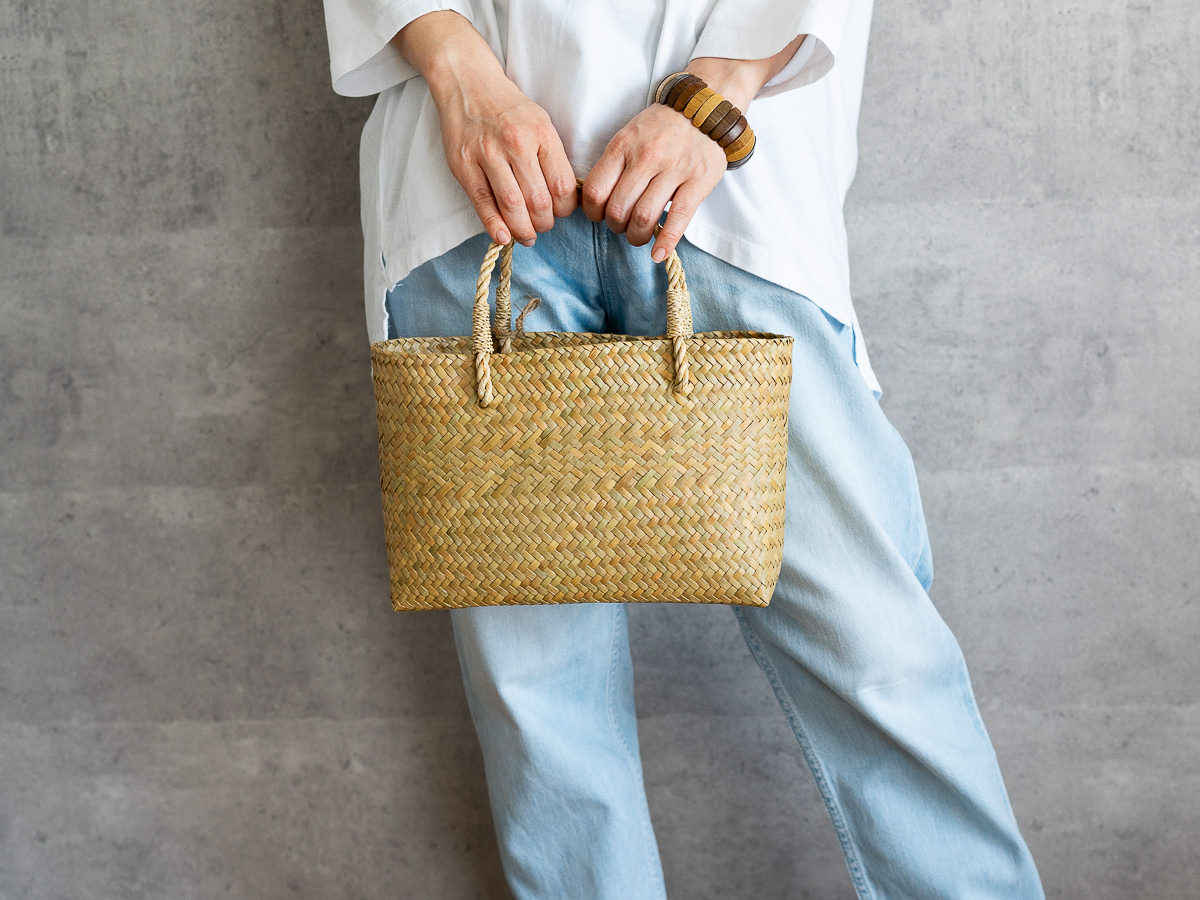
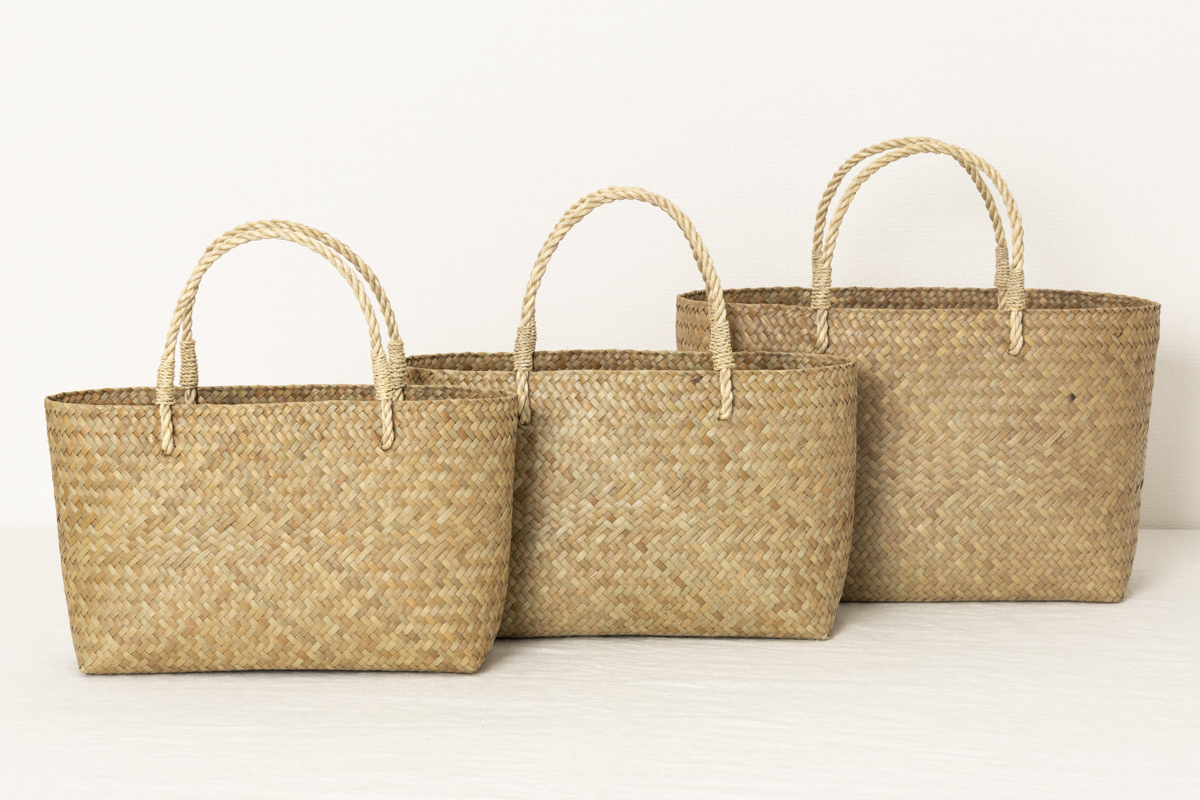
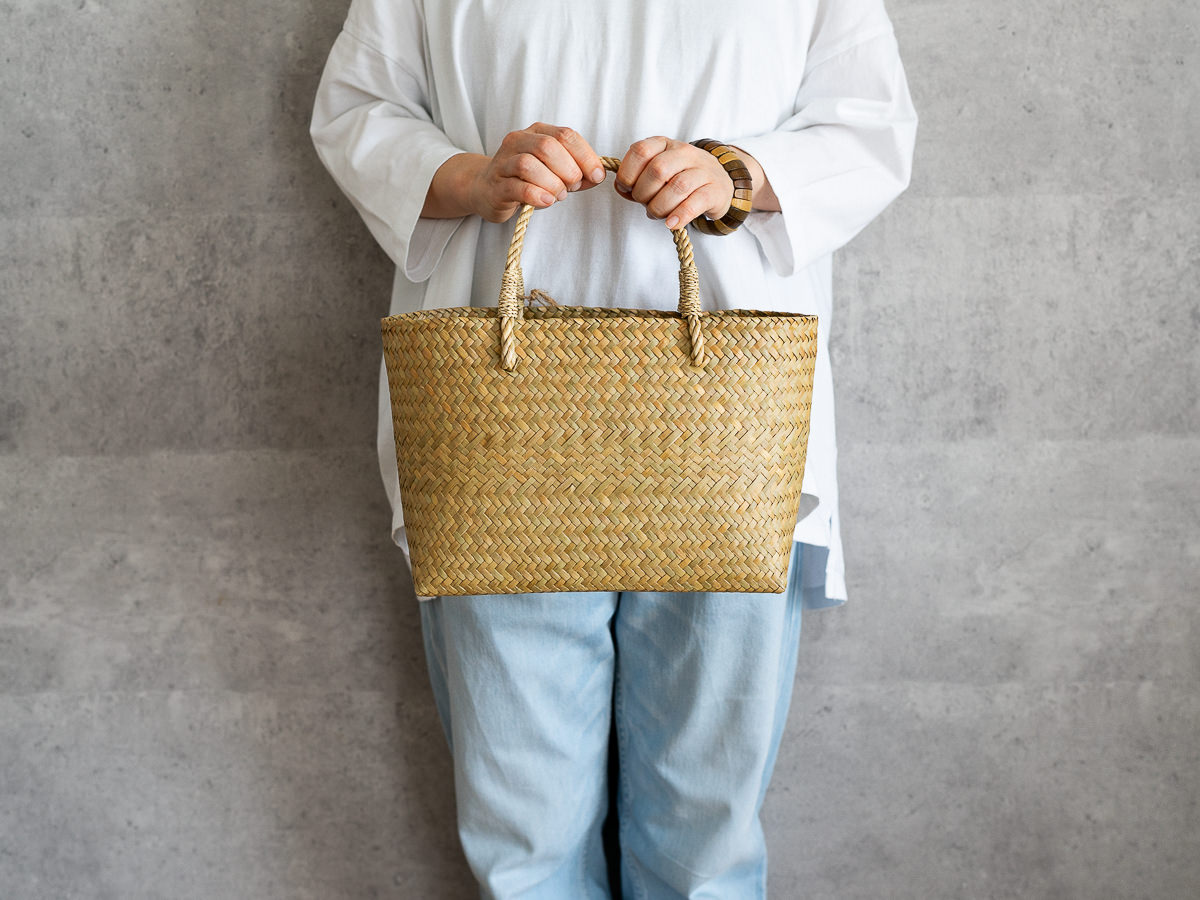
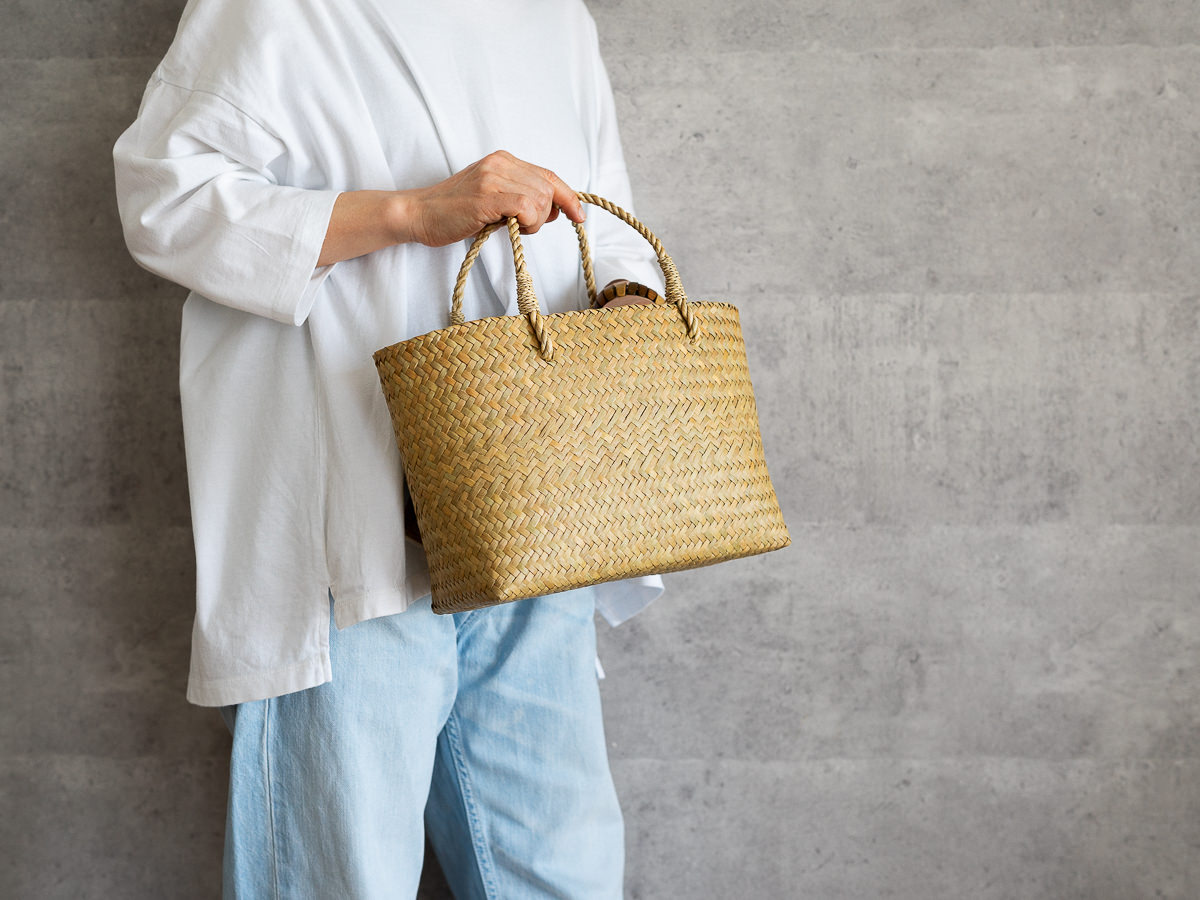
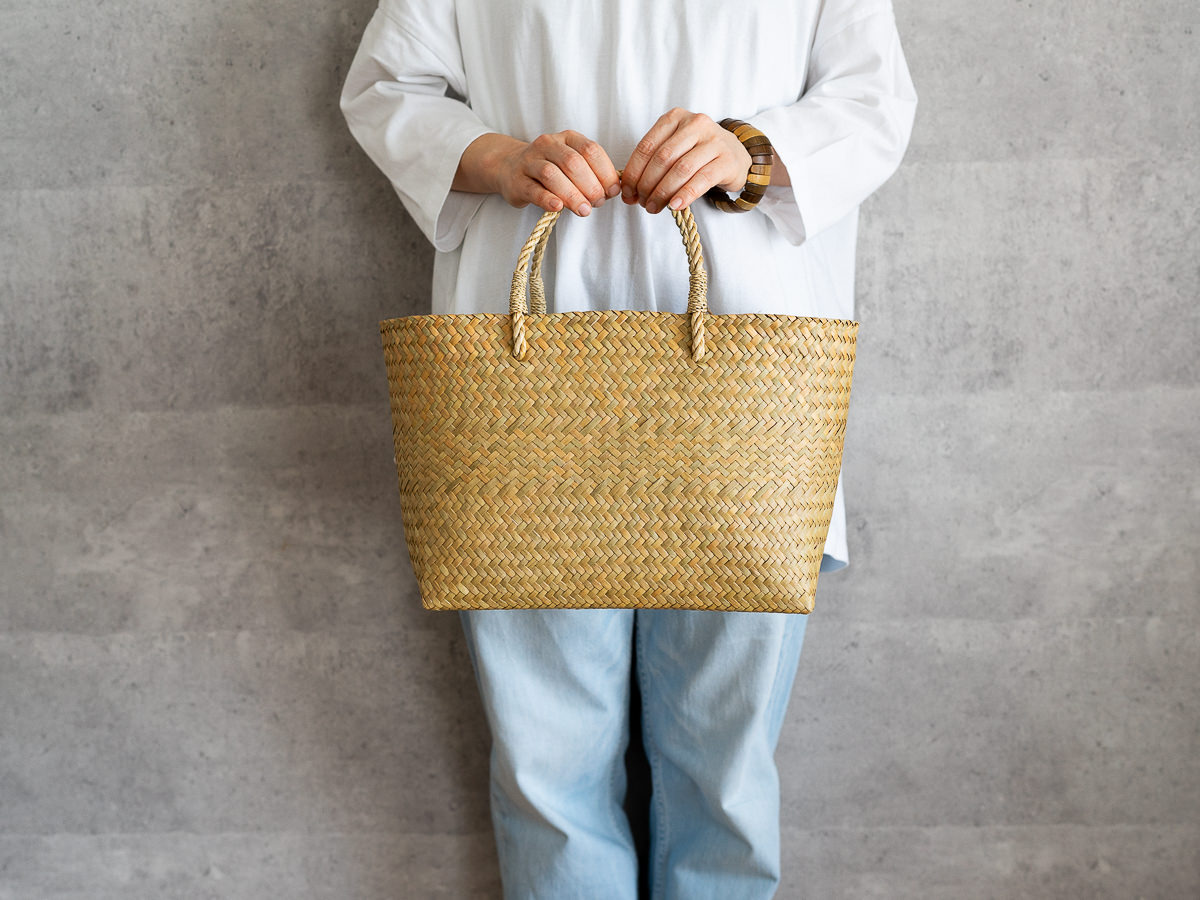
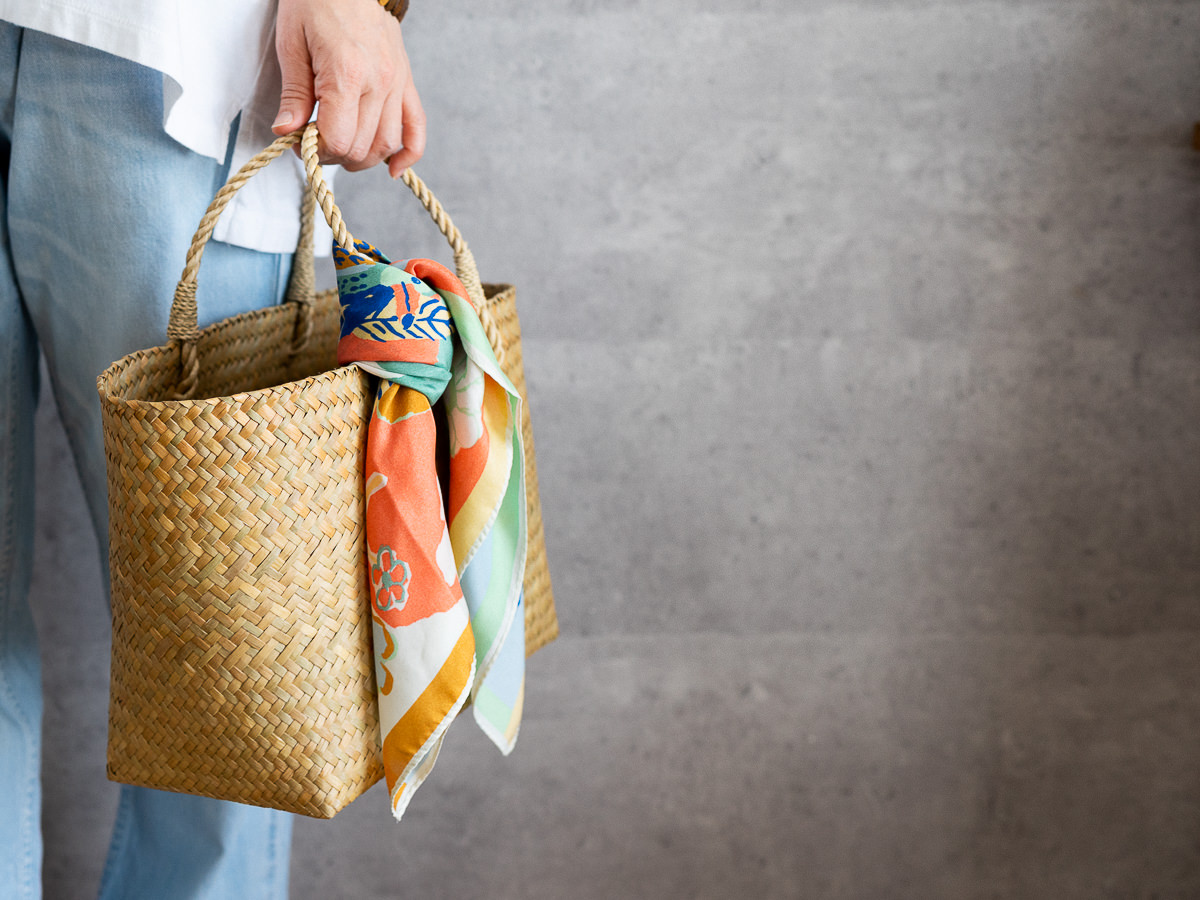
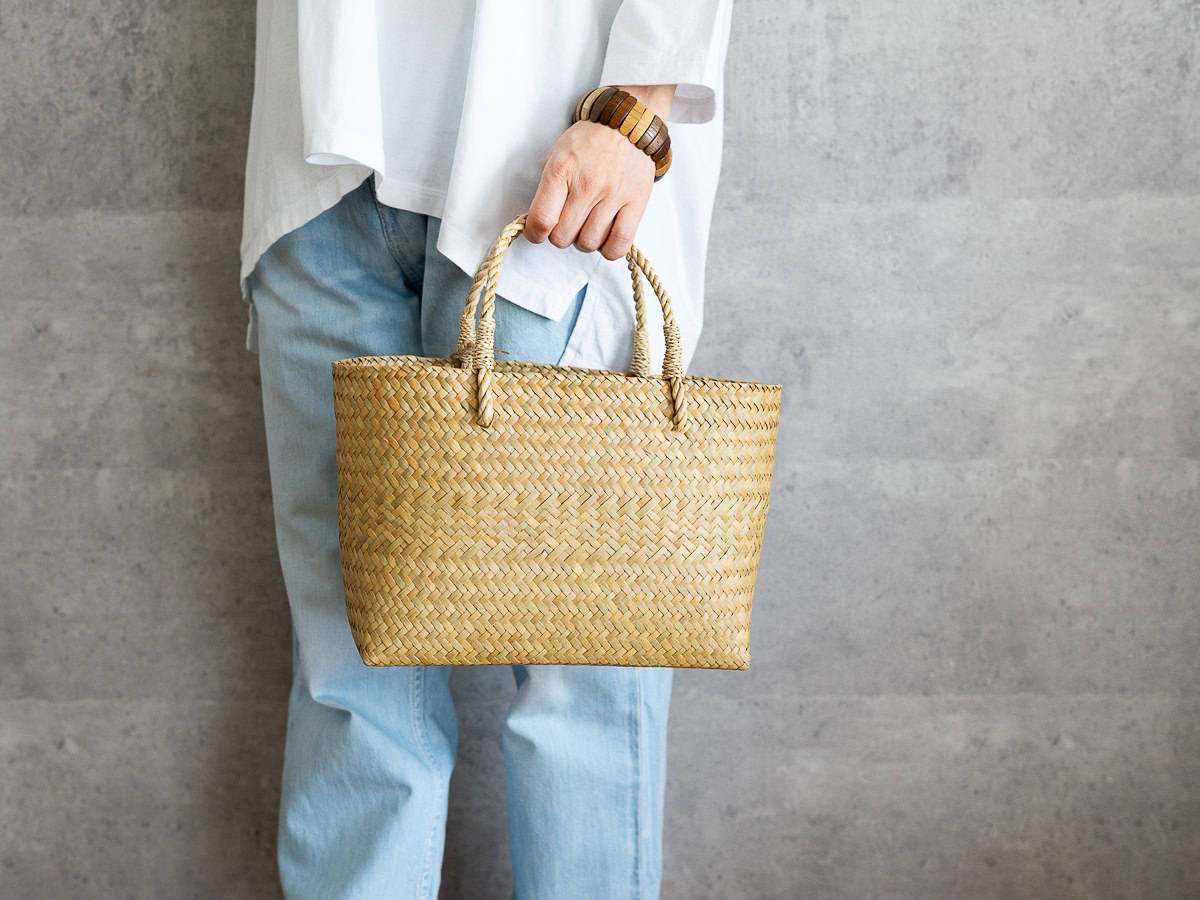
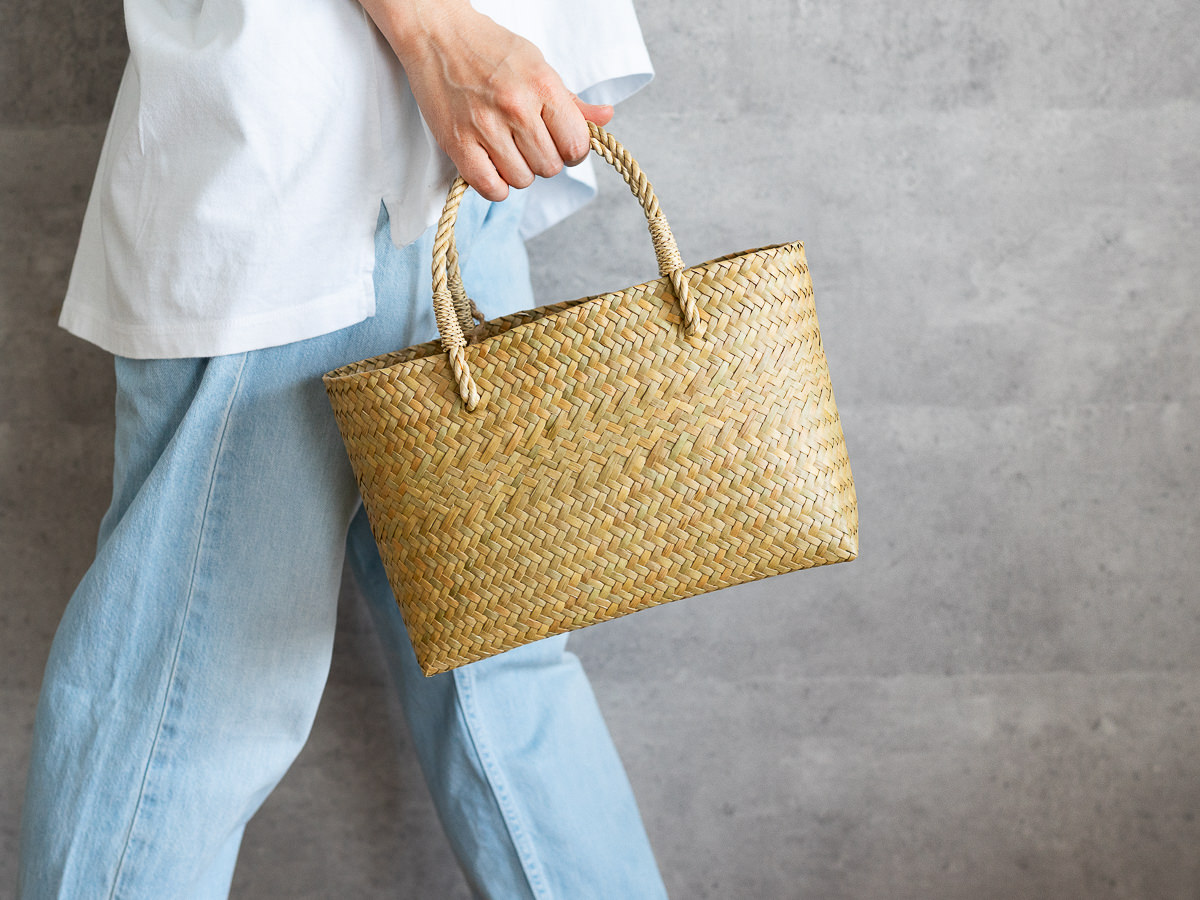
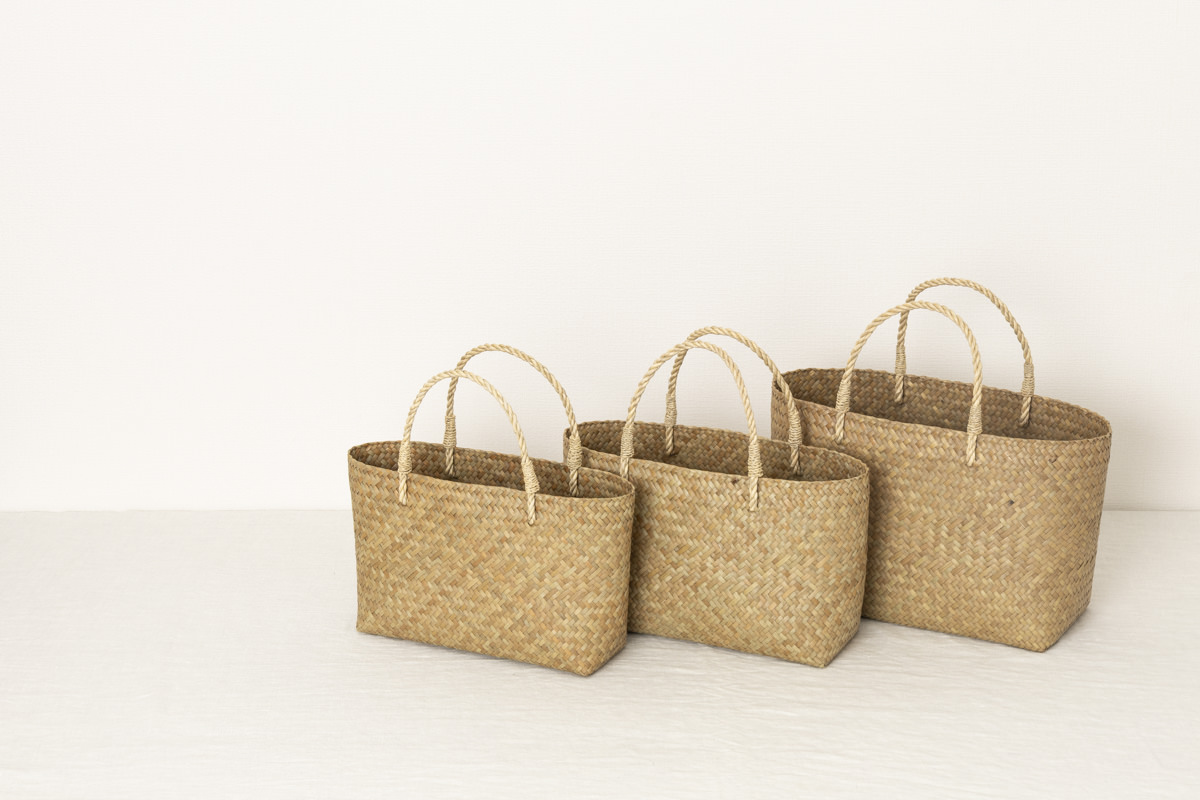
This basket is woven from a grass that grows naturally in the wetlands of Thailand, known locally as Krajood.
It is light in weight, yet has a gentle firmness and a sense of stability.
The calm tone unique to natural materials allows it to blend effortlessly into many settings, complementing a wide range of outfits with ease.
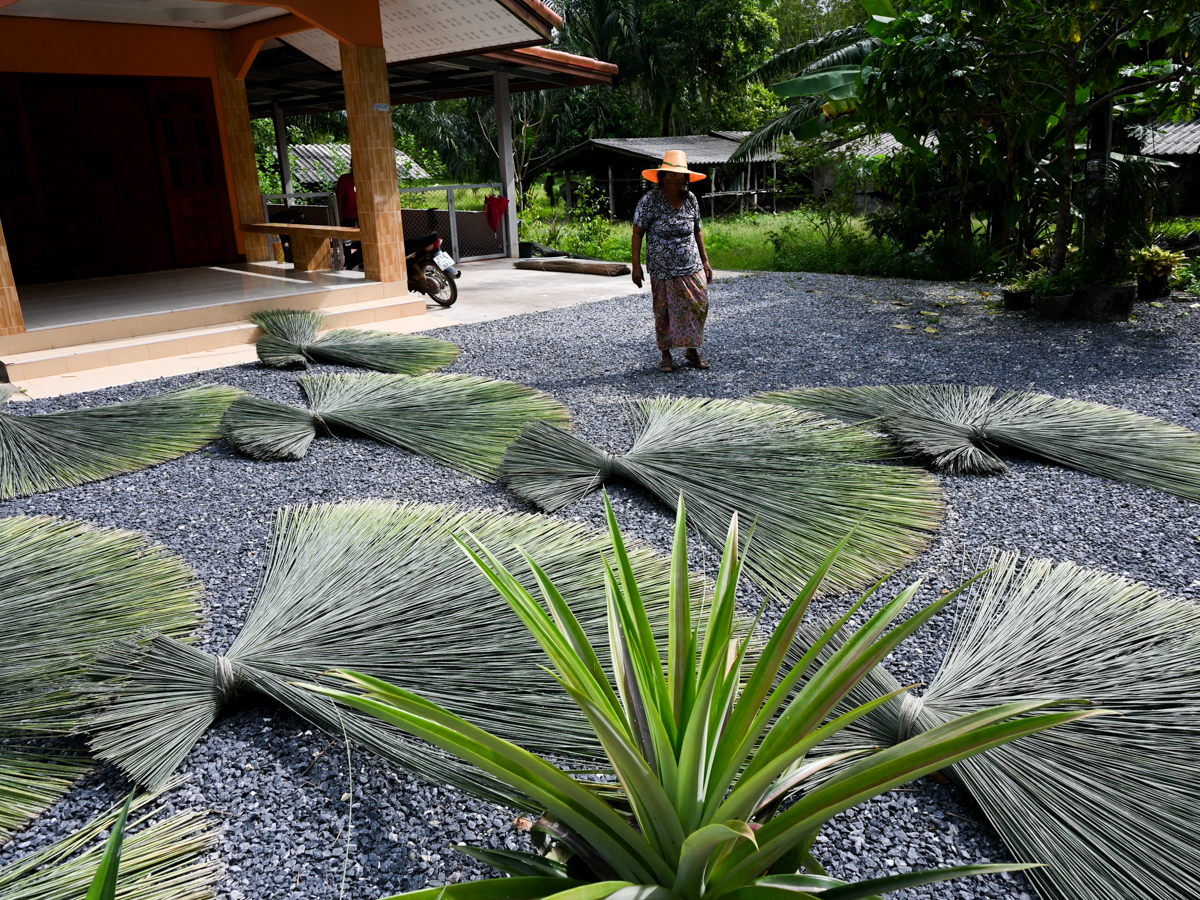
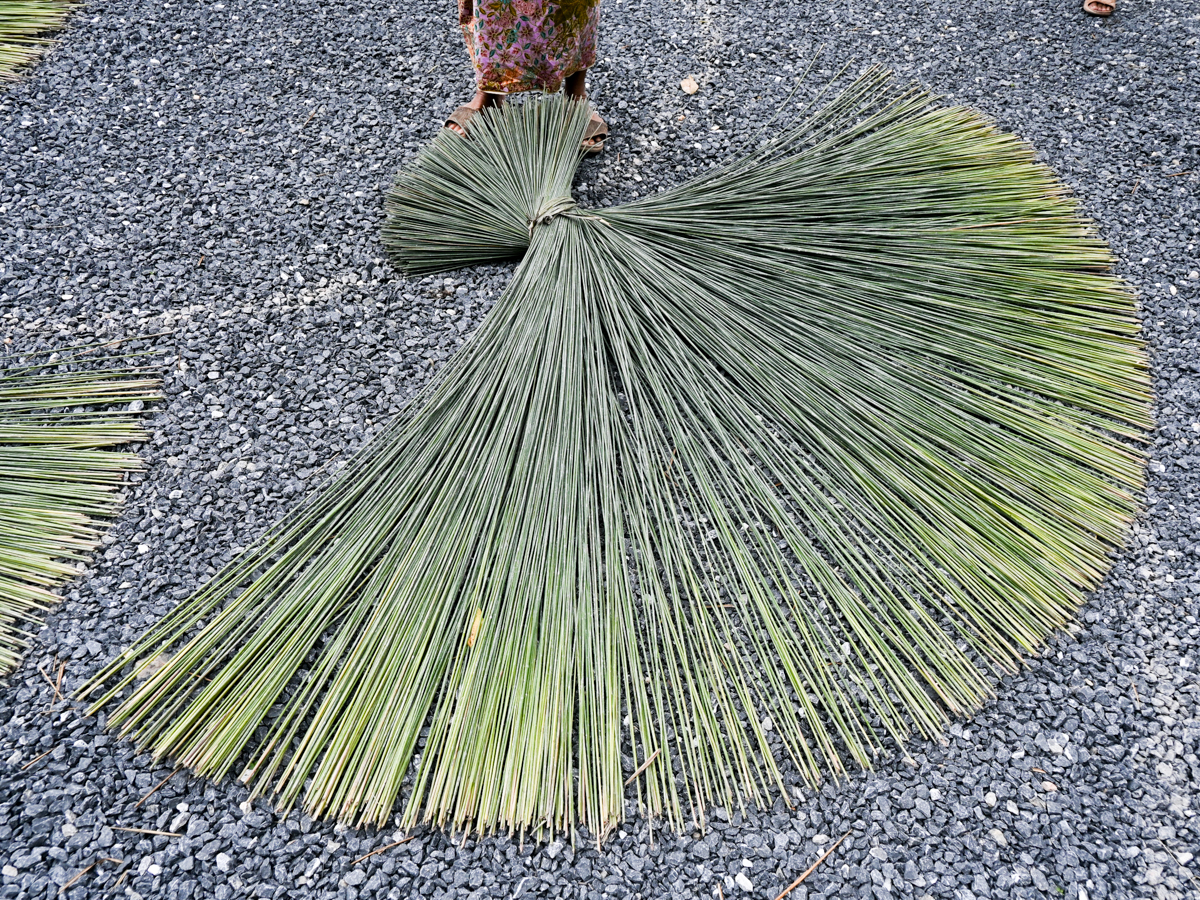
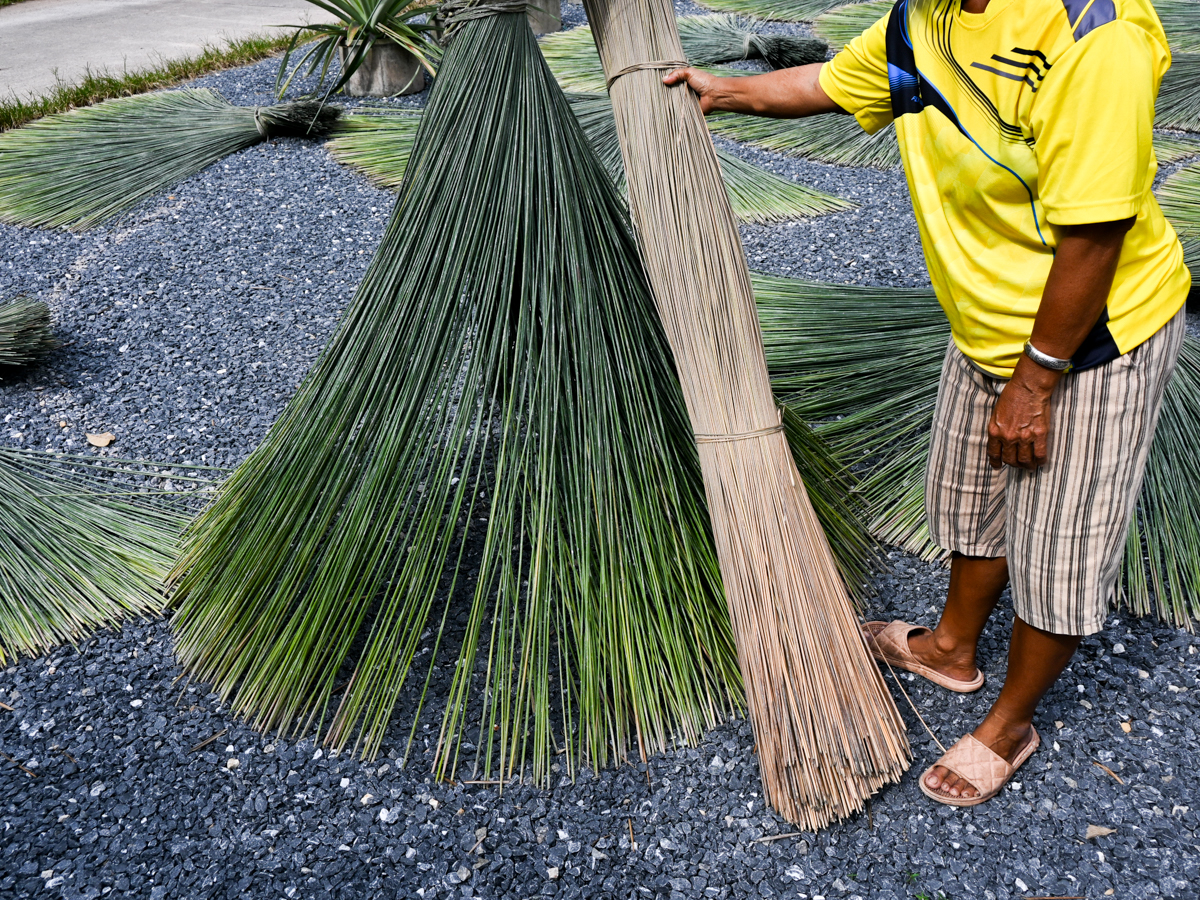
The basket is made by cutting the stems of Krajood grass from the root, drying them in the sun, flattening them, and then weaving them together.The stems are mainly harvested from spring (around May) to summer (around August) in Thailand. On clear, sunny days, they are dried all at once under strong sunlight. Shown here are bundles of Krajood stems freshly cut from the water’s edge.A clay-rich mud is applied to the stems, and they are then sun-dried for about three to five days. They are left to dry for several days, until the color gradually changes to a greenish brown—similar to the bundle shown on the right in the photograph.Through sun-drying, the material is given flexibility and a slight moisture content, which helps prevent cracking caused by over-drying and increases its strength as a weaving material.
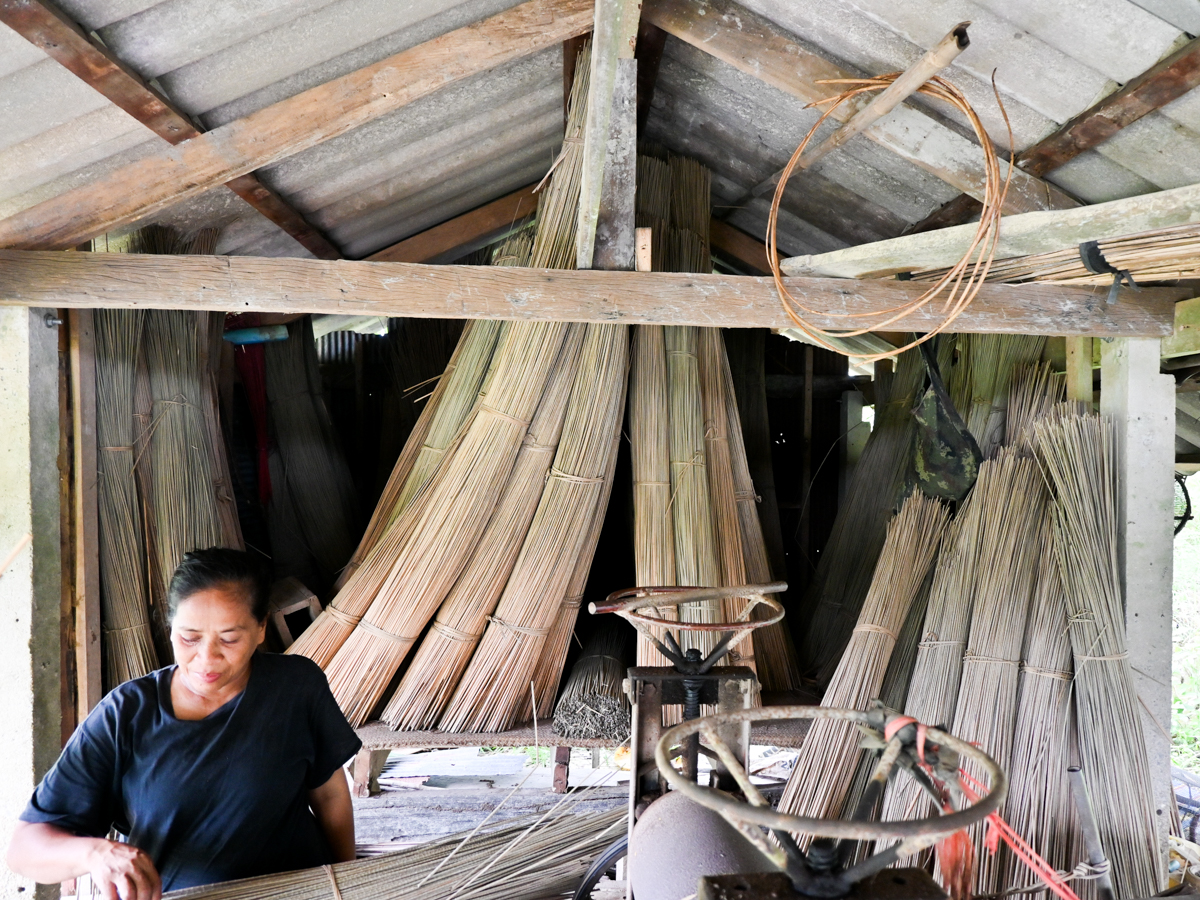
The makers vary by region. In some areas, a highly skilled weaver serves as a teacher, guiding others in the group as they work. In other places, baskets are woven by three generations of the same family.
In many villages, production is often carried out by small groups of about four to five people.
For most people, basket making is not their primary occupation. It is often done in between agricultural work such as rice farming, and many of the weavers today belong to the older generation.
Although the number of younger weavers remains small, the value of products made from natural materials is being rediscovered within Thailand. We are told that more young people are beginning to choose and use these baskets once again.
We have shared scenes from our visit to a Krajood village in Thailand in our Journal. We hope you will take a look.
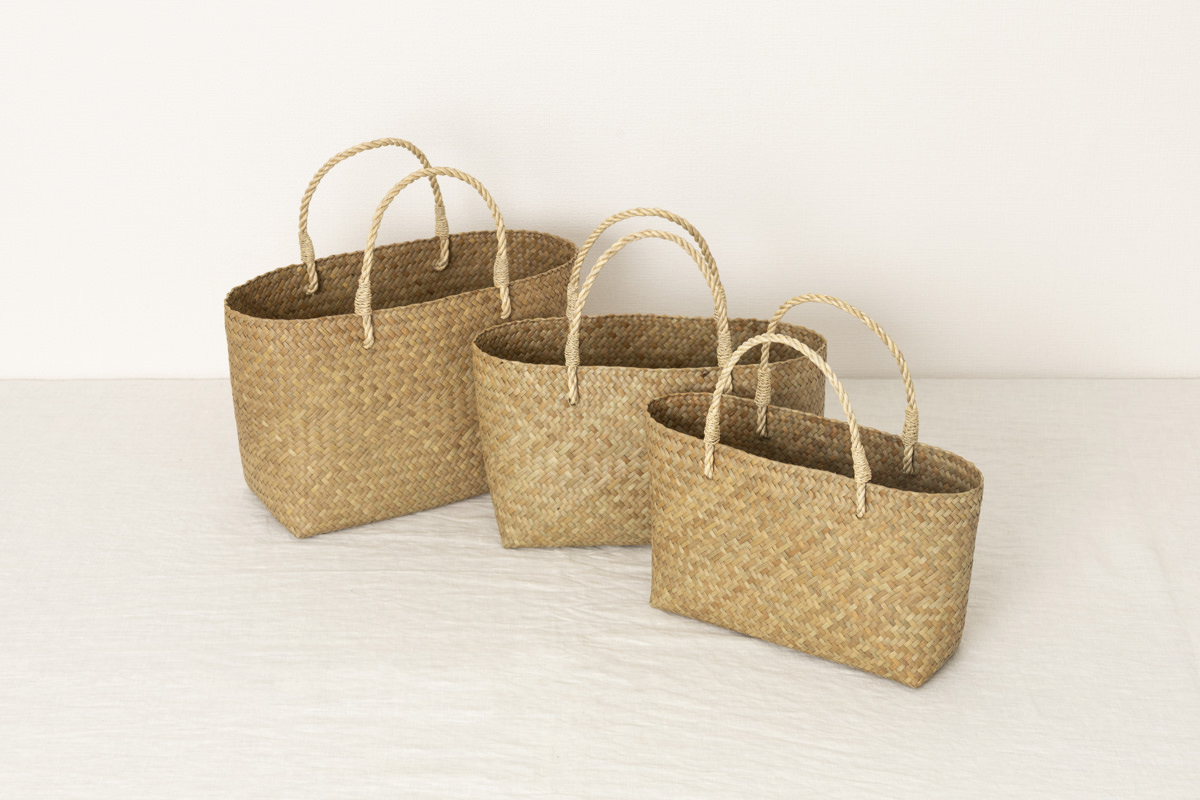
On this page, we introduce a slim oval basket bag made of Krajood, available in three sizes: S, M, and L.
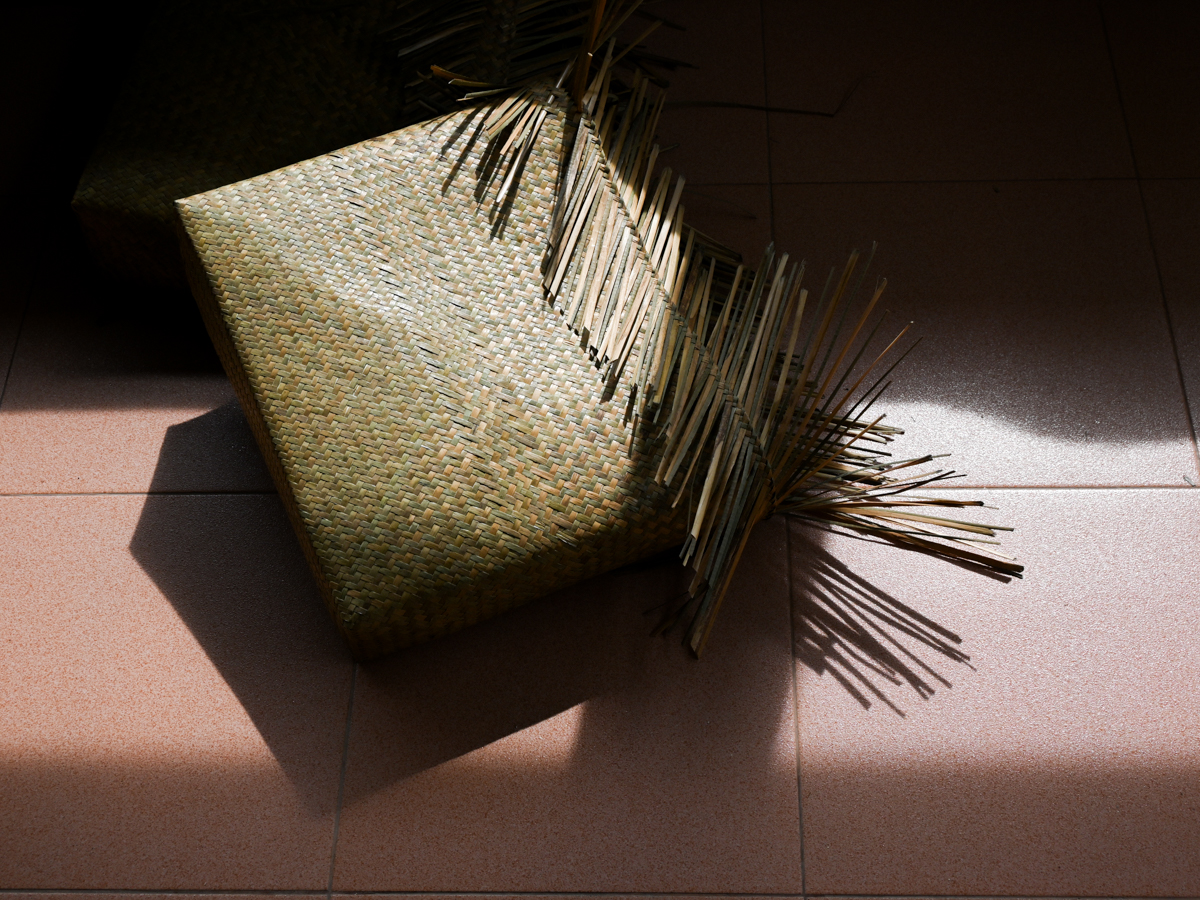
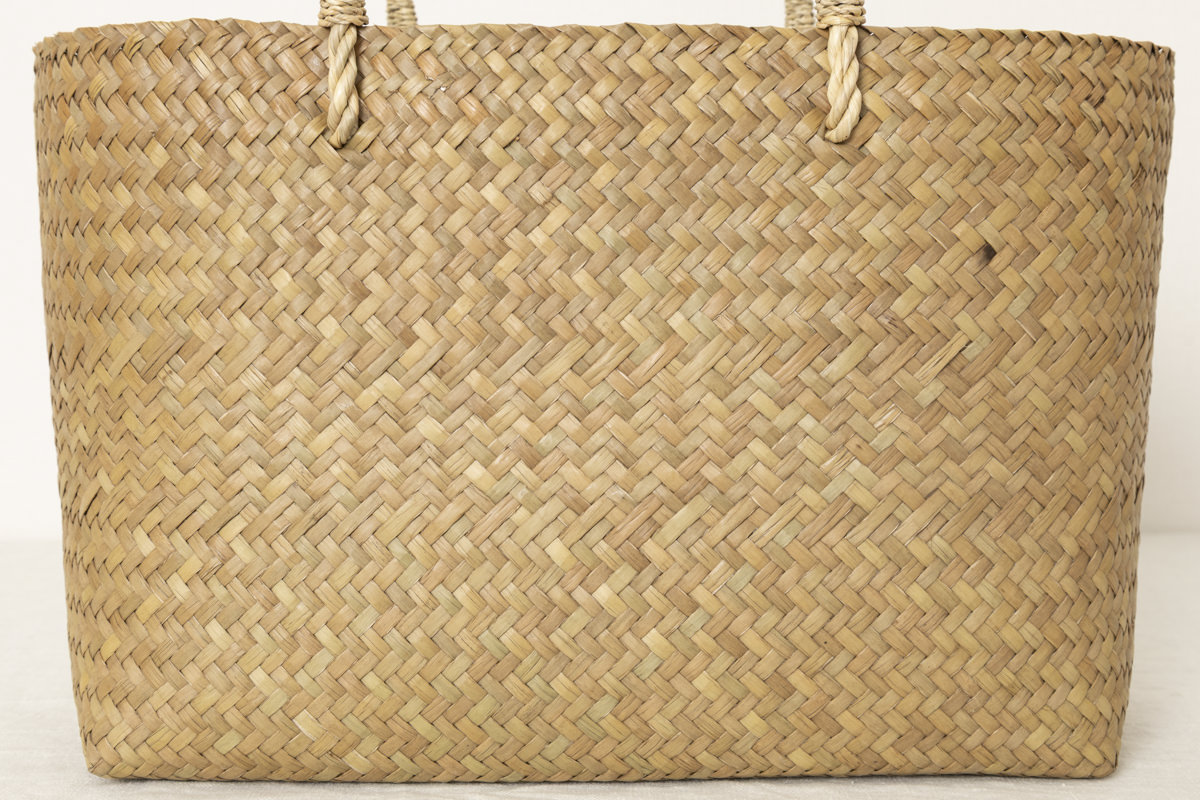
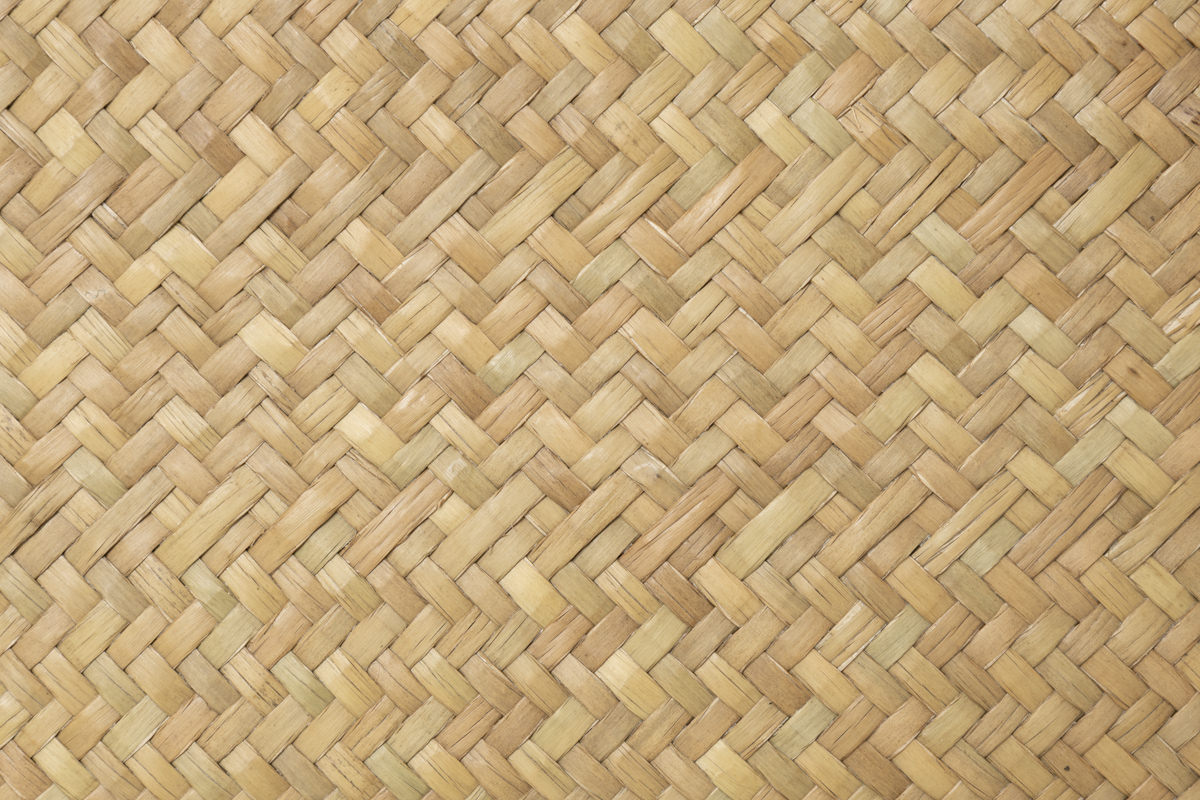
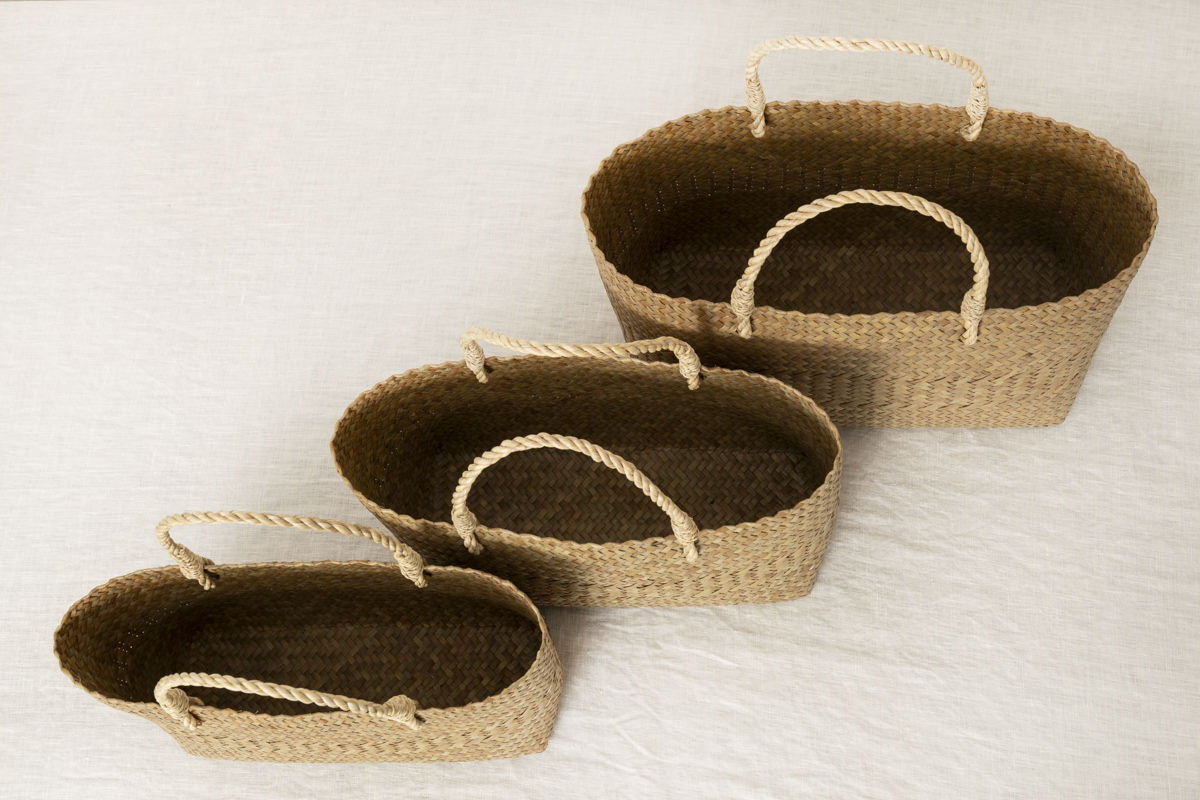
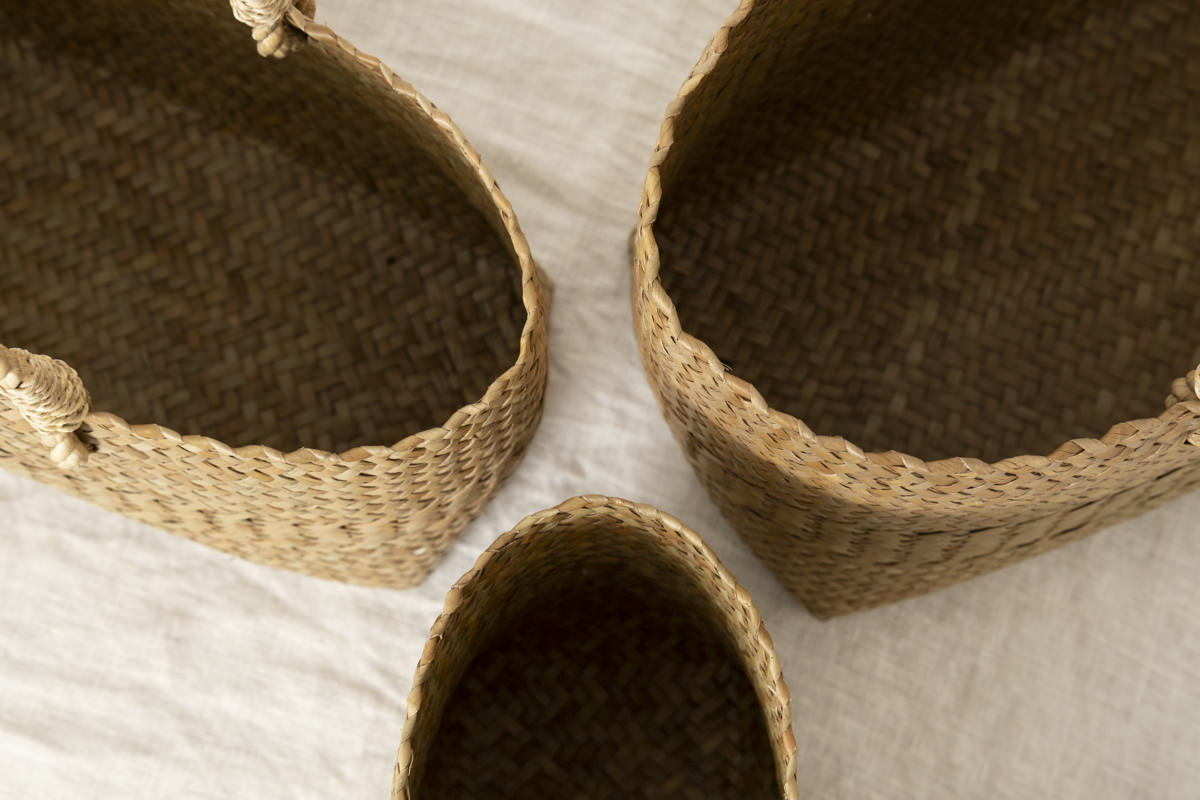
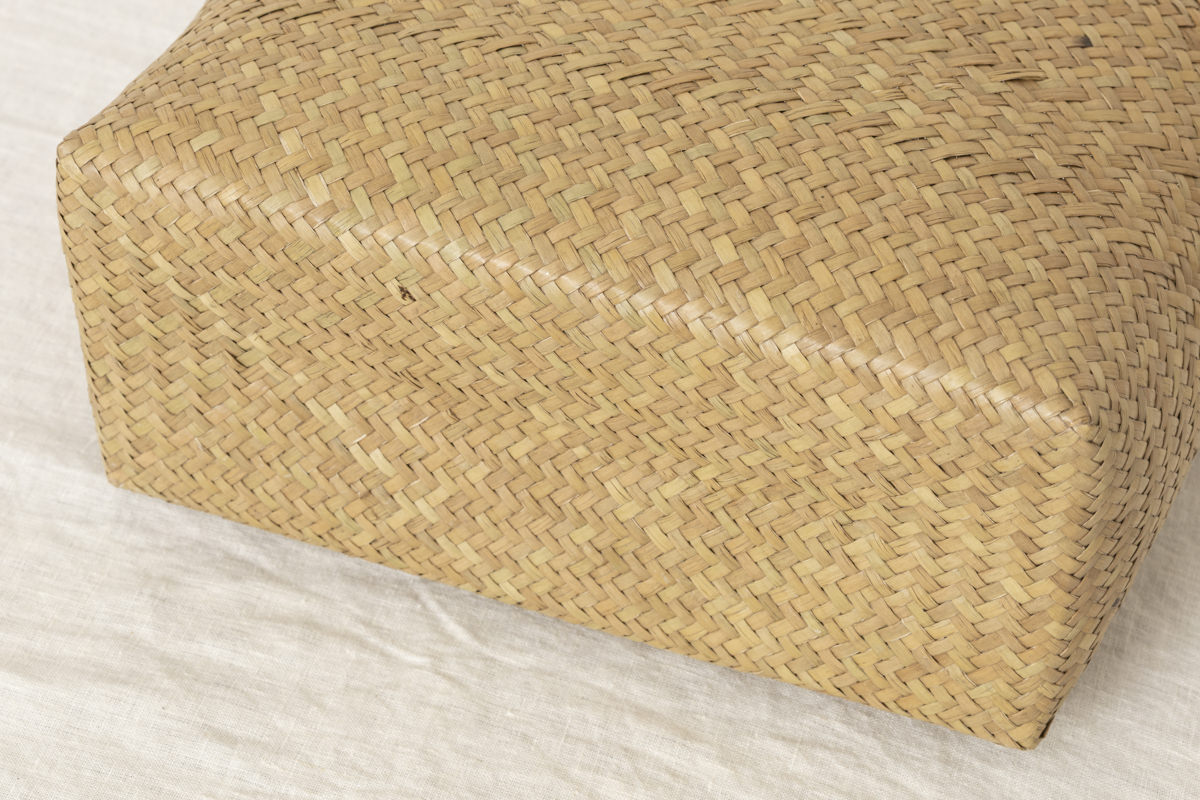
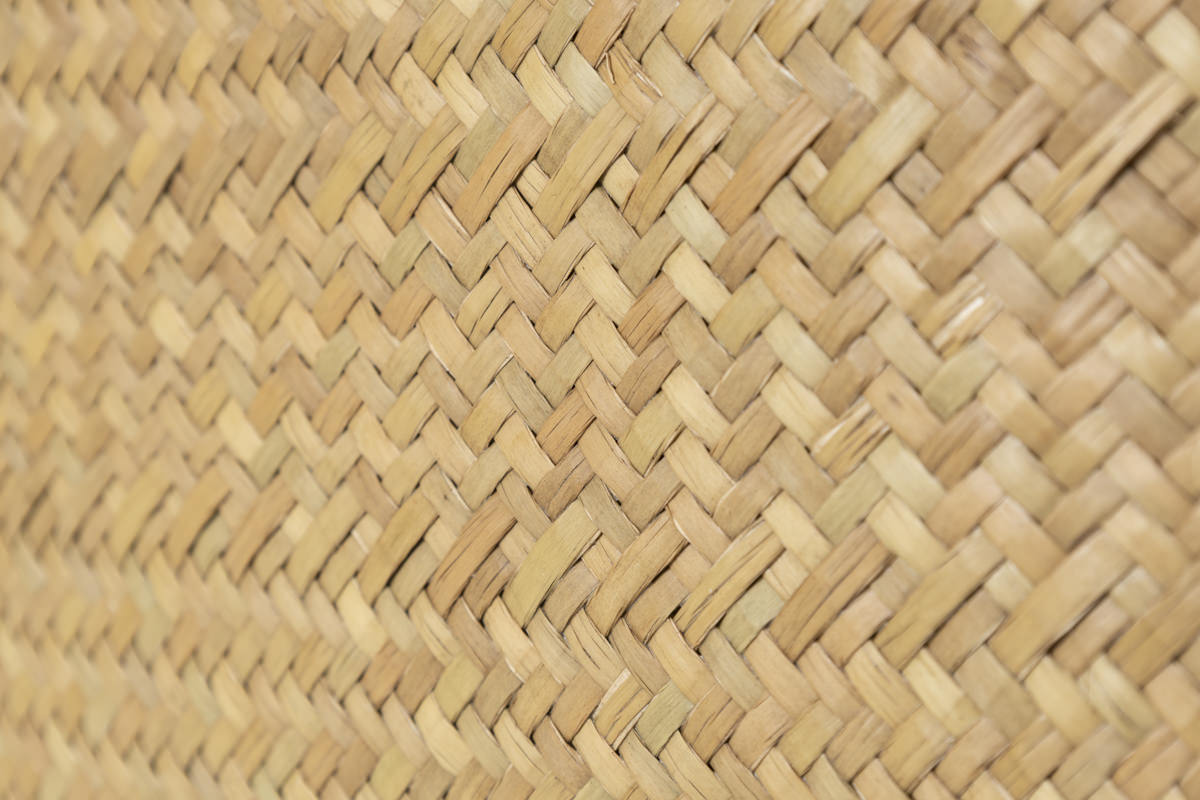
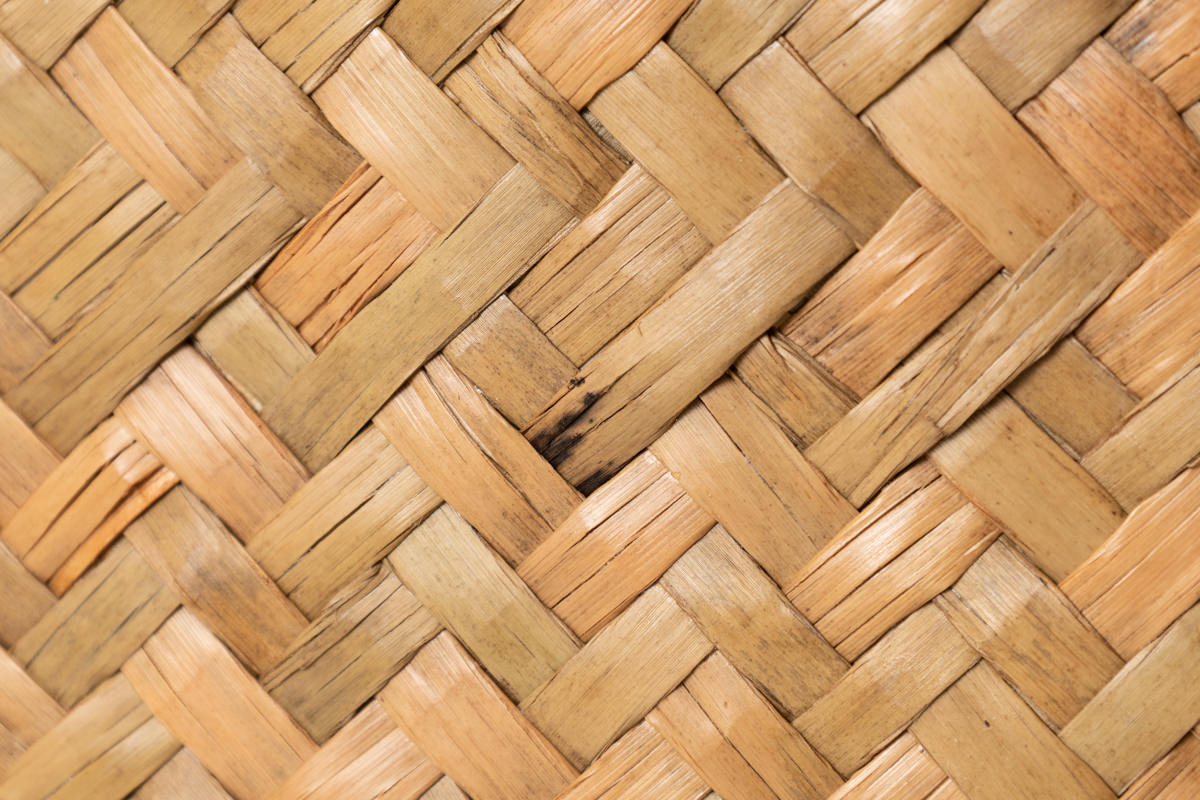
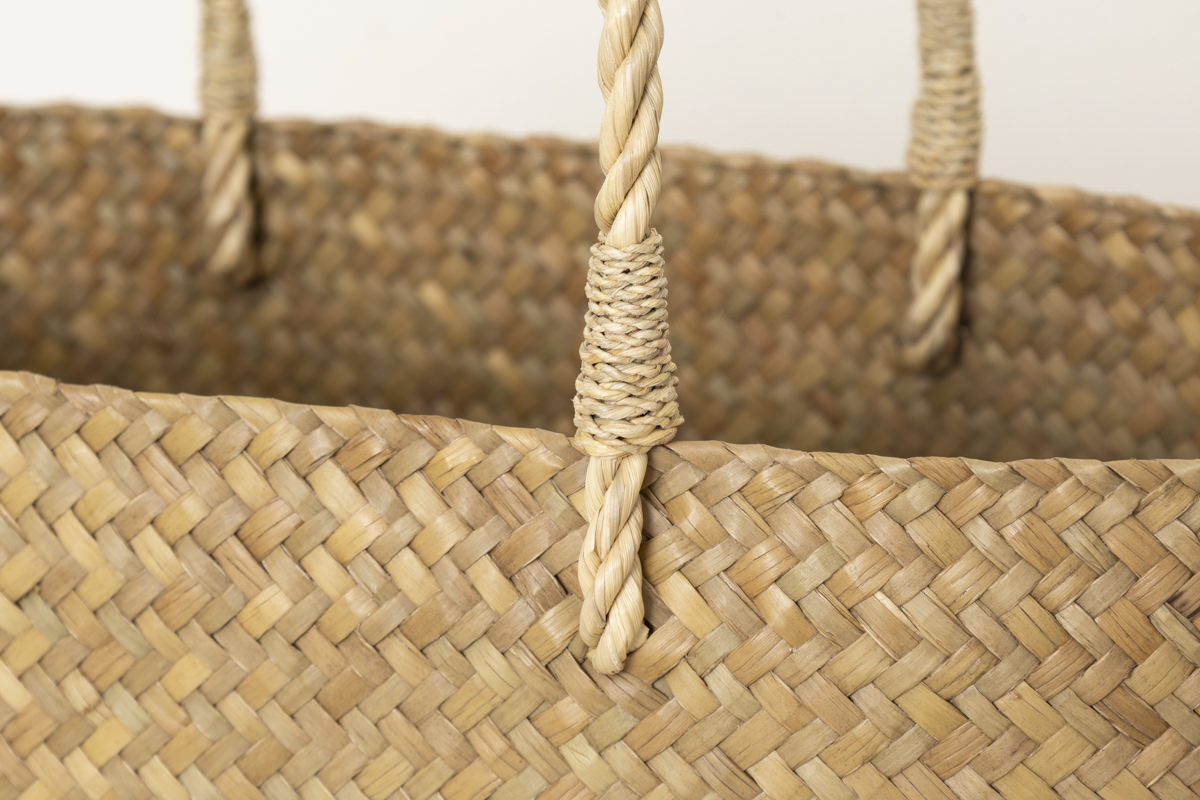
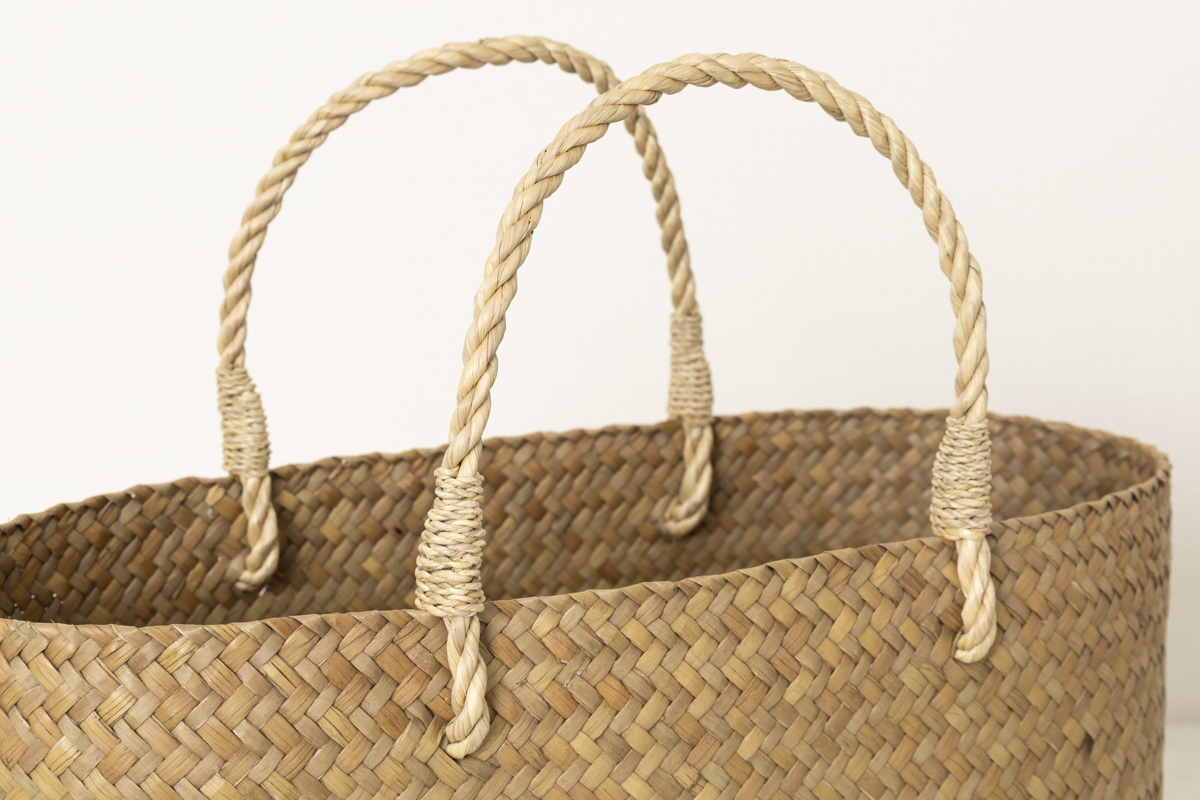
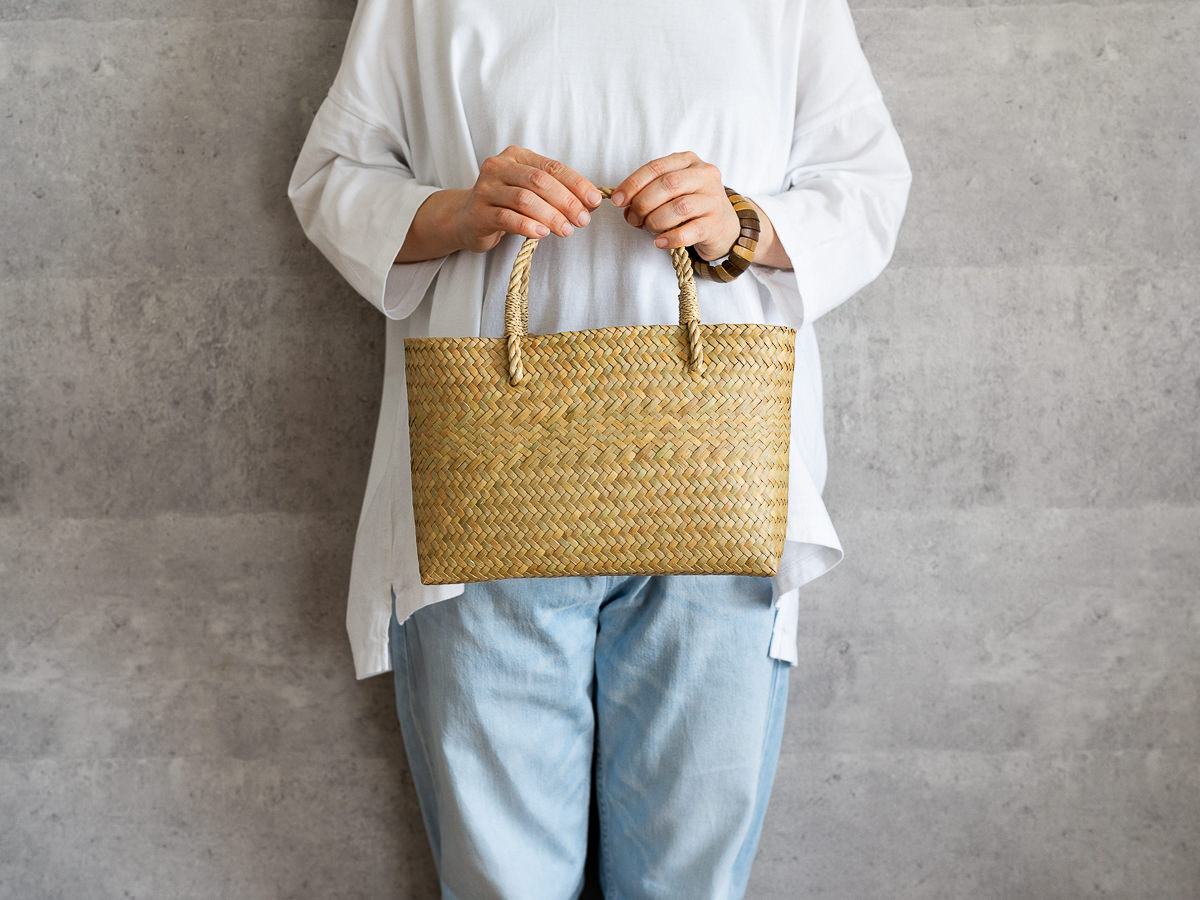
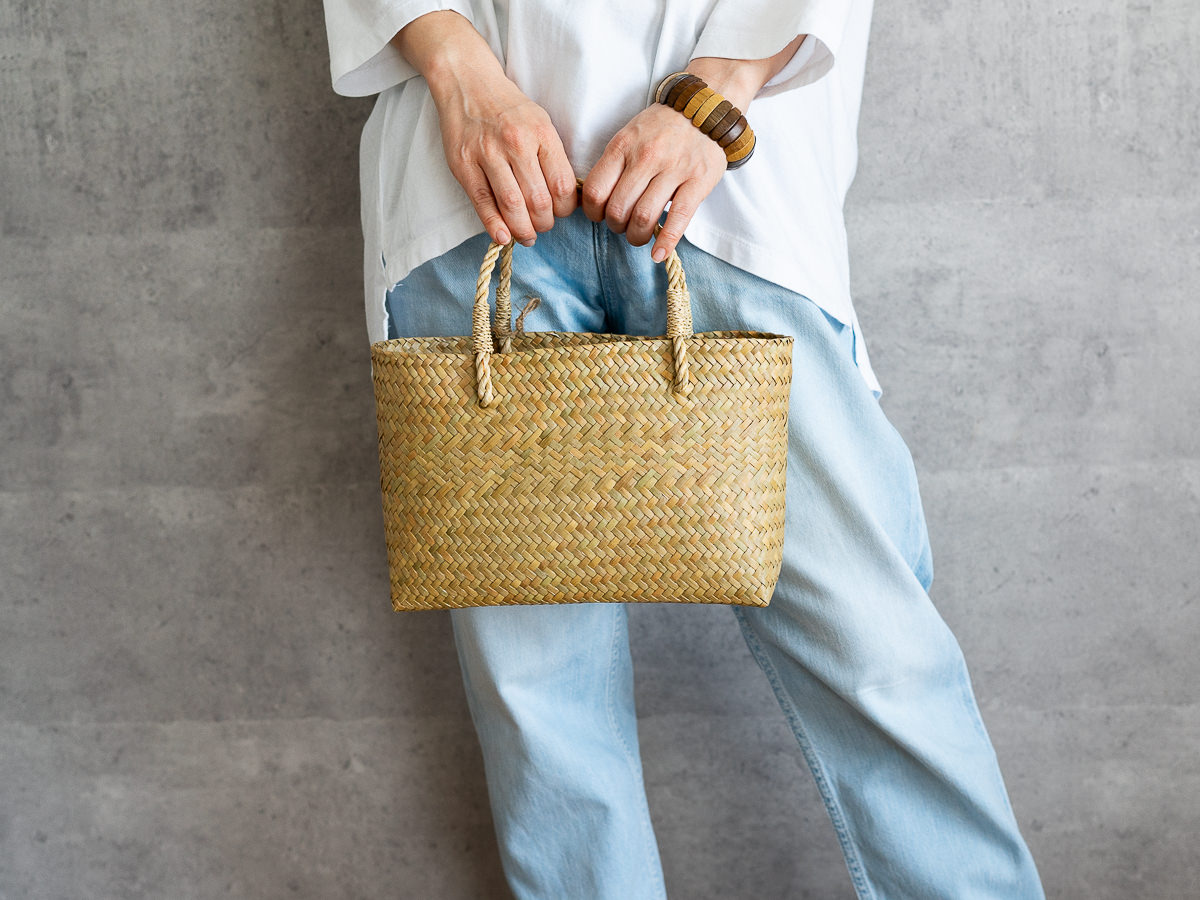
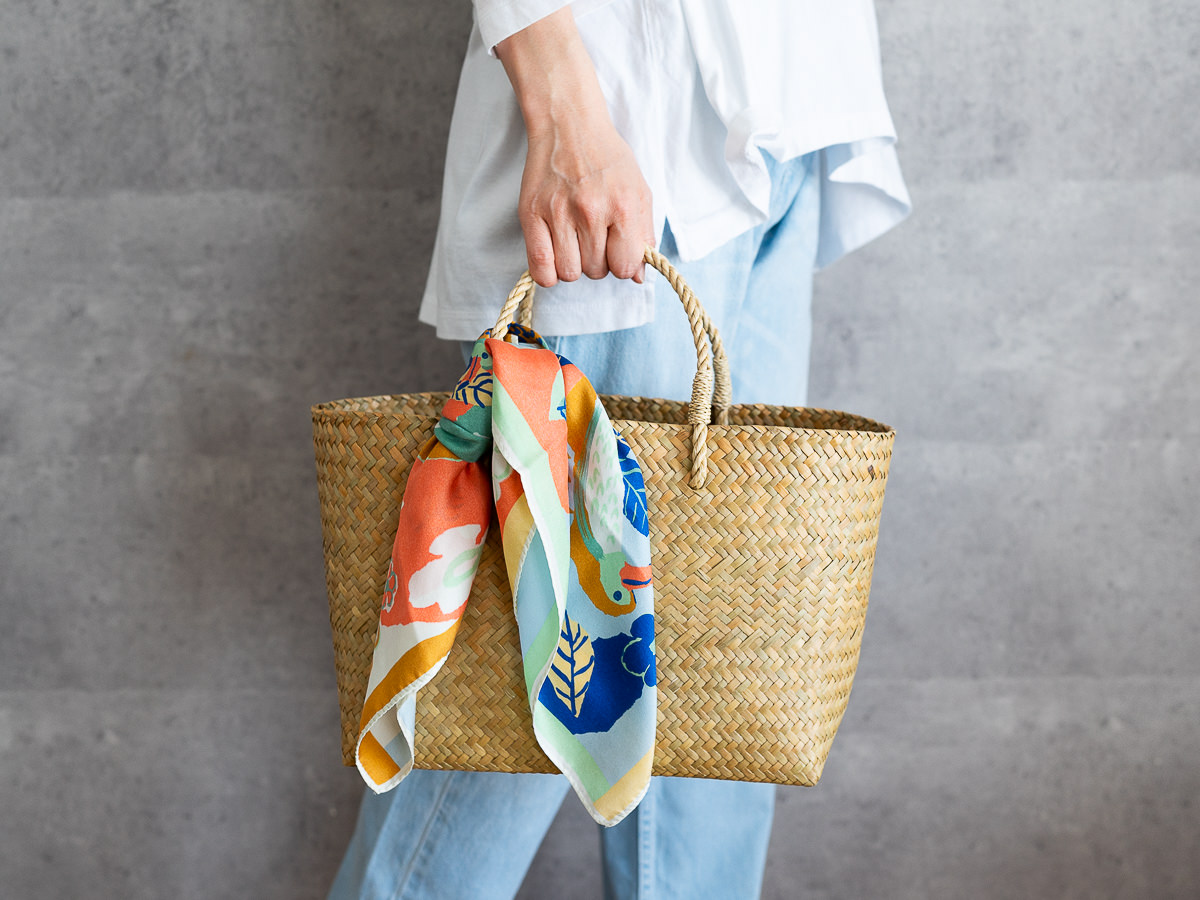
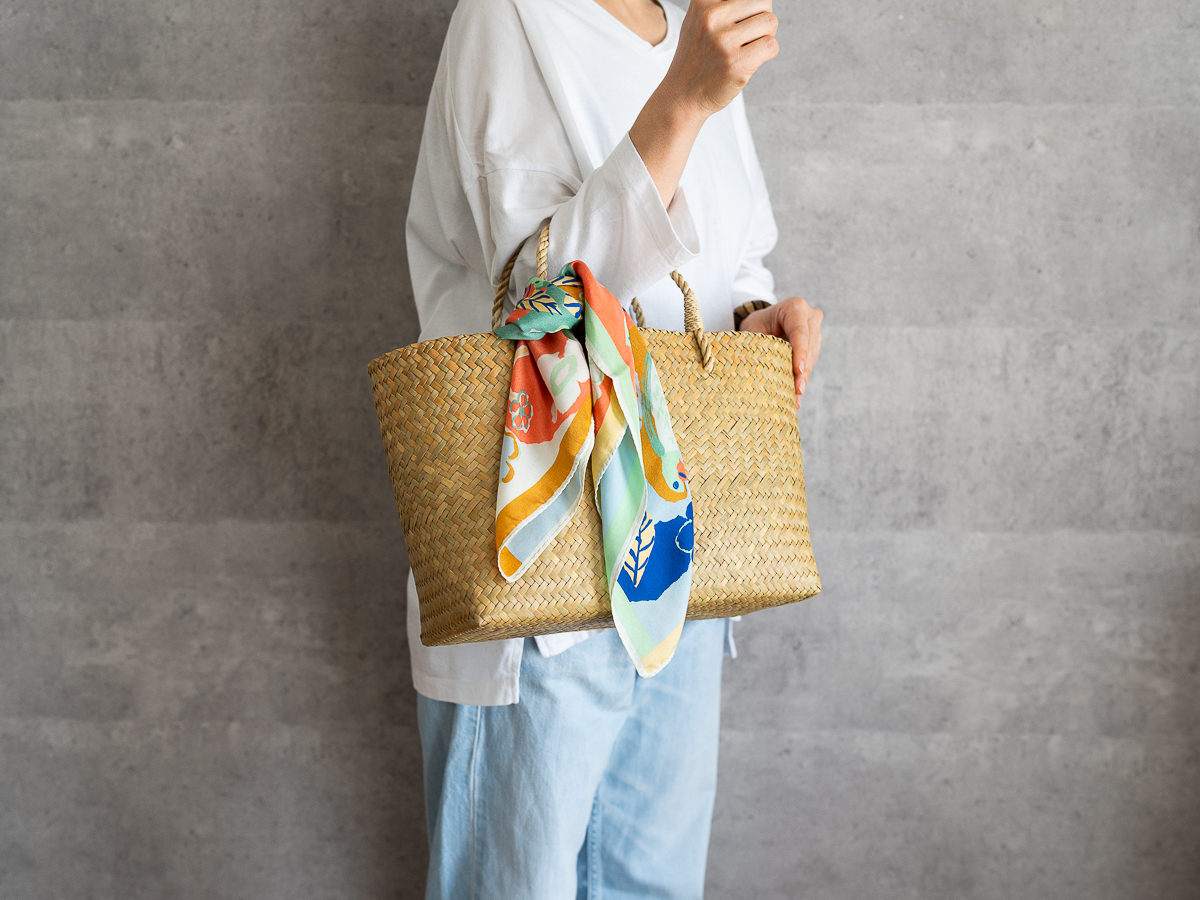
The basket is woven in a technique known in Japan as ajiro-ami. The flattened stems are interlaced one over the other, forming a sheet roughly the size of a woven mat. This sheet is then shaped into the form of a basket.If you look closely, you will notice that the weave changes at the center of the basket’s side. It appears almost like a subtle pattern, emerging gently as an accent on the basket.The shape is a horizontally elongated, slim oval. It allows you to place items such as a wallet, pouch, and notebook neatly side by side.The rim is finished thinly and cleanly, giving a refined impression.This is the underside of the basket. While the opening is oval in shape, the base is rectangular.As the final step in the basket-making process, the entire surface is coated with starch glue. This application is an essential process that strengthens the Krajood basket and enhances its durability.As shown here, you may occasionally notice stain-like markings on the strips. We hope you will understand these as characteristics unique to natural materials.This is the connection between the handle and the rim. The handle rope is threaded through the woven Krajood body.The handle is made from a sedge known in Thai as Kok, a plant from the Cyperaceae family. The Kok is twisted into rope form and used as the handle.This is the S size. It is compact enough to rest neatly on your lap.Perfect for a stroll or a short outing. In addition to a wallet, smartphone, and pouch, it is sized to neatly fit an A5 notebook.This is the M size. In addition to your everyday essentials, it can comfortably hold a bottle of water and a B5 notebook.Suitable for outings as well as for commuting. It is a well-balanced size that offers versatility for a wide range of uses.This is the L size. In addition to your valuables, it is spacious enough to carry a light cardigan, shawl, or scarf. It can also be used as a shopping basket when picking up a few groceries.You may drape a favorite bandana, handkerchief, or stole over the opening, or tie it around the handle.Adding a piece of fabric gently changes its impression, allowing you to enjoy it in ways that reflect your outfit or mood.
The starch glue applied to the surface of the Krajood basket helps prevent the shape from collapsing and increases its strength for everyday use. It is a necessary finishing process, and also reflects the wisdom of the makers, who continually consider how to create baskets that are truly durable.
The glue is thoroughly dried. However, in very rare cases, those with sensitive skin may experience slight redness or irritation when it comes into direct contact with the surface.
If you have concerns, you may wish to avoid direct contact with the skin—for example, by wearing long sleeves when carrying the basket.
A silhouette that comes to mind when you think of a basket bag— balanced in proportion, and familiar in its form.
Suitable for those choosing a basket bag for the first time, and also as an additional piece for those who already own one.
Simple, easy to use, and steady in its shape.
It pairs beautifully with a dress, or with a simple T-shirt and denim— likely suiting many styles with ease.
It may also be enjoyable to consider how it coordinates with a scarf, stole, or hat.
We invite you to choose the size that best suits your preference.
About Krajood Craft in Thailand
Thailand lies in a tropical climate zone, where the year is broadly divided into a rainy season and a dry season.
It is sometimes said that the shape of Thailand resembles the face of an elephant. The Malay Peninsula forms what is often described as its “trunk.”
Southern Thailand, located along this peninsula, has a slightly different climate. Depending on the season, monsoon winds blow either from the southwest or from the northeast. As a result, this region experiences longer periods of rainfall compared to other parts of the country, with the dry season lasting only about two months.
Krajood is the name of a grass that grows in the wetlands of southern Thailand, where the climate is hot and humid. This is the term used by local people in Thai.
In Thailand, where rainfall is abundant, flooding can occur frequently. In some years, Krajood may be washed away or damaged by floods, leading to poor harvests. While demand for Krajood baskets continues to grow both within Thailand and abroad, securing sufficient materials for basket making has become a challenging issue for the makers.
The Krajood craft introduced here is mainly produced in provinces along the eastern side of the Malay Peninsula, facing the Gulf of Thailand—such as Surat Thani, Nakhon Si Thammarat, Pattani, and Narathiwat.
The Krajood baskets we carry are made by skilled artisans and have passed careful inspection by hand and eye, ensuring a high level of quality.
Please note: This item ships from Japan. As the buyer, you are responsible for any import duties, customs fees, or local taxes that may be charged in your country. These costs are not included in the item price or shipping cost. Please check with your local customs authority if you are unsure about any potential charges before placing your order.
This basket is woven from a grass that grows naturally in the wetlands of Thailand, known locally as Krajood.
It is light in weight, yet has a gentle firmness and a sense of stability.
The calm tone unique to natural materials allows it to blend effortlessly into many settings, complementing a wide range of outfits with ease.
The basket is made by cutting the stems of Krajood grass from the root, drying them in the sun, flattening them, and then weaving them together.The stems are mainly harvested from spring (around May) to summer (around August) in Thailand. On clear, sunny days, they are dried all at once under strong sunlight. Shown here are bundles of Krajood stems freshly cut from the water’s edge.A clay-rich mud is applied to the stems, and they are then sun-dried for about three to five days. They are left to dry for several days, until the color gradually changes to a greenish brown—similar to the bundle shown on the right in the photograph.Through sun-drying, the material is given flexibility and a slight moisture content, which helps prevent cracking caused by over-drying and increases its strength as a weaving material.
The makers vary by region. In some areas, a highly skilled weaver serves as a teacher, guiding others in the group as they work. In other places, baskets are woven by three generations of the same family.
In many villages, production is often carried out by small groups of about four to five people.
For most people, basket making is not their primary occupation. It is often done in between agricultural work such as rice farming, and many of the weavers today belong to the older generation.
Although the number of younger weavers remains small, the value of products made from natural materials is being rediscovered within Thailand. We are told that more young people are beginning to choose and use these baskets once again.
We have shared scenes from our visit to a Krajood village in Thailand in our Journal. We hope you will take a look.
On this page, we introduce a slim oval basket bag made of Krajood, available in three sizes: S, M, and L.
The basket is woven in a technique known in Japan as ajiro-ami. The flattened stems are interlaced one over the other, forming a sheet roughly the size of a woven mat. This sheet is then shaped into the form of a basket.If you look closely, you will notice that the weave changes at the center of the basket’s side. It appears almost like a subtle pattern, emerging gently as an accent on the basket.The shape is a horizontally elongated, slim oval. It allows you to place items such as a wallet, pouch, and notebook neatly side by side.The rim is finished thinly and cleanly, giving a refined impression.This is the underside of the basket. While the opening is oval in shape, the base is rectangular.As the final step in the basket-making process, the entire surface is coated with starch glue. This application is an essential process that strengthens the Krajood basket and enhances its durability.As shown here, you may occasionally notice stain-like markings on the strips. We hope you will understand these as characteristics unique to natural materials.This is the connection between the handle and the rim. The handle rope is threaded through the woven Krajood body.The handle is made from a sedge known in Thai as Kok, a plant from the Cyperaceae family. The Kok is twisted into rope form and used as the handle.This is the S size. It is compact enough to rest neatly on your lap.Perfect for a stroll or a short outing. In addition to a wallet, smartphone, and pouch, it is sized to neatly fit an A5 notebook.This is the M size. In addition to your everyday essentials, it can comfortably hold a bottle of water and a B5 notebook.Suitable for outings as well as for commuting. It is a well-balanced size that offers versatility for a wide range of uses.This is the L size. In addition to your valuables, it is spacious enough to carry a light cardigan, shawl, or scarf. It can also be used as a shopping basket when picking up a few groceries.You may drape a favorite bandana, handkerchief, or stole over the opening, or tie it around the handle.Adding a piece of fabric gently changes its impression, allowing you to enjoy it in ways that reflect your outfit or mood.
The starch glue applied to the surface of the Krajood basket helps prevent the shape from collapsing and increases its strength for everyday use. It is a necessary finishing process, and also reflects the wisdom of the makers, who continually consider how to create baskets that are truly durable.
The glue is thoroughly dried. However, in very rare cases, those with sensitive skin may experience slight redness or irritation when it comes into direct contact with the surface.
If you have concerns, you may wish to avoid direct contact with the skin—for example, by wearing long sleeves when carrying the basket.
A silhouette that comes to mind when you think of a basket bag— balanced in proportion, and familiar in its form.
Suitable for those choosing a basket bag for the first time, and also as an additional piece for those who already own one.
Simple, easy to use, and steady in its shape.
It pairs beautifully with a dress, or with a simple T-shirt and denim— likely suiting many styles with ease.
It may also be enjoyable to consider how it coordinates with a scarf, stole, or hat.
We invite you to choose the size that best suits your preference.
About Krajood Craft in Thailand
Thailand lies in a tropical climate zone, where the year is broadly divided into a rainy season and a dry season.
It is sometimes said that the shape of Thailand resembles the face of an elephant. The Malay Peninsula forms what is often described as its “trunk.”
Southern Thailand, located along this peninsula, has a slightly different climate. Depending on the season, monsoon winds blow either from the southwest or from the northeast. As a result, this region experiences longer periods of rainfall compared to other parts of the country, with the dry season lasting only about two months.
Krajood is the name of a grass that grows in the wetlands of southern Thailand, where the climate is hot and humid. This is the term used by local people in Thai.
In Thailand, where rainfall is abundant, flooding can occur frequently. In some years, Krajood may be washed away or damaged by floods, leading to poor harvests. While demand for Krajood baskets continues to grow both within Thailand and abroad, securing sufficient materials for basket making has become a challenging issue for the makers.
The Krajood craft introduced here is mainly produced in provinces along the eastern side of the Malay Peninsula, facing the Gulf of Thailand—such as Surat Thani, Nakhon Si Thammarat, Pattani, and Narathiwat.
The Krajood baskets we carry are made by skilled artisans and have passed careful inspection by hand and eye, ensuring a high level of quality.
Please note: This item ships from Japan. As the buyer, you are responsible for any import duties, customs fees, or local taxes that may be charged in your country. These costs are not included in the item price or shipping cost. Please check with your local customs authority if you are unsure about any potential charges before placing your order.
This basket is woven from a grass that grows naturally in the wetlands of Thailand, known locally as Krajood.
It is light in weight, yet has a gentle firmness and a sense of stability.
The calm tone unique to natural materials allows it to blend effortlessly into many settings, complementing a wide range of outfits with ease.
The basket is made by cutting the stems of Krajood grass from the root, drying them in the sun, flattening them, and then weaving them together.The stems are mainly harvested from spring (around May) to summer (around August) in Thailand. On clear, sunny days, they are dried all at once under strong sunlight. Shown here are bundles of Krajood stems freshly cut from the water’s edge.A clay-rich mud is applied to the stems, and they are then sun-dried for about three to five days. They are left to dry for several days, until the color gradually changes to a greenish brown—similar to the bundle shown on the right in the photograph.Through sun-drying, the material is given flexibility and a slight moisture content, which helps prevent cracking caused by over-drying and increases its strength as a weaving material.
The makers vary by region. In some areas, a highly skilled weaver serves as a teacher, guiding others in the group as they work. In other places, baskets are woven by three generations of the same family.
In many villages, production is often carried out by small groups of about four to five people.
For most people, basket making is not their primary occupation. It is often done in between agricultural work such as rice farming, and many of the weavers today belong to the older generation.
Although the number of younger weavers remains small, the value of products made from natural materials is being rediscovered within Thailand. We are told that more young people are beginning to choose and use these baskets once again.
We have shared scenes from our visit to a Krajood village in Thailand in our Journal. We hope you will take a look.
On this page, we introduce a slim oval basket bag made of Krajood, available in three sizes: S, M, and L.
The basket is woven in a technique known in Japan as ajiro-ami. The flattened stems are interlaced one over the other, forming a sheet roughly the size of a woven mat. This sheet is then shaped into the form of a basket.If you look closely, you will notice that the weave changes at the center of the basket’s side. It appears almost like a subtle pattern, emerging gently as an accent on the basket.The shape is a horizontally elongated, slim oval. It allows you to place items such as a wallet, pouch, and notebook neatly side by side.The rim is finished thinly and cleanly, giving a refined impression.This is the underside of the basket. While the opening is oval in shape, the base is rectangular.As the final step in the basket-making process, the entire surface is coated with starch glue. This application is an essential process that strengthens the Krajood basket and enhances its durability.As shown here, you may occasionally notice stain-like markings on the strips. We hope you will understand these as characteristics unique to natural materials.This is the connection between the handle and the rim. The handle rope is threaded through the woven Krajood body.The handle is made from a sedge known in Thai as Kok, a plant from the Cyperaceae family. The Kok is twisted into rope form and used as the handle.This is the S size. It is compact enough to rest neatly on your lap.Perfect for a stroll or a short outing. In addition to a wallet, smartphone, and pouch, it is sized to neatly fit an A5 notebook.This is the M size. In addition to your everyday essentials, it can comfortably hold a bottle of water and a B5 notebook.Suitable for outings as well as for commuting. It is a well-balanced size that offers versatility for a wide range of uses.This is the L size. In addition to your valuables, it is spacious enough to carry a light cardigan, shawl, or scarf. It can also be used as a shopping basket when picking up a few groceries.You may drape a favorite bandana, handkerchief, or stole over the opening, or tie it around the handle.Adding a piece of fabric gently changes its impression, allowing you to enjoy it in ways that reflect your outfit or mood.
The starch glue applied to the surface of the Krajood basket helps prevent the shape from collapsing and increases its strength for everyday use. It is a necessary finishing process, and also reflects the wisdom of the makers, who continually consider how to create baskets that are truly durable.
The glue is thoroughly dried. However, in very rare cases, those with sensitive skin may experience slight redness or irritation when it comes into direct contact with the surface.
If you have concerns, you may wish to avoid direct contact with the skin—for example, by wearing long sleeves when carrying the basket.
A silhouette that comes to mind when you think of a basket bag— balanced in proportion, and familiar in its form.
Suitable for those choosing a basket bag for the first time, and also as an additional piece for those who already own one.
Simple, easy to use, and steady in its shape.
It pairs beautifully with a dress, or with a simple T-shirt and denim— likely suiting many styles with ease.
It may also be enjoyable to consider how it coordinates with a scarf, stole, or hat.
We invite you to choose the size that best suits your preference.
About Krajood Craft in Thailand
Thailand lies in a tropical climate zone, where the year is broadly divided into a rainy season and a dry season.
It is sometimes said that the shape of Thailand resembles the face of an elephant. The Malay Peninsula forms what is often described as its “trunk.”
Southern Thailand, located along this peninsula, has a slightly different climate. Depending on the season, monsoon winds blow either from the southwest or from the northeast. As a result, this region experiences longer periods of rainfall compared to other parts of the country, with the dry season lasting only about two months.
Krajood is the name of a grass that grows in the wetlands of southern Thailand, where the climate is hot and humid. This is the term used by local people in Thai.
In Thailand, where rainfall is abundant, flooding can occur frequently. In some years, Krajood may be washed away or damaged by floods, leading to poor harvests. While demand for Krajood baskets continues to grow both within Thailand and abroad, securing sufficient materials for basket making has become a challenging issue for the makers.
The Krajood craft introduced here is mainly produced in provinces along the eastern side of the Malay Peninsula, facing the Gulf of Thailand—such as Surat Thani, Nakhon Si Thammarat, Pattani, and Narathiwat.
The Krajood baskets we carry are made by skilled artisans and have passed careful inspection by hand and eye, ensuring a high level of quality.
Please note: This item ships from Japan. As the buyer, you are responsible for any import duties, customs fees, or local taxes that may be charged in your country. These costs are not included in the item price or shipping cost. Please check with your local customs authority if you are unsure about any potential charges before placing your order.