Shopping Basket Mini Oval / Willow, Hazel / DEU 640207-1 ドイツ/やなぎ×ヘーゼル ショッピングバスケット ミニ オーバル
Shopping Basket Mini Oval / Willow, Hazel / DEU 640207-1 ドイツ/やなぎ×ヘーゼル ショッピングバスケット ミニ オーバル
This basket is woven from willow bark, and features a handle.
The maker is Benjamin, who currently lives in Germany. Born and raised in France, he learned basketry from his father, also a basket maker, and mastered traditional French techniques.
This form is one of the traditional basket shapes commonly found in France, especially in the western regions.
According to Benjamin, until about two generations ago, farmers in western France (paysans) would make several of these practical baskets themselves each year during the winter farming off-season. These were carefully crafted, finely woven baskets made with time and patience.
Such baskets, made in this way, were commonly used as “potato baskets” to store harvested potatoes. This piece is a smaller version of that traditional form.
This basket is made using willow, a material commonly found in Europe, together with hazel.
While its fruit is widely known as “hazelnuts,” hazel—also called Corylus avellana—is a deciduous shrub belonging to the birch family.
In the United Kingdom, also in Europe, hazel is one of the most commonly seen shrubs. Since ancient times, it has been used as a material for thatching roofs, as well as for wattle fencing, coracle boats, and walking sticks—making it an essential material in everyday life.
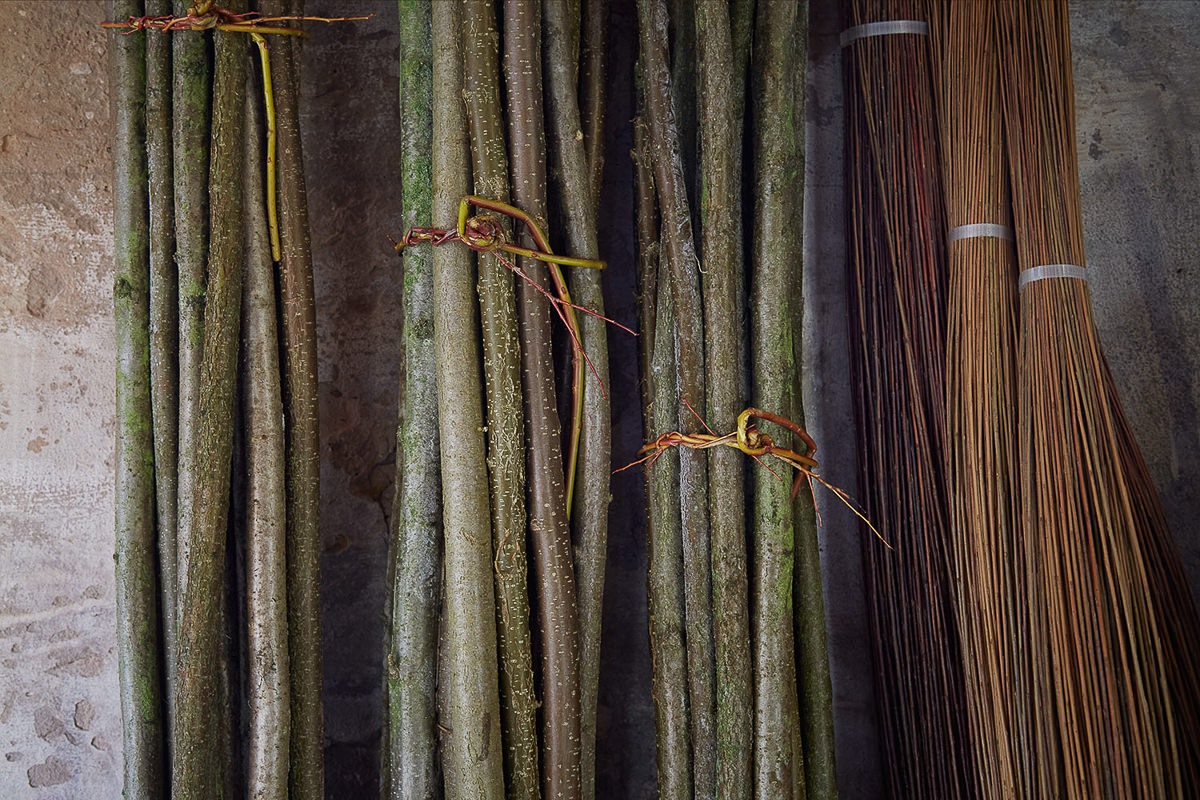
The material shown on the left side of the photo is a hazel twig. Benjamin harvests only what he needs at the time of making, from plants that grow naturally in hedgerows.
He says he especially prefers hazel in winter, choosing pieces that are fresh and healthy.
As a material, hazel is easy to split lengthwise and to twist. It is strong yet lightweight, making it well suited for basketry.
Depending on the piece, European chestnut, dogwood, and buckthorn may also be used.
This traditional basket form, rooted in the rural regions of western France, is introduced here as the “Shopping Basket Mini.”
This piece is the oval type among them.
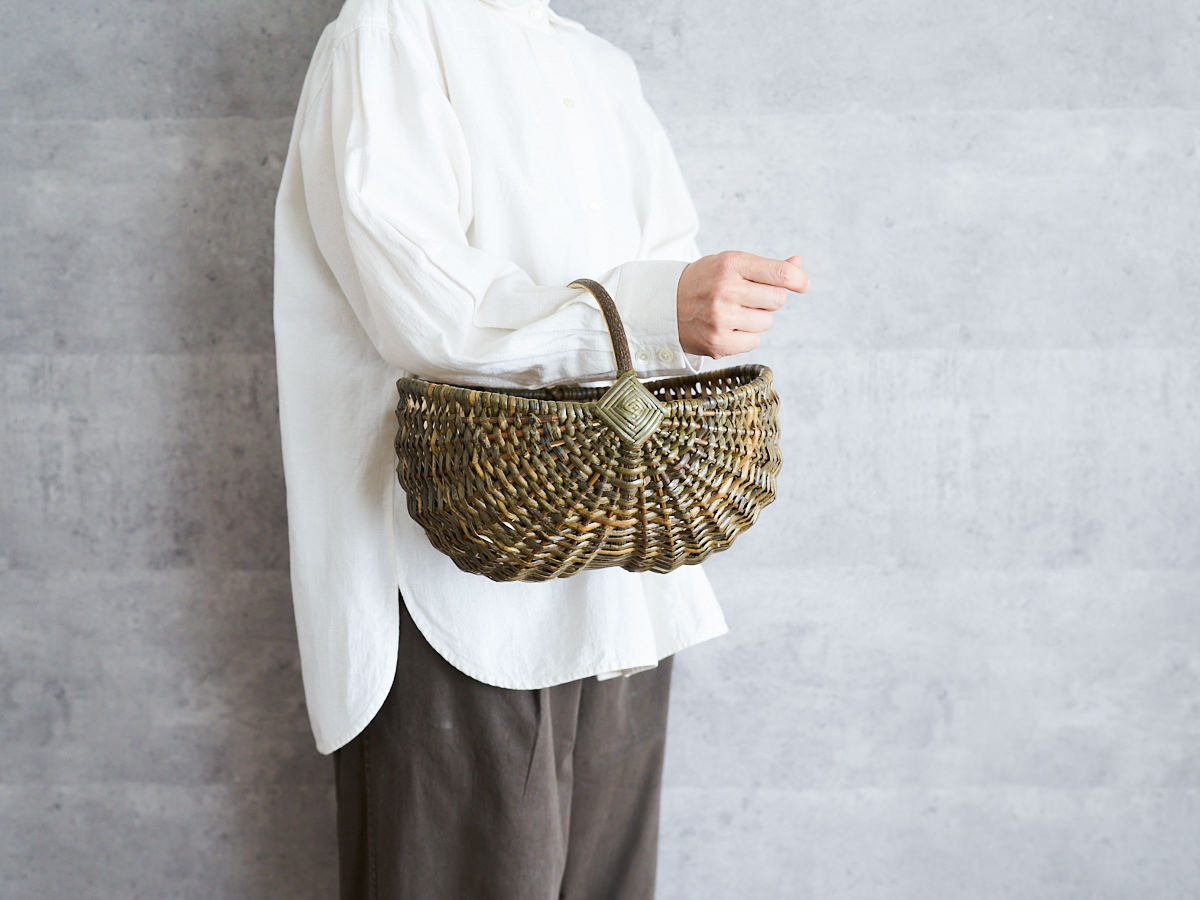
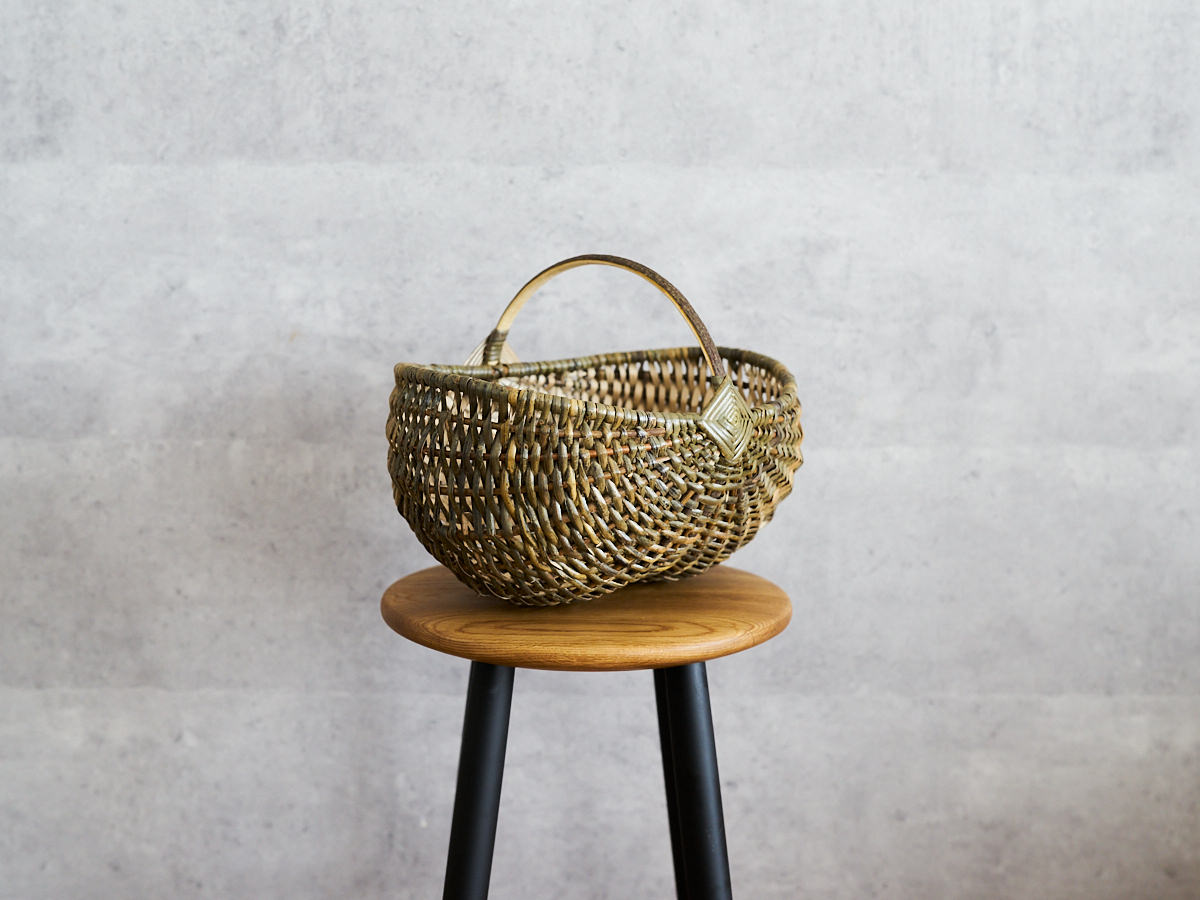
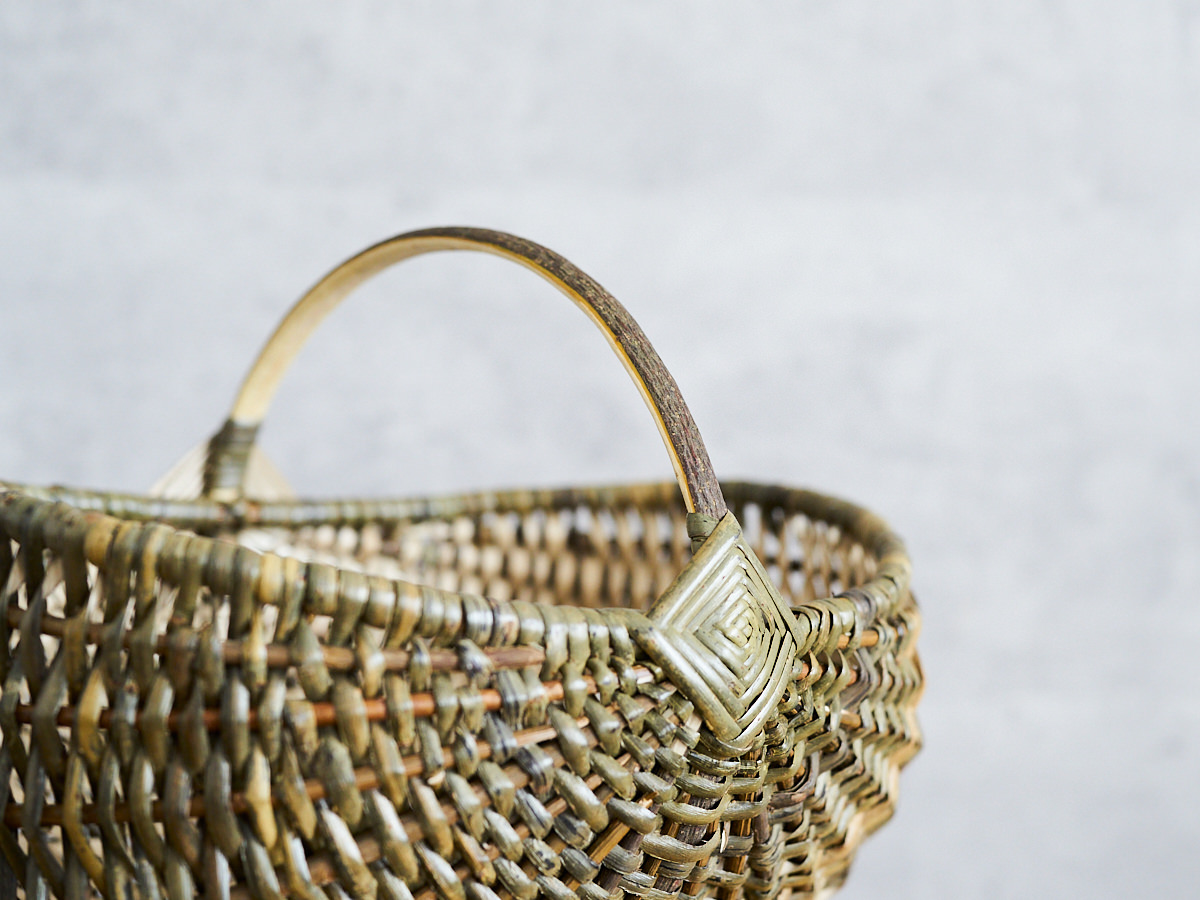
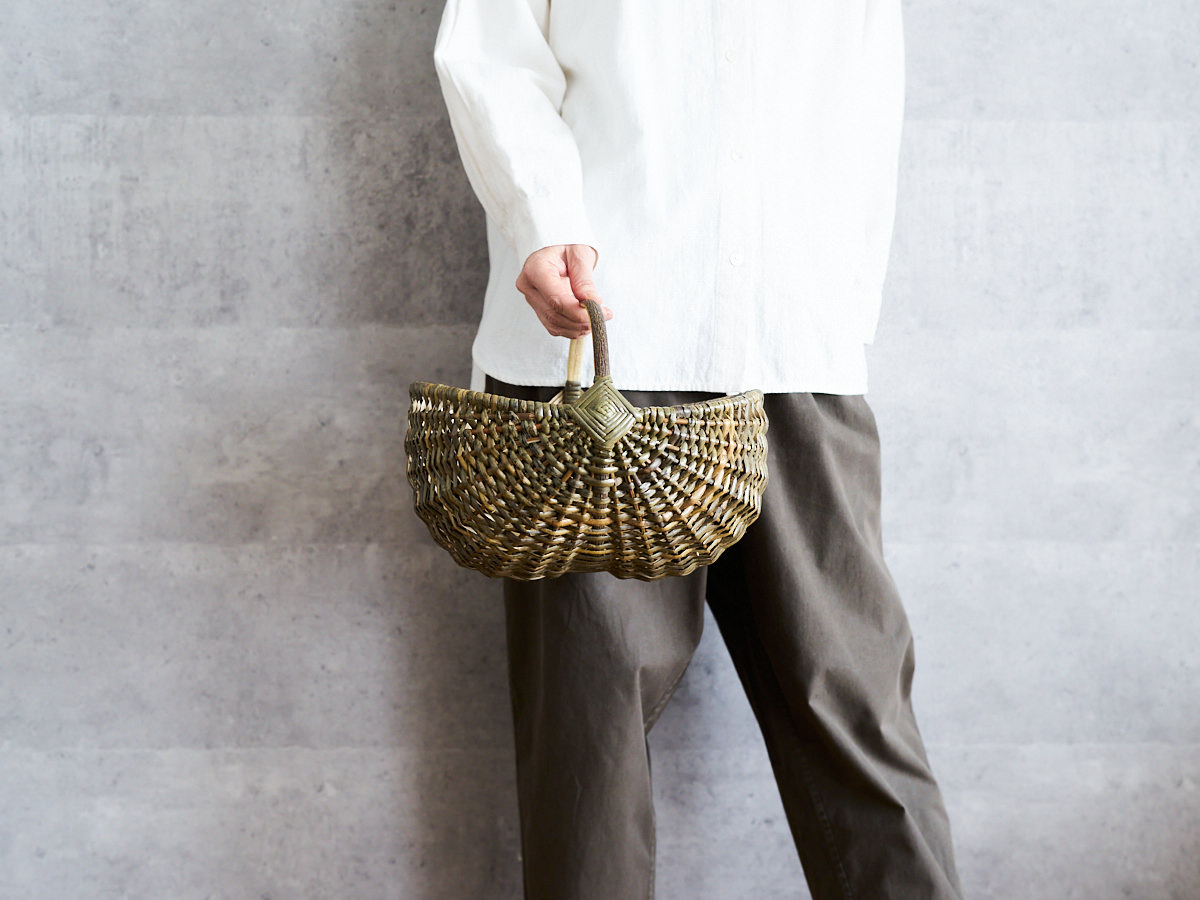
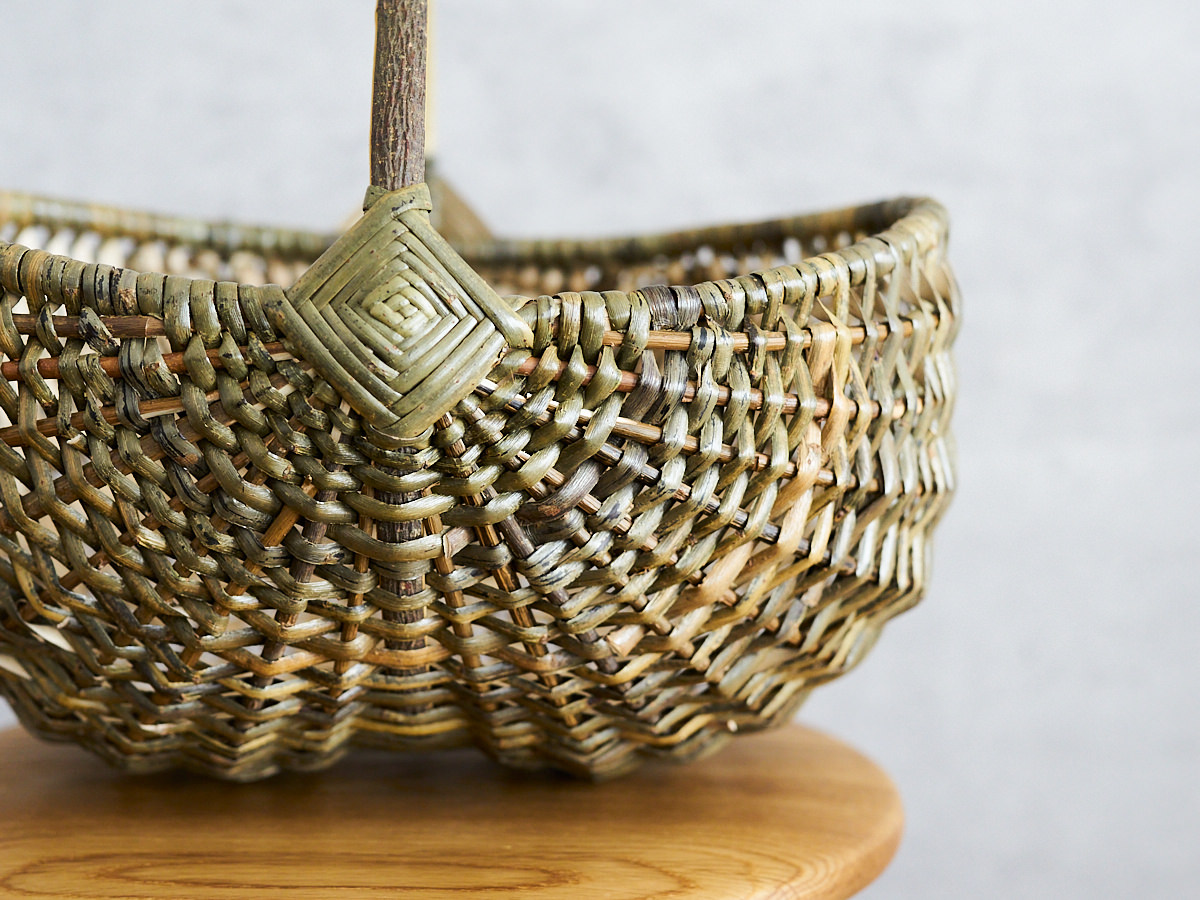
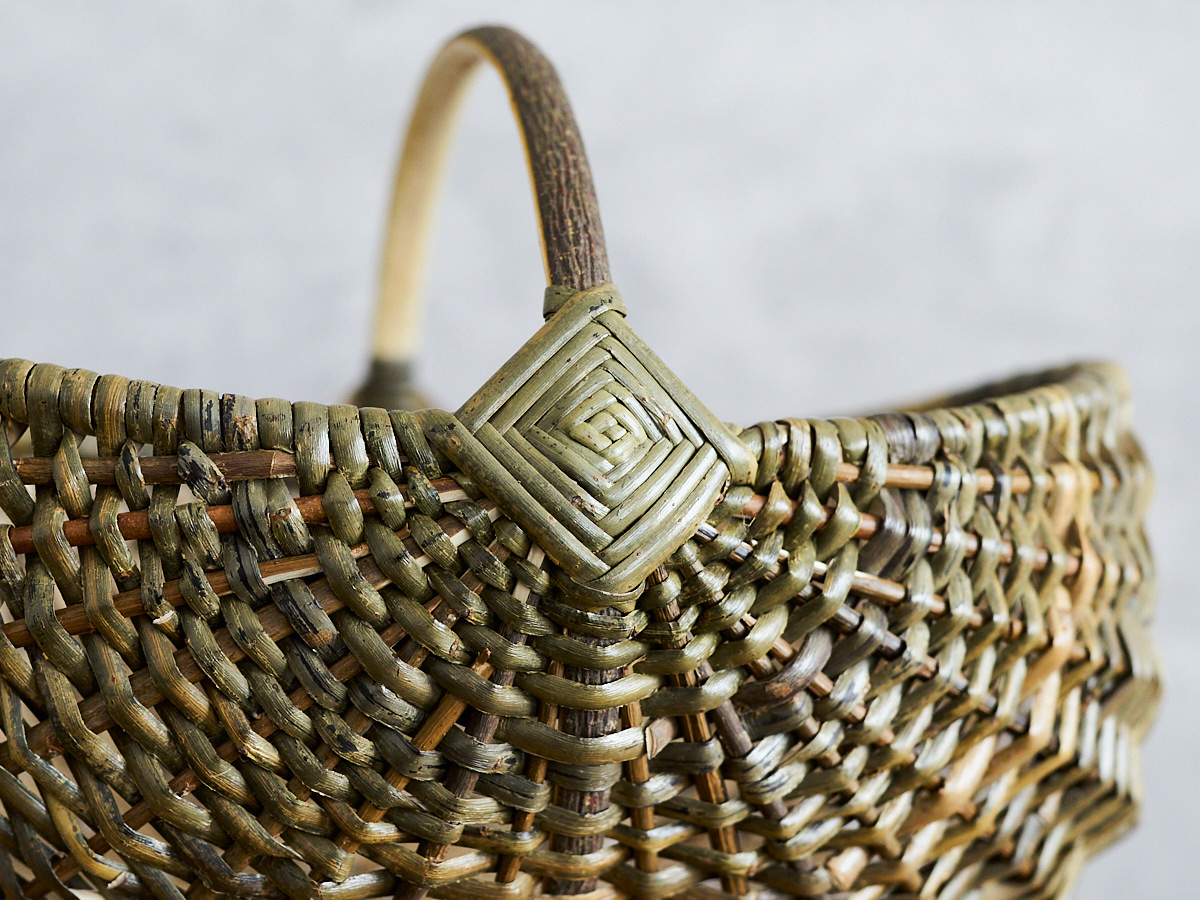
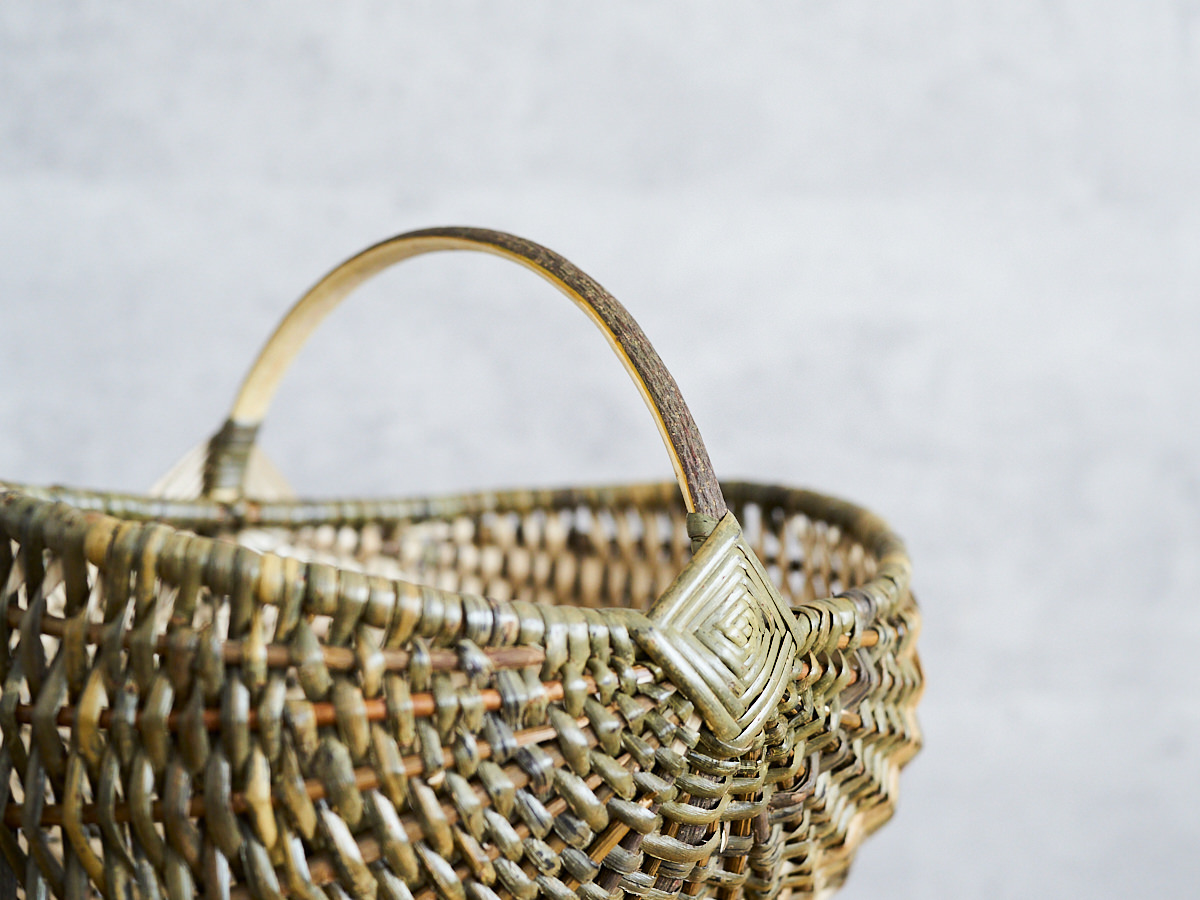
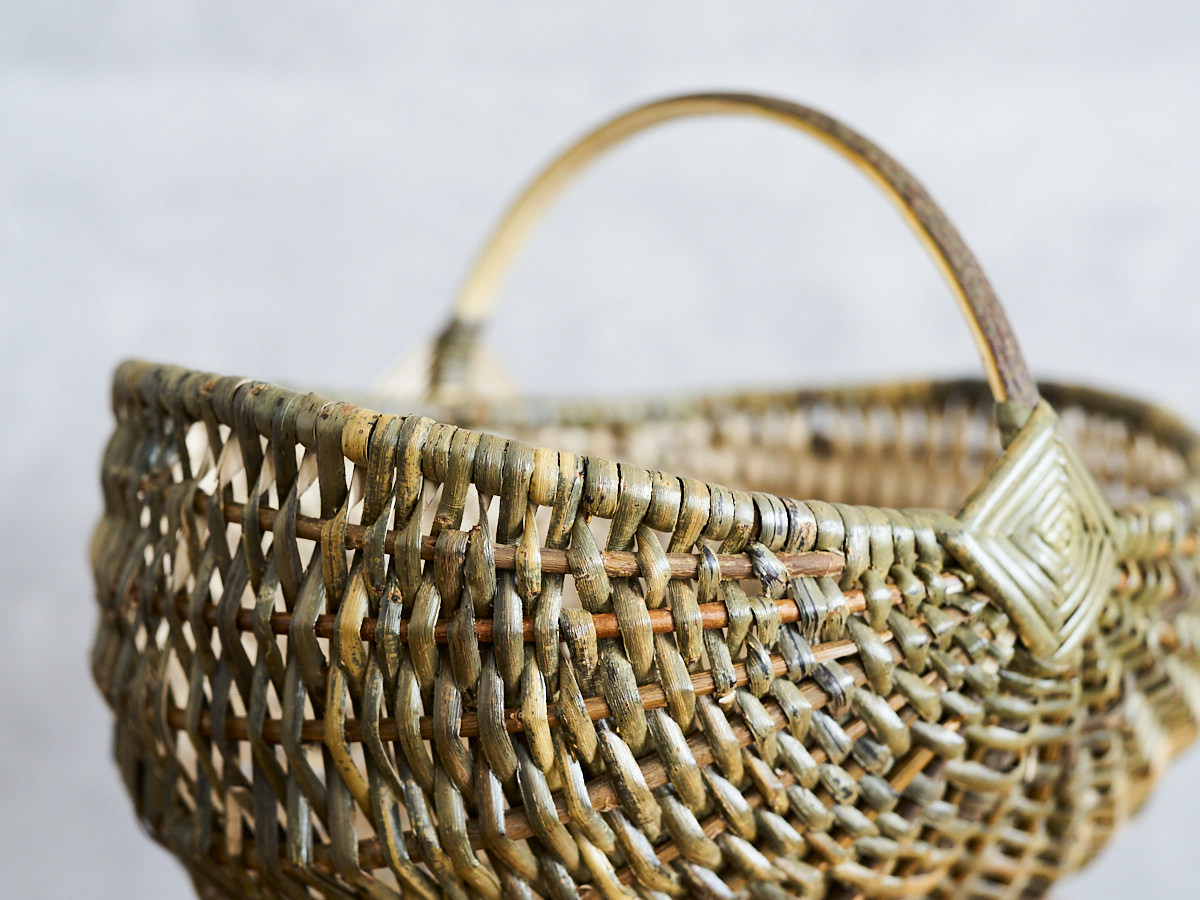
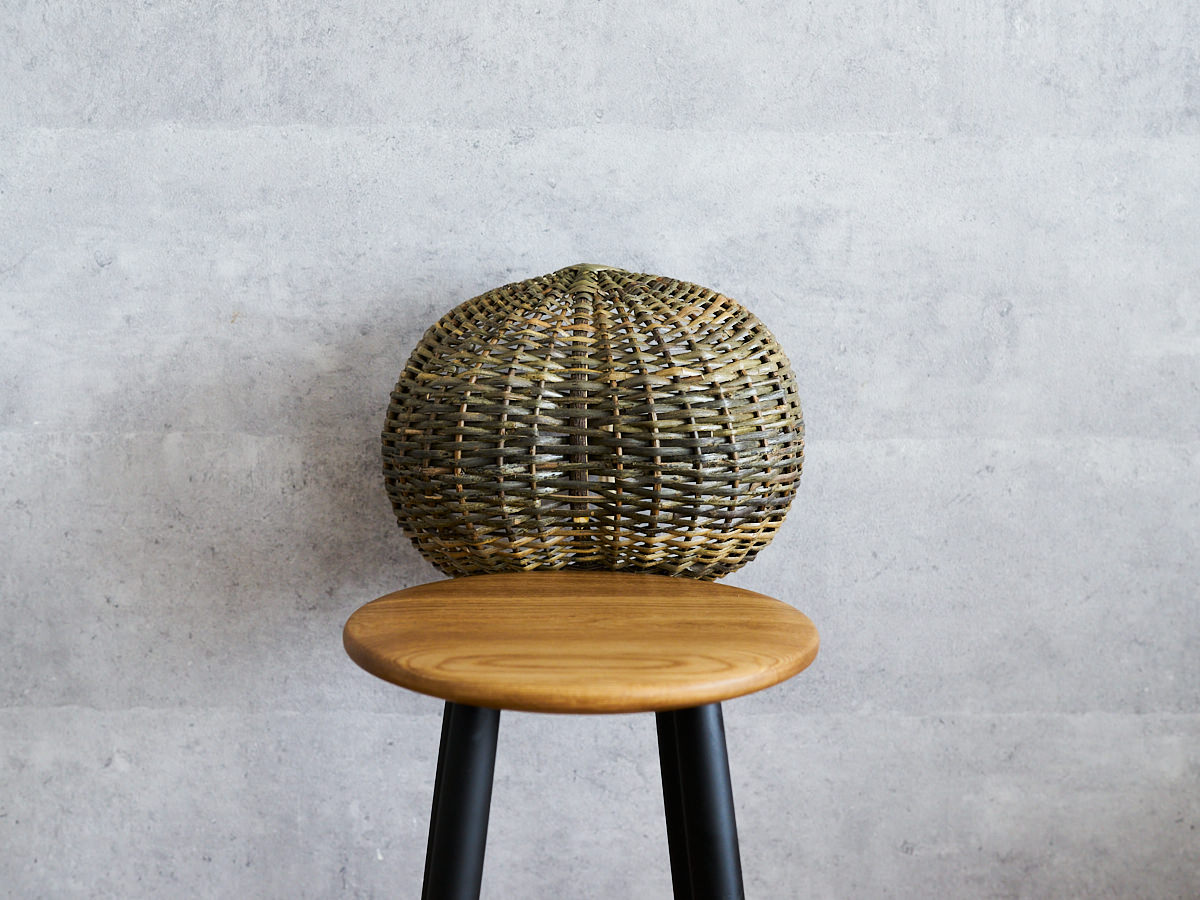
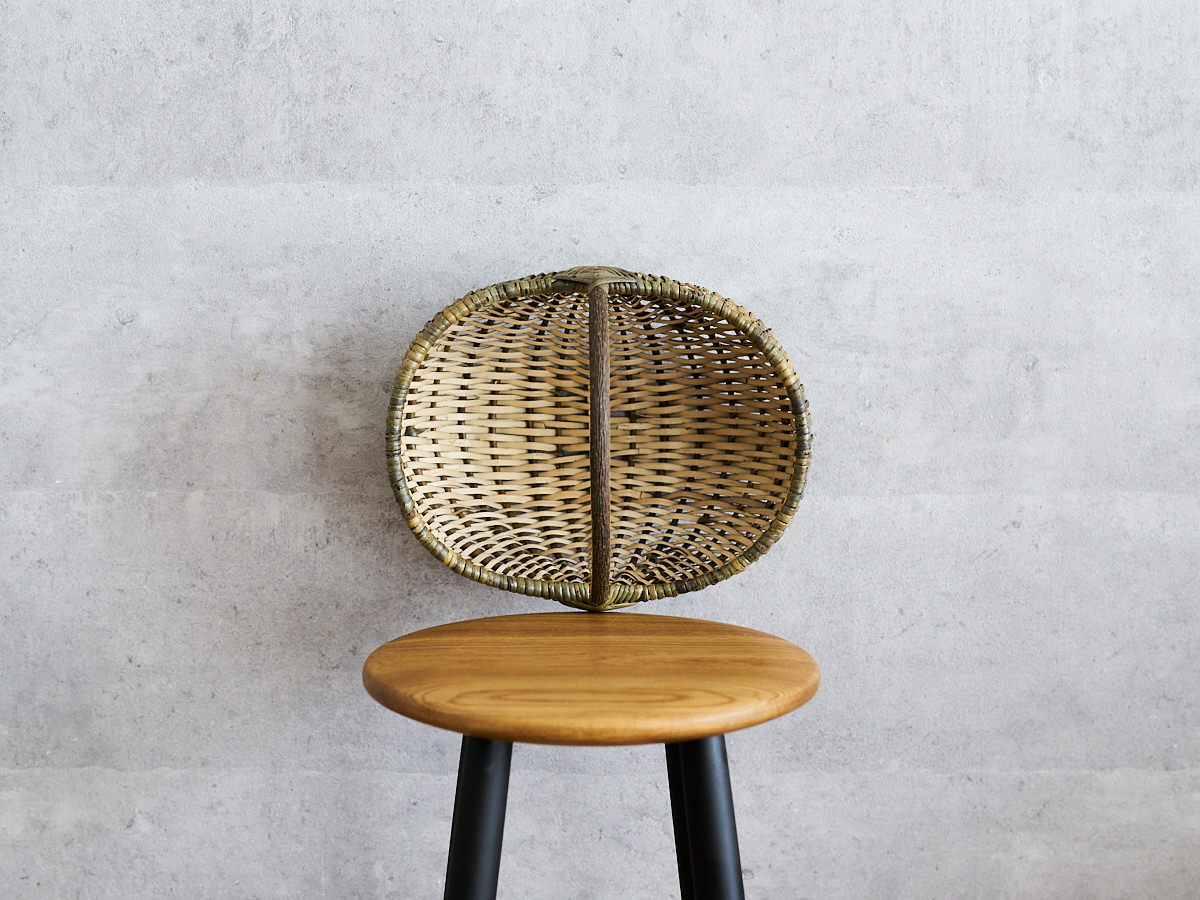
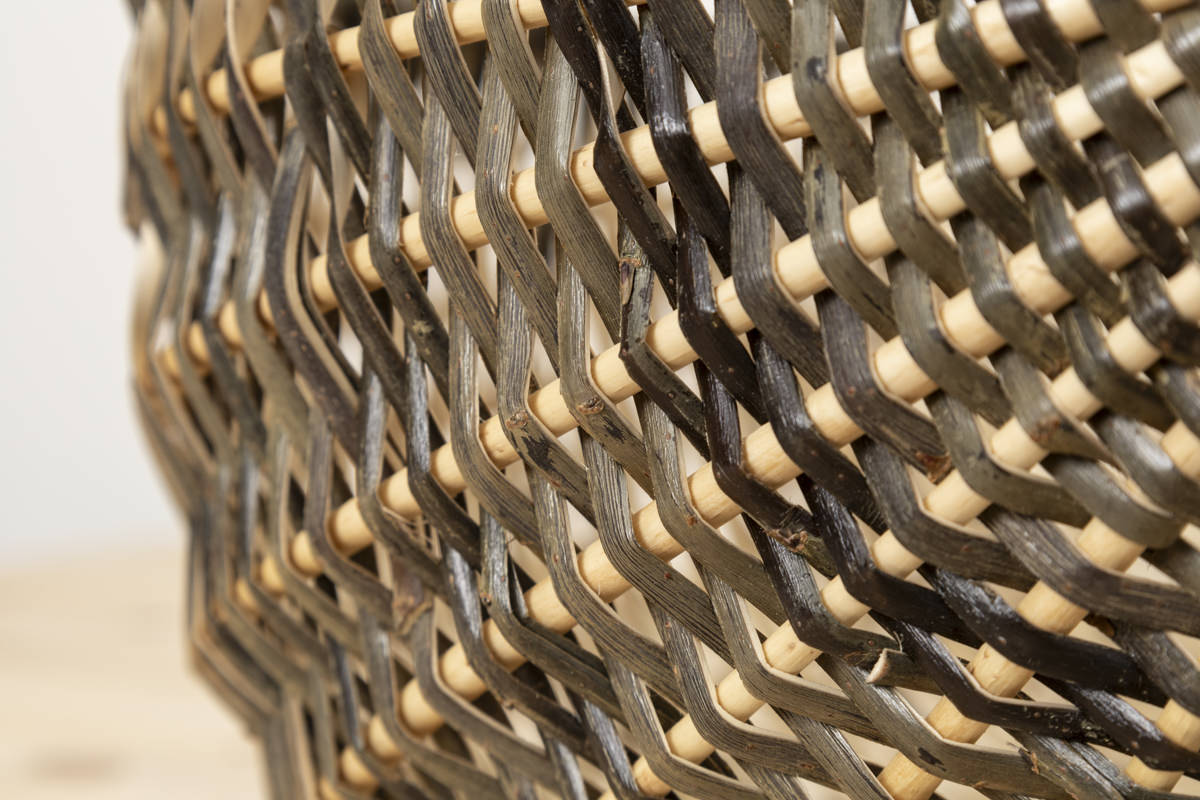
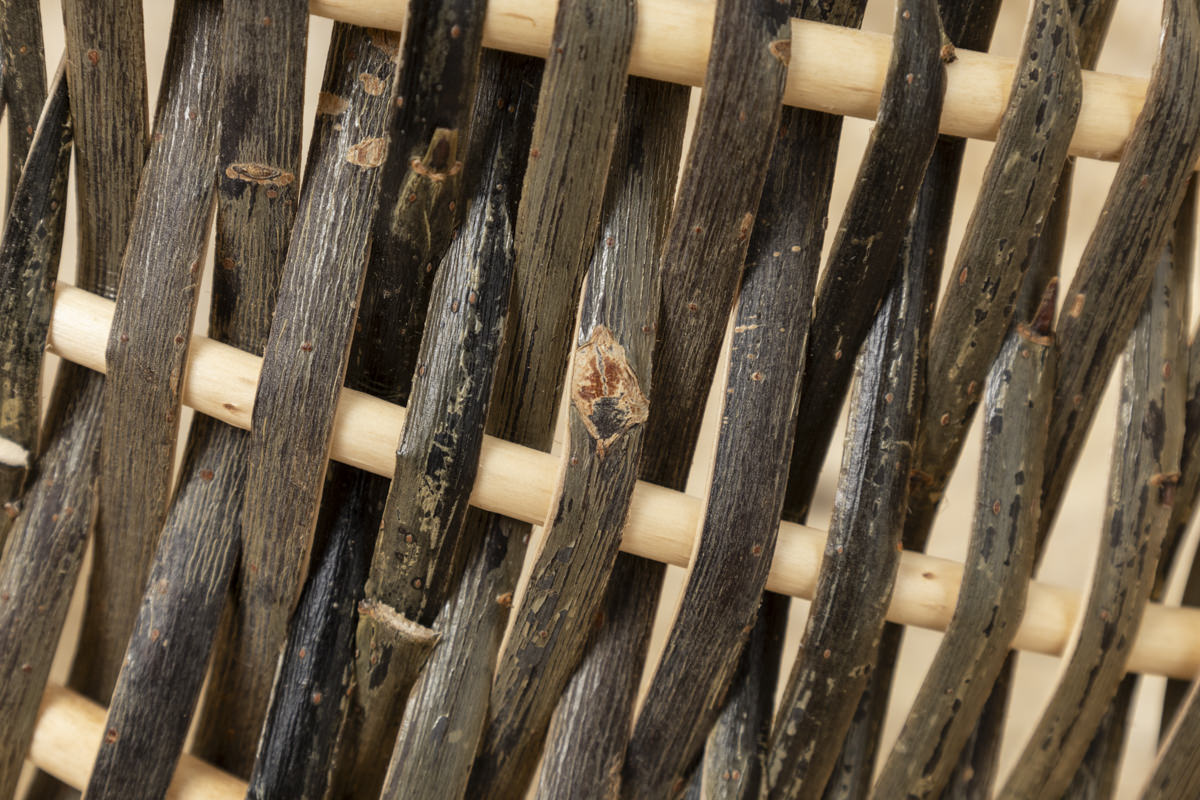
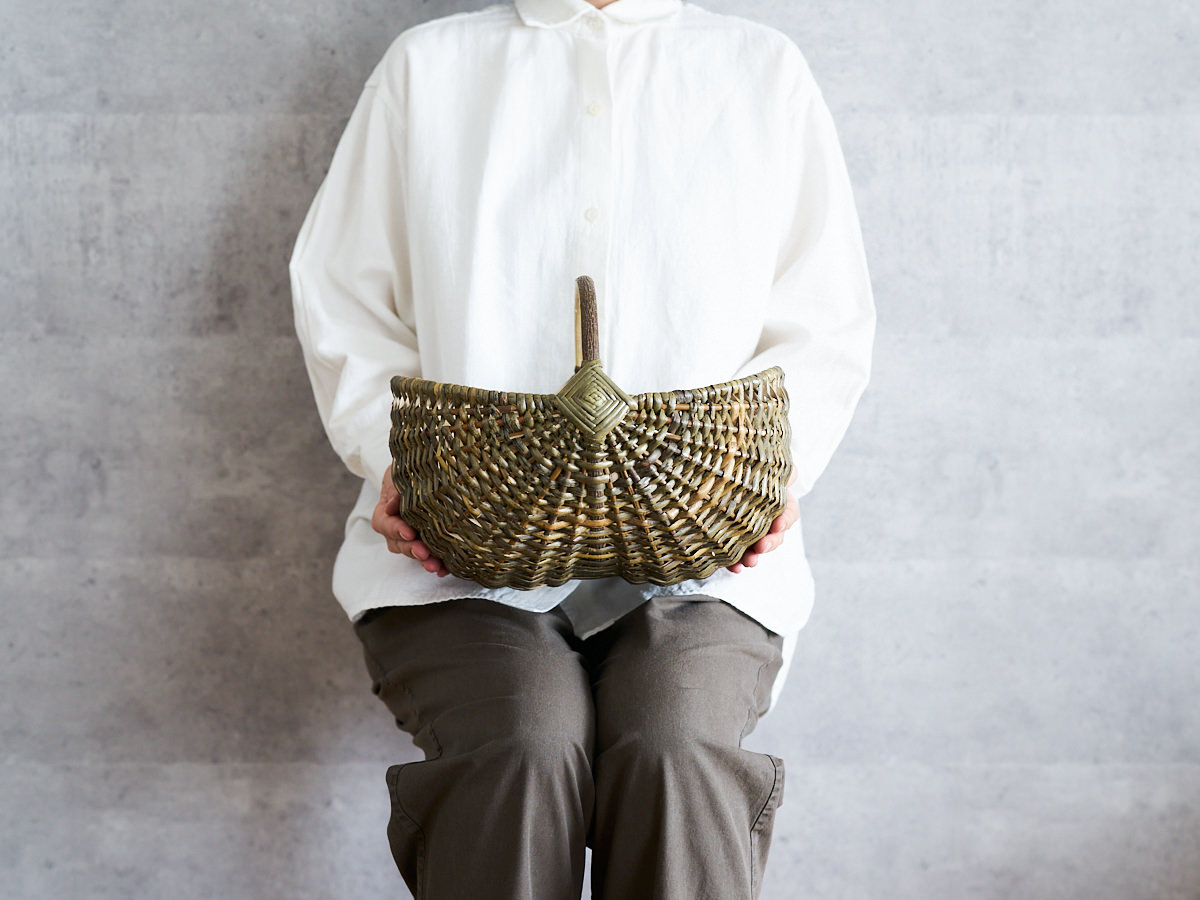
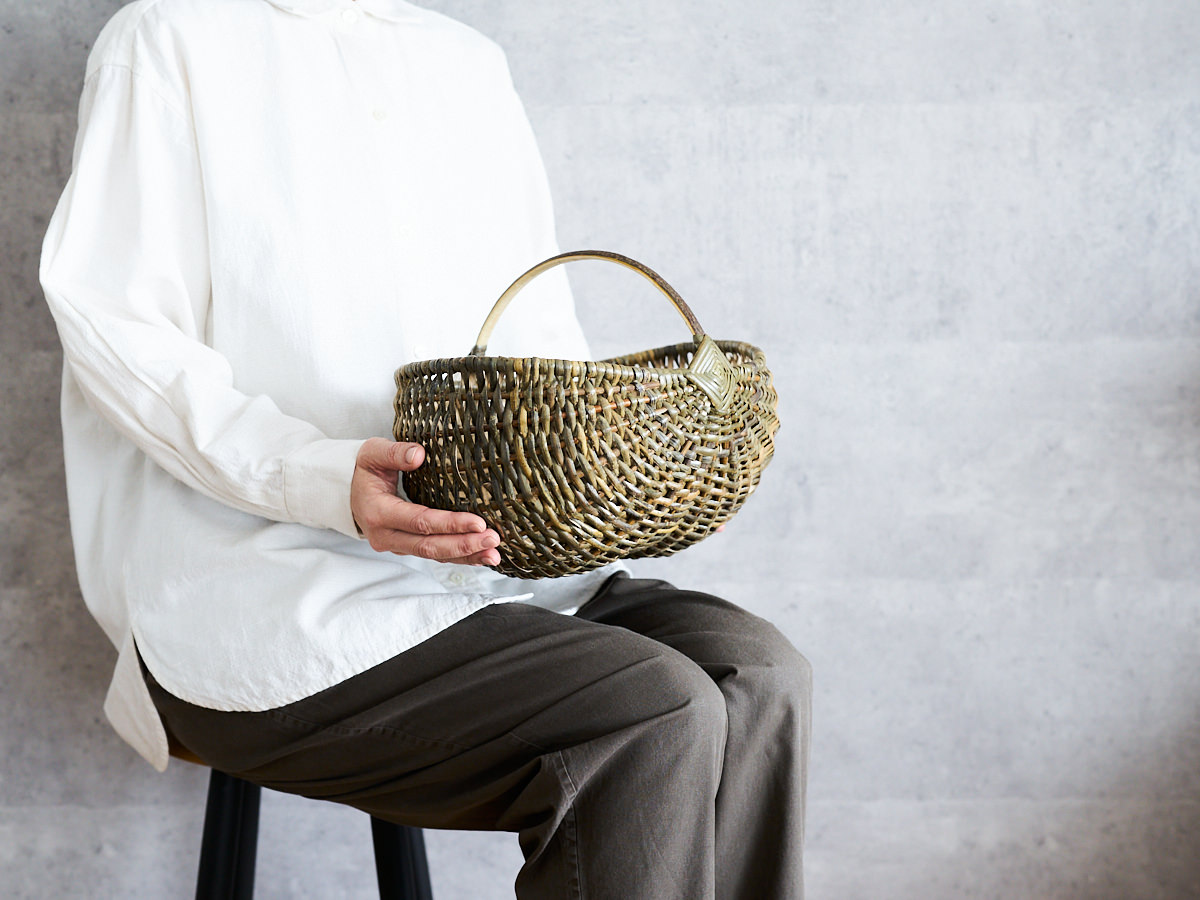
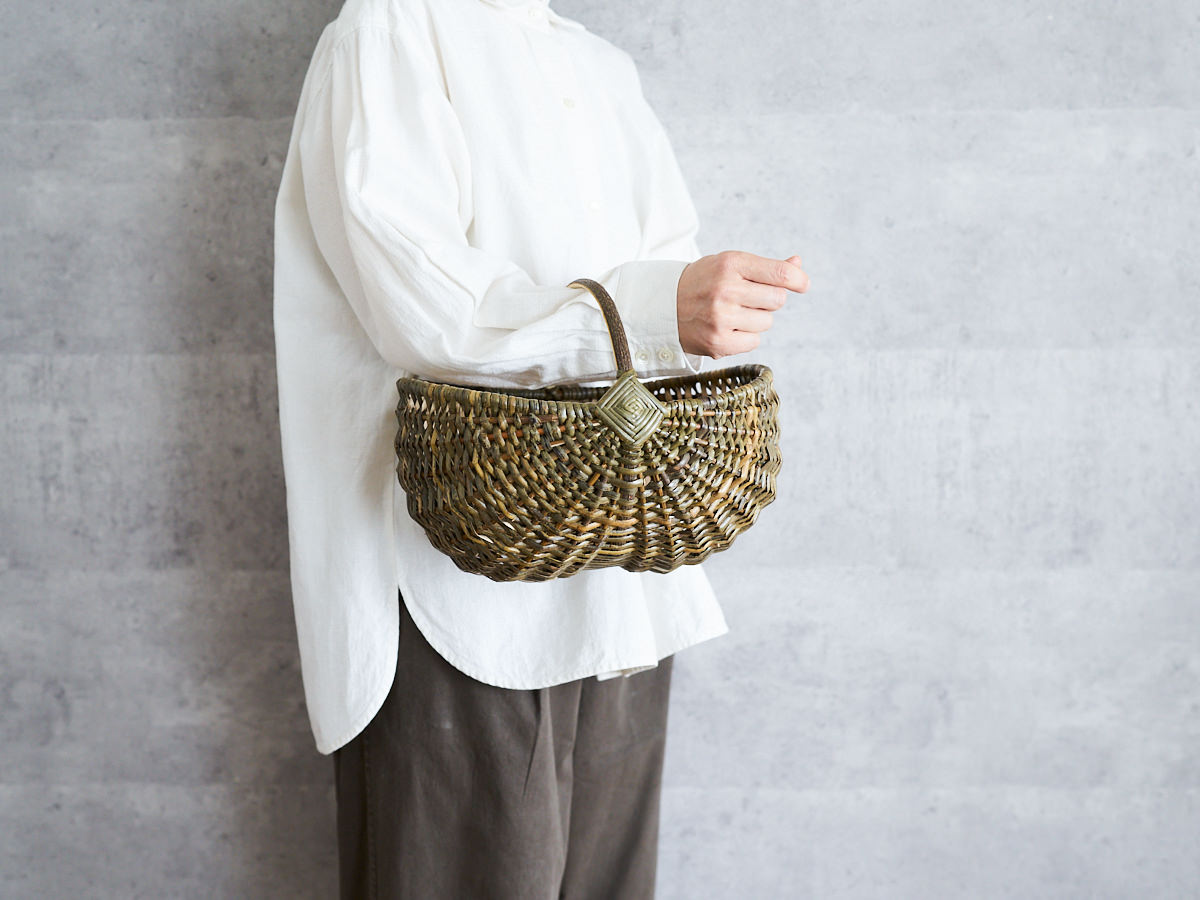
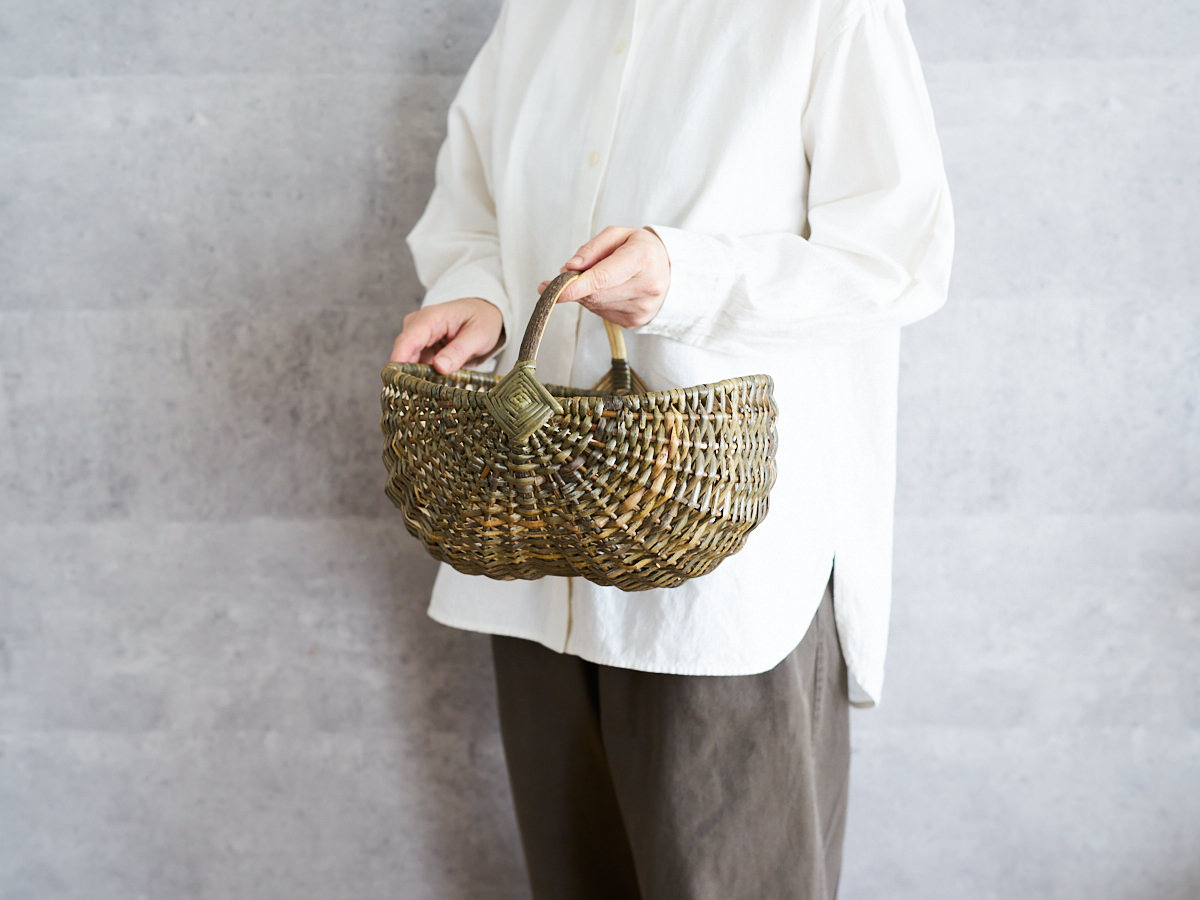
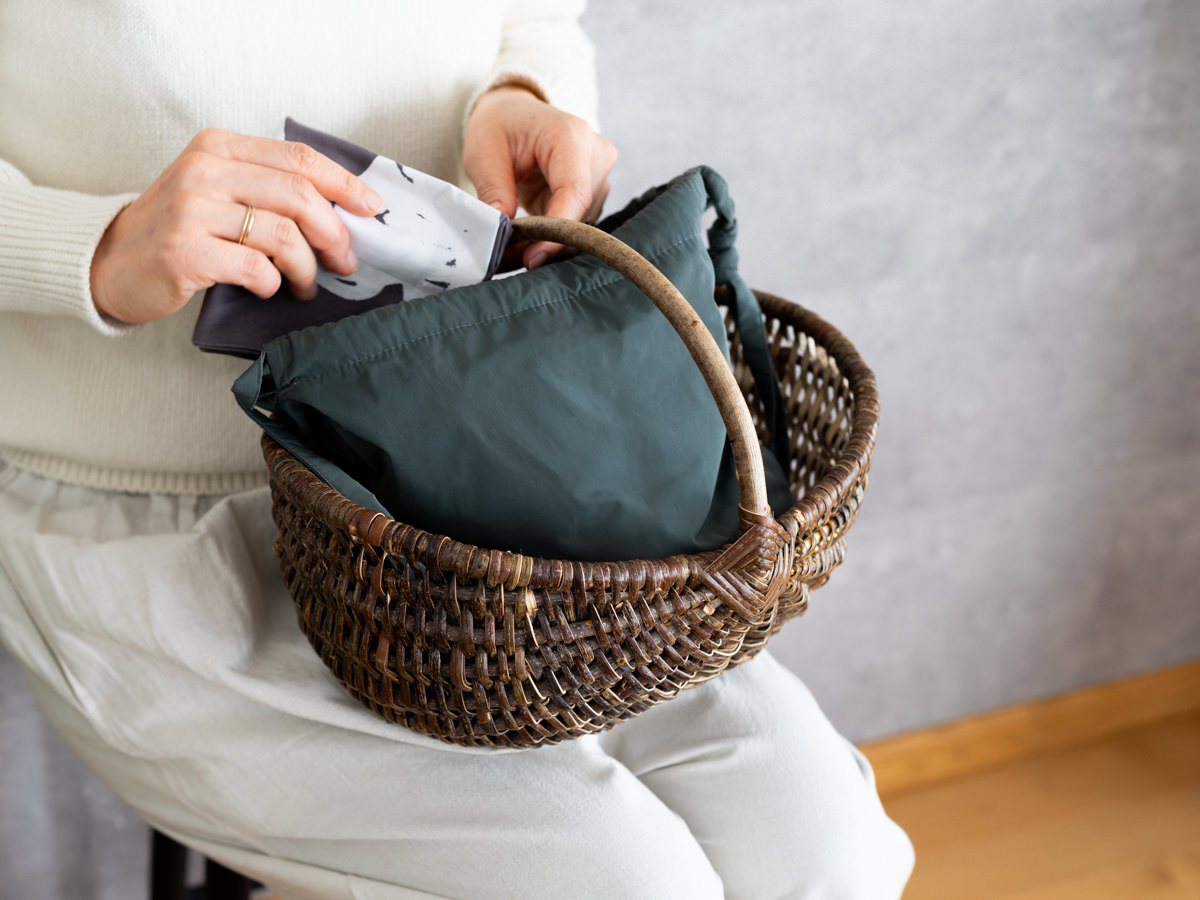
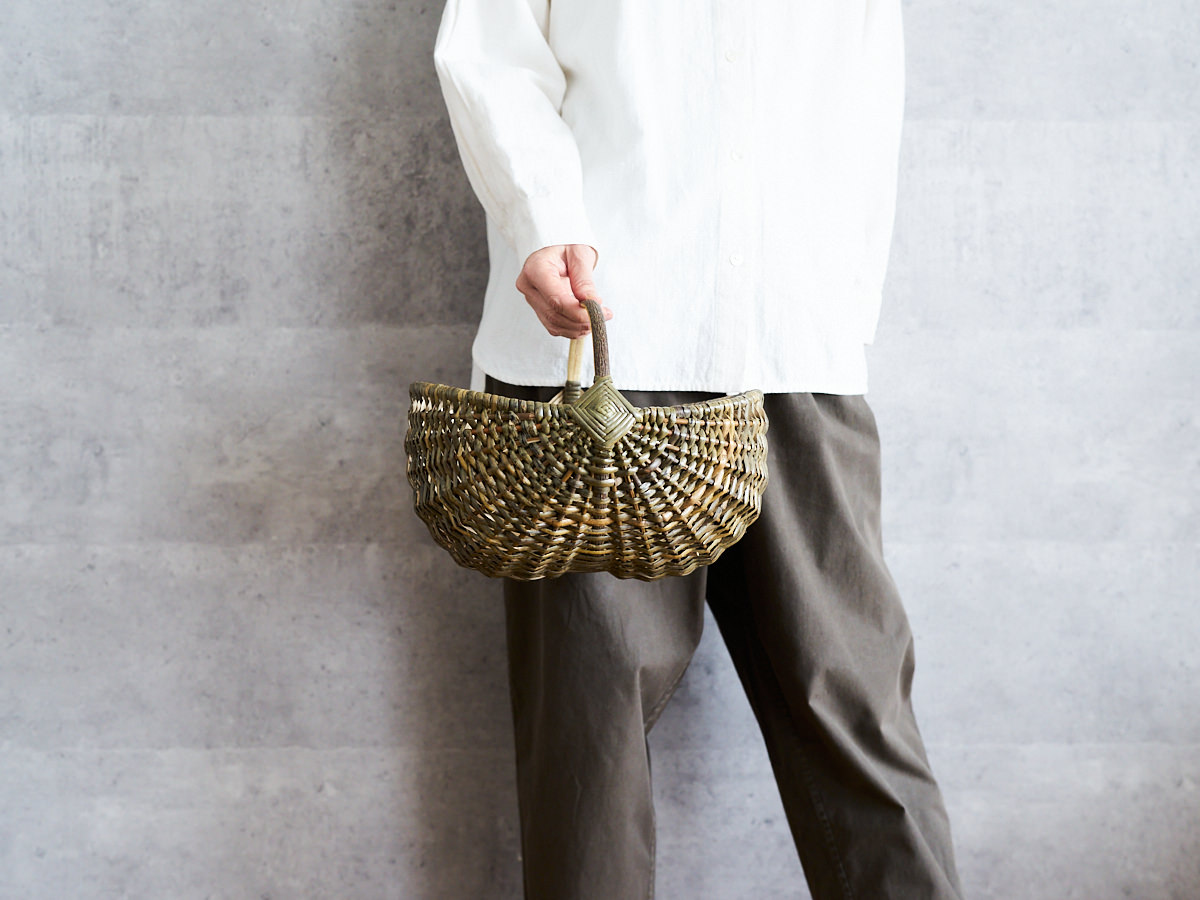
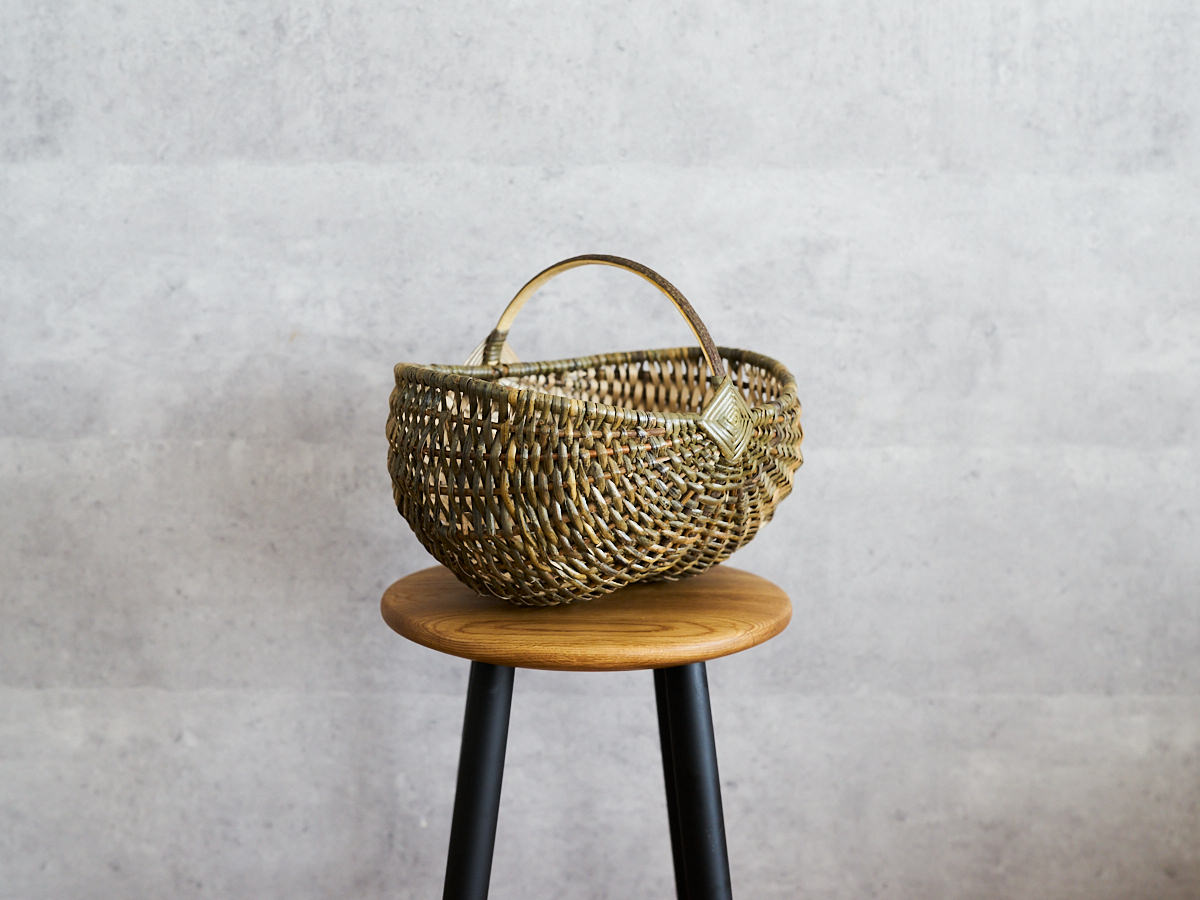
This basket begins with a cross-shaped framework, formed by the handle and the rim, and is made from hazel (or, depending on the availability of materials, European chestnut, buckthorn, or dogwood). The vertical elements are made from slender willow rods with the bark still intact, while the horizontal elements are woven from thin strips of willow bark, alternating over and under as they are worked.This is the point where the handle and the basket are joined. It features a diamond-shaped decorative weave, characteristic of European basketry.This is the handle. It is smoothly finished and comfortable to hold. The natural mottled pattern of the branches adds a sense of warmth and quiet charm.This is the rim of the basket. It is so smoothly finished that you can hardly feel any unevenness. There are almost no gaps, showing how carefully and attentively it has been wrapped. The way it gently rises toward the outside of the basket also gives it a refined and appealing form.This is the base of the basket. It forms an oval shape drawn with gentle, flowing curves.It allows for easy placing in and taking out of items, making it a reliable basket for everyday use.Woven from willow bark strips in subtly varied tones—deep green and soft khaki—the basket has a calm presence and a rich, nuanced character.As a natural characteristic of willow bark, you may notice nodes or buds on the surface, as well as slight peeling of the outer layer, as shown in the photo. These are natural features and do not affect use, and therefore are not considered defects. Thank you for your understanding.When held with both hands, the shape of the basket fits naturally into the curve of your palms.Although it is tightly woven with minimal gaps, it remains surprisingly light, making it easy to carry without strain.It can be carried over the arm, making it a convenient size for everyday outings as a hand basket.While not particularly large, it holds items such as fruits and vegetables securely, even when filled with various things. Above all, it makes everyday shopping feel more enjoyable.
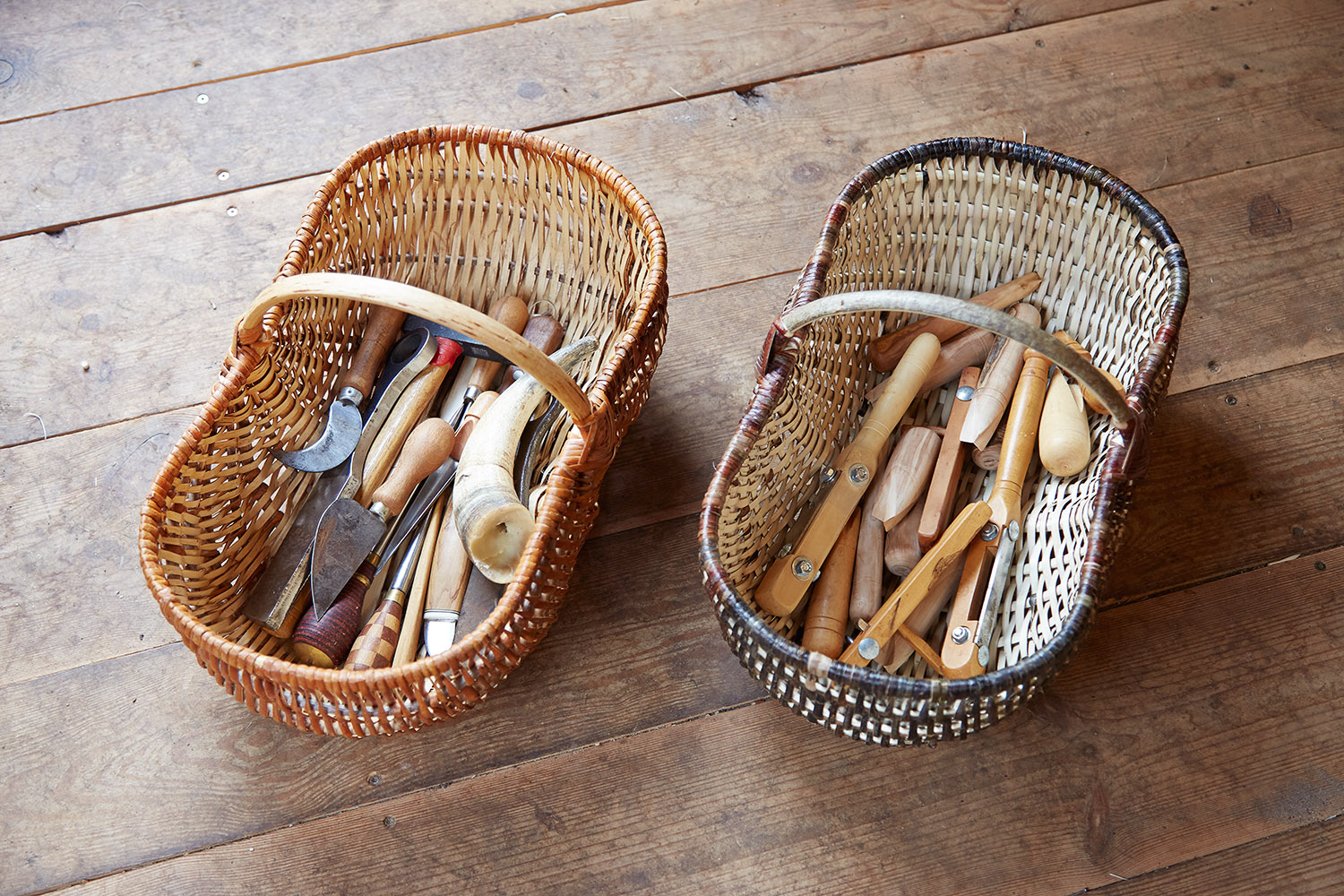
The maker, Benjamin, uses a basket of the same construction as a tool carrier when making his baskets.
In keeping with its original use, it would also be well suited for harvesting vegetables such as potatoes from a home garden, or for carrying tools and equipment for DIY projects and gardening.
This is the same basket made with willow branches in warmer tones. (This color variation is not currently in stock.)
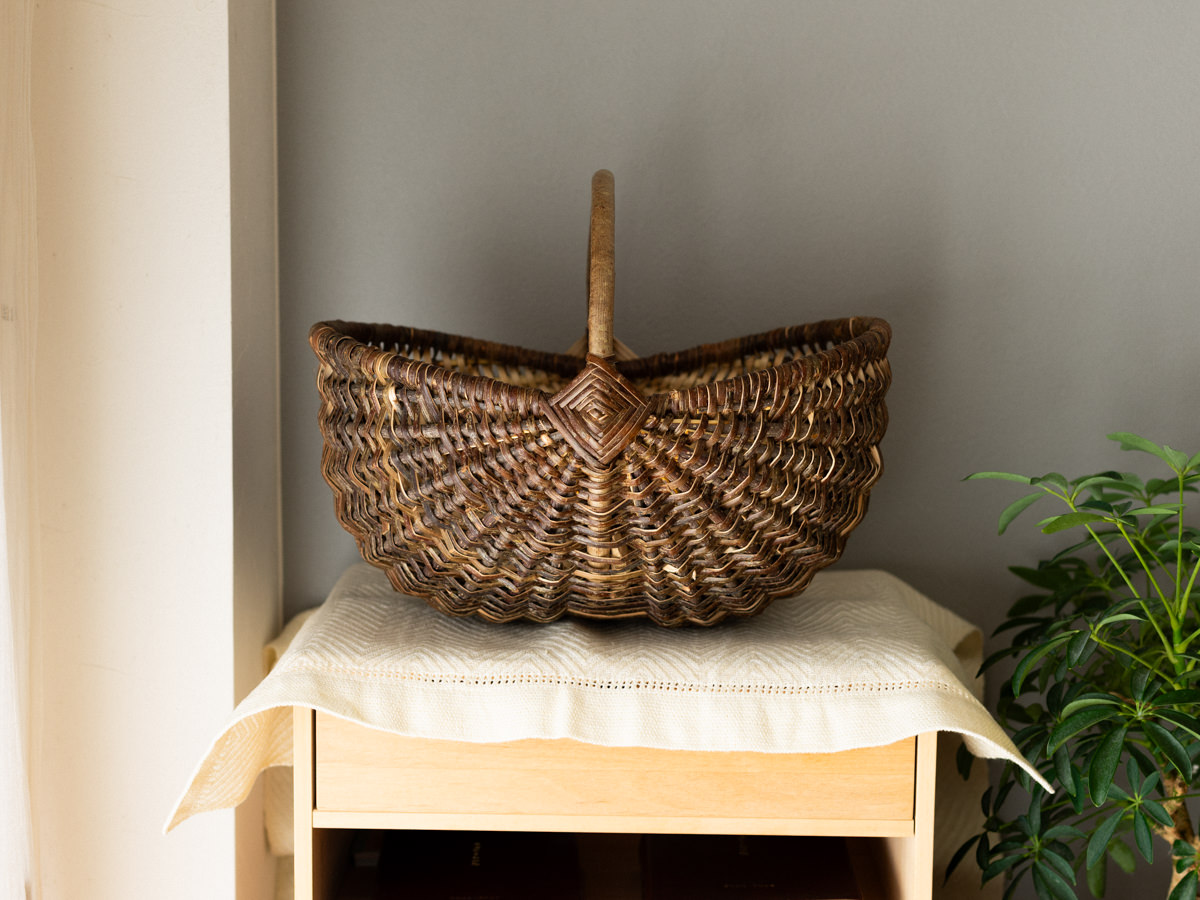
It can also be used indoors as a storage basket. You might gather and store charging devices, cords, or small everyday items such as medicine.
Even when items are placed in casually, simply covering them with a cloth allows it to blend in neatly as part of your interior.
With its wide opening, it also works well in a “bag-in-basket” style, placing a drawstring pouch or a bag inside.
(The current stock is not in warm tones, but in deeper green shades.)
The calm, deep green tones with subtle gradation blend easily with a wide range of interiors and clothing.
Though finely woven, this basket also offers durability. Such baskets, once traditionally made in France, are now rarely produced even locally.
Through the basket, one can sense the lives of farmers in France in earlier times.
While its size and form have been adapted for modern use, it remains a well-crafted basket that continues to support everyday life.
Please enjoy it as a companion for your daily shopping and outings.
*As natural materials are used, there may be variations in color from piece to piece. Some may appear lighter or darker, and the overall color balance may differ depending on the condition of the materials. For this reason, we cannot accept returns based on differences in color or texture. Thank you for your understanding.
Benjamin’s Basket Weaving
Before becoming a basket maker, Benjamin worked in fields such as biology, environmental studies, social work, and photography. Over time, however, he found himself weary of the fast-paced urban lifestyle.
Seeking a more meaningful way of living and working, he chose to devote himself to basket weaving.
“I love the simple feeling of touching wood, going out into nature, collecting hazel, and working with my hands,” he says.
“Baskets are used every day to carry and store things. Being able to make such objects—not by machine, but from renewable, local materials— gives me a sense of independence.”
He says his goal in basket making is always to reach perfection— a goal that can never truly be attained, which is precisely why it continues to inspire him. The baskets he creates are all of exceptional quality, beautifully shaped, and built to last.
Please also take a look at our journal featuring Benjamin from Germany.
Please note: This item ships from Japan. As the buyer, you are responsible for any import duties, customs fees, or local taxes that may be charged in your country. These costs are not included in the item price or shipping cost. Please check with your local customs authority if you are unsure about any potential charges before placing your order.
This basket is woven from willow bark, and features a handle.
The maker is Benjamin, who currently lives in Germany. Born and raised in France, he learned basketry from his father, also a basket maker, and mastered traditional French techniques.
This form is one of the traditional basket shapes commonly found in France, especially in the western regions.
According to Benjamin, until about two generations ago, farmers in western France (paysans) would make several of these practical baskets themselves each year during the winter farming off-season. These were carefully crafted, finely woven baskets made with time and patience.
Such baskets, made in this way, were commonly used as “potato baskets” to store harvested potatoes. This piece is a smaller version of that traditional form.
This basket is made using willow, a material commonly found in Europe, together with hazel.
While its fruit is widely known as “hazelnuts,” hazel—also called Corylus avellana—is a deciduous shrub belonging to the birch family.
In the United Kingdom, also in Europe, hazel is one of the most commonly seen shrubs. Since ancient times, it has been used as a material for thatching roofs, as well as for wattle fencing, coracle boats, and walking sticks—making it an essential material in everyday life.
The material shown on the left side of the photo is a hazel twig. Benjamin harvests only what he needs at the time of making, from plants that grow naturally in hedgerows.
He says he especially prefers hazel in winter, choosing pieces that are fresh and healthy.
As a material, hazel is easy to split lengthwise and to twist. It is strong yet lightweight, making it well suited for basketry.
Depending on the piece, European chestnut, dogwood, and buckthorn may also be used.
This traditional basket form, rooted in the rural regions of western France, is introduced here as the “Shopping Basket Mini.”
This piece is the oval type among them.
This basket begins with a cross-shaped framework, formed by the handle and the rim, and is made from hazel (or, depending on the availability of materials, European chestnut, buckthorn, or dogwood). The vertical elements are made from slender willow rods with the bark still intact, while the horizontal elements are woven from thin strips of willow bark, alternating over and under as they are worked.This is the point where the handle and the basket are joined. It features a diamond-shaped decorative weave, characteristic of European basketry.This is the handle. It is smoothly finished and comfortable to hold. The natural mottled pattern of the branches adds a sense of warmth and quiet charm.This is the rim of the basket. It is so smoothly finished that you can hardly feel any unevenness. There are almost no gaps, showing how carefully and attentively it has been wrapped. The way it gently rises toward the outside of the basket also gives it a refined and appealing form.This is the base of the basket. It forms an oval shape drawn with gentle, flowing curves.It allows for easy placing in and taking out of items, making it a reliable basket for everyday use.Woven from willow bark strips in subtly varied tones—deep green and soft khaki—the basket has a calm presence and a rich, nuanced character.As a natural characteristic of willow bark, you may notice nodes or buds on the surface, as well as slight peeling of the outer layer, as shown in the photo. These are natural features and do not affect use, and therefore are not considered defects. Thank you for your understanding.When held with both hands, the shape of the basket fits naturally into the curve of your palms.Although it is tightly woven with minimal gaps, it remains surprisingly light, making it easy to carry without strain.It can be carried over the arm, making it a convenient size for everyday outings as a hand basket.While not particularly large, it holds items such as fruits and vegetables securely, even when filled with various things. Above all, it makes everyday shopping feel more enjoyable.
The maker, Benjamin, uses a basket of the same construction as a tool carrier when making his baskets.
In keeping with its original use, it would also be well suited for harvesting vegetables such as potatoes from a home garden, or for carrying tools and equipment for DIY projects and gardening.
This is the same basket made with willow branches in warmer tones. (This color variation is not currently in stock.)
It can also be used indoors as a storage basket. You might gather and store charging devices, cords, or small everyday items such as medicine.
Even when items are placed in casually, simply covering them with a cloth allows it to blend in neatly as part of your interior.
With its wide opening, it also works well in a “bag-in-basket” style, placing a drawstring pouch or a bag inside.
(The current stock is not in warm tones, but in deeper green shades.)
The calm, deep green tones with subtle gradation blend easily with a wide range of interiors and clothing.
Though finely woven, this basket also offers durability. Such baskets, once traditionally made in France, are now rarely produced even locally.
Through the basket, one can sense the lives of farmers in France in earlier times.
While its size and form have been adapted for modern use, it remains a well-crafted basket that continues to support everyday life.
Please enjoy it as a companion for your daily shopping and outings.
*As natural materials are used, there may be variations in color from piece to piece. Some may appear lighter or darker, and the overall color balance may differ depending on the condition of the materials. For this reason, we cannot accept returns based on differences in color or texture. Thank you for your understanding.
Benjamin’s Basket Weaving
Before becoming a basket maker, Benjamin worked in fields such as biology, environmental studies, social work, and photography. Over time, however, he found himself weary of the fast-paced urban lifestyle.
Seeking a more meaningful way of living and working, he chose to devote himself to basket weaving.
“I love the simple feeling of touching wood, going out into nature, collecting hazel, and working with my hands,” he says.
“Baskets are used every day to carry and store things. Being able to make such objects—not by machine, but from renewable, local materials— gives me a sense of independence.”
He says his goal in basket making is always to reach perfection— a goal that can never truly be attained, which is precisely why it continues to inspire him. The baskets he creates are all of exceptional quality, beautifully shaped, and built to last.
Please also take a look at our journal featuring Benjamin from Germany.
Please note: This item ships from Japan. As the buyer, you are responsible for any import duties, customs fees, or local taxes that may be charged in your country. These costs are not included in the item price or shipping cost. Please check with your local customs authority if you are unsure about any potential charges before placing your order.
This basket is woven from willow bark, and features a handle.
The maker is Benjamin, who currently lives in Germany. Born and raised in France, he learned basketry from his father, also a basket maker, and mastered traditional French techniques.
This form is one of the traditional basket shapes commonly found in France, especially in the western regions.
According to Benjamin, until about two generations ago, farmers in western France (paysans) would make several of these practical baskets themselves each year during the winter farming off-season. These were carefully crafted, finely woven baskets made with time and patience.
Such baskets, made in this way, were commonly used as “potato baskets” to store harvested potatoes. This piece is a smaller version of that traditional form.
This basket is made using willow, a material commonly found in Europe, together with hazel.
While its fruit is widely known as “hazelnuts,” hazel—also called Corylus avellana—is a deciduous shrub belonging to the birch family.
In the United Kingdom, also in Europe, hazel is one of the most commonly seen shrubs. Since ancient times, it has been used as a material for thatching roofs, as well as for wattle fencing, coracle boats, and walking sticks—making it an essential material in everyday life.
The material shown on the left side of the photo is a hazel twig. Benjamin harvests only what he needs at the time of making, from plants that grow naturally in hedgerows.
He says he especially prefers hazel in winter, choosing pieces that are fresh and healthy.
As a material, hazel is easy to split lengthwise and to twist. It is strong yet lightweight, making it well suited for basketry.
Depending on the piece, European chestnut, dogwood, and buckthorn may also be used.
This traditional basket form, rooted in the rural regions of western France, is introduced here as the “Shopping Basket Mini.”
This piece is the oval type among them.
This basket begins with a cross-shaped framework, formed by the handle and the rim, and is made from hazel (or, depending on the availability of materials, European chestnut, buckthorn, or dogwood). The vertical elements are made from slender willow rods with the bark still intact, while the horizontal elements are woven from thin strips of willow bark, alternating over and under as they are worked.This is the point where the handle and the basket are joined. It features a diamond-shaped decorative weave, characteristic of European basketry.This is the handle. It is smoothly finished and comfortable to hold. The natural mottled pattern of the branches adds a sense of warmth and quiet charm.This is the rim of the basket. It is so smoothly finished that you can hardly feel any unevenness. There are almost no gaps, showing how carefully and attentively it has been wrapped. The way it gently rises toward the outside of the basket also gives it a refined and appealing form.This is the base of the basket. It forms an oval shape drawn with gentle, flowing curves.It allows for easy placing in and taking out of items, making it a reliable basket for everyday use.Woven from willow bark strips in subtly varied tones—deep green and soft khaki—the basket has a calm presence and a rich, nuanced character.As a natural characteristic of willow bark, you may notice nodes or buds on the surface, as well as slight peeling of the outer layer, as shown in the photo. These are natural features and do not affect use, and therefore are not considered defects. Thank you for your understanding.When held with both hands, the shape of the basket fits naturally into the curve of your palms.Although it is tightly woven with minimal gaps, it remains surprisingly light, making it easy to carry without strain.It can be carried over the arm, making it a convenient size for everyday outings as a hand basket.While not particularly large, it holds items such as fruits and vegetables securely, even when filled with various things. Above all, it makes everyday shopping feel more enjoyable.
The maker, Benjamin, uses a basket of the same construction as a tool carrier when making his baskets.
In keeping with its original use, it would also be well suited for harvesting vegetables such as potatoes from a home garden, or for carrying tools and equipment for DIY projects and gardening.
This is the same basket made with willow branches in warmer tones. (This color variation is not currently in stock.)
It can also be used indoors as a storage basket. You might gather and store charging devices, cords, or small everyday items such as medicine.
Even when items are placed in casually, simply covering them with a cloth allows it to blend in neatly as part of your interior.
With its wide opening, it also works well in a “bag-in-basket” style, placing a drawstring pouch or a bag inside.
(The current stock is not in warm tones, but in deeper green shades.)
The calm, deep green tones with subtle gradation blend easily with a wide range of interiors and clothing.
Though finely woven, this basket also offers durability. Such baskets, once traditionally made in France, are now rarely produced even locally.
Through the basket, one can sense the lives of farmers in France in earlier times.
While its size and form have been adapted for modern use, it remains a well-crafted basket that continues to support everyday life.
Please enjoy it as a companion for your daily shopping and outings.
*As natural materials are used, there may be variations in color from piece to piece. Some may appear lighter or darker, and the overall color balance may differ depending on the condition of the materials. For this reason, we cannot accept returns based on differences in color or texture. Thank you for your understanding.
Benjamin’s Basket Weaving
Before becoming a basket maker, Benjamin worked in fields such as biology, environmental studies, social work, and photography. Over time, however, he found himself weary of the fast-paced urban lifestyle.
Seeking a more meaningful way of living and working, he chose to devote himself to basket weaving.
“I love the simple feeling of touching wood, going out into nature, collecting hazel, and working with my hands,” he says.
“Baskets are used every day to carry and store things. Being able to make such objects—not by machine, but from renewable, local materials— gives me a sense of independence.”
He says his goal in basket making is always to reach perfection— a goal that can never truly be attained, which is precisely why it continues to inspire him. The baskets he creates are all of exceptional quality, beautifully shaped, and built to last.
Please also take a look at our journal featuring Benjamin from Germany.
Please note: This item ships from Japan. As the buyer, you are responsible for any import duties, customs fees, or local taxes that may be charged in your country. These costs are not included in the item price or shipping cost. Please check with your local customs authority if you are unsure about any potential charges before placing your order.