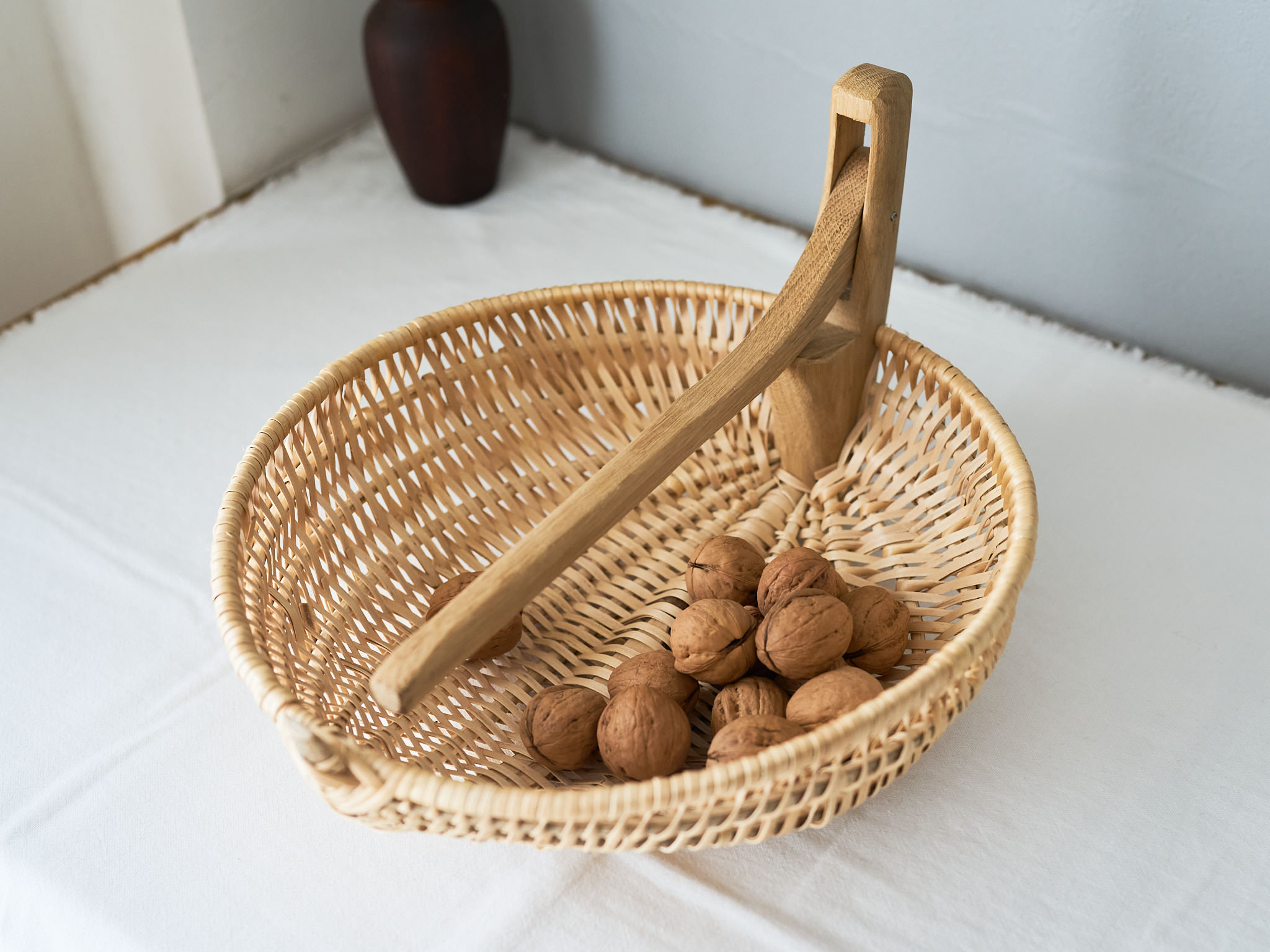
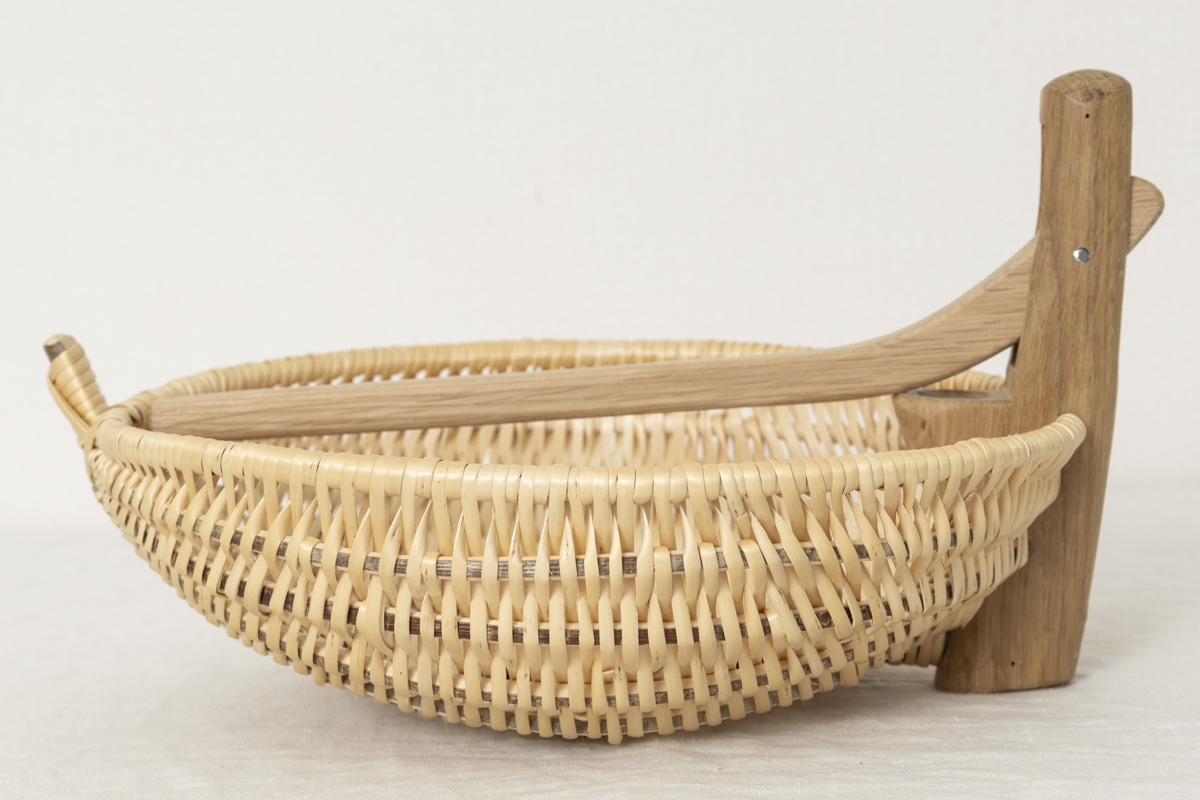
This shallow basket is woven from peeled willow (white willow).
The maker is Léon, who lives in France.
He is the father of Benjamin, who makes baskets in Germany, and a second-generation basket maker himself.
While passing on his basketry skills to his son Benjamin, Léon continues to make baskets in France to this day.
This basket is made using willow, a material commonly found in Europe, together with hazel.
While its fruit is widely known as “hazelnuts,” hazel—also called Corylus avellana—is a deciduous shrub belonging to the birch family.
In the United Kingdom, hazel is one of the most commonly seen shrubs. Since ancient times, it has been used as a material for thatching roofs, as well as for wattle fencing, coracle boats, and walking sticks—making it an essential material in everyday life.
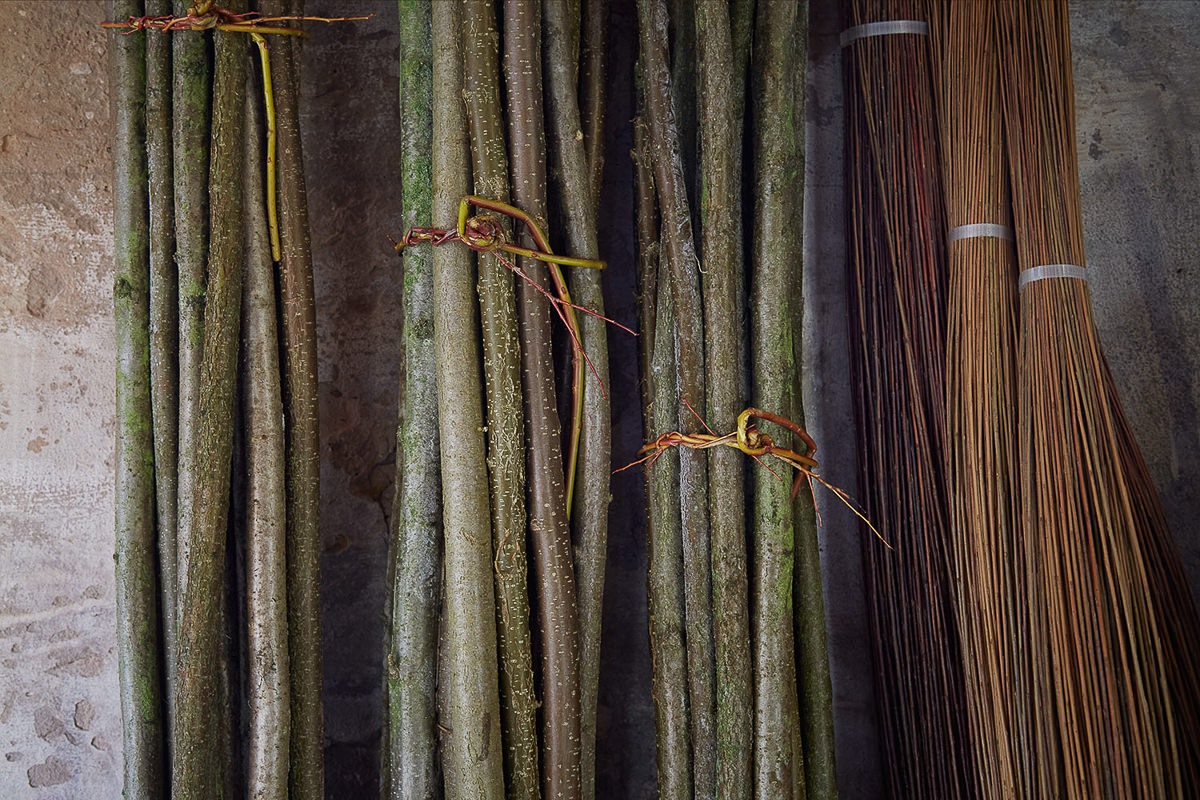
The material shown on the left side of the photo is a hazel twig. Benjamin and Léon harvest only what they need at the time of making, from plants that grow naturally in hedgerows.
As a material, hazel is easy to split lengthwise and to twist. It is strong yet lightweight, making it well suited for basketry.
Depending on the piece, European chestnut, dogwood, and buckthorn may also be used.
This basket features a movable handle and has a form that is rarely seen elsewhere.
At first, we were not sure what this basket was used for.
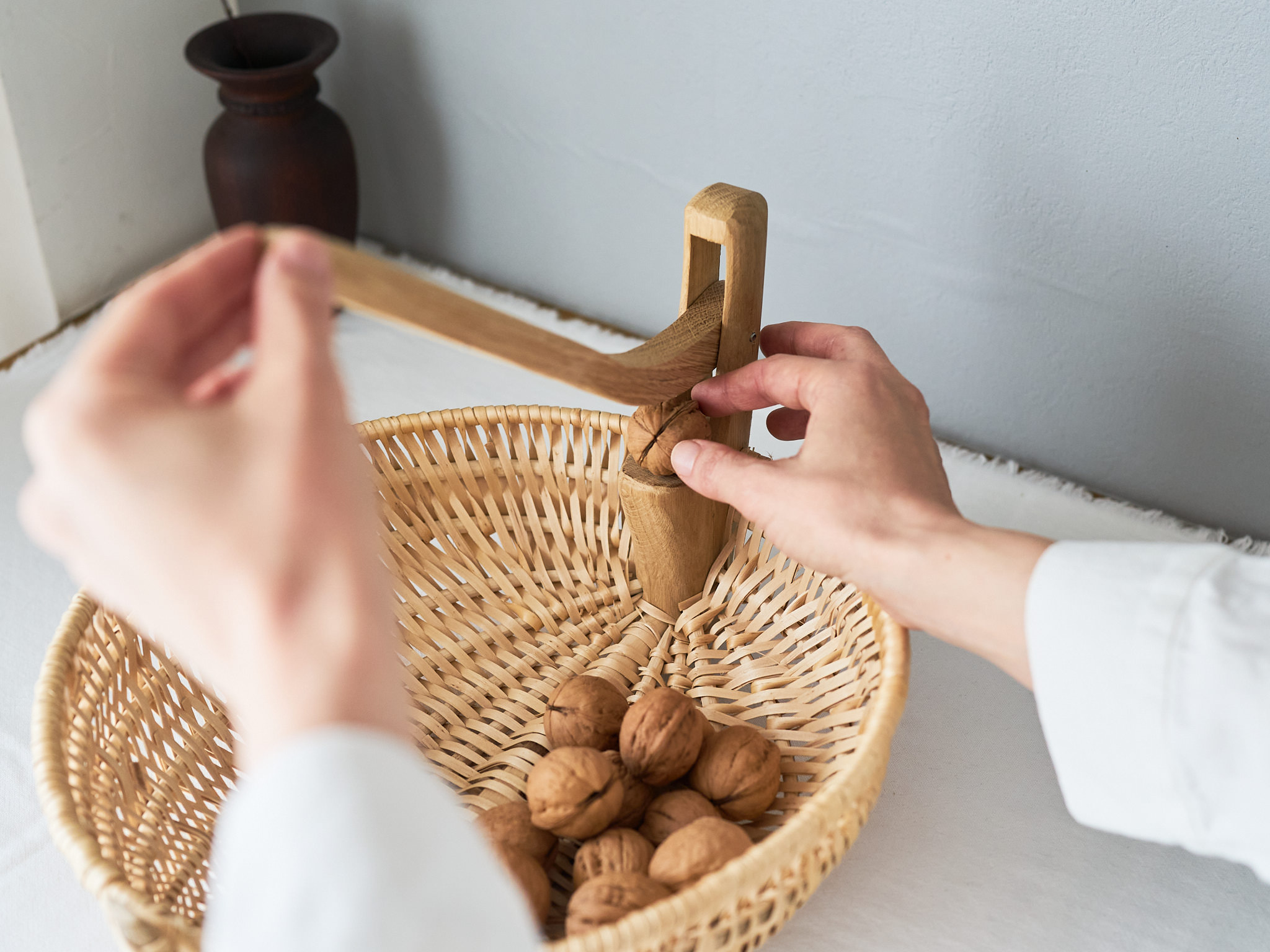
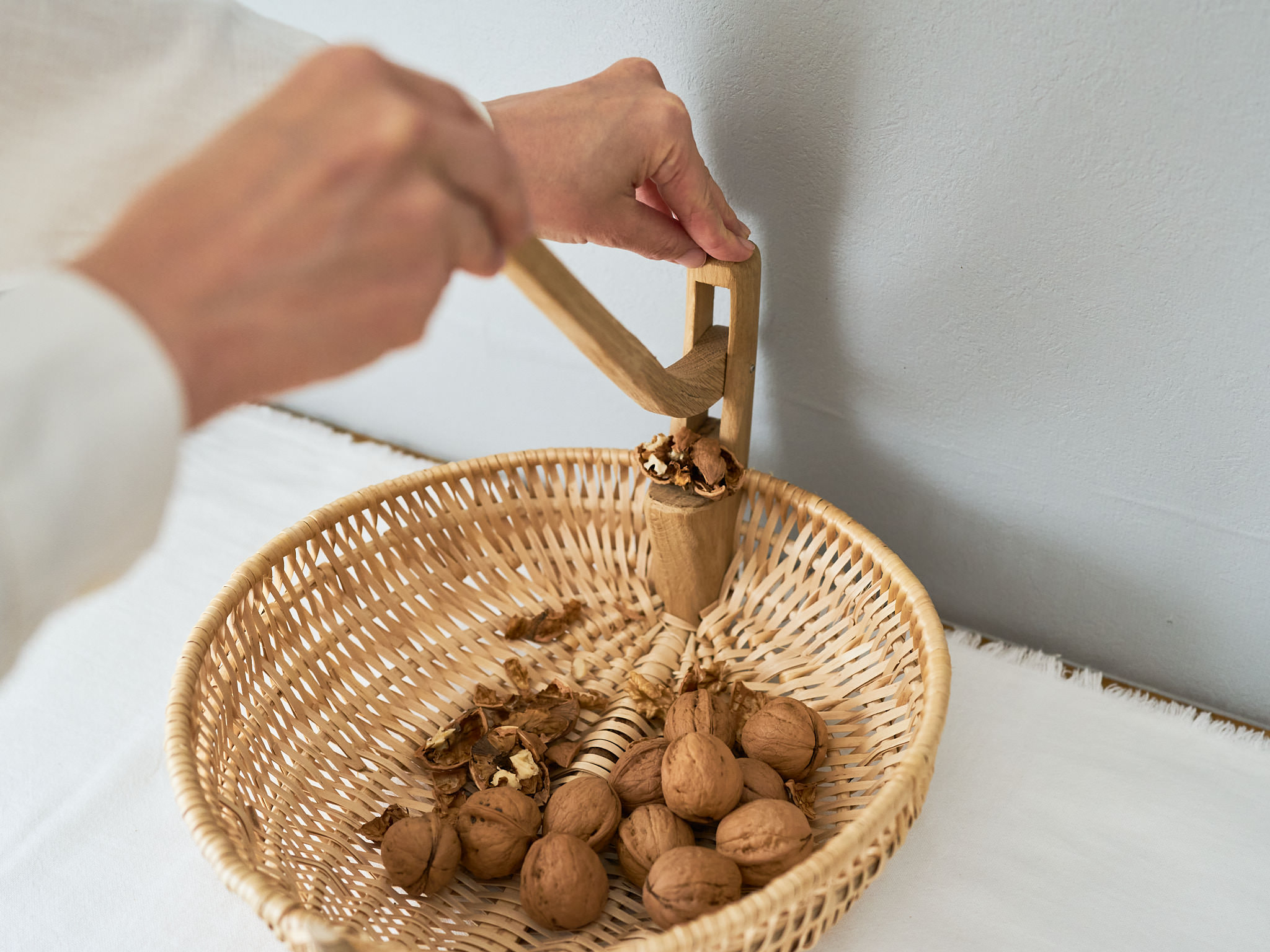
It turns out to be a basket fitted with a wooden tool designed for cracking walnuts.
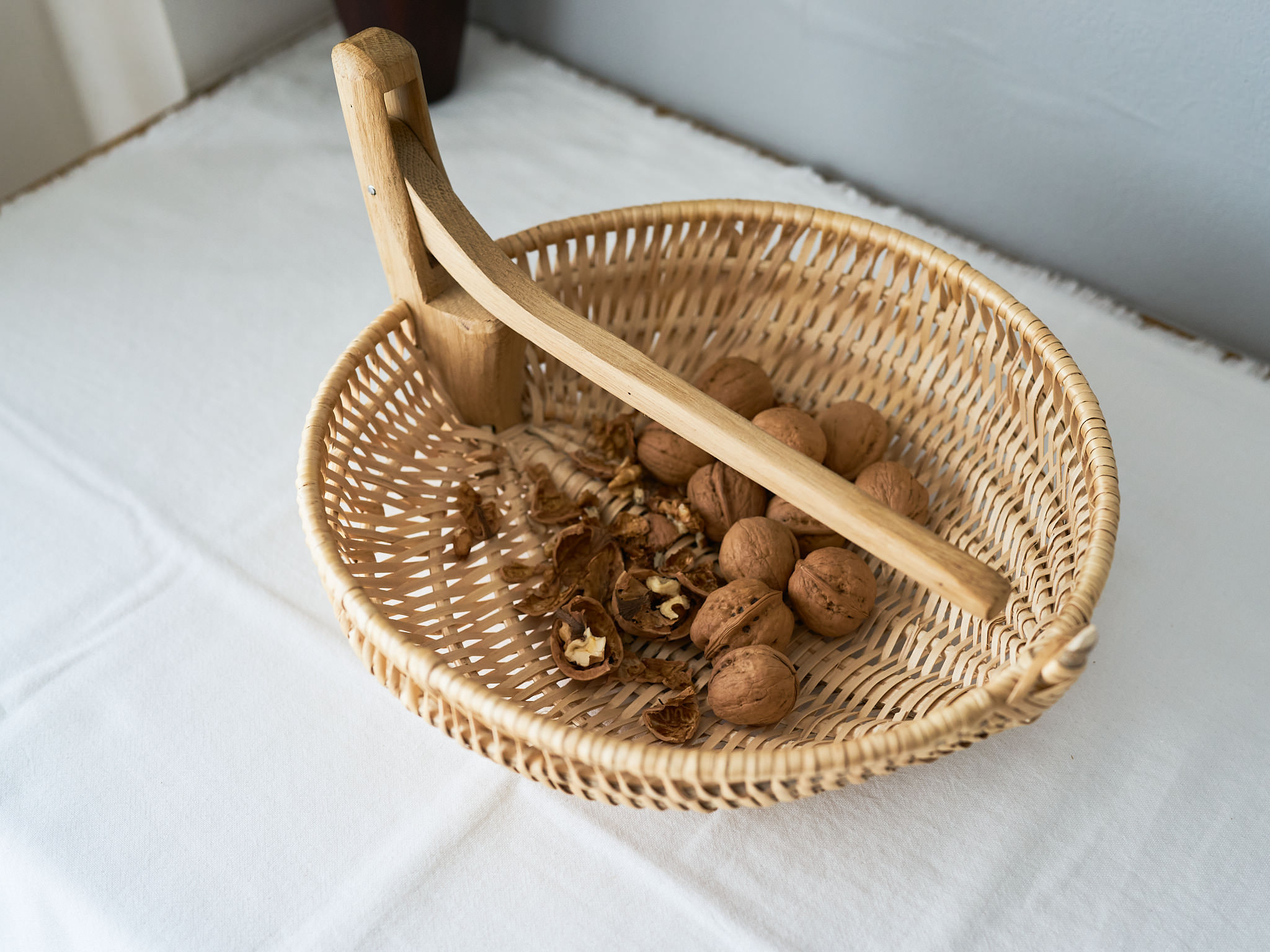
You can store walnuts in the basket and use the attached tool to crack the shells when needed, making it a highly functional design.
Here, we introduce this “walnut cracking basket.”
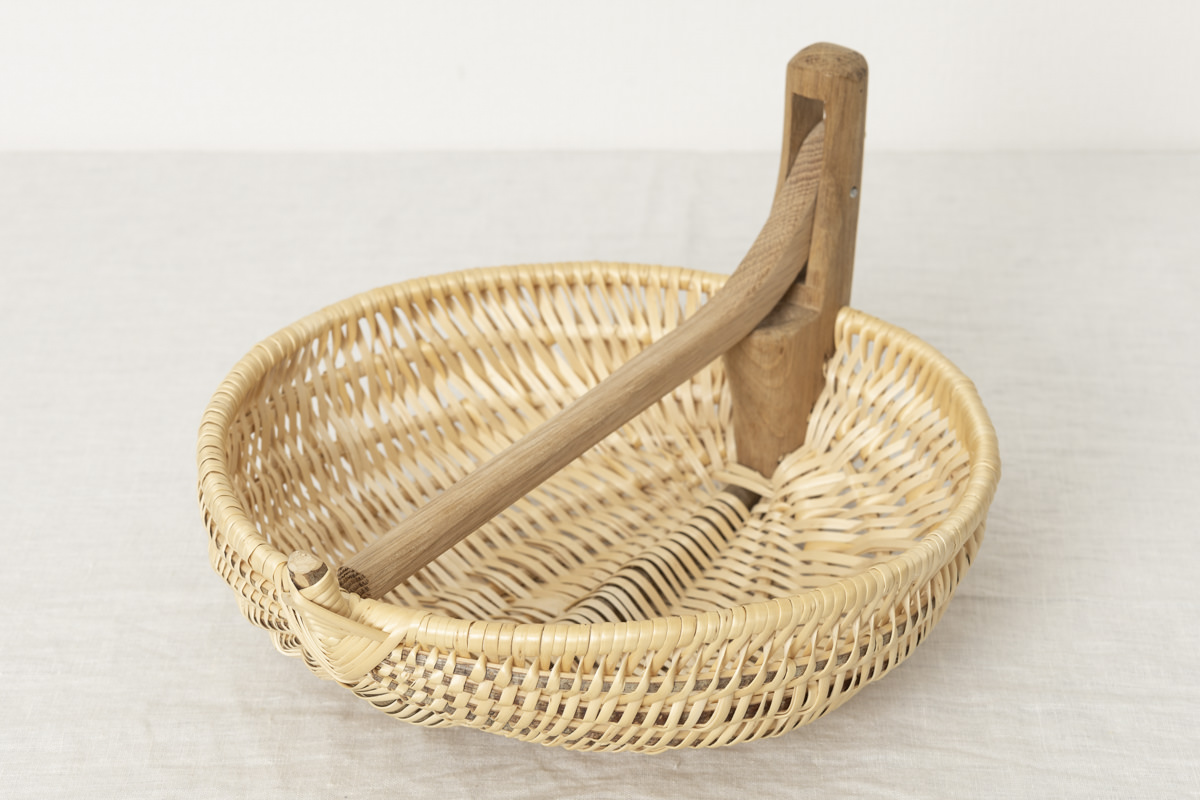
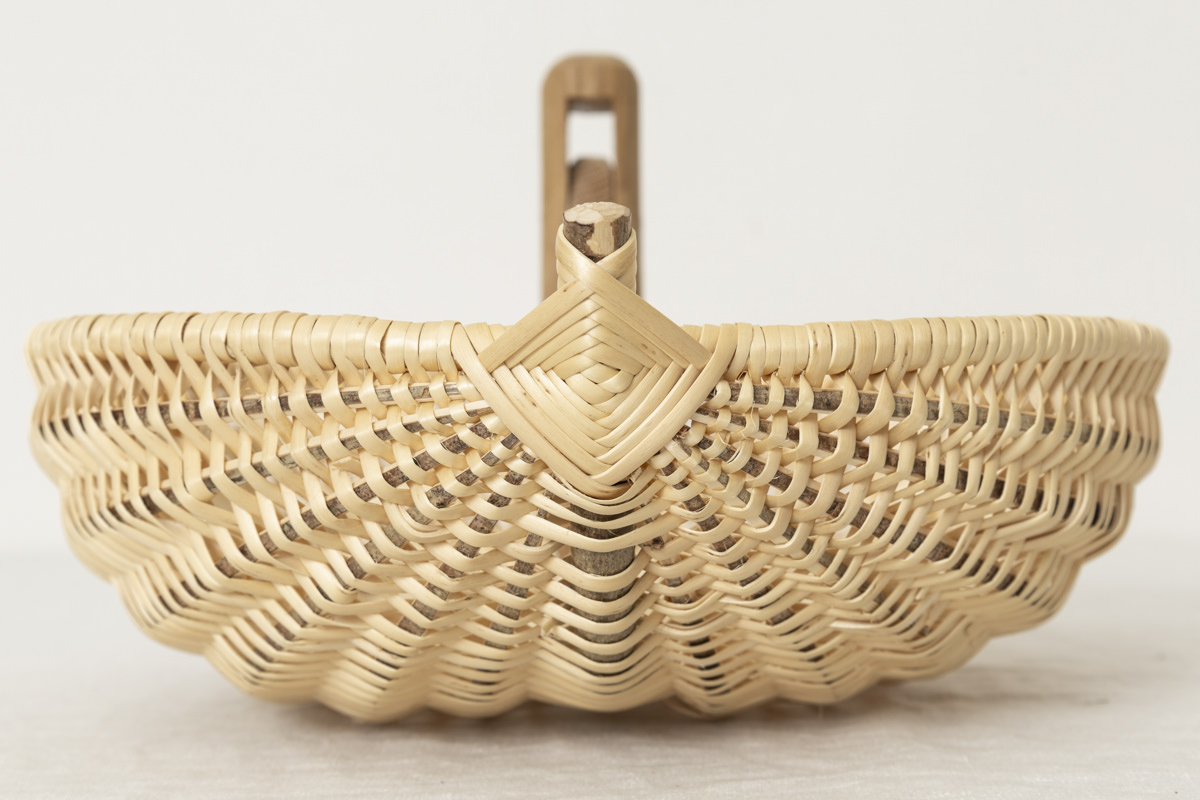
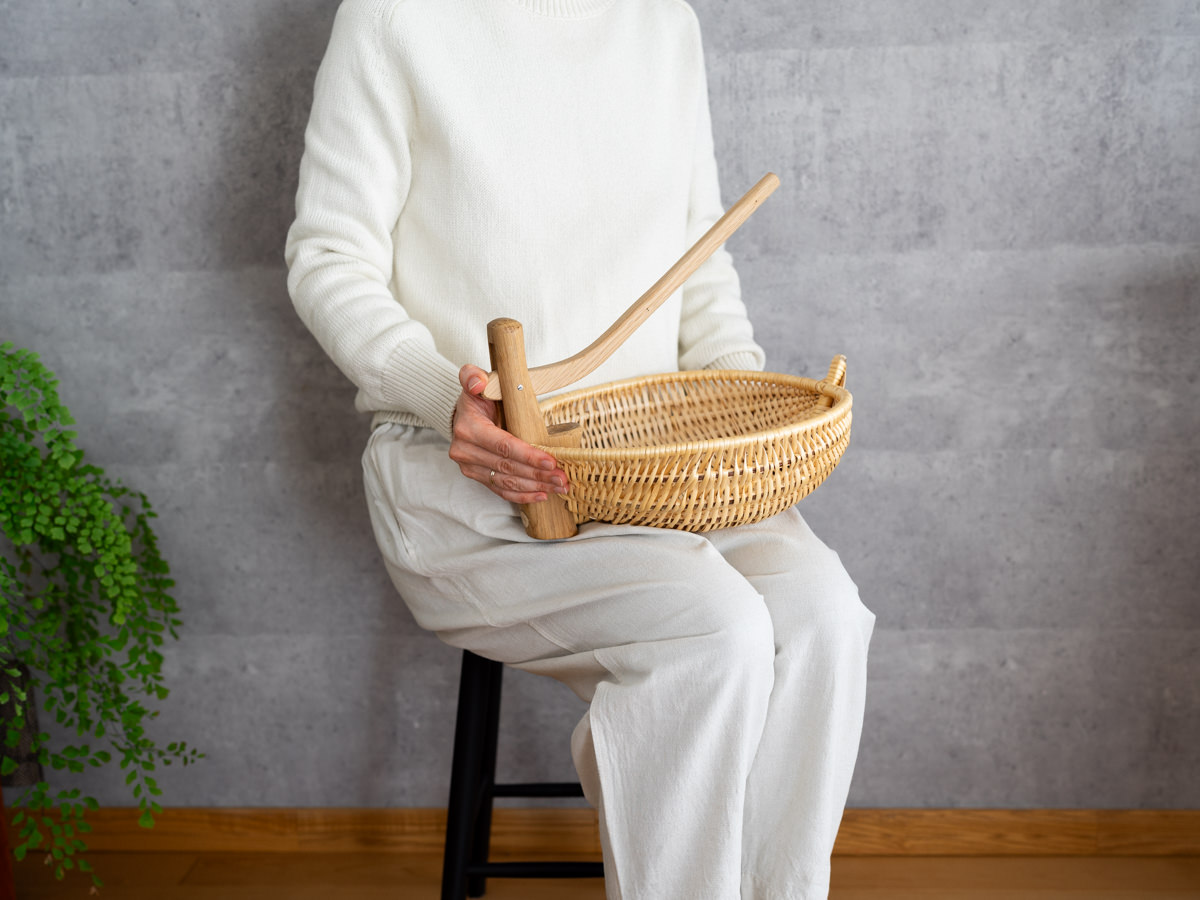
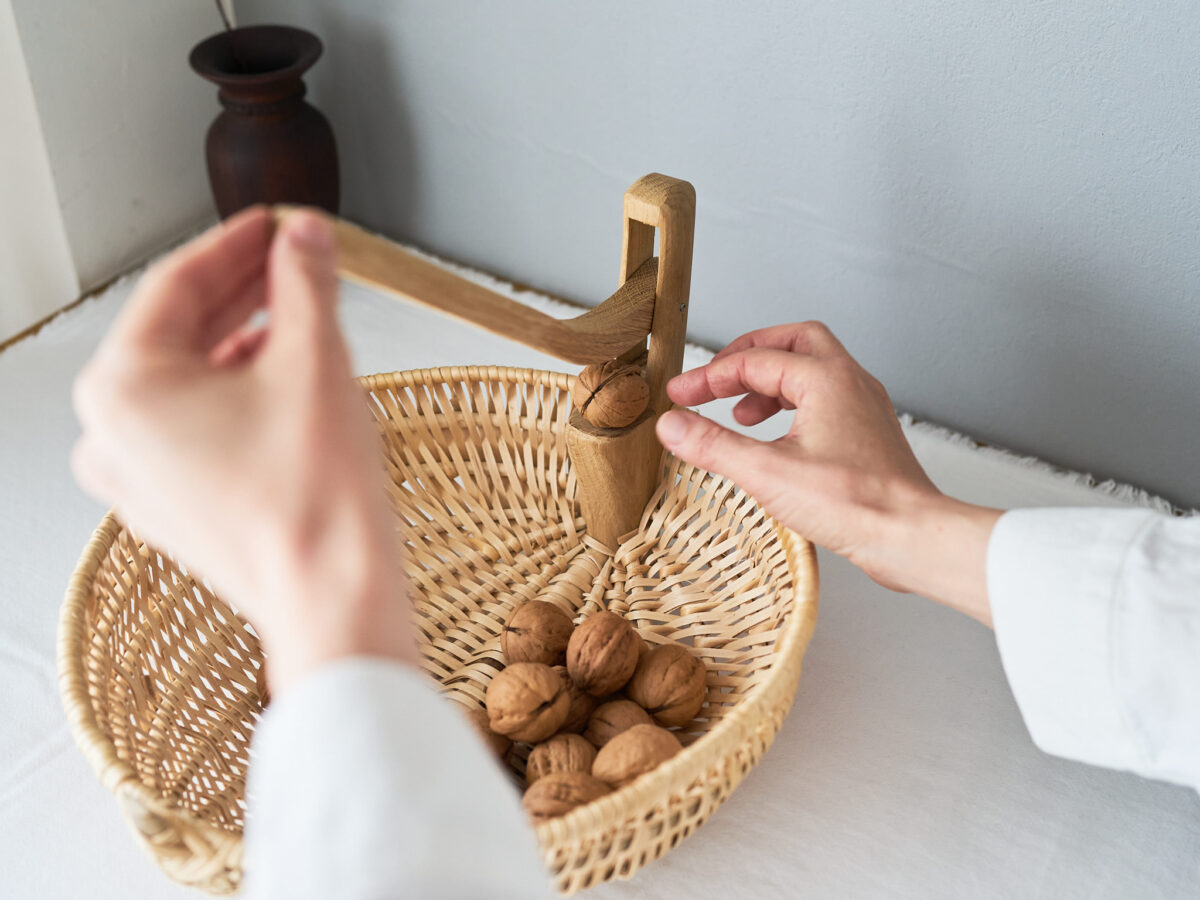
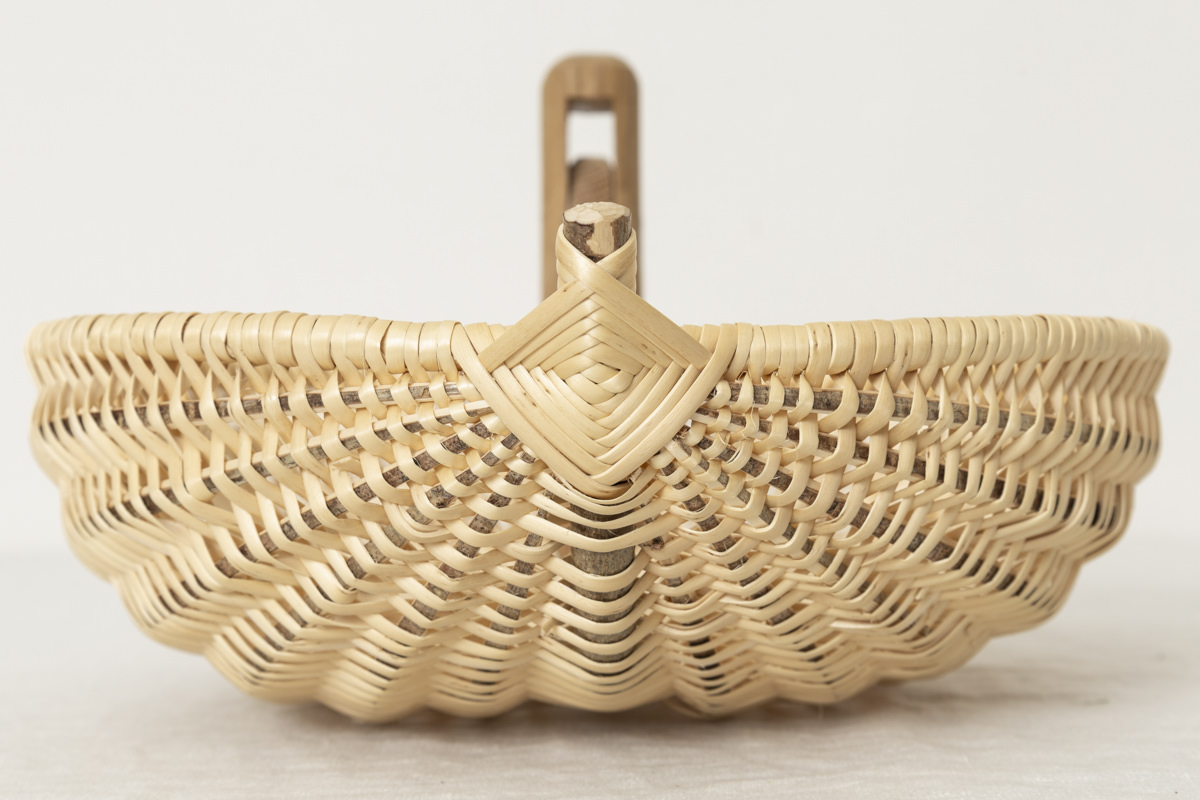
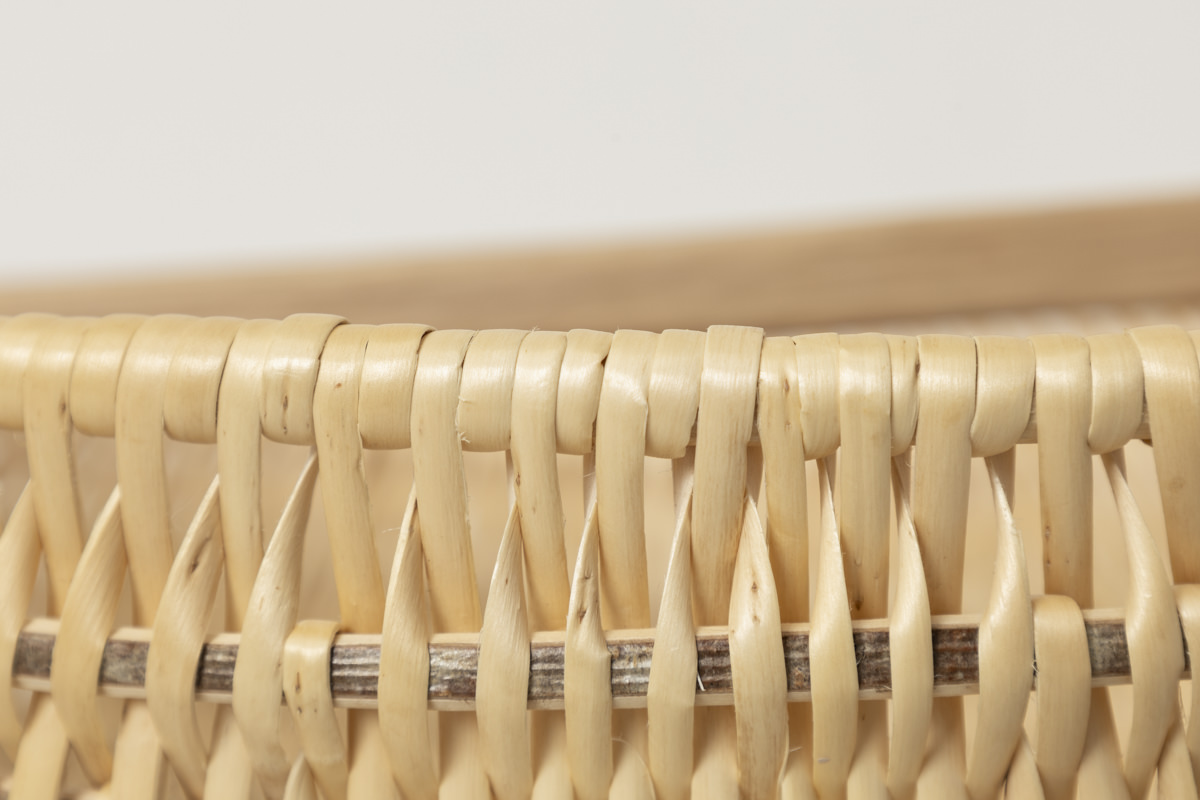
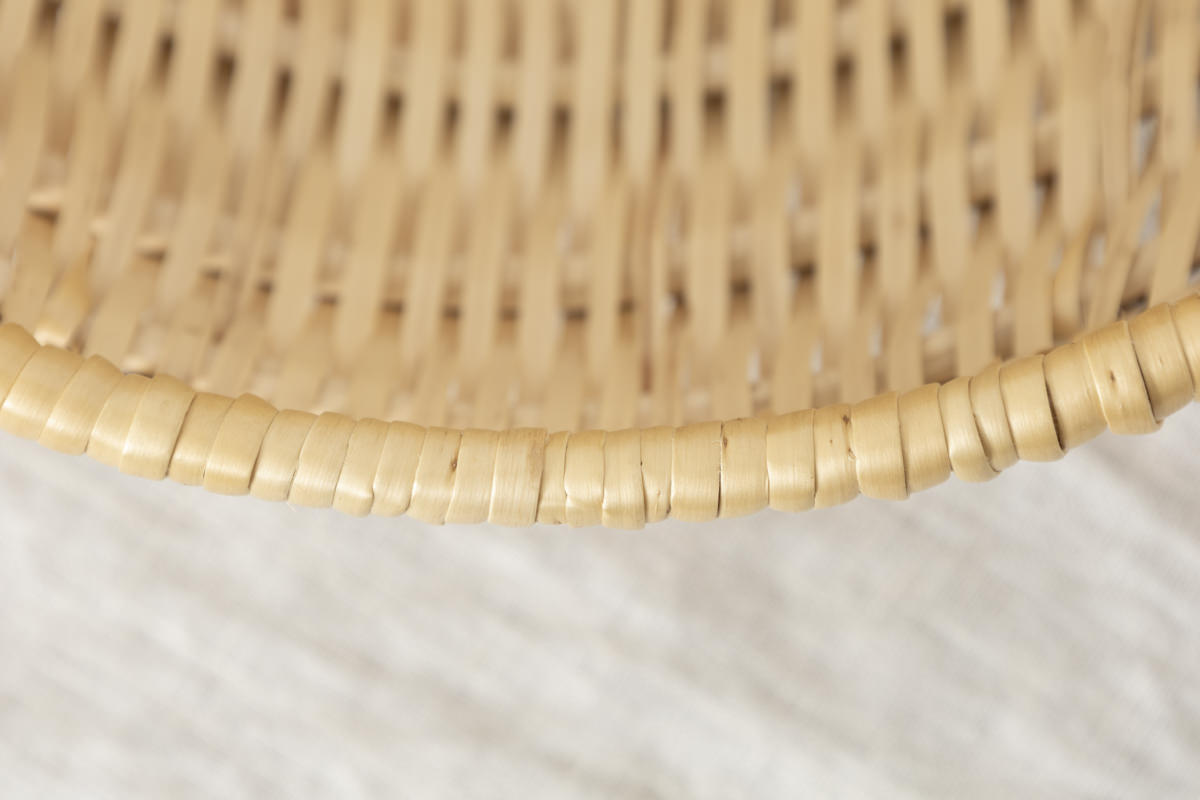
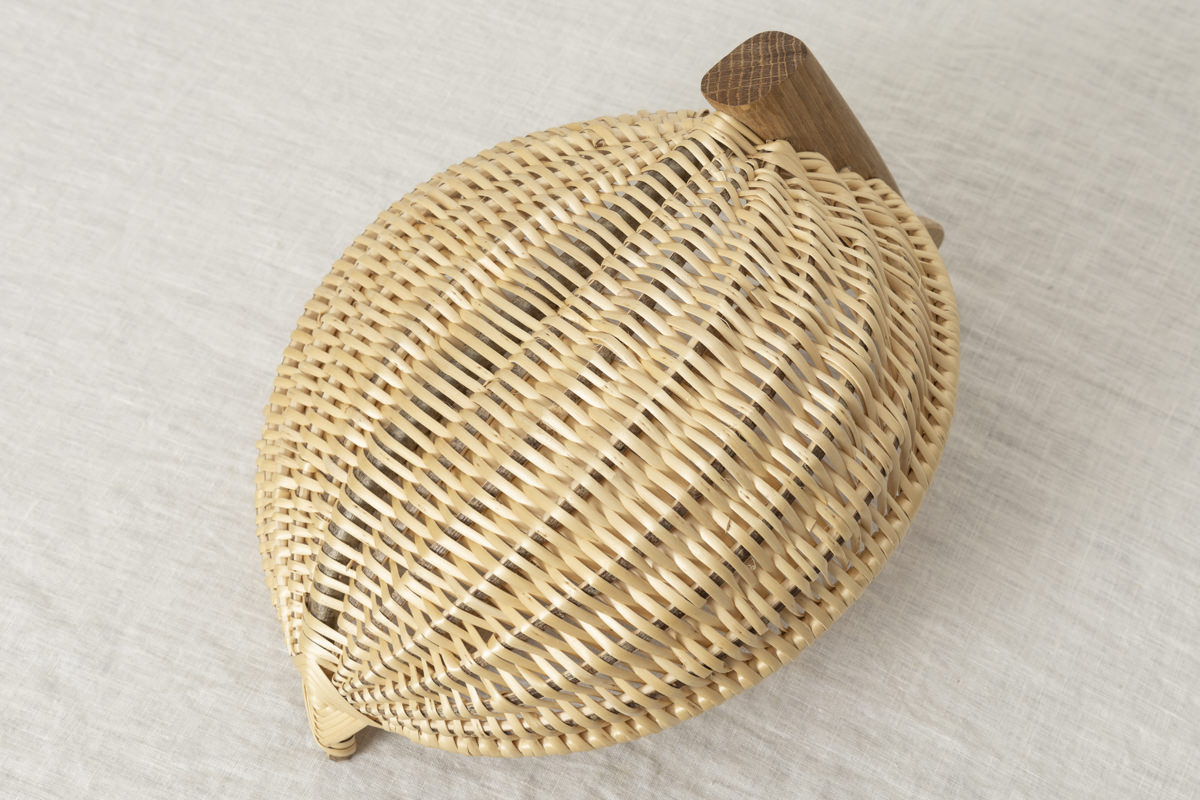
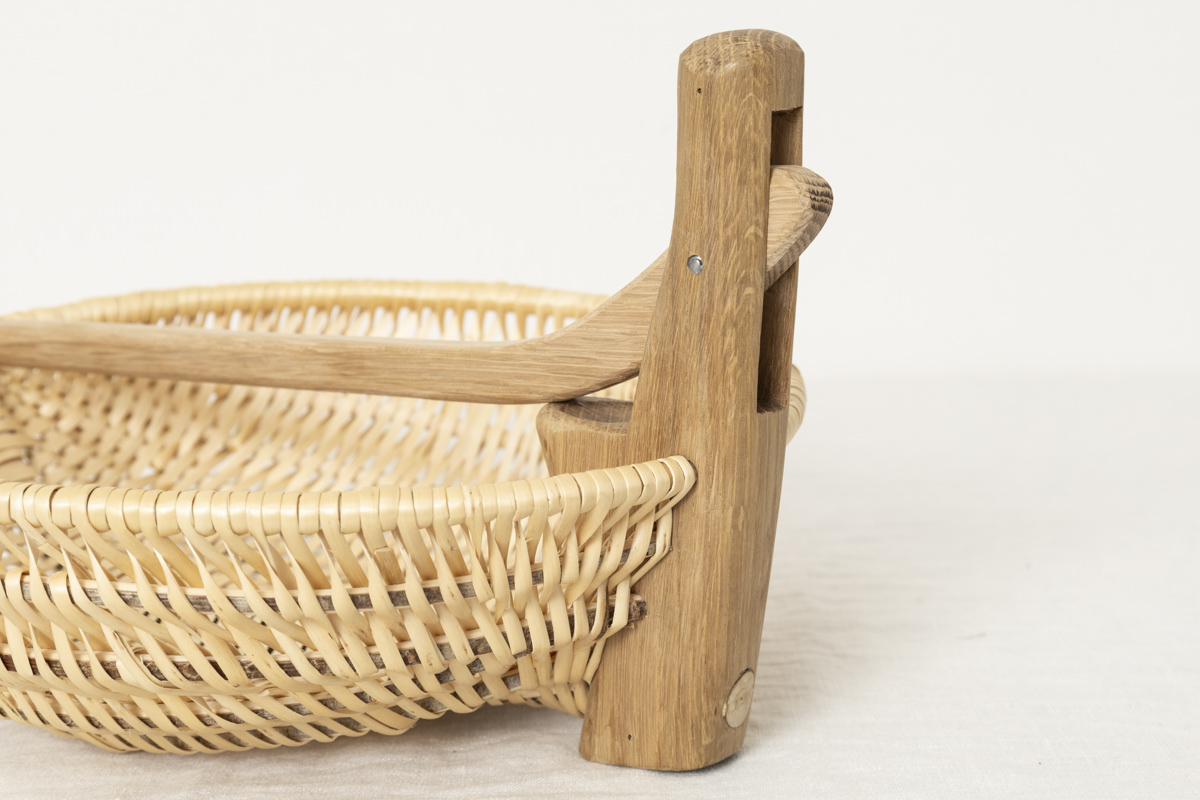
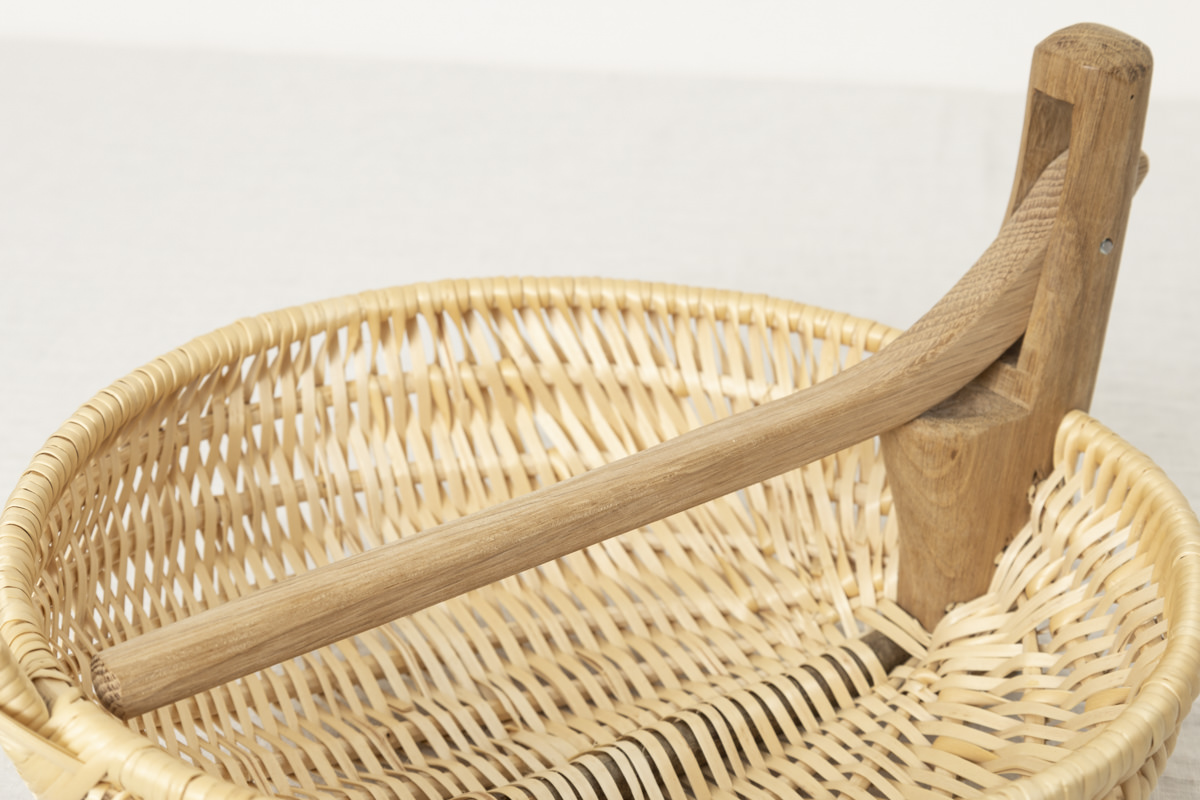
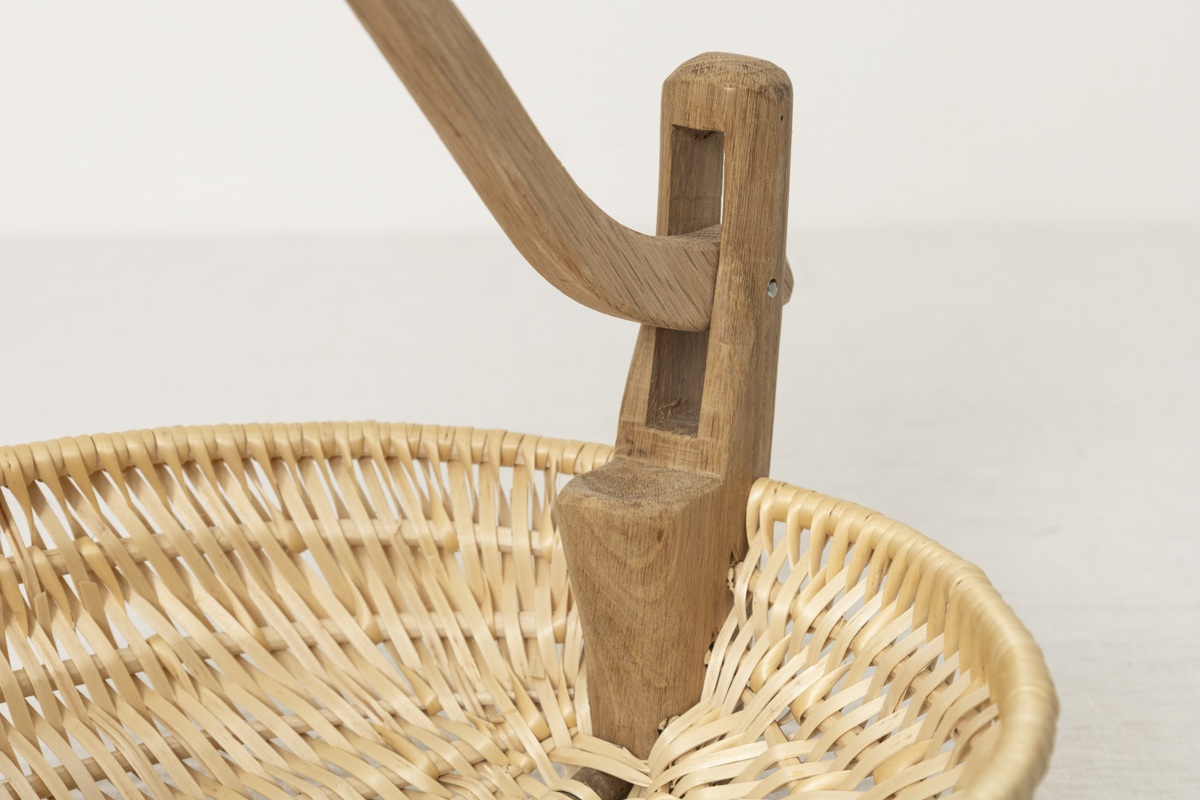
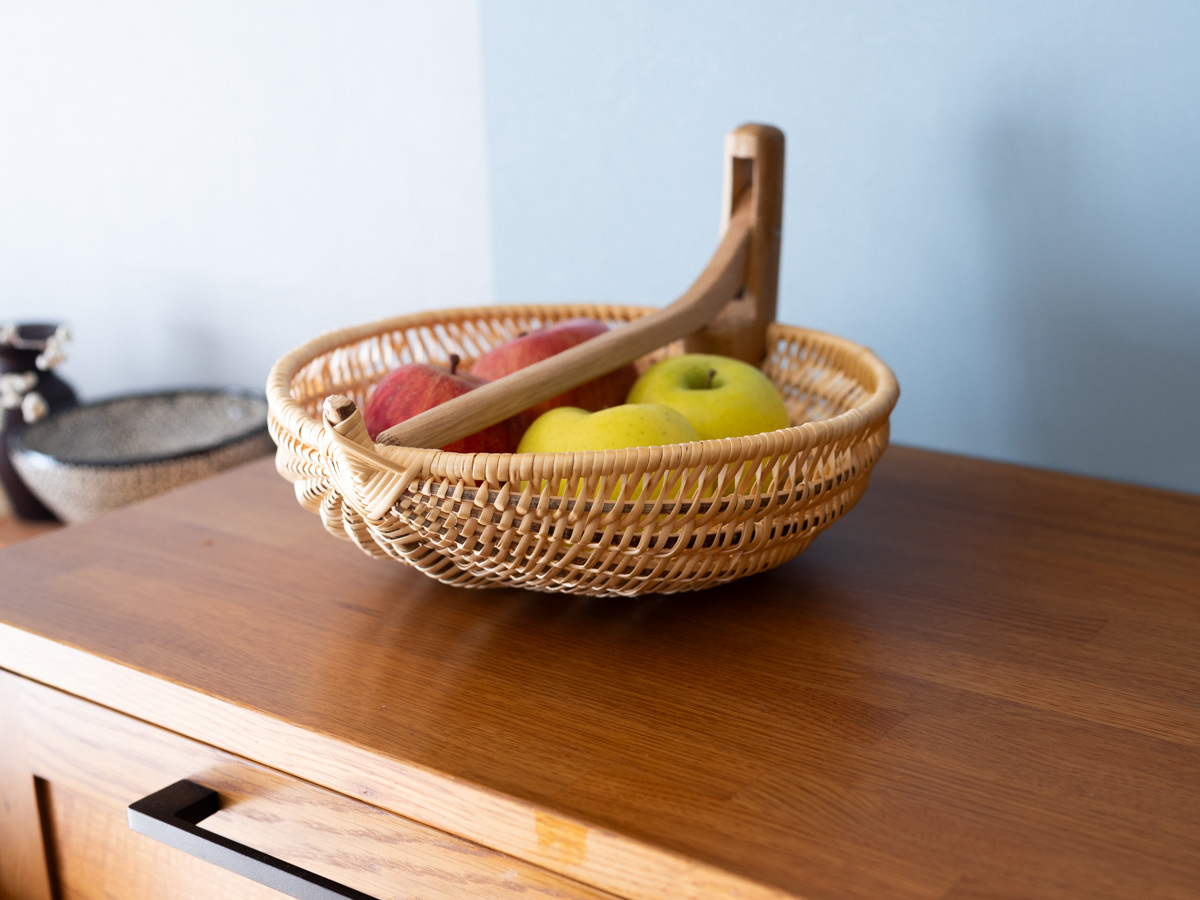
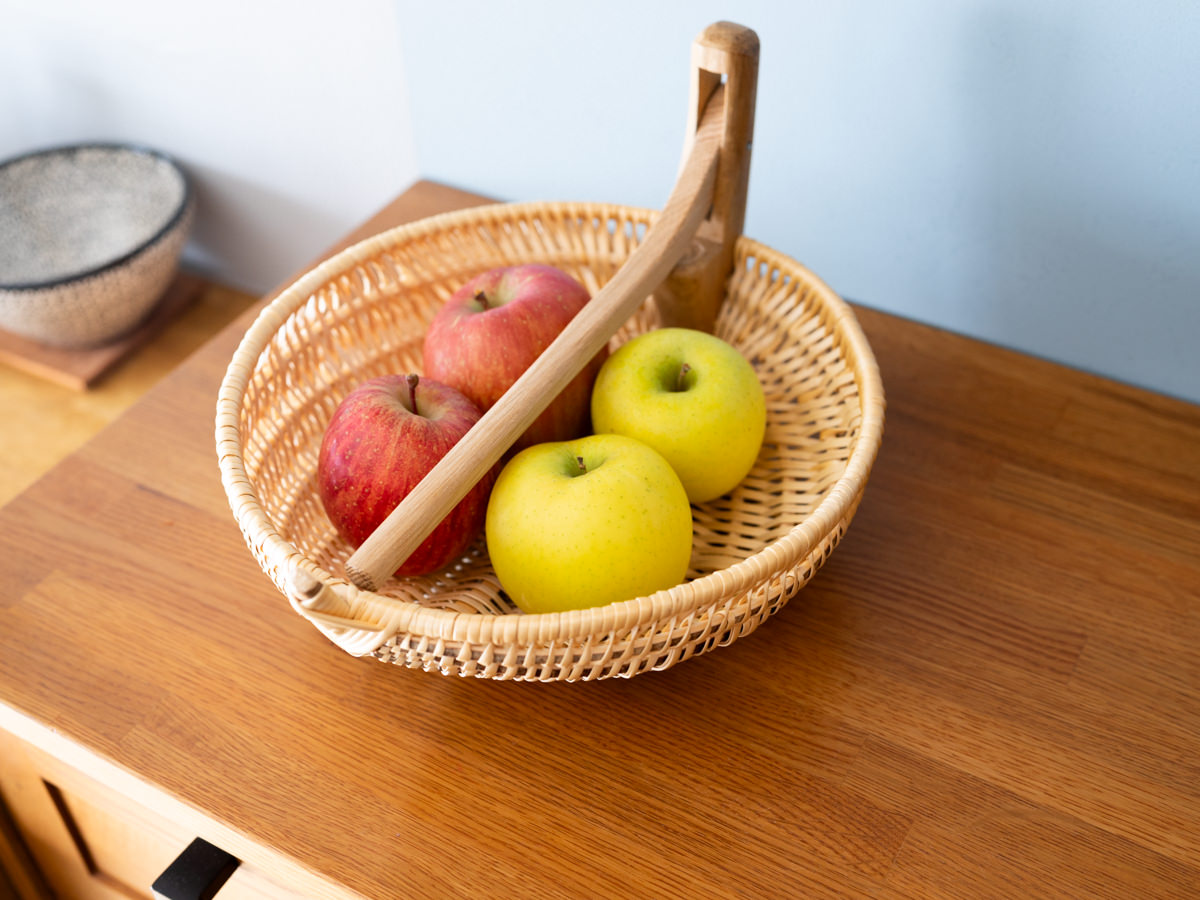
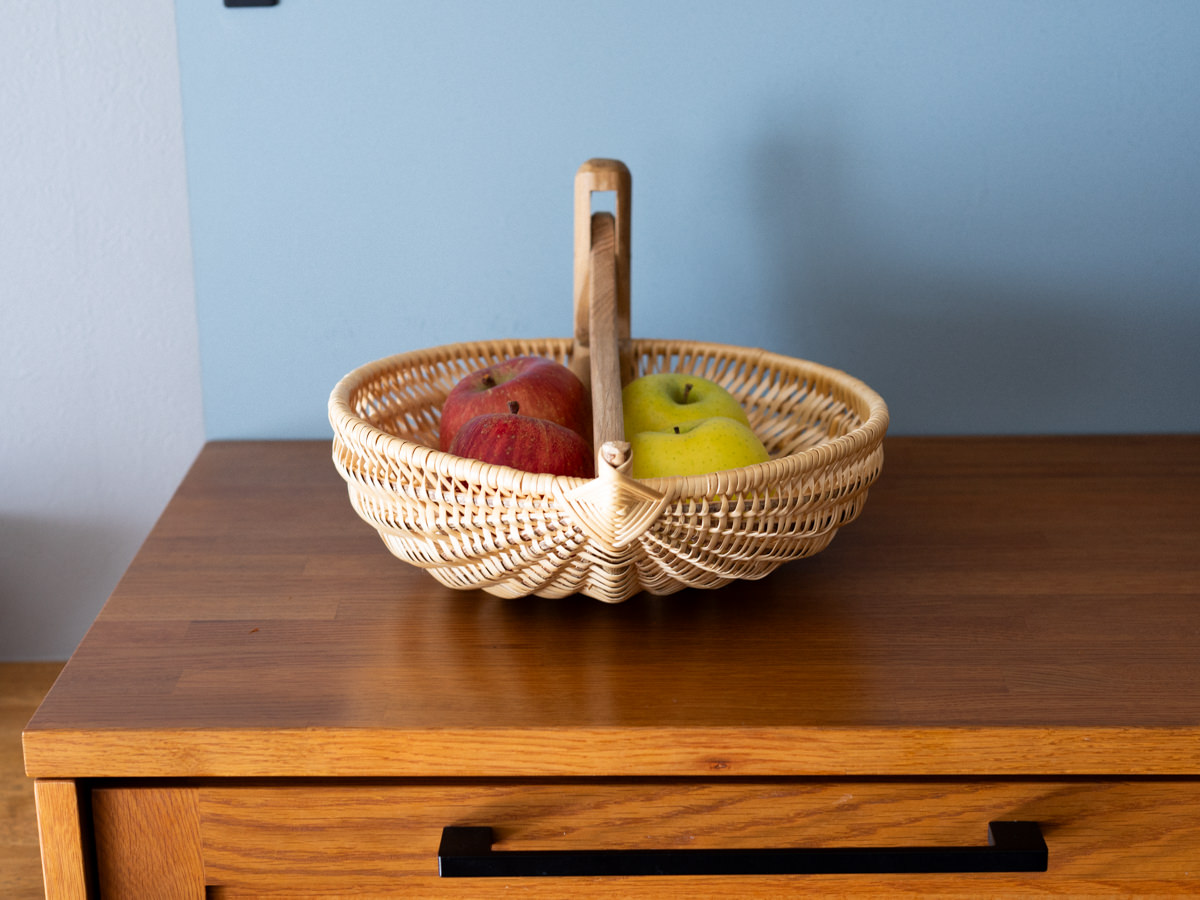
This basket is constructed with hazel (or, depending on availability, European chestnut, buckthorn, or dogwood) used for the handle and rim that form its framework. The vertical elements are also made of hazel, while the horizontal elements are finished with peeled willow. It also features a diamond-shaped decorative weave, characteristic of European basketry.This is a side view of the basket. The wooden tool and the basket both come into contact with the ground, giving it a stable and well-balanced structure.The rim is tightly wrapped with minimal gaps, resulting in a carefully finished edge.Even when viewed from above, you can sense the meticulous craftsmanship in every detail.This is the base of the basket. A thick hazel rod runs through the center, and it is carefully woven with peeled willow, giving it a firm and sturdy structure.This wooden tool is also crafted by Léon himself.Now, to the handle. It is the kind of handle that makes you want to pick up the basket the moment you touch it. Light and easy to lift, it can be raised effortlessly.When lifted in this way, you can see a space at the base where walnuts are placed.Place a walnut there, and when you press the handle downward,as you can see, the shell cracks open, allowing you to take out the nut inside.With its stable construction, it works not only as a walnut cracker but also as a fruit basket.The handle can also be used as a gentle divider within the basket.In the kitchen, it can also be used to store root vegetables such as onions and potatoes. When held with both hands, the smooth texture of the peeled willow feels pleasantly comfortable.This basket has been used in daily life for practical purposes—from harvest and storage to preparation.
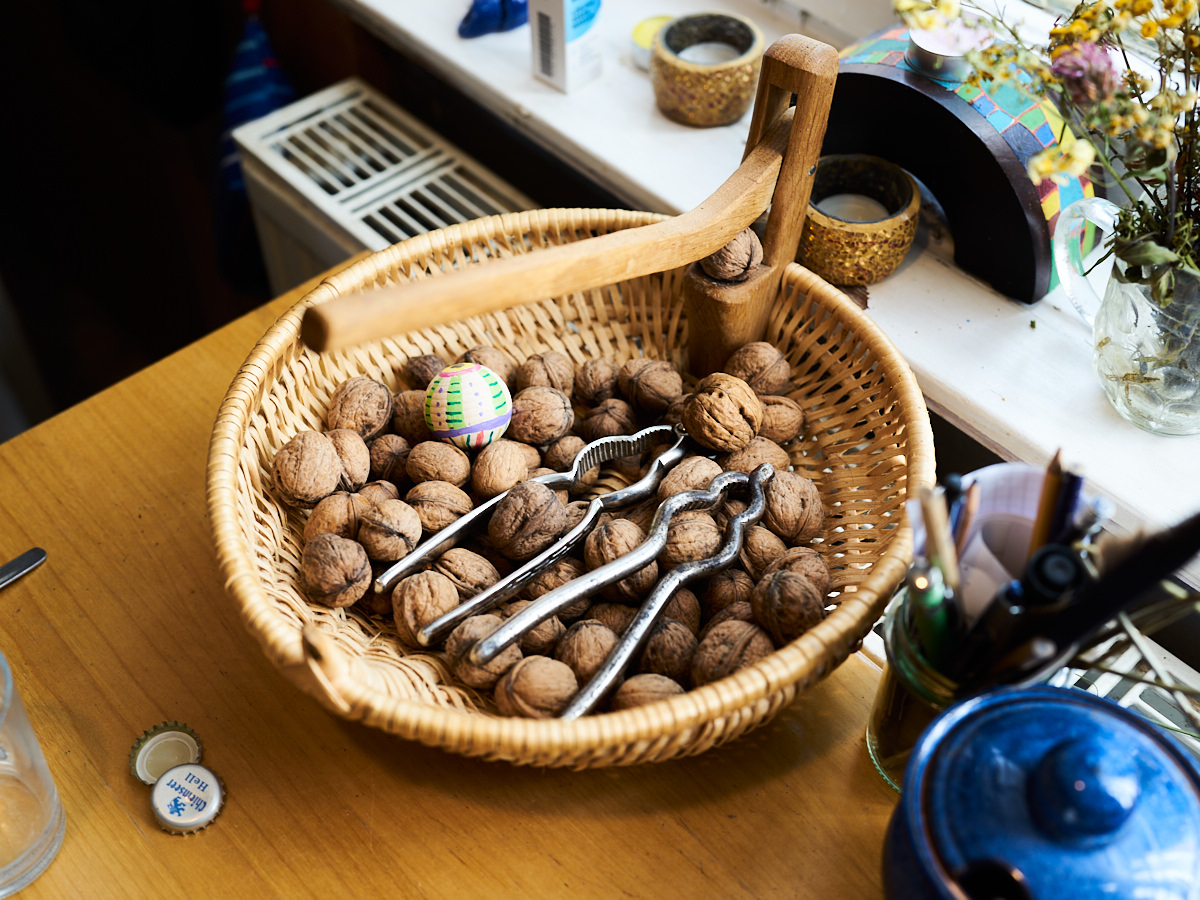
This is a walnut cracking basket we saw on the table when visiting Benjamin’s home in Germany.
In the garden in front of his workshop stands a large walnut tree, from which many nuts fall.
The basket was used to store those walnuts and to crack them when needed—truly a basket made for practical, everyday use.
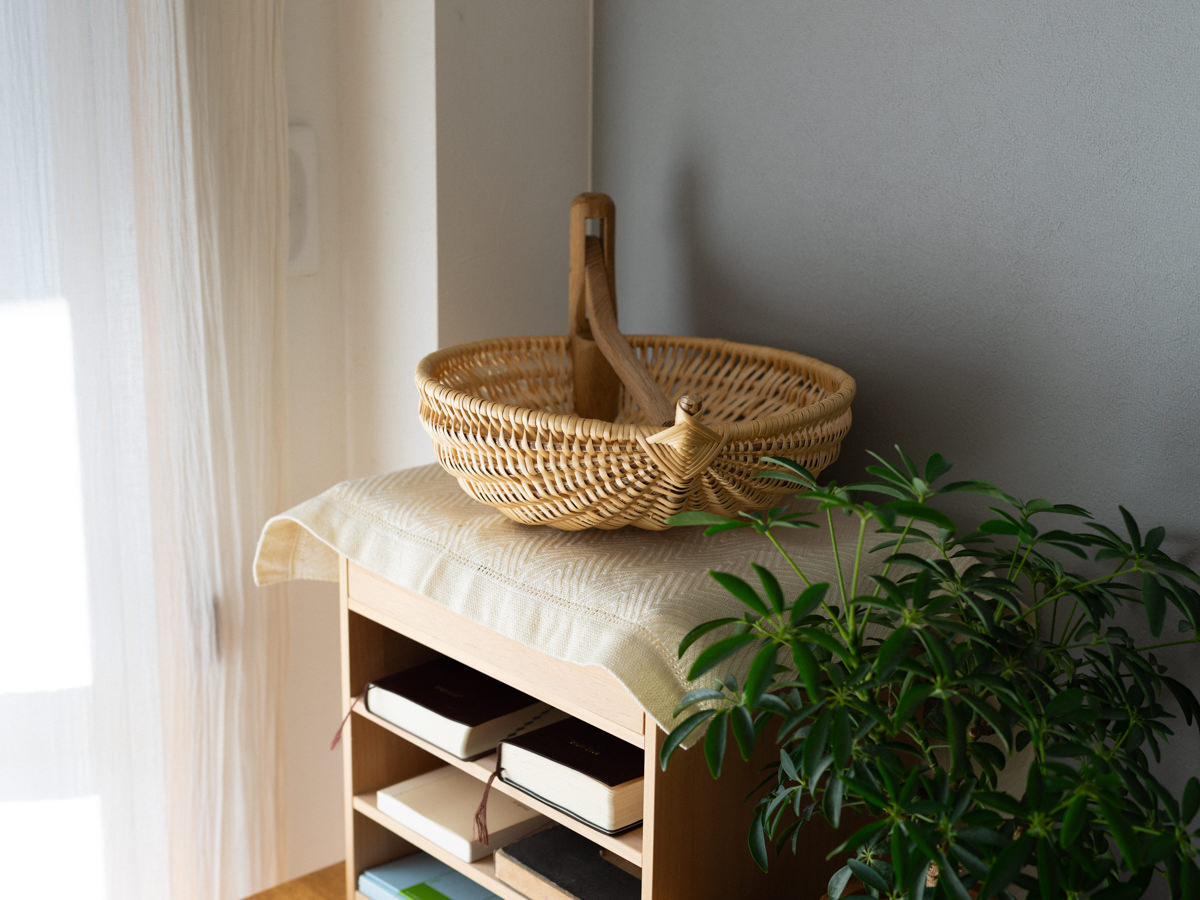
Although it is a basket designed for cracking walnuts, even when simply placed, it evokes a sense of the European landscape.
The color of the peeled willow gently shines in natural light. Over time, it gradually deepens, developing a richer tone with use.
When cracking walnuts, pieces of the shell may scatter, so please be mindful of your surroundings when using it.
This uniquely shaped walnut cracking basket, made in France, can be enjoyed in various ways as part of your daily life.
Benjamin’s Basket Weaving
Before becoming a basket maker, Benjamin worked in fields such as biology, environmental studies, social work, and photography. Over time, however, he found himself weary of the fast-paced urban lifestyle.
Seeking a more meaningful way of living and working, he chose to devote himself to basket weaving.
“I love the simple feeling of touching wood, going out into nature, collecting hazel, and working with my hands,” he says.
“Baskets are used every day to carry and store things. Being able to make such objects—not by machine, but from renewable, local materials— gives me a sense of independence.”
He says his goal in basket making is always to reach perfection— a goal that can never truly be attained, which is precisely why it continues to inspire him. The baskets he creates are all of exceptional quality, beautifully shaped, and built to last.
Please also take a look at our journal featuring Benjamin from Germany.
Please note: This item ships from Japan. As the buyer, you are responsible for any import duties, customs fees, or local taxes that may be charged in your country. These costs are not included in the item price or shipping cost. Please check with your local customs authority if you are unsure about any potential charges before placing your order.
This shallow basket is woven from peeled willow (white willow).
The maker is Léon, who lives in France.
He is the father of Benjamin, who makes baskets in Germany, and a second-generation basket maker himself.
While passing on his basketry skills to his son Benjamin, Léon continues to make baskets in France to this day.
This basket is made using willow, a material commonly found in Europe, together with hazel.
While its fruit is widely known as “hazelnuts,” hazel—also called Corylus avellana—is a deciduous shrub belonging to the birch family.
In the United Kingdom, hazel is one of the most commonly seen shrubs. Since ancient times, it has been used as a material for thatching roofs, as well as for wattle fencing, coracle boats, and walking sticks—making it an essential material in everyday life.
The material shown on the left side of the photo is a hazel twig. Benjamin and Léon harvest only what they need at the time of making, from plants that grow naturally in hedgerows.
As a material, hazel is easy to split lengthwise and to twist. It is strong yet lightweight, making it well suited for basketry.
Depending on the piece, European chestnut, dogwood, and buckthorn may also be used.
This basket features a movable handle and has a form that is rarely seen elsewhere.
At first, we were not sure what this basket was used for.
It turns out to be a basket fitted with a wooden tool designed for cracking walnuts.
You can store walnuts in the basket and use the attached tool to crack the shells when needed, making it a highly functional design.
Here, we introduce this “walnut cracking basket.”
This basket is constructed with hazel (or, depending on availability, European chestnut, buckthorn, or dogwood) used for the handle and rim that form its framework. The vertical elements are also made of hazel, while the horizontal elements are finished with peeled willow. It also features a diamond-shaped decorative weave, characteristic of European basketry.This is a side view of the basket. The wooden tool and the basket both come into contact with the ground, giving it a stable and well-balanced structure.The rim is tightly wrapped with minimal gaps, resulting in a carefully finished edge.Even when viewed from above, you can sense the meticulous craftsmanship in every detail.This is the base of the basket. A thick hazel rod runs through the center, and it is carefully woven with peeled willow, giving it a firm and sturdy structure.This wooden tool is also crafted by Léon himself.Now, to the handle. It is the kind of handle that makes you want to pick up the basket the moment you touch it. Light and easy to lift, it can be raised effortlessly.When lifted in this way, you can see a space at the base where walnuts are placed.Place a walnut there, and when you press the handle downward,as you can see, the shell cracks open, allowing you to take out the nut inside.With its stable construction, it works not only as a walnut cracker but also as a fruit basket.The handle can also be used as a gentle divider within the basket.In the kitchen, it can also be used to store root vegetables such as onions and potatoes. When held with both hands, the smooth texture of the peeled willow feels pleasantly comfortable.This basket has been used in daily life for practical purposes—from harvest and storage to preparation.
This is a walnut cracking basket we saw on the table when visiting Benjamin’s home in Germany.
In the garden in front of his workshop stands a large walnut tree, from which many nuts fall.
The basket was used to store those walnuts and to crack them when needed—truly a basket made for practical, everyday use.
Although it is a basket designed for cracking walnuts, even when simply placed, it evokes a sense of the European landscape.
The color of the peeled willow gently shines in natural light. Over time, it gradually deepens, developing a richer tone with use.
When cracking walnuts, pieces of the shell may scatter, so please be mindful of your surroundings when using it.
This uniquely shaped walnut cracking basket, made in France, can be enjoyed in various ways as part of your daily life.
Benjamin’s Basket Weaving
Before becoming a basket maker, Benjamin worked in fields such as biology, environmental studies, social work, and photography. Over time, however, he found himself weary of the fast-paced urban lifestyle.
Seeking a more meaningful way of living and working, he chose to devote himself to basket weaving.
“I love the simple feeling of touching wood, going out into nature, collecting hazel, and working with my hands,” he says.
“Baskets are used every day to carry and store things. Being able to make such objects—not by machine, but from renewable, local materials— gives me a sense of independence.”
He says his goal in basket making is always to reach perfection— a goal that can never truly be attained, which is precisely why it continues to inspire him. The baskets he creates are all of exceptional quality, beautifully shaped, and built to last.
Please also take a look at our journal featuring Benjamin from Germany.
Please note: This item ships from Japan. As the buyer, you are responsible for any import duties, customs fees, or local taxes that may be charged in your country. These costs are not included in the item price or shipping cost. Please check with your local customs authority if you are unsure about any potential charges before placing your order.
This shallow basket is woven from peeled willow (white willow).
The maker is Léon, who lives in France.
He is the father of Benjamin, who makes baskets in Germany, and a second-generation basket maker himself.
While passing on his basketry skills to his son Benjamin, Léon continues to make baskets in France to this day.
This basket is made using willow, a material commonly found in Europe, together with hazel.
While its fruit is widely known as “hazelnuts,” hazel—also called Corylus avellana—is a deciduous shrub belonging to the birch family.
In the United Kingdom, hazel is one of the most commonly seen shrubs. Since ancient times, it has been used as a material for thatching roofs, as well as for wattle fencing, coracle boats, and walking sticks—making it an essential material in everyday life.
The material shown on the left side of the photo is a hazel twig. Benjamin and Léon harvest only what they need at the time of making, from plants that grow naturally in hedgerows.
As a material, hazel is easy to split lengthwise and to twist. It is strong yet lightweight, making it well suited for basketry.
Depending on the piece, European chestnut, dogwood, and buckthorn may also be used.
This basket features a movable handle and has a form that is rarely seen elsewhere.
At first, we were not sure what this basket was used for.
It turns out to be a basket fitted with a wooden tool designed for cracking walnuts.
You can store walnuts in the basket and use the attached tool to crack the shells when needed, making it a highly functional design.
Here, we introduce this “walnut cracking basket.”
This basket is constructed with hazel (or, depending on availability, European chestnut, buckthorn, or dogwood) used for the handle and rim that form its framework. The vertical elements are also made of hazel, while the horizontal elements are finished with peeled willow. It also features a diamond-shaped decorative weave, characteristic of European basketry.This is a side view of the basket. The wooden tool and the basket both come into contact with the ground, giving it a stable and well-balanced structure.The rim is tightly wrapped with minimal gaps, resulting in a carefully finished edge.Even when viewed from above, you can sense the meticulous craftsmanship in every detail.This is the base of the basket. A thick hazel rod runs through the center, and it is carefully woven with peeled willow, giving it a firm and sturdy structure.This wooden tool is also crafted by Léon himself.Now, to the handle. It is the kind of handle that makes you want to pick up the basket the moment you touch it. Light and easy to lift, it can be raised effortlessly.When lifted in this way, you can see a space at the base where walnuts are placed.Place a walnut there, and when you press the handle downward,as you can see, the shell cracks open, allowing you to take out the nut inside.With its stable construction, it works not only as a walnut cracker but also as a fruit basket.The handle can also be used as a gentle divider within the basket.In the kitchen, it can also be used to store root vegetables such as onions and potatoes. When held with both hands, the smooth texture of the peeled willow feels pleasantly comfortable.This basket has been used in daily life for practical purposes—from harvest and storage to preparation.
This is a walnut cracking basket we saw on the table when visiting Benjamin’s home in Germany.
In the garden in front of his workshop stands a large walnut tree, from which many nuts fall.
The basket was used to store those walnuts and to crack them when needed—truly a basket made for practical, everyday use.
Although it is a basket designed for cracking walnuts, even when simply placed, it evokes a sense of the European landscape.
The color of the peeled willow gently shines in natural light. Over time, it gradually deepens, developing a richer tone with use.
When cracking walnuts, pieces of the shell may scatter, so please be mindful of your surroundings when using it.
This uniquely shaped walnut cracking basket, made in France, can be enjoyed in various ways as part of your daily life.
Benjamin’s Basket Weaving
Before becoming a basket maker, Benjamin worked in fields such as biology, environmental studies, social work, and photography. Over time, however, he found himself weary of the fast-paced urban lifestyle.
Seeking a more meaningful way of living and working, he chose to devote himself to basket weaving.
“I love the simple feeling of touching wood, going out into nature, collecting hazel, and working with my hands,” he says.
“Baskets are used every day to carry and store things. Being able to make such objects—not by machine, but from renewable, local materials— gives me a sense of independence.”
He says his goal in basket making is always to reach perfection— a goal that can never truly be attained, which is precisely why it continues to inspire him. The baskets he creates are all of exceptional quality, beautifully shaped, and built to last.
Please also take a look at our journal featuring Benjamin from Germany.
Please note: This item ships from Japan. As the buyer, you are responsible for any import duties, customs fees, or local taxes that may be charged in your country. These costs are not included in the item price or shipping cost. Please check with your local customs authority if you are unsure about any potential charges before placing your order.