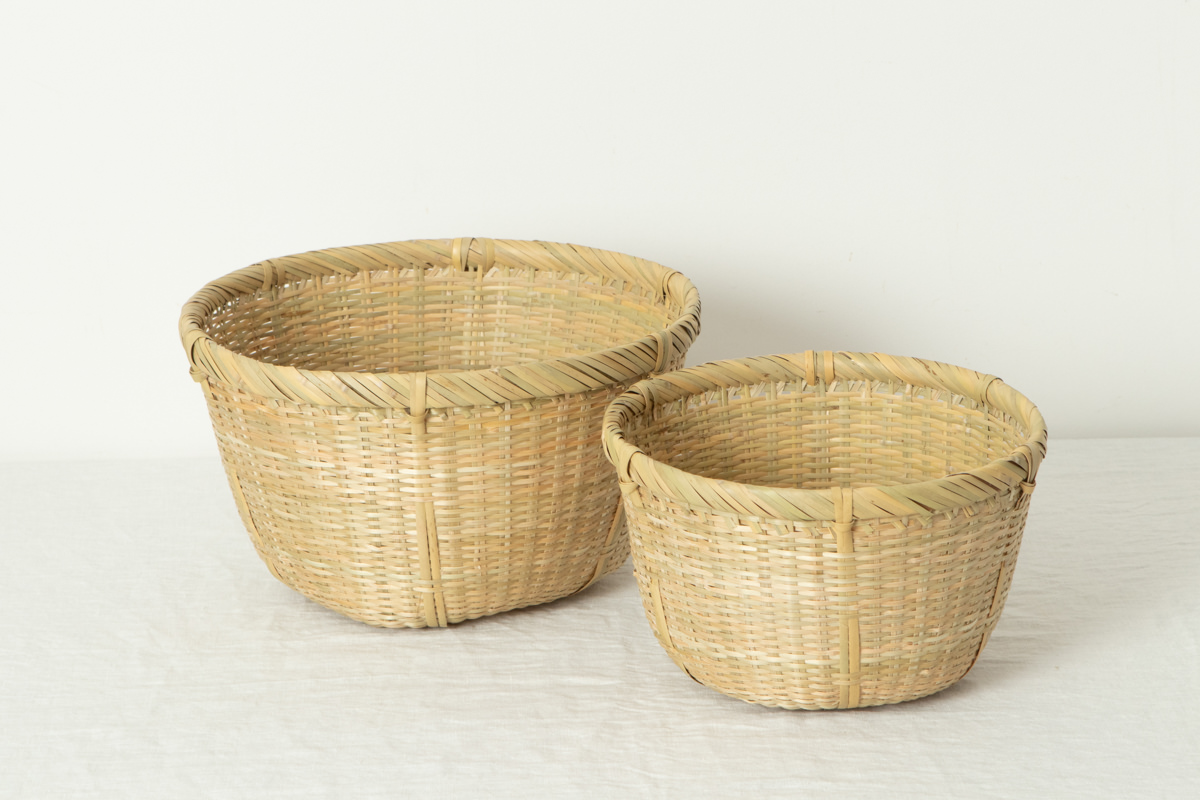
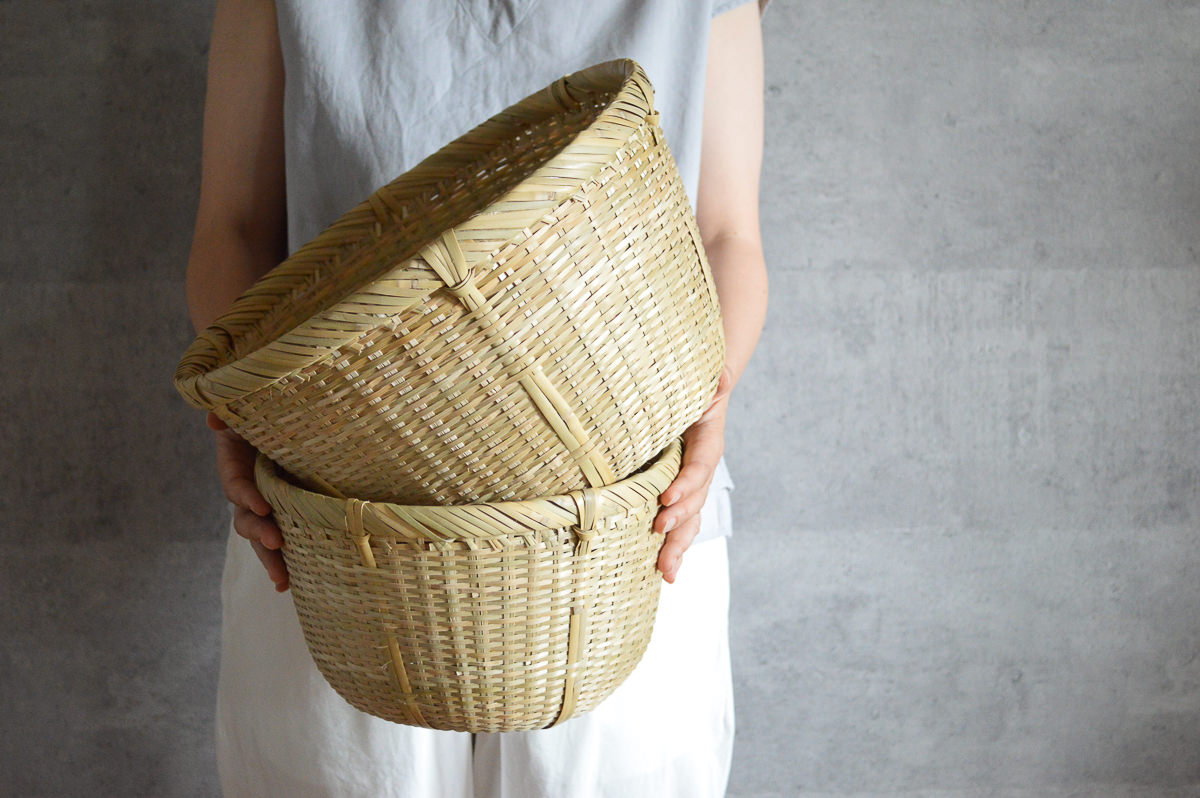
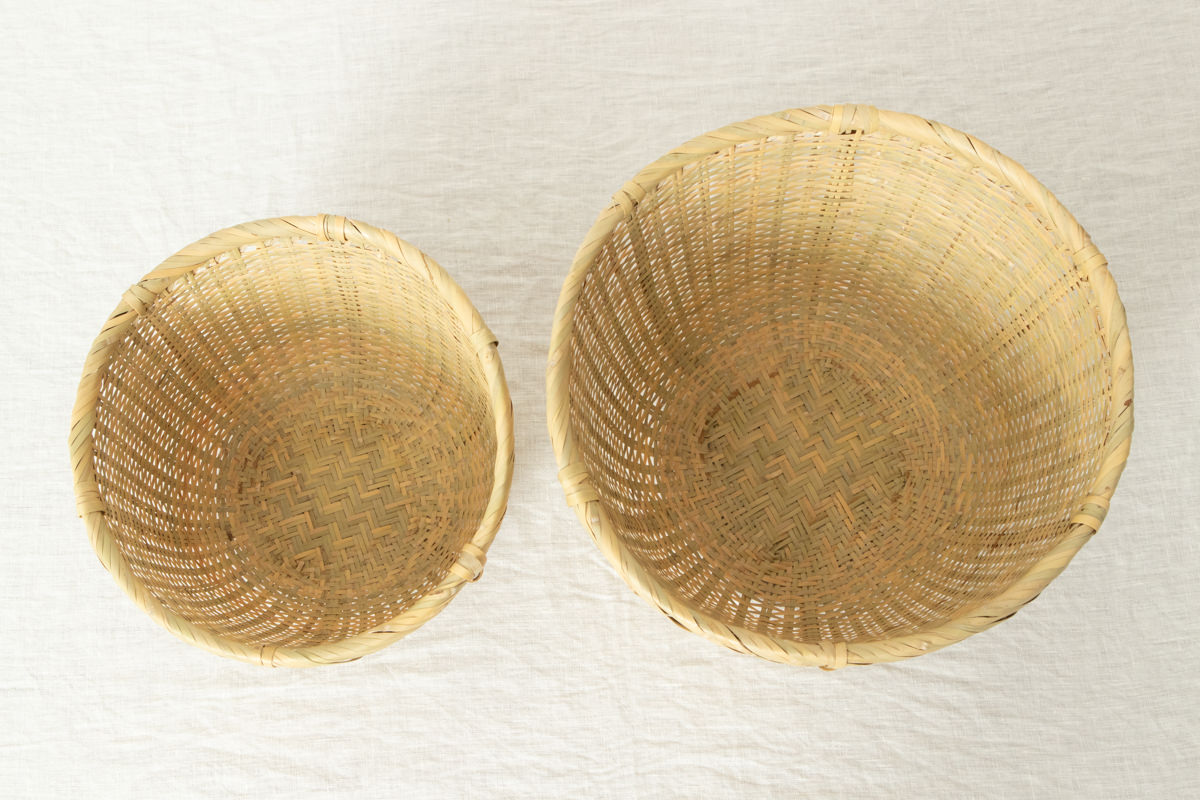
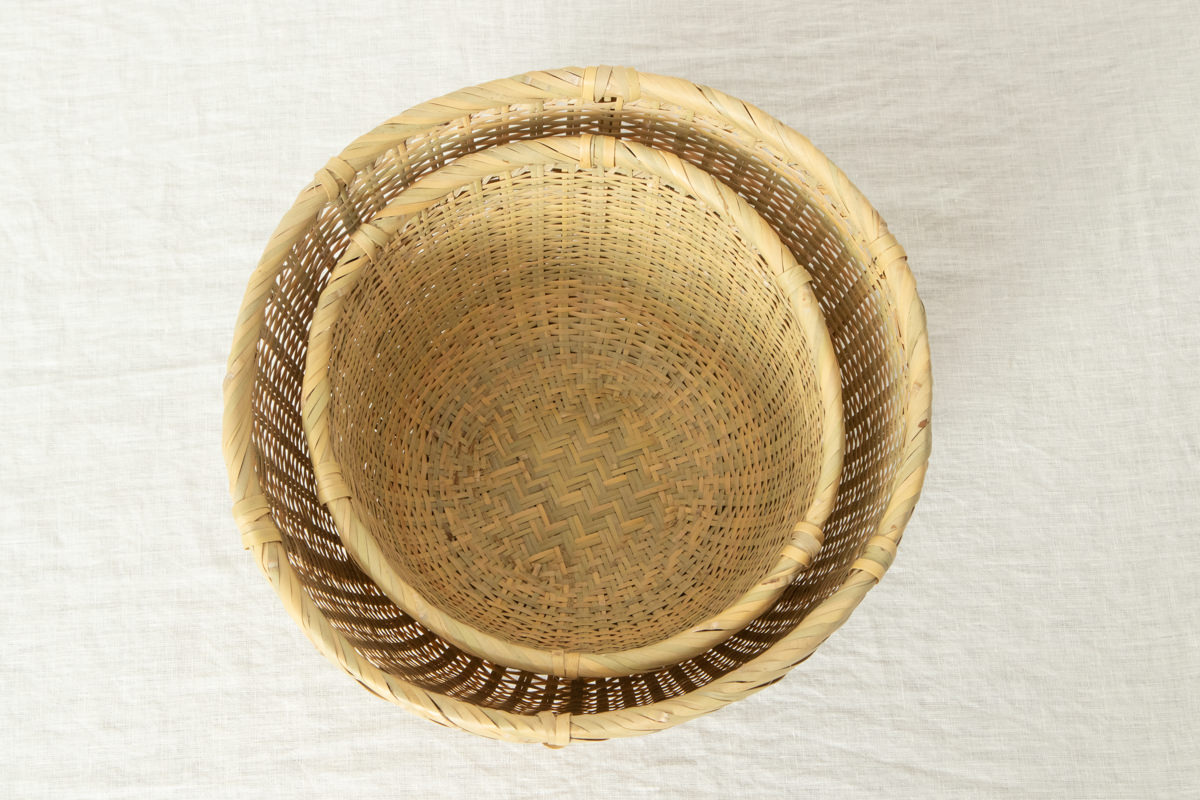
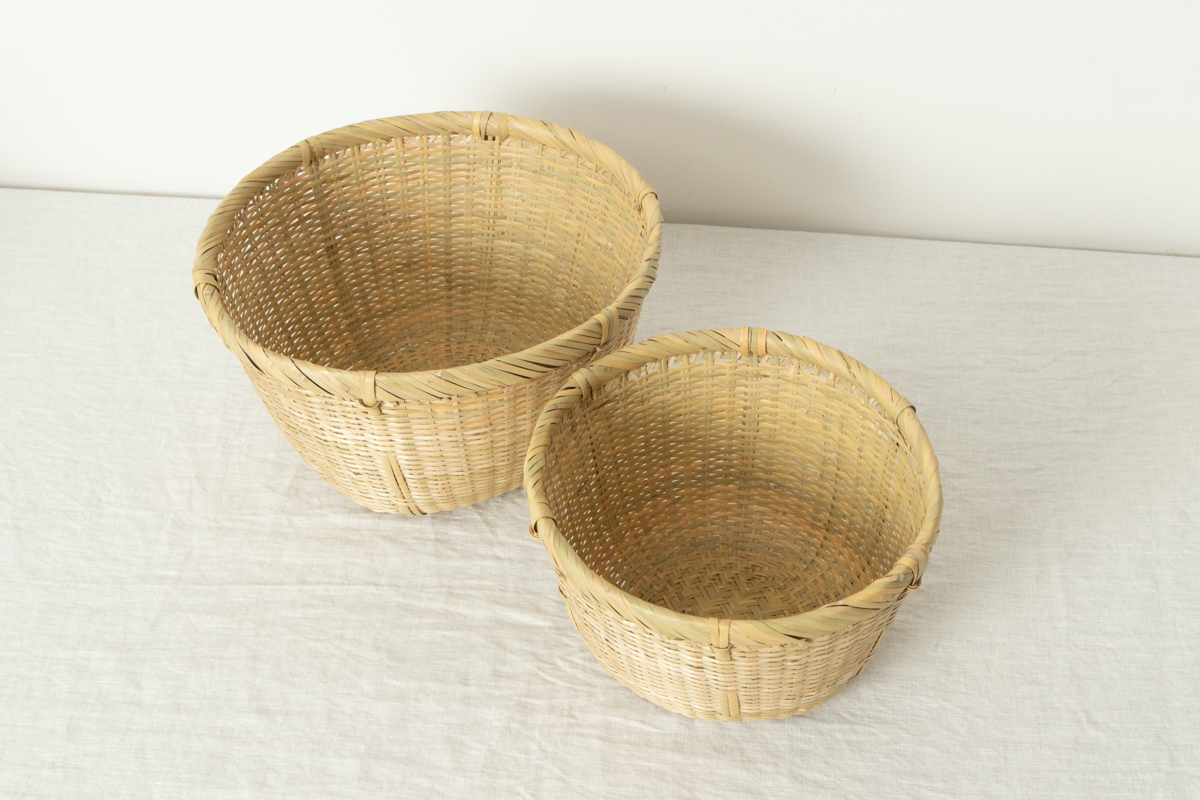
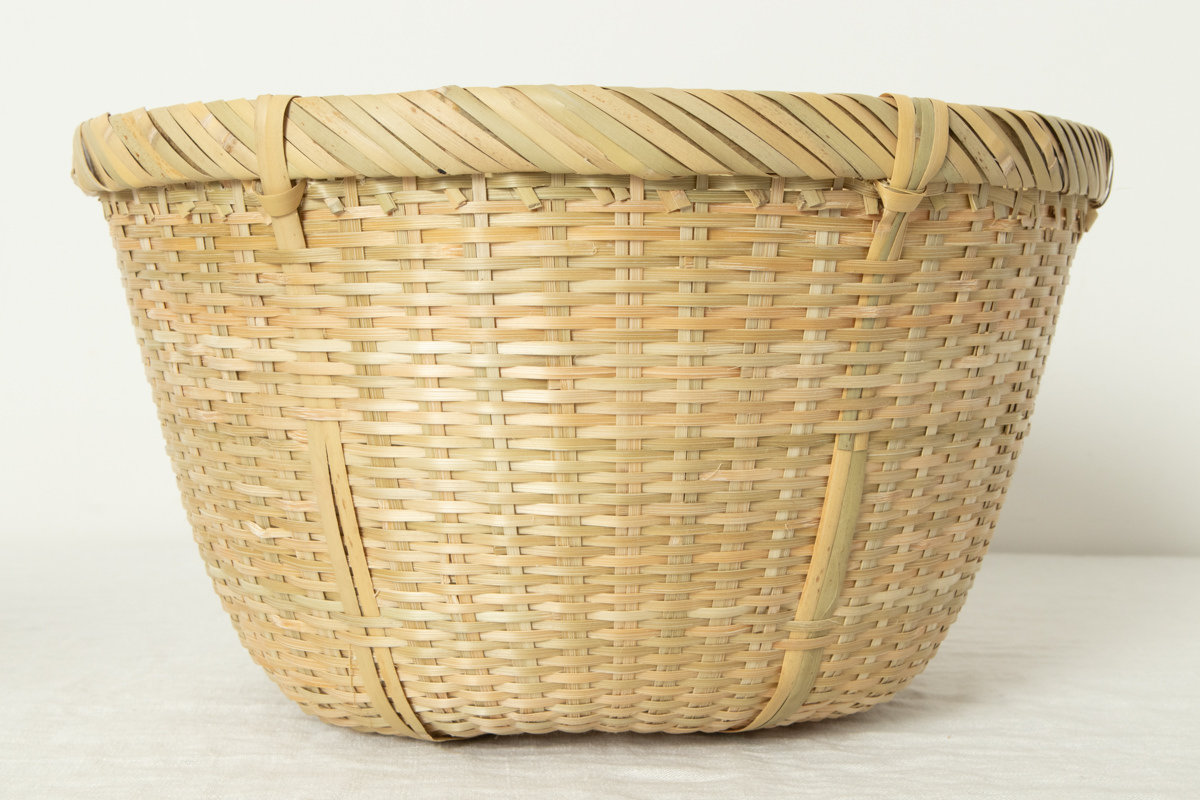
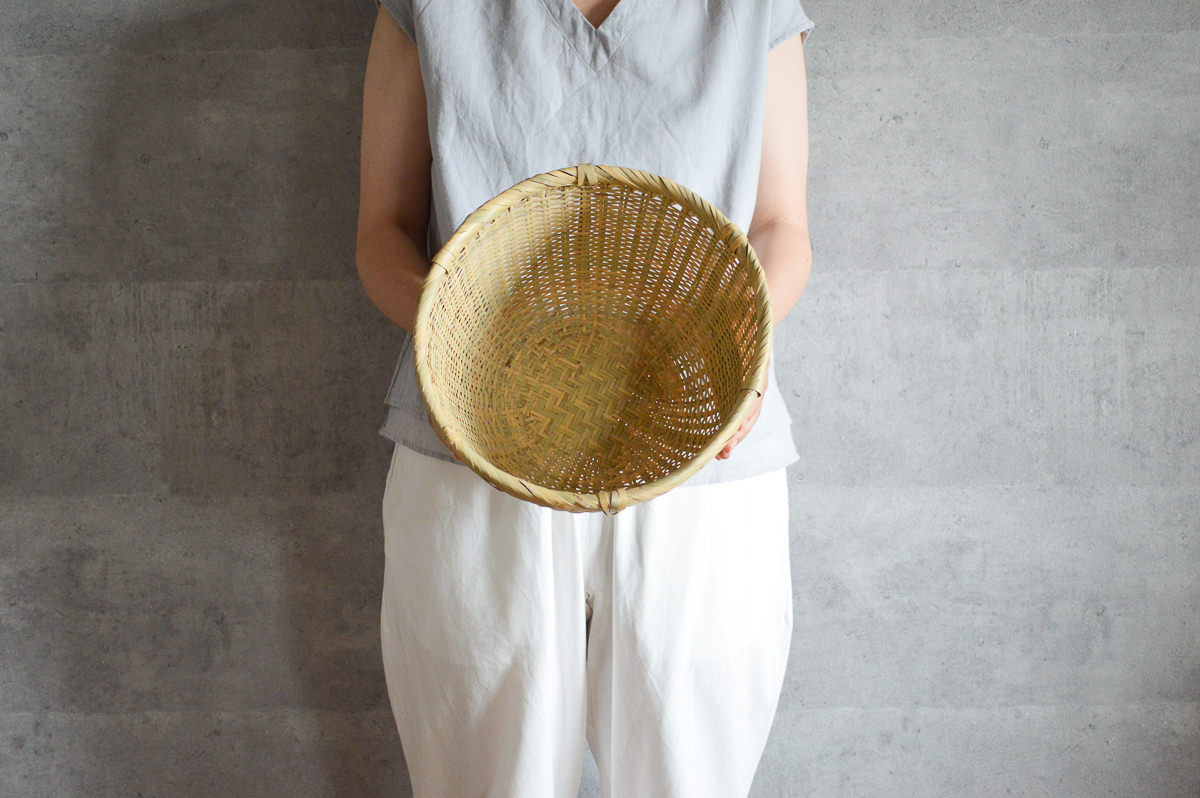
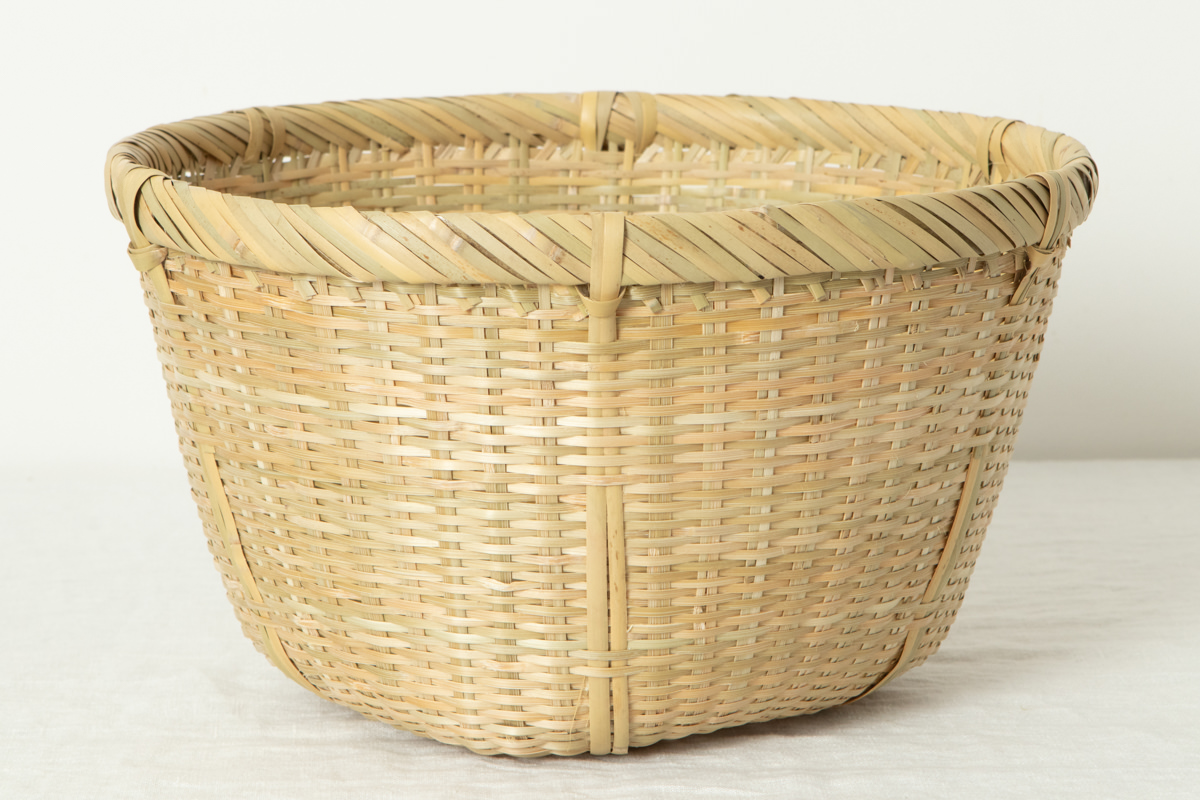
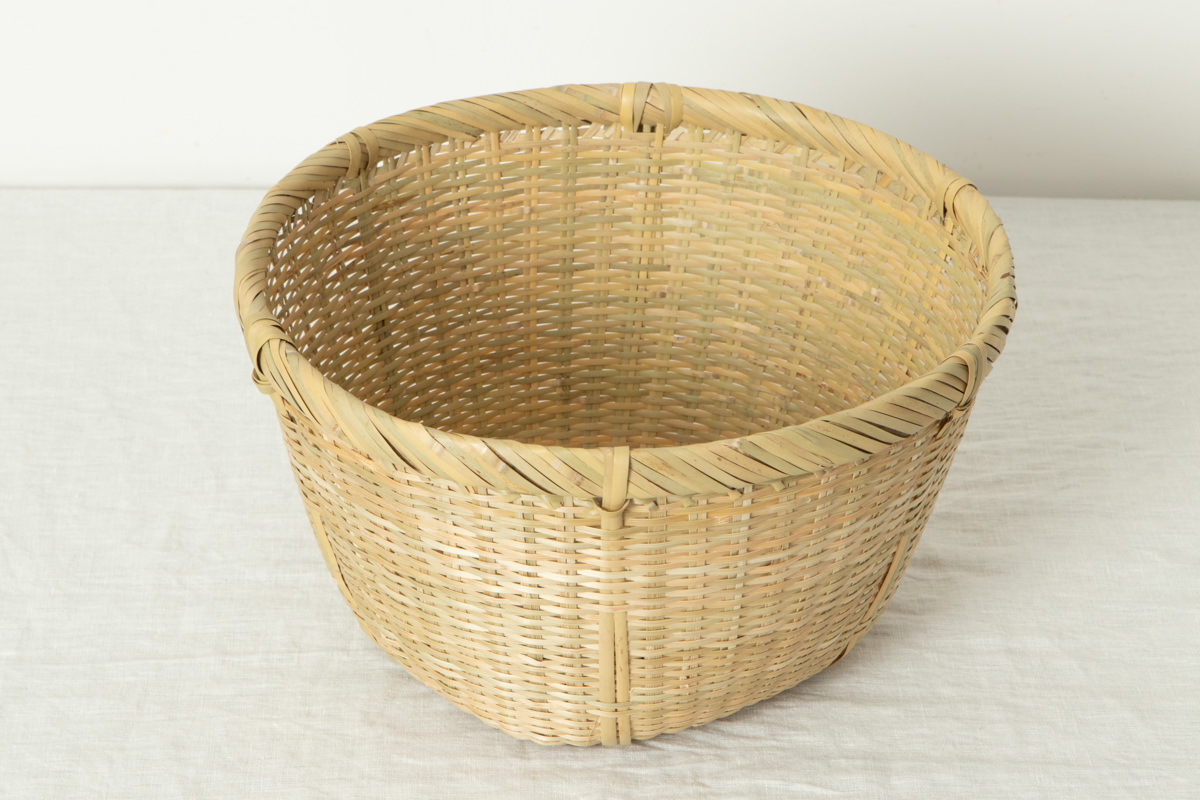
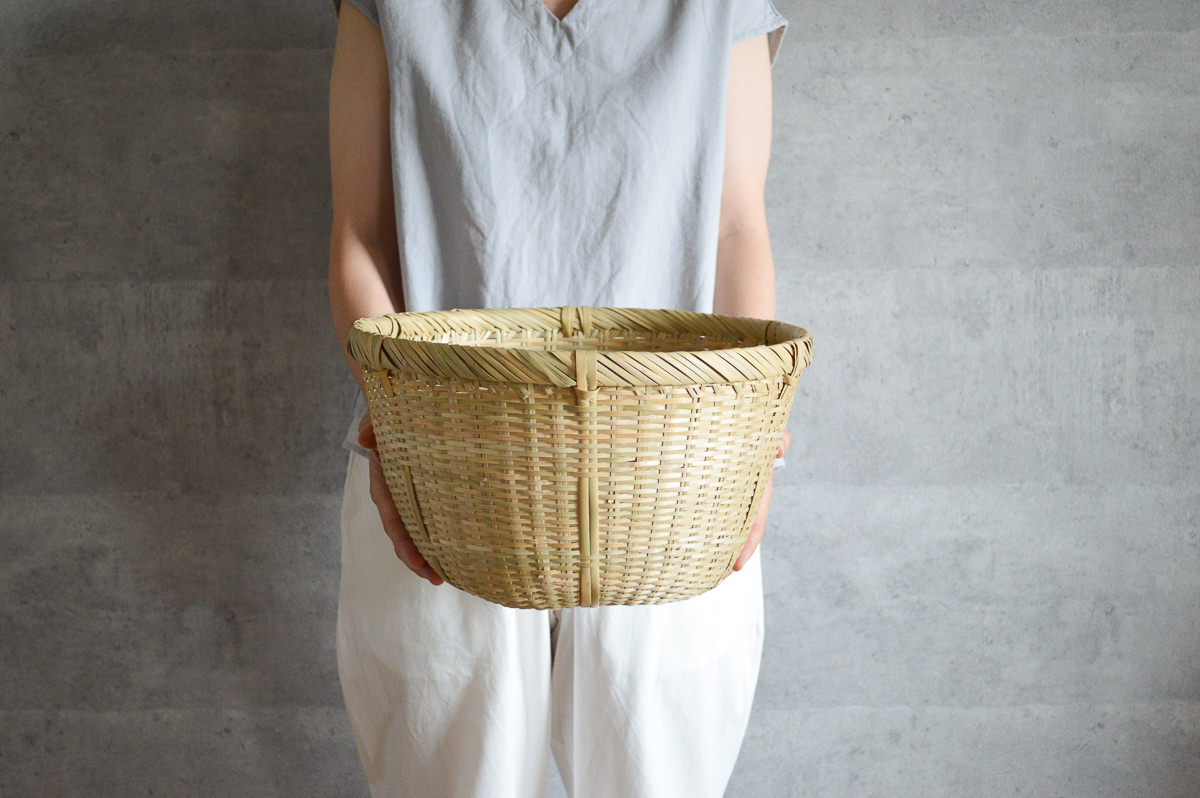
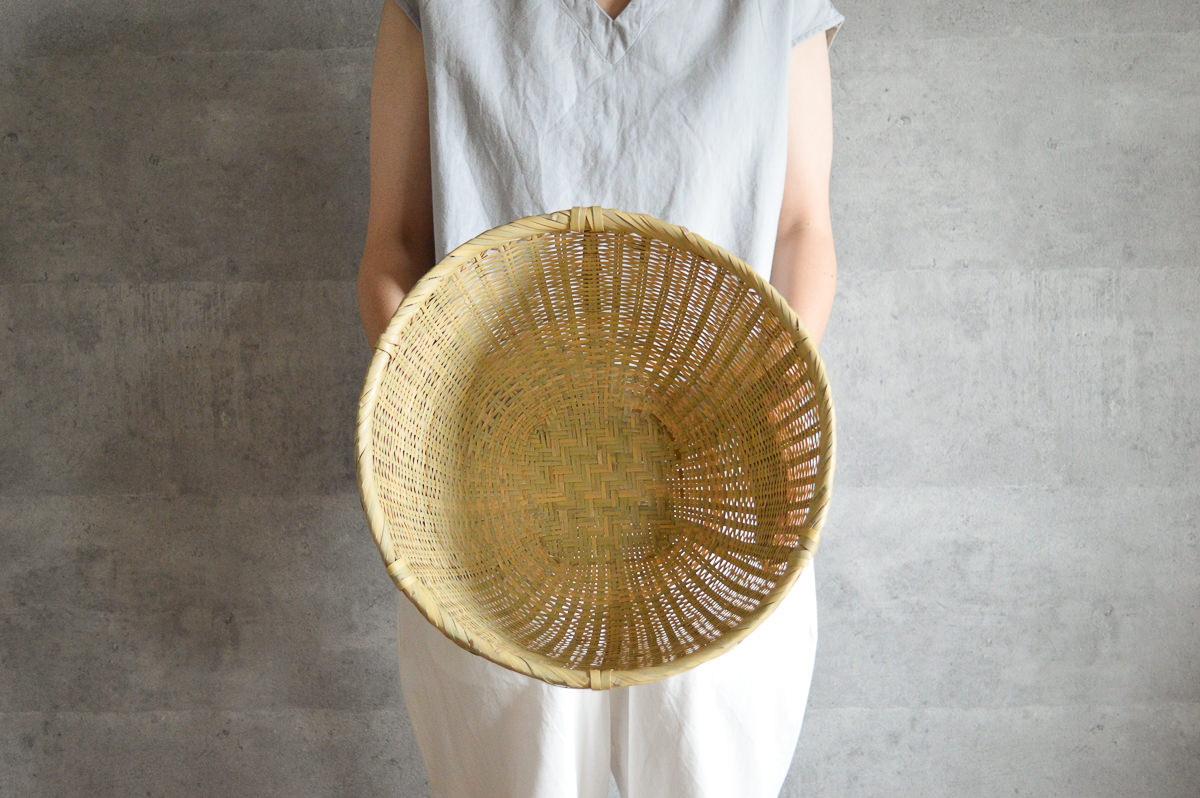
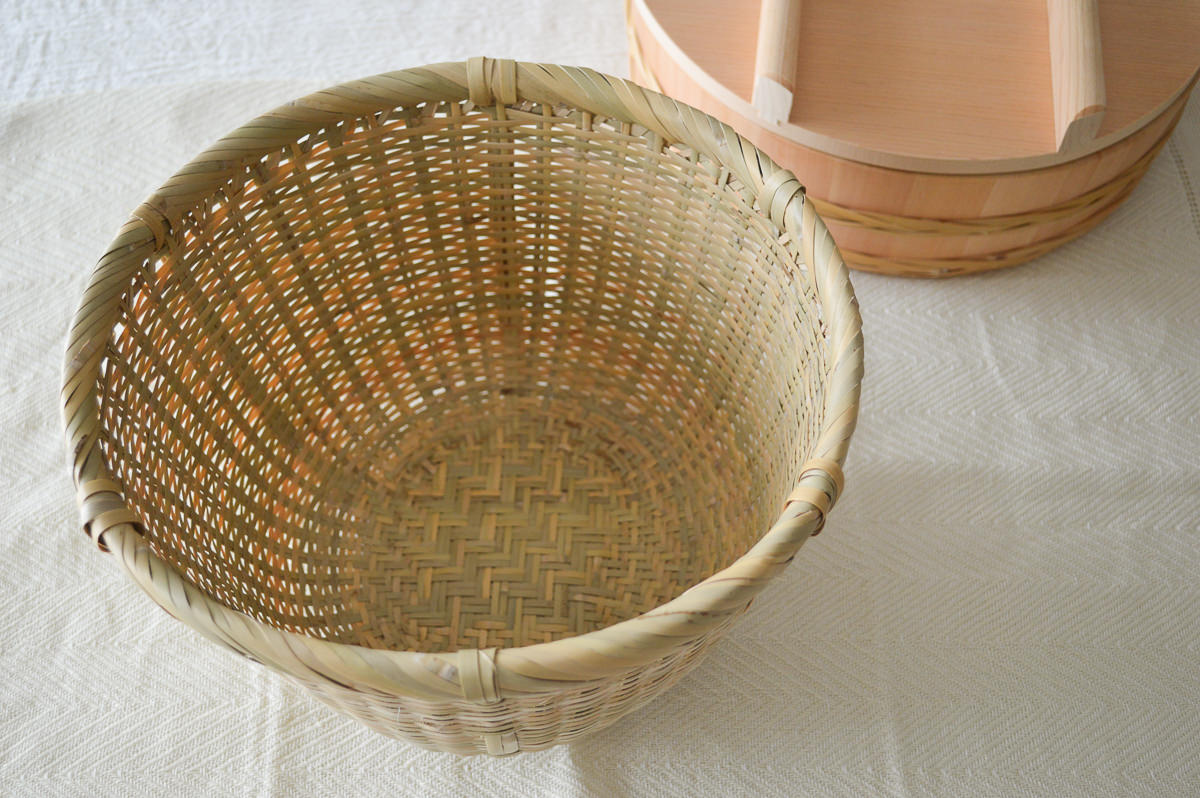
This is a large rice washing basket, made from medake bamboo grown in Ehime, Japan, with a capacity to hold about one to two sho of rice.
Although produced in Ehime, it is based on the techniques of “shinodake craft,” a traditional bamboo craft designated in Miyagi Prefecture.
The maker studied the techniques of zaru making in shinodake craft in Miyagi over several years, then moved to Ehime, where the material was changed from shinodake to locally sourced medake bamboo.
While making careful adjustments, a wide variety of zaru are crafted.
Shinodake craft from Miyagi is regarded as one of the finest traditions of zaru making in Japan.
Today, however, production has declined significantly due to the aging of makers.
In this context, it feels deeply meaningful that these techniques are being carried on in a different environment, with the maker continuing to devote themselves to the making of zaru.
Many makers study bamboo craft from Oita and Kyushu at the Beppu Bamboo Craft Training Center in Oita Prefecture, and later return to their hometowns to continue their work.
However, it is extremely rare—and truly valuable—for someone to learn the bamboo craft techniques of the Tohoku region, then move to another area and carry on that tradition in their work.
When continuing bamboo craft in a different region, one of the major challenges is how to source materials.
In Japan, the types of bamboo that grow naturally vary by area —such as shinodake, medake, madake, nemagari bamboo, and moso bamboo— so once the location changes, it becomes difficult to obtain the same materials used in other regions.
The maker harvests medake bamboo growing in the mountains of Ehime and Kochi, using it as a substitute for shinodake, and prepares the material themselves while weaving each zaru.
Medake is sometimes referred to as “shinodake” because of its similar appearance, but in fact it is harder than the shinodake used in Miyagi, resulting in a sturdier finished piece.
During their training in Miyagi, the maker also traveled throughout Japan to study bamboo craft in different regions.
As a result, this piece can be seen as a kind of hybrid—combining the techniques of Miyagi-style zaru with elements of bamboo craft from across the country.
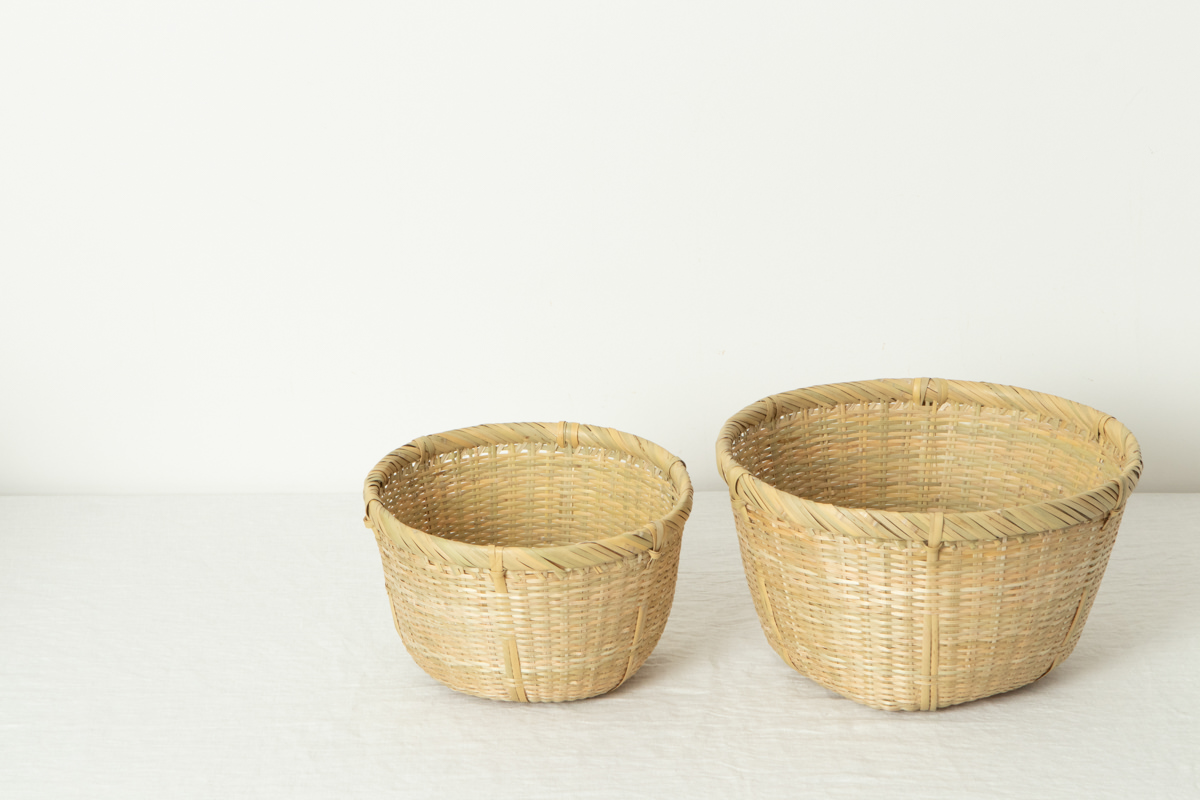
On this page, we introduce the rice washing basket in two sizes: large (12 ribs) and extra large (13 ribs).
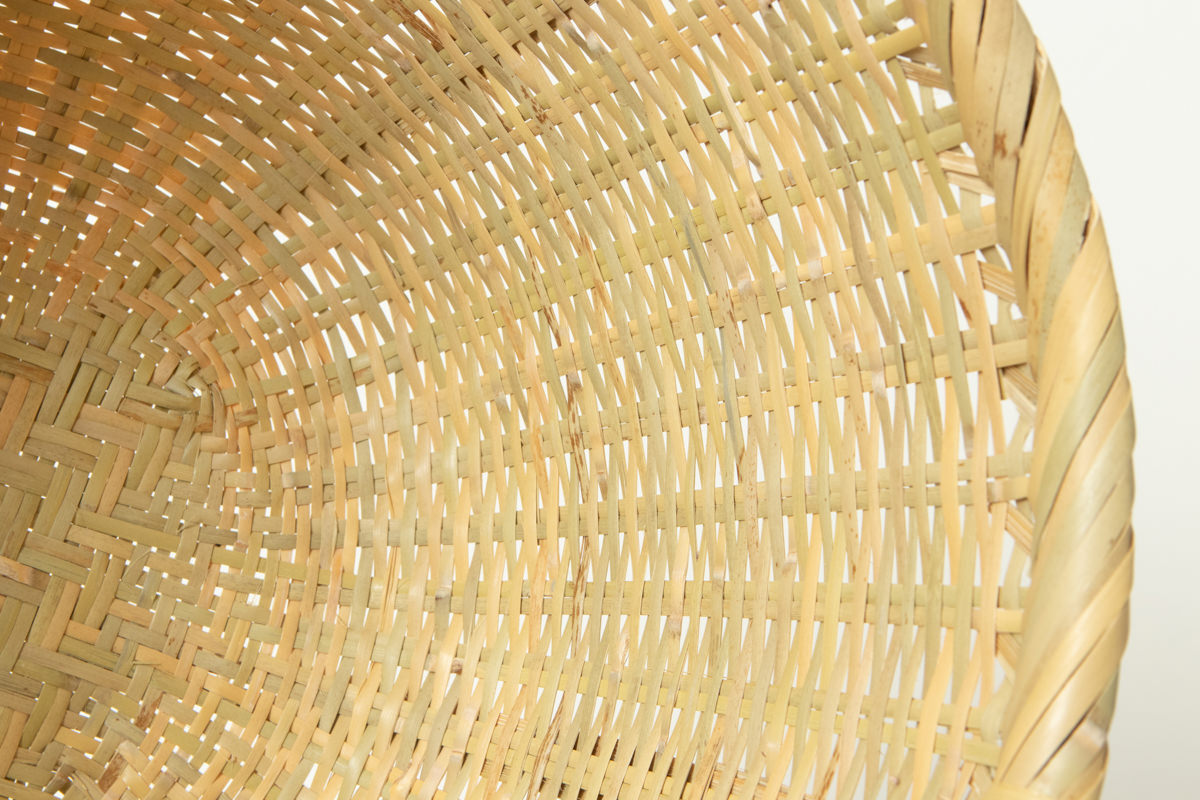
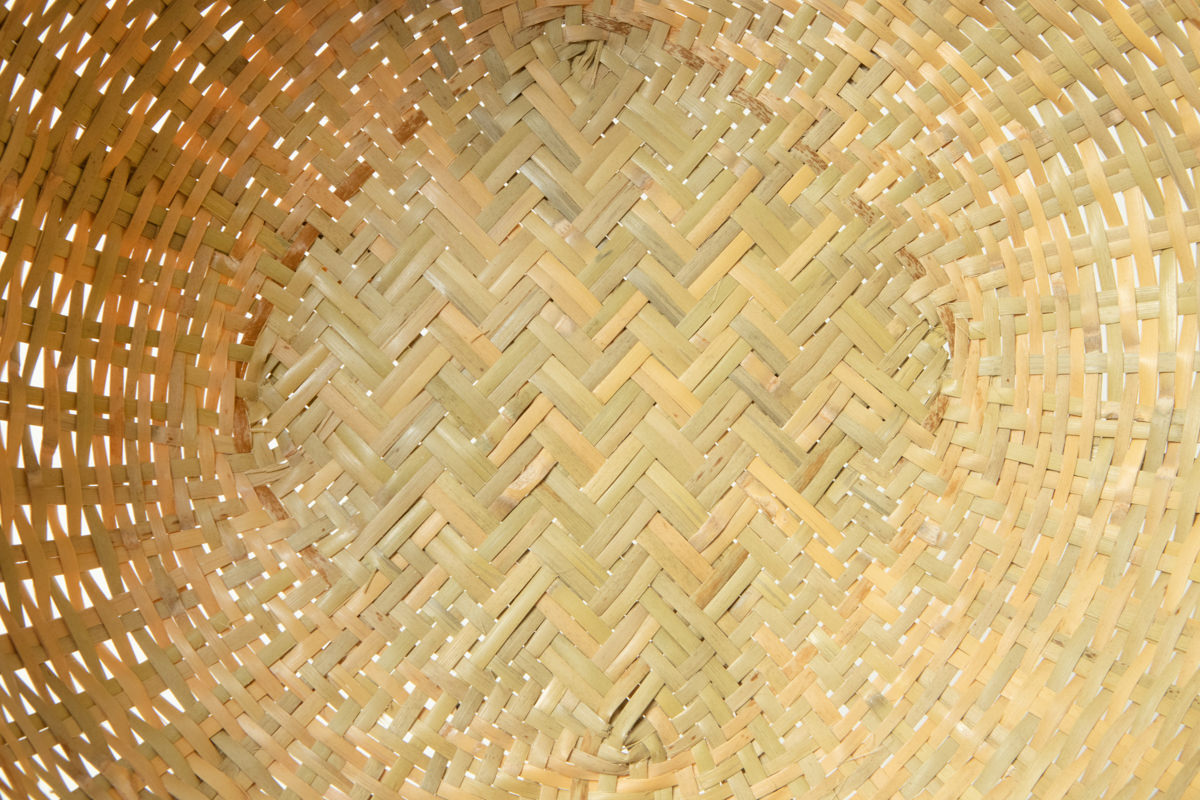
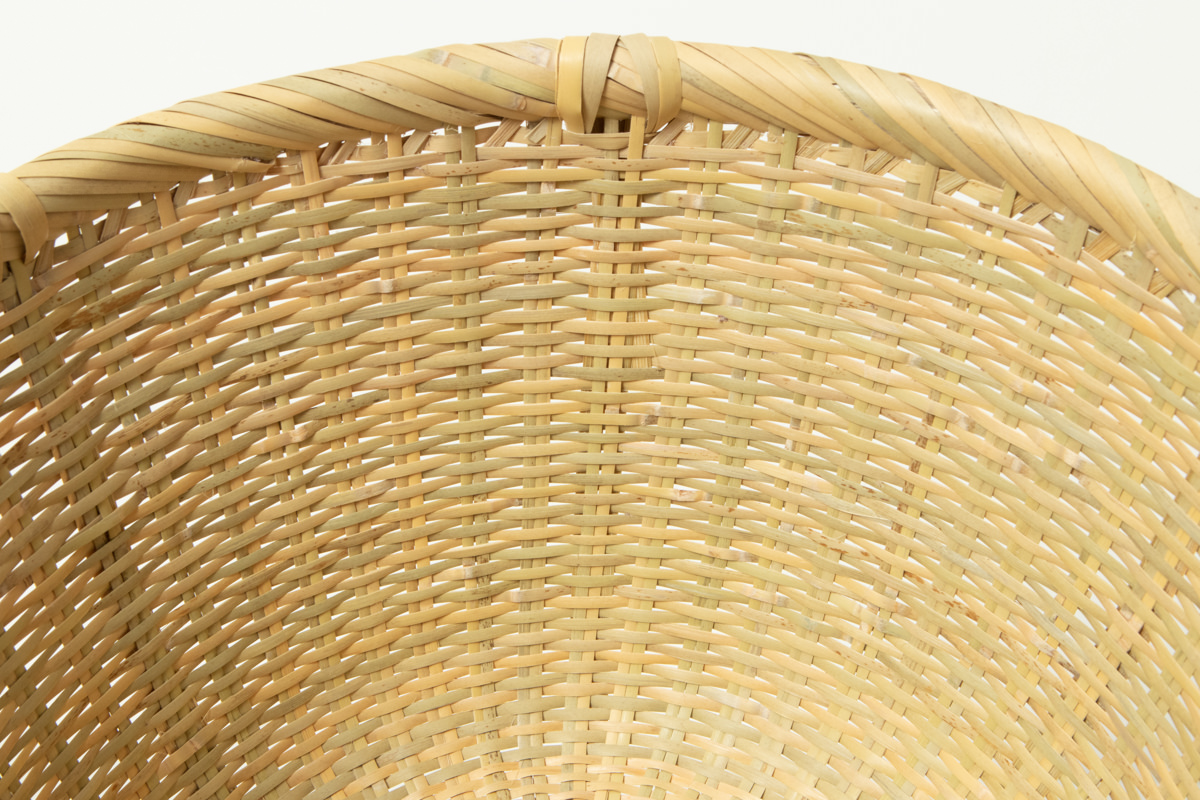
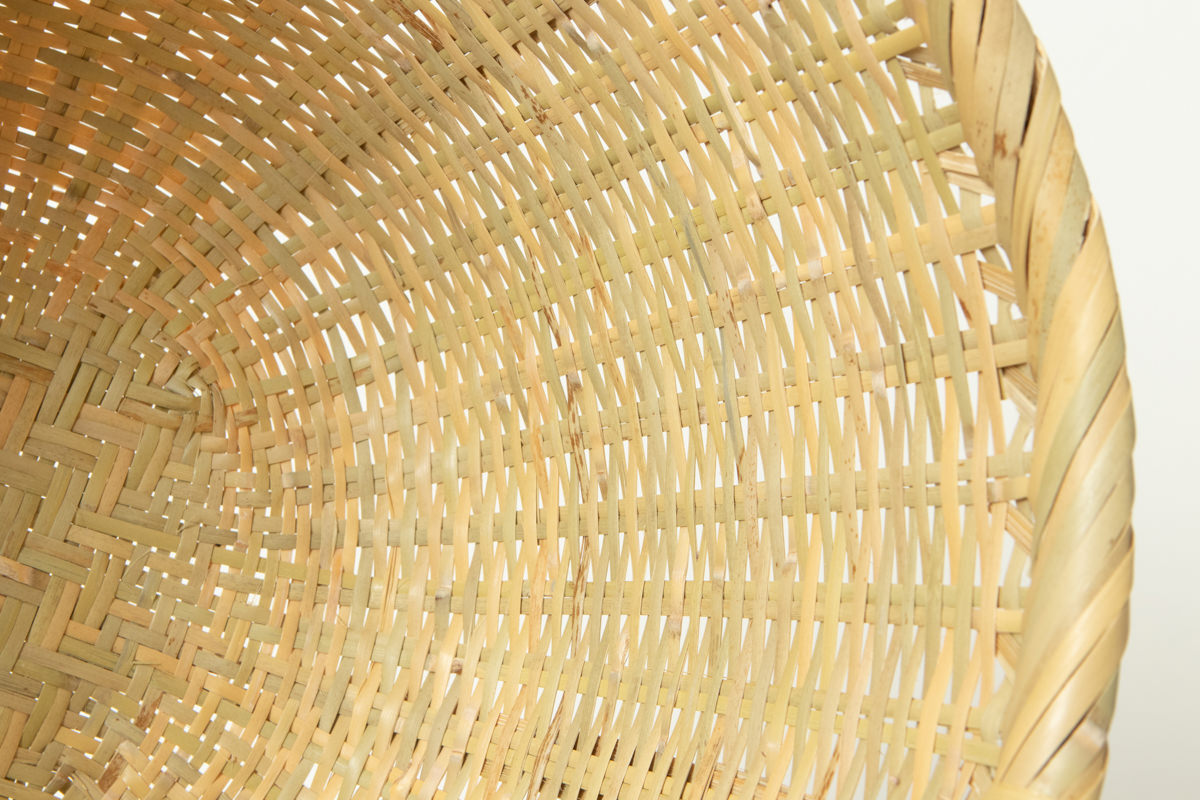
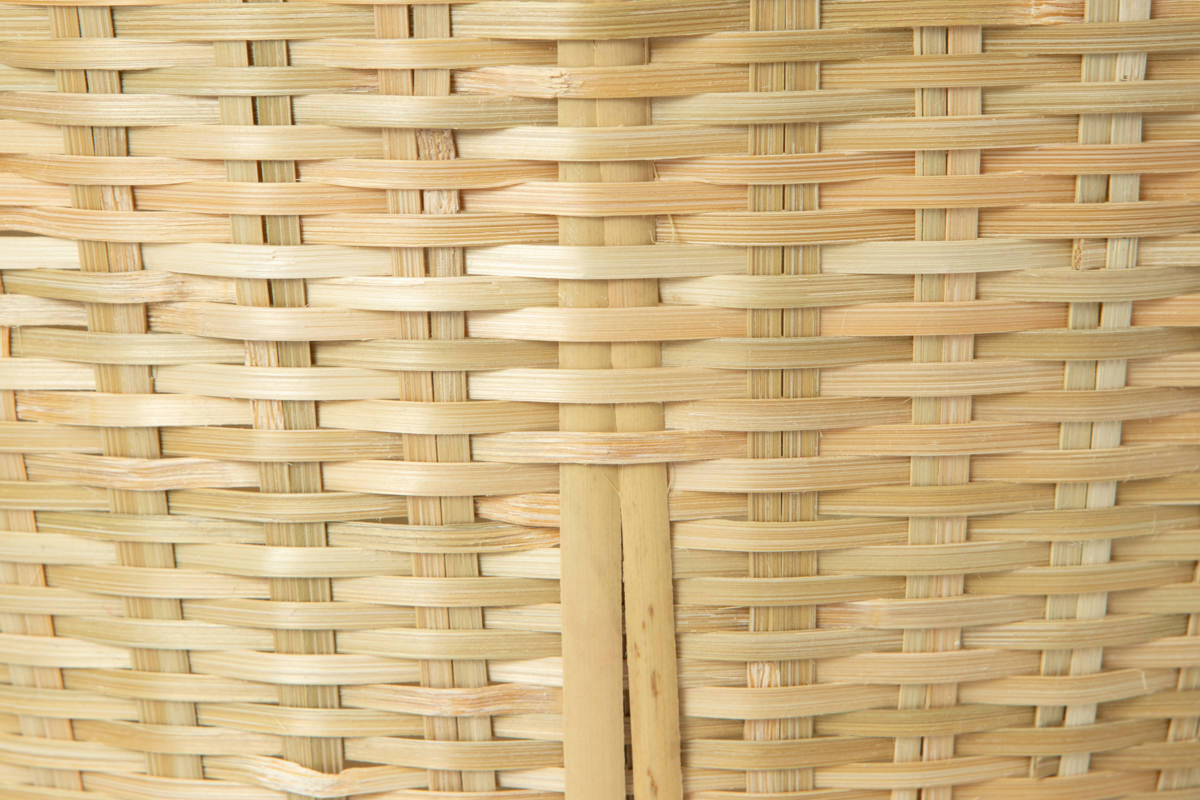
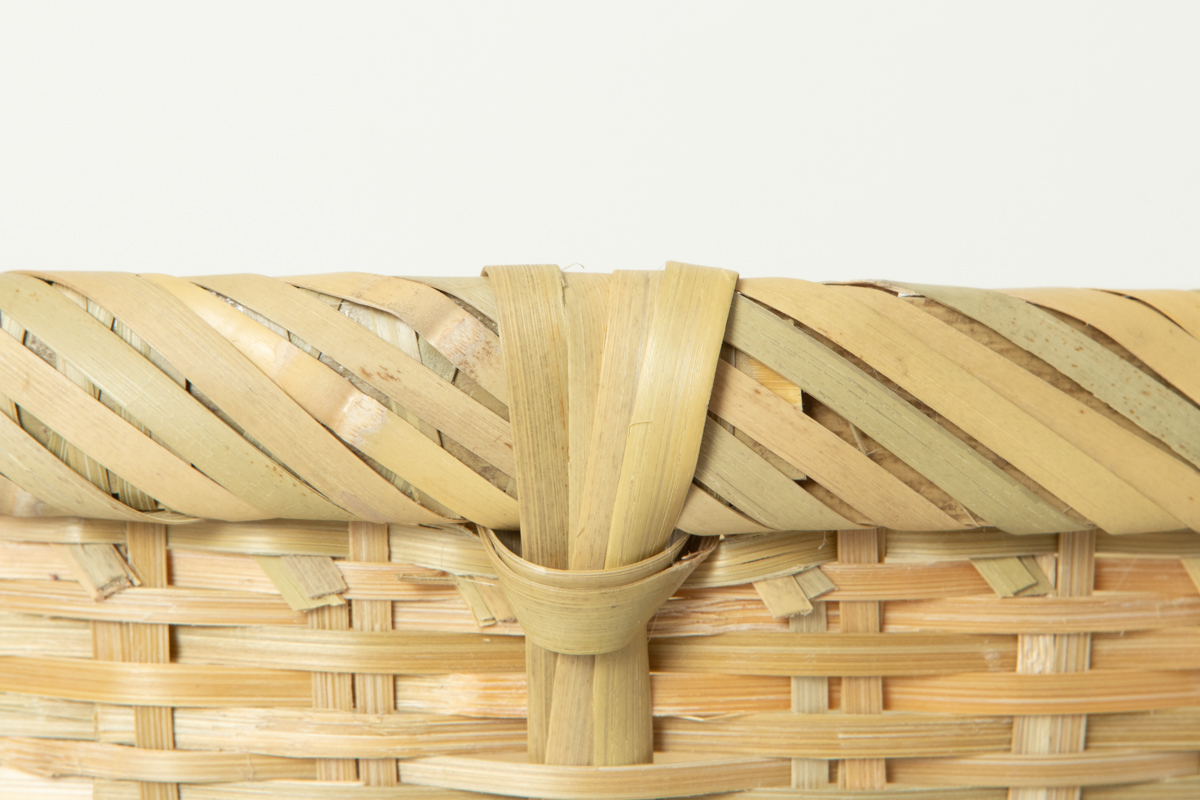
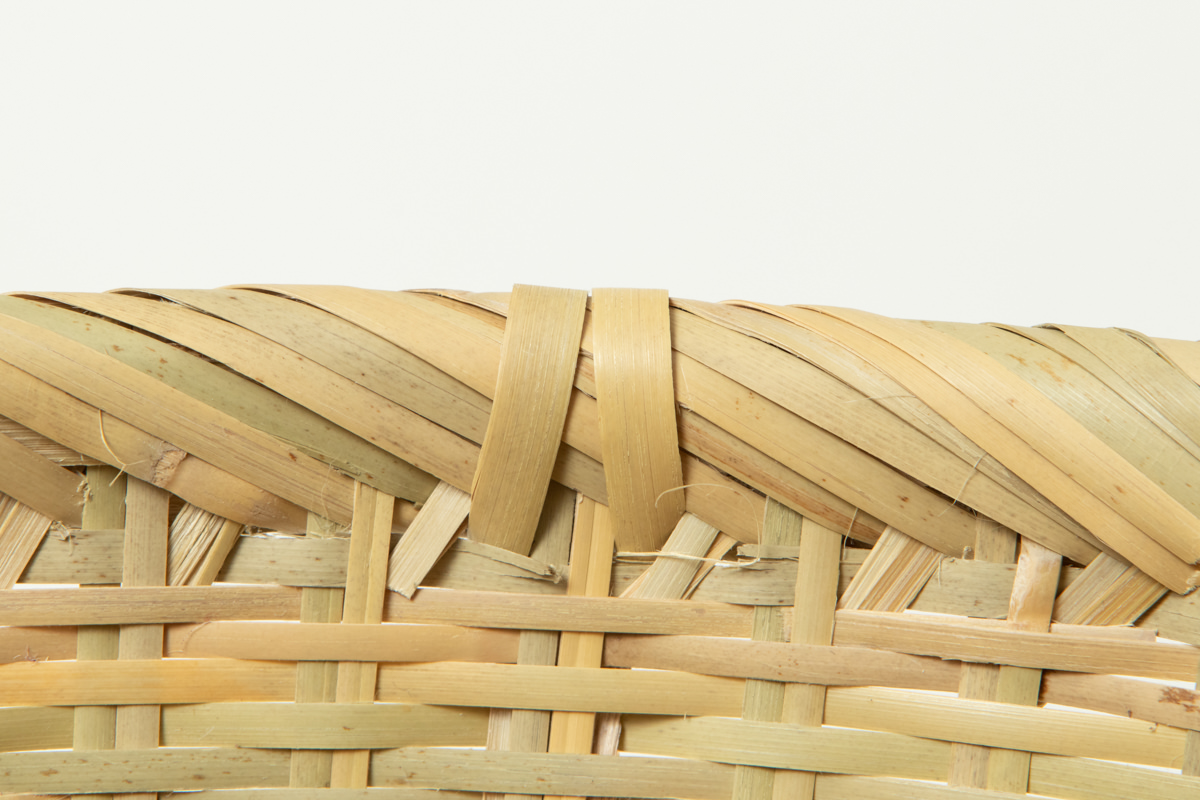
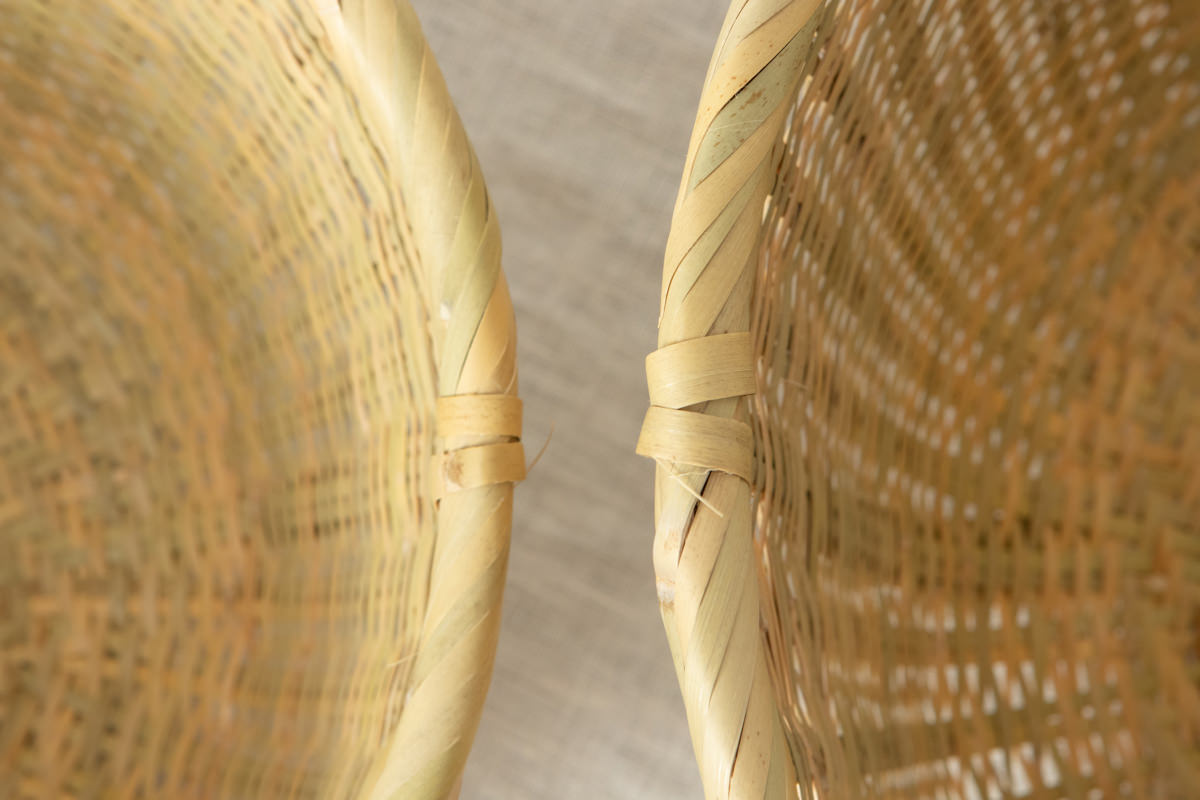
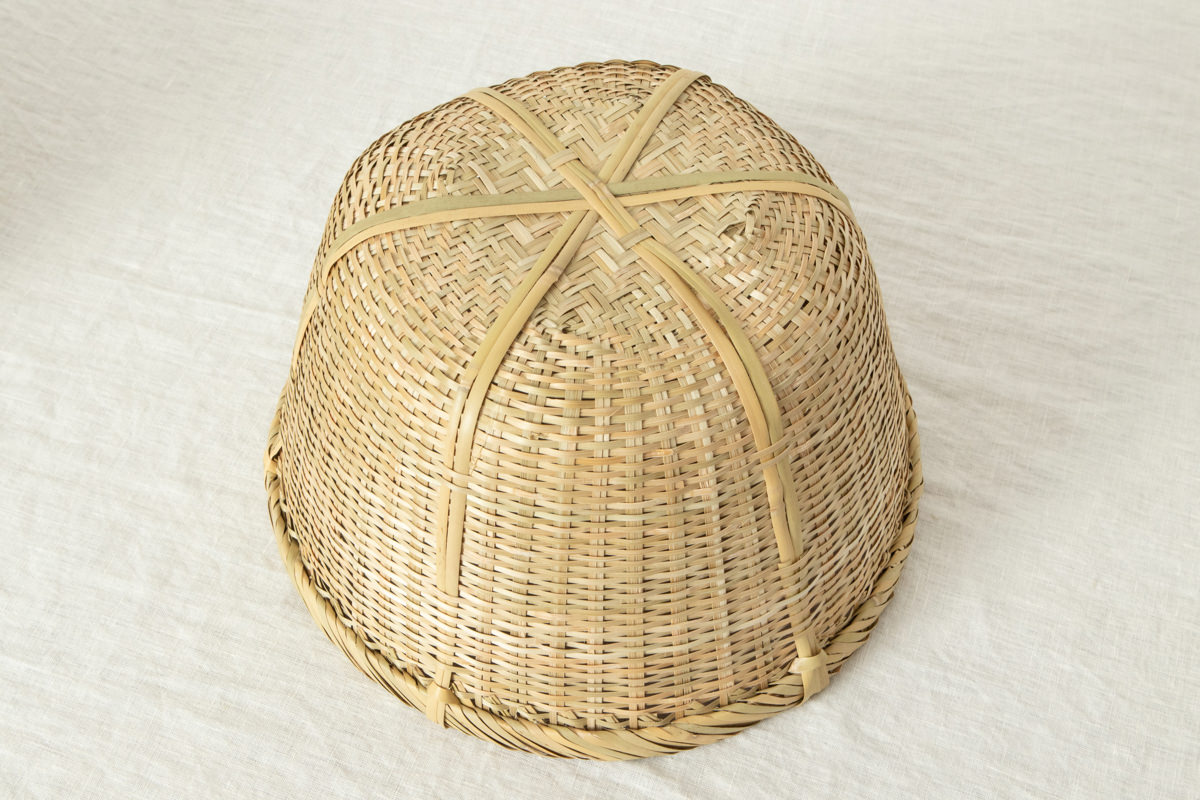
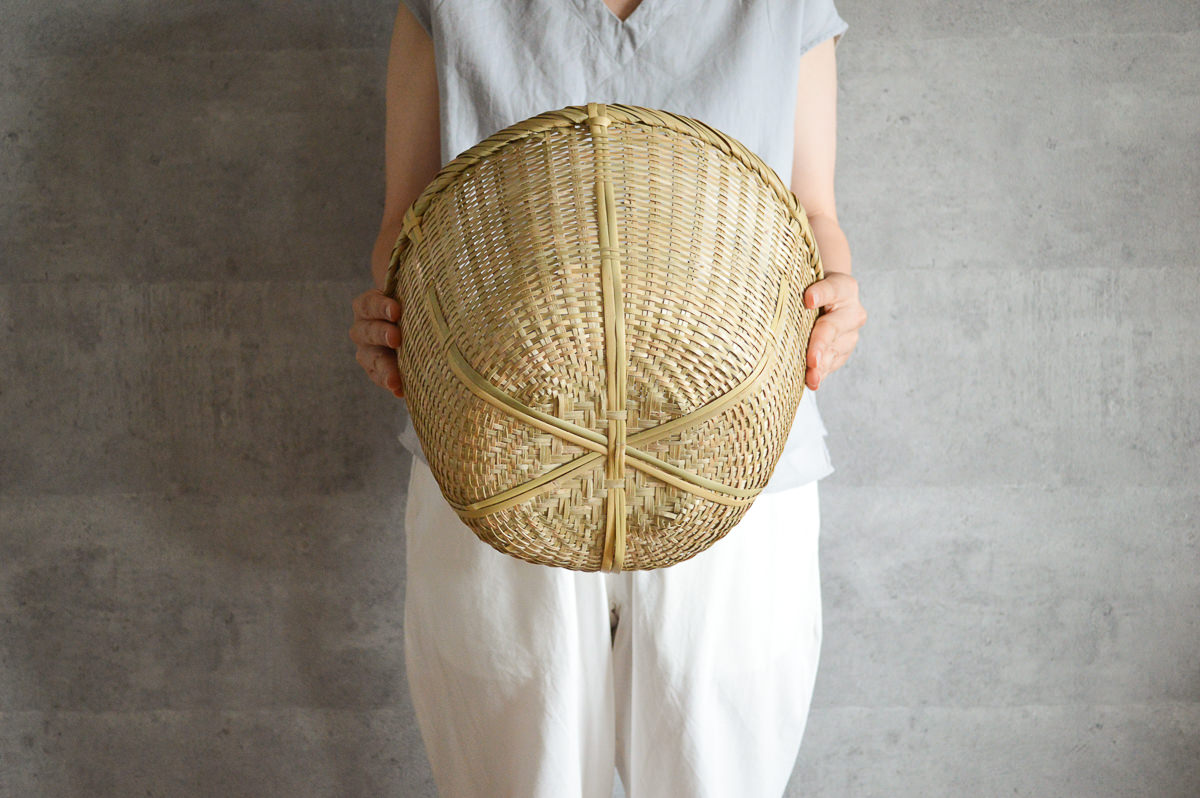
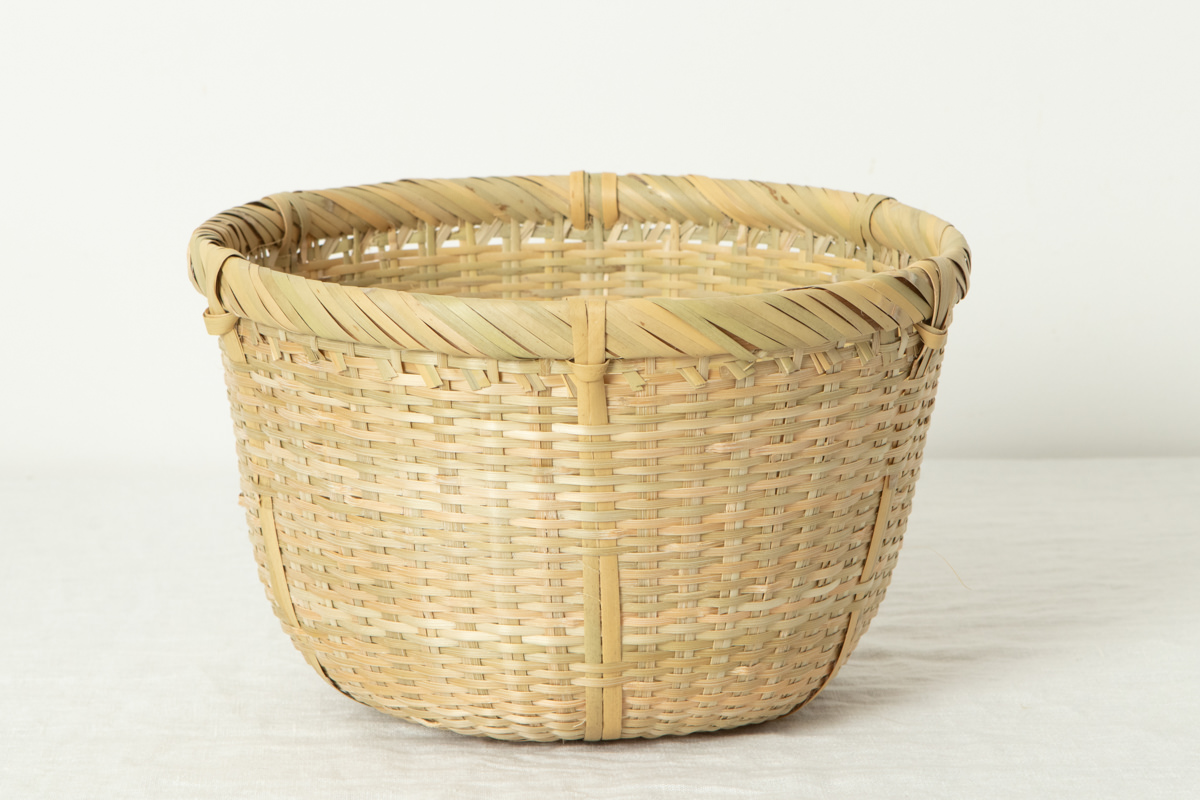
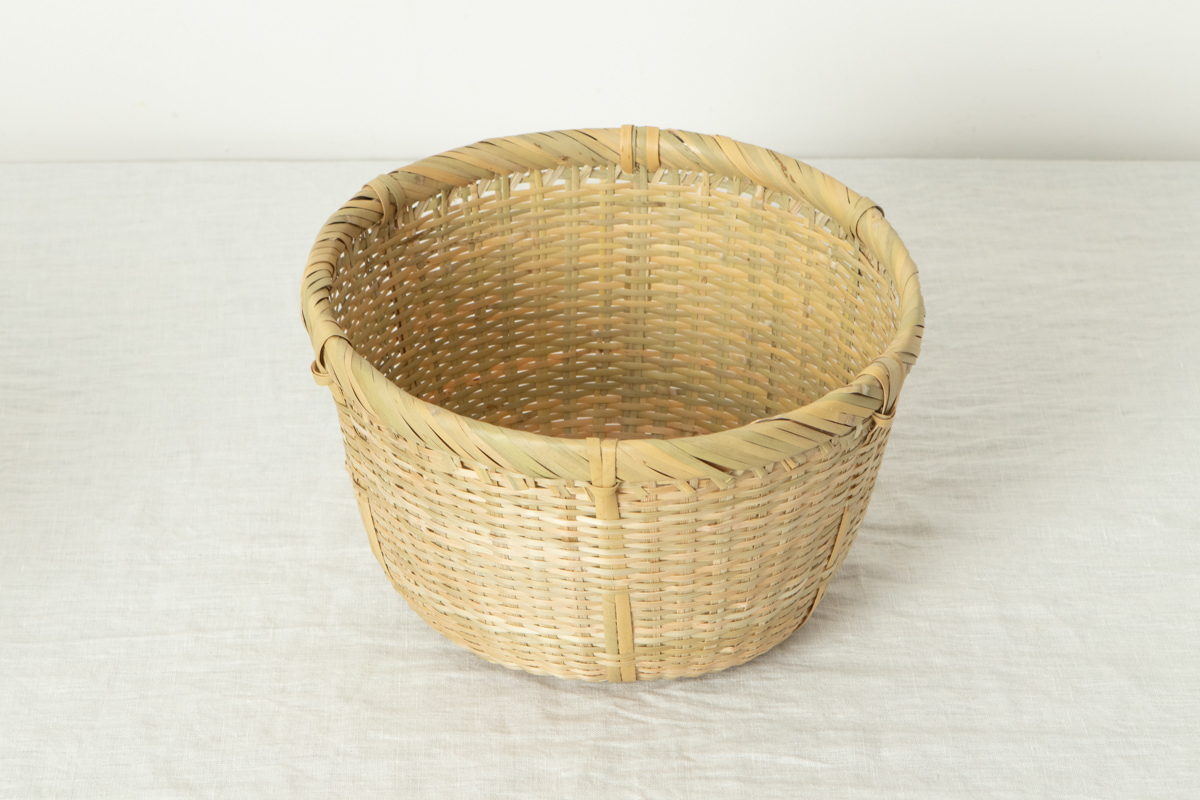
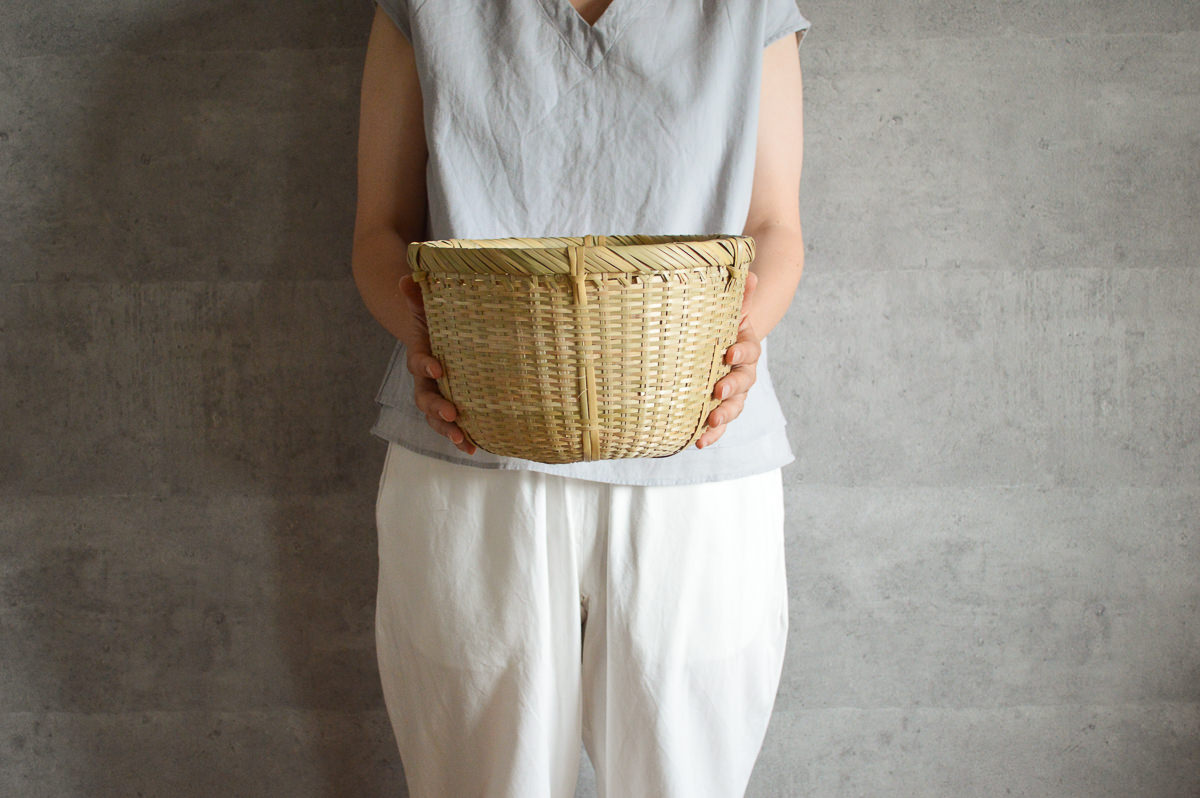
The terms “12 ribs” and “13 ribs” are size names used in Miyagi to describe rice washing baskets.The ajiro-ami weave on the base is formed by weaving bamboo strips in pairs, and the number of these pairs determines the size—and name—of the basket. In this example, 13 pairs are used to form the base, and then the sides are raised from it, which is why this basket is called a “13-rib zaru” (jūsanbon zaru).Medake bamboo is split lengthwise and shaved thin, then woven using the outer skin of the bamboo. The work begins from the base, the sides are raised, and the basket is woven in a regular pattern by wrapping horizontal strips around the vertical ribs.The smooth outer surface of the bamboo skin is used on the outside. It repels water and helps prevent splinters from scratching your hands or ingredients, so even when your hands touch it during washing, it feels completely smooth.It offers excellent drainage, while the tightly woven structure prevents rice grains from slipping through.This is the outer side of the basket. Here too, the bamboo strips are carefully finished so that the surface feels gentle to the touch.This is the rim. Madake bamboo is used as the core, and medake bamboo is carefully wrapped around it to finish. In addition, strengthening ribs (chikara-dake) run vertically from the rim, pass around the base, and are secured at the opposite rim.This is the view from the inside of the basket.Both sizes are finished with the same rim construction.This is the underside of the basket. Here too, the bamboo strips are carefully finished so that the surface feels gentle to the touch.
The three pairs of chikara-dake (reinforcing ribs) running across the base play a crucial role in this kind of basket.
Rice becomes quite heavy when filled with water, but these reinforcing ribs provide firm support, helping support the base and maintain its structure.
Both the large and extra large sizes are made with this reinforced construction.
This is the large size (12-rib zaru). Three pairs of chikara-dake (reinforcing ribs) also run across the base.This is the extra large size (13-rib zaru). Here as well, three pairs of chikara-dake (reinforcing ribs) run across the base.
It is well suited for preparing meals when family or friends gather together.
With its excellent drainage, it is ideal not only for washing rice, but also for rinsing vegetables or draining noodles after boiling.
Each size holds about one sho or two sho of rice, respectively.
In practice, it is possible to hold a larger amount, but doing so may place extra strain on the base and lead to faster wear, so it is best to use it with some margin.
After use, scrub it lightly with a tawashi brush, rinse it well, and allow it to dry thoroughly before using it again.
For more detailed information on handling and care, please refer to the section below titled “For long-lasting use of your zaru.”
It can also be used beyond the kitchen—as a basket for storing cloth items or for organizing small belongings.
It may feel a little large for modern households, but it is a zaru that serves an essential role.
Please check the size carefully and choose the one that suits you best.
For long-lasting use of your zaru
How long “long-lasting” is can vary depending on how it is used and the environment, but zaru used around water tend to wear relatively quickly. Even with careful use, when used regularly, a lifespan of about 3 to 5 years is generally considered good.
Depending on how it is handled, it may wear out sooner or become unusable due to mold. We hope the following notes will help you enjoy it for as long as possible.
When the basket contains rice—especially when the rice has absorbed water and become heavy— repeatedly lifting it by holding only the rim may accelerate wear and eventually lead to damage. When lifting, please support the basket from underneathor hold the entire basket, and handle it as gently as possible.
When removing rice from the basket or after washing it, tapping the rim against hard surfaces such as a sink or a rice cooker to shake out water or grains —even lightly—can, over time, cause wear and eventually lead to damage of the rim. Instead, hold the basket with both hands and shake it gently to drain water, or lightly tap the bottom to release the rice.
Although it drains well, the bamboo will still absorb moisture and remain damp after use. If it is used again before it has fully dried, repeated use in that condition may lead to darkening or mold, so we recommend avoiding this. Ideally, it is best to use it once a day, and then allow it to dry thoroughly before the next use. Some people also keep another zaru of a different type and alternate between them —morning and evening, or every other day.
This has been a rather long explanation, but once you become familiar with it, it is an easy and practical zaru to use. We hope you will feel free to incorporate it into your daily life.
Please note: This item ships from Japan. As the buyer, you are responsible for any import duties, customs fees, or local taxes that may be charged in your country. These costs are not included in the item price or shipping cost. Please check with your local customs authority if you are unsure about any potential charges before placing your order.
This is a large rice washing basket, made from medake bamboo grown in Ehime, Japan, with a capacity to hold about one to two sho of rice.
Although produced in Ehime, it is based on the techniques of “shinodake craft,” a traditional bamboo craft designated in Miyagi Prefecture.
The maker studied the techniques of zaru making in shinodake craft in Miyagi over several years, then moved to Ehime, where the material was changed from shinodake to locally sourced medake bamboo.
While making careful adjustments, a wide variety of zaru are crafted.
Shinodake craft from Miyagi is regarded as one of the finest traditions of zaru making in Japan.
Today, however, production has declined significantly due to the aging of makers.
In this context, it feels deeply meaningful that these techniques are being carried on in a different environment, with the maker continuing to devote themselves to the making of zaru.
Many makers study bamboo craft from Oita and Kyushu at the Beppu Bamboo Craft Training Center in Oita Prefecture, and later return to their hometowns to continue their work.
However, it is extremely rare—and truly valuable—for someone to learn the bamboo craft techniques of the Tohoku region, then move to another area and carry on that tradition in their work.
When continuing bamboo craft in a different region, one of the major challenges is how to source materials.
In Japan, the types of bamboo that grow naturally vary by area —such as shinodake, medake, madake, nemagari bamboo, and moso bamboo— so once the location changes, it becomes difficult to obtain the same materials used in other regions.
The maker harvests medake bamboo growing in the mountains of Ehime and Kochi, using it as a substitute for shinodake, and prepares the material themselves while weaving each zaru.
Medake is sometimes referred to as “shinodake” because of its similar appearance, but in fact it is harder than the shinodake used in Miyagi, resulting in a sturdier finished piece.
During their training in Miyagi, the maker also traveled throughout Japan to study bamboo craft in different regions.
As a result, this piece can be seen as a kind of hybrid—combining the techniques of Miyagi-style zaru with elements of bamboo craft from across the country.
On this page, we introduce the rice washing basket in two sizes: large (12 ribs) and extra large (13 ribs).
The terms “12 ribs” and “13 ribs” are size names used in Miyagi to describe rice washing baskets.The ajiro-ami weave on the base is formed by weaving bamboo strips in pairs, and the number of these pairs determines the size—and name—of the basket. In this example, 13 pairs are used to form the base, and then the sides are raised from it, which is why this basket is called a “13-rib zaru” (jūsanbon zaru).Medake bamboo is split lengthwise and shaved thin, then woven using the outer skin of the bamboo. The work begins from the base, the sides are raised, and the basket is woven in a regular pattern by wrapping horizontal strips around the vertical ribs.The smooth outer surface of the bamboo skin is used on the outside. It repels water and helps prevent splinters from scratching your hands or ingredients, so even when your hands touch it during washing, it feels completely smooth.It offers excellent drainage, while the tightly woven structure prevents rice grains from slipping through.This is the outer side of the basket. Here too, the bamboo strips are carefully finished so that the surface feels gentle to the touch.This is the rim. Madake bamboo is used as the core, and medake bamboo is carefully wrapped around it to finish. In addition, strengthening ribs (chikara-dake) run vertically from the rim, pass around the base, and are secured at the opposite rim.This is the view from the inside of the basket.Both sizes are finished with the same rim construction.This is the underside of the basket. Here too, the bamboo strips are carefully finished so that the surface feels gentle to the touch.
The three pairs of chikara-dake (reinforcing ribs) running across the base play a crucial role in this kind of basket.
Rice becomes quite heavy when filled with water, but these reinforcing ribs provide firm support, helping support the base and maintain its structure.
Both the large and extra large sizes are made with this reinforced construction.
This is the large size (12-rib zaru). Three pairs of chikara-dake (reinforcing ribs) also run across the base.This is the extra large size (13-rib zaru). Here as well, three pairs of chikara-dake (reinforcing ribs) run across the base.
It is well suited for preparing meals when family or friends gather together.
With its excellent drainage, it is ideal not only for washing rice, but also for rinsing vegetables or draining noodles after boiling.
Each size holds about one sho or two sho of rice, respectively.
In practice, it is possible to hold a larger amount, but doing so may place extra strain on the base and lead to faster wear, so it is best to use it with some margin.
After use, scrub it lightly with a tawashi brush, rinse it well, and allow it to dry thoroughly before using it again.
For more detailed information on handling and care, please refer to the section below titled “For long-lasting use of your zaru.”
It can also be used beyond the kitchen—as a basket for storing cloth items or for organizing small belongings.
It may feel a little large for modern households, but it is a zaru that serves an essential role.
Please check the size carefully and choose the one that suits you best.
For long-lasting use of your zaru
How long “long-lasting” is can vary depending on how it is used and the environment, but zaru used around water tend to wear relatively quickly. Even with careful use, when used regularly, a lifespan of about 3 to 5 years is generally considered good.
Depending on how it is handled, it may wear out sooner or become unusable due to mold. We hope the following notes will help you enjoy it for as long as possible.
When the basket contains rice—especially when the rice has absorbed water and become heavy— repeatedly lifting it by holding only the rim may accelerate wear and eventually lead to damage. When lifting, please support the basket from underneathor hold the entire basket, and handle it as gently as possible.
When removing rice from the basket or after washing it, tapping the rim against hard surfaces such as a sink or a rice cooker to shake out water or grains —even lightly—can, over time, cause wear and eventually lead to damage of the rim. Instead, hold the basket with both hands and shake it gently to drain water, or lightly tap the bottom to release the rice.
Although it drains well, the bamboo will still absorb moisture and remain damp after use. If it is used again before it has fully dried, repeated use in that condition may lead to darkening or mold, so we recommend avoiding this. Ideally, it is best to use it once a day, and then allow it to dry thoroughly before the next use. Some people also keep another zaru of a different type and alternate between them —morning and evening, or every other day.
This has been a rather long explanation, but once you become familiar with it, it is an easy and practical zaru to use. We hope you will feel free to incorporate it into your daily life.
Please note: This item ships from Japan. As the buyer, you are responsible for any import duties, customs fees, or local taxes that may be charged in your country. These costs are not included in the item price or shipping cost. Please check with your local customs authority if you are unsure about any potential charges before placing your order.
This is a large rice washing basket, made from medake bamboo grown in Ehime, Japan, with a capacity to hold about one to two sho of rice.
Although produced in Ehime, it is based on the techniques of “shinodake craft,” a traditional bamboo craft designated in Miyagi Prefecture.
The maker studied the techniques of zaru making in shinodake craft in Miyagi over several years, then moved to Ehime, where the material was changed from shinodake to locally sourced medake bamboo.
While making careful adjustments, a wide variety of zaru are crafted.
Shinodake craft from Miyagi is regarded as one of the finest traditions of zaru making in Japan.
Today, however, production has declined significantly due to the aging of makers.
In this context, it feels deeply meaningful that these techniques are being carried on in a different environment, with the maker continuing to devote themselves to the making of zaru.
Many makers study bamboo craft from Oita and Kyushu at the Beppu Bamboo Craft Training Center in Oita Prefecture, and later return to their hometowns to continue their work.
However, it is extremely rare—and truly valuable—for someone to learn the bamboo craft techniques of the Tohoku region, then move to another area and carry on that tradition in their work.
When continuing bamboo craft in a different region, one of the major challenges is how to source materials.
In Japan, the types of bamboo that grow naturally vary by area —such as shinodake, medake, madake, nemagari bamboo, and moso bamboo— so once the location changes, it becomes difficult to obtain the same materials used in other regions.
The maker harvests medake bamboo growing in the mountains of Ehime and Kochi, using it as a substitute for shinodake, and prepares the material themselves while weaving each zaru.
Medake is sometimes referred to as “shinodake” because of its similar appearance, but in fact it is harder than the shinodake used in Miyagi, resulting in a sturdier finished piece.
During their training in Miyagi, the maker also traveled throughout Japan to study bamboo craft in different regions.
As a result, this piece can be seen as a kind of hybrid—combining the techniques of Miyagi-style zaru with elements of bamboo craft from across the country.
On this page, we introduce the rice washing basket in two sizes: large (12 ribs) and extra large (13 ribs).
The terms “12 ribs” and “13 ribs” are size names used in Miyagi to describe rice washing baskets.The ajiro-ami weave on the base is formed by weaving bamboo strips in pairs, and the number of these pairs determines the size—and name—of the basket. In this example, 13 pairs are used to form the base, and then the sides are raised from it, which is why this basket is called a “13-rib zaru” (jūsanbon zaru).Medake bamboo is split lengthwise and shaved thin, then woven using the outer skin of the bamboo. The work begins from the base, the sides are raised, and the basket is woven in a regular pattern by wrapping horizontal strips around the vertical ribs.The smooth outer surface of the bamboo skin is used on the outside. It repels water and helps prevent splinters from scratching your hands or ingredients, so even when your hands touch it during washing, it feels completely smooth.It offers excellent drainage, while the tightly woven structure prevents rice grains from slipping through.This is the outer side of the basket. Here too, the bamboo strips are carefully finished so that the surface feels gentle to the touch.This is the rim. Madake bamboo is used as the core, and medake bamboo is carefully wrapped around it to finish. In addition, strengthening ribs (chikara-dake) run vertically from the rim, pass around the base, and are secured at the opposite rim.This is the view from the inside of the basket.Both sizes are finished with the same rim construction.This is the underside of the basket. Here too, the bamboo strips are carefully finished so that the surface feels gentle to the touch.
The three pairs of chikara-dake (reinforcing ribs) running across the base play a crucial role in this kind of basket.
Rice becomes quite heavy when filled with water, but these reinforcing ribs provide firm support, helping support the base and maintain its structure.
Both the large and extra large sizes are made with this reinforced construction.
This is the large size (12-rib zaru). Three pairs of chikara-dake (reinforcing ribs) also run across the base.This is the extra large size (13-rib zaru). Here as well, three pairs of chikara-dake (reinforcing ribs) run across the base.
It is well suited for preparing meals when family or friends gather together.
With its excellent drainage, it is ideal not only for washing rice, but also for rinsing vegetables or draining noodles after boiling.
Each size holds about one sho or two sho of rice, respectively.
In practice, it is possible to hold a larger amount, but doing so may place extra strain on the base and lead to faster wear, so it is best to use it with some margin.
After use, scrub it lightly with a tawashi brush, rinse it well, and allow it to dry thoroughly before using it again.
For more detailed information on handling and care, please refer to the section below titled “For long-lasting use of your zaru.”
It can also be used beyond the kitchen—as a basket for storing cloth items or for organizing small belongings.
It may feel a little large for modern households, but it is a zaru that serves an essential role.
Please check the size carefully and choose the one that suits you best.
For long-lasting use of your zaru
How long “long-lasting” is can vary depending on how it is used and the environment, but zaru used around water tend to wear relatively quickly. Even with careful use, when used regularly, a lifespan of about 3 to 5 years is generally considered good.
Depending on how it is handled, it may wear out sooner or become unusable due to mold. We hope the following notes will help you enjoy it for as long as possible.
When the basket contains rice—especially when the rice has absorbed water and become heavy— repeatedly lifting it by holding only the rim may accelerate wear and eventually lead to damage. When lifting, please support the basket from underneathor hold the entire basket, and handle it as gently as possible.
When removing rice from the basket or after washing it, tapping the rim against hard surfaces such as a sink or a rice cooker to shake out water or grains —even lightly—can, over time, cause wear and eventually lead to damage of the rim. Instead, hold the basket with both hands and shake it gently to drain water, or lightly tap the bottom to release the rice.
Although it drains well, the bamboo will still absorb moisture and remain damp after use. If it is used again before it has fully dried, repeated use in that condition may lead to darkening or mold, so we recommend avoiding this. Ideally, it is best to use it once a day, and then allow it to dry thoroughly before the next use. Some people also keep another zaru of a different type and alternate between them —morning and evening, or every other day.
This has been a rather long explanation, but once you become familiar with it, it is an easy and practical zaru to use. We hope you will feel free to incorporate it into your daily life.
Please note: This item ships from Japan. As the buyer, you are responsible for any import duties, customs fees, or local taxes that may be charged in your country. These costs are not included in the item price or shipping cost. Please check with your local customs authority if you are unsure about any potential charges before placing your order.