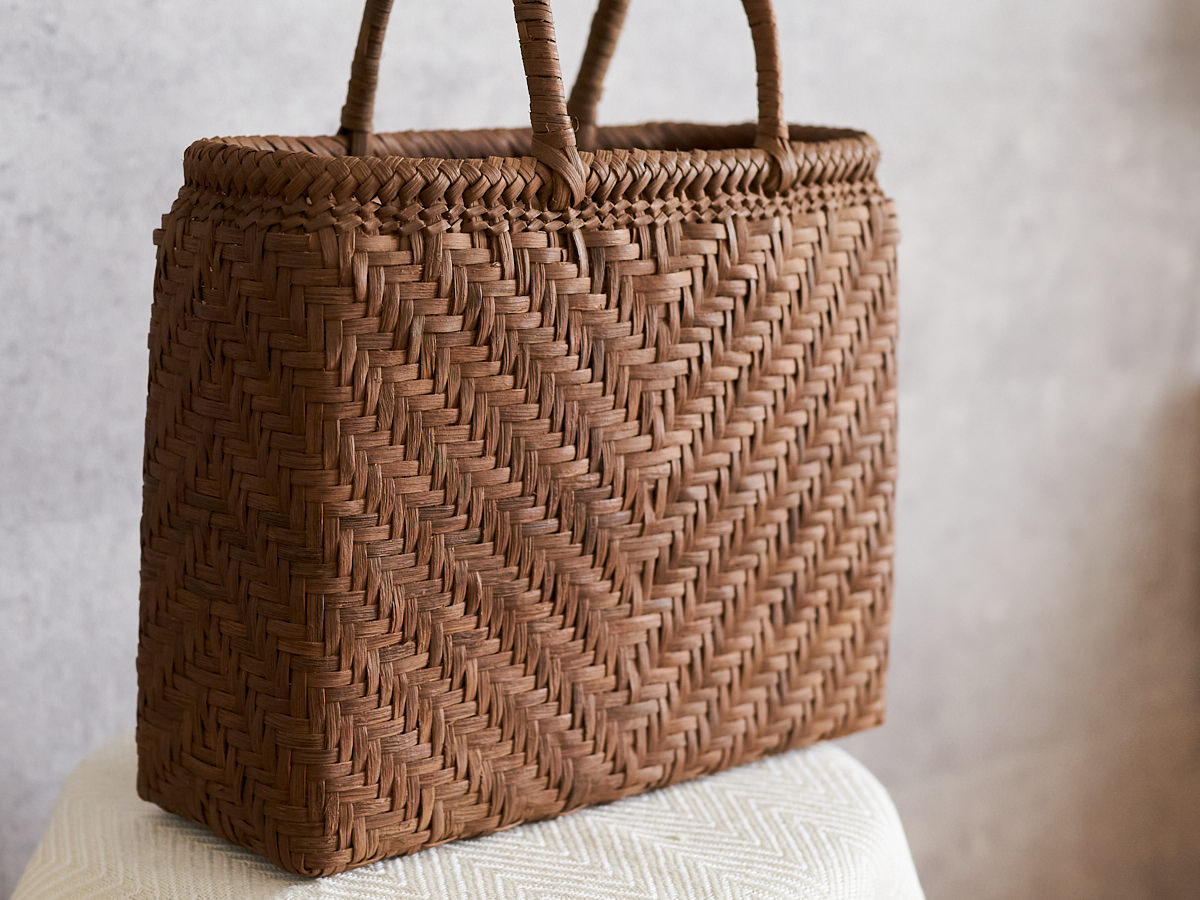
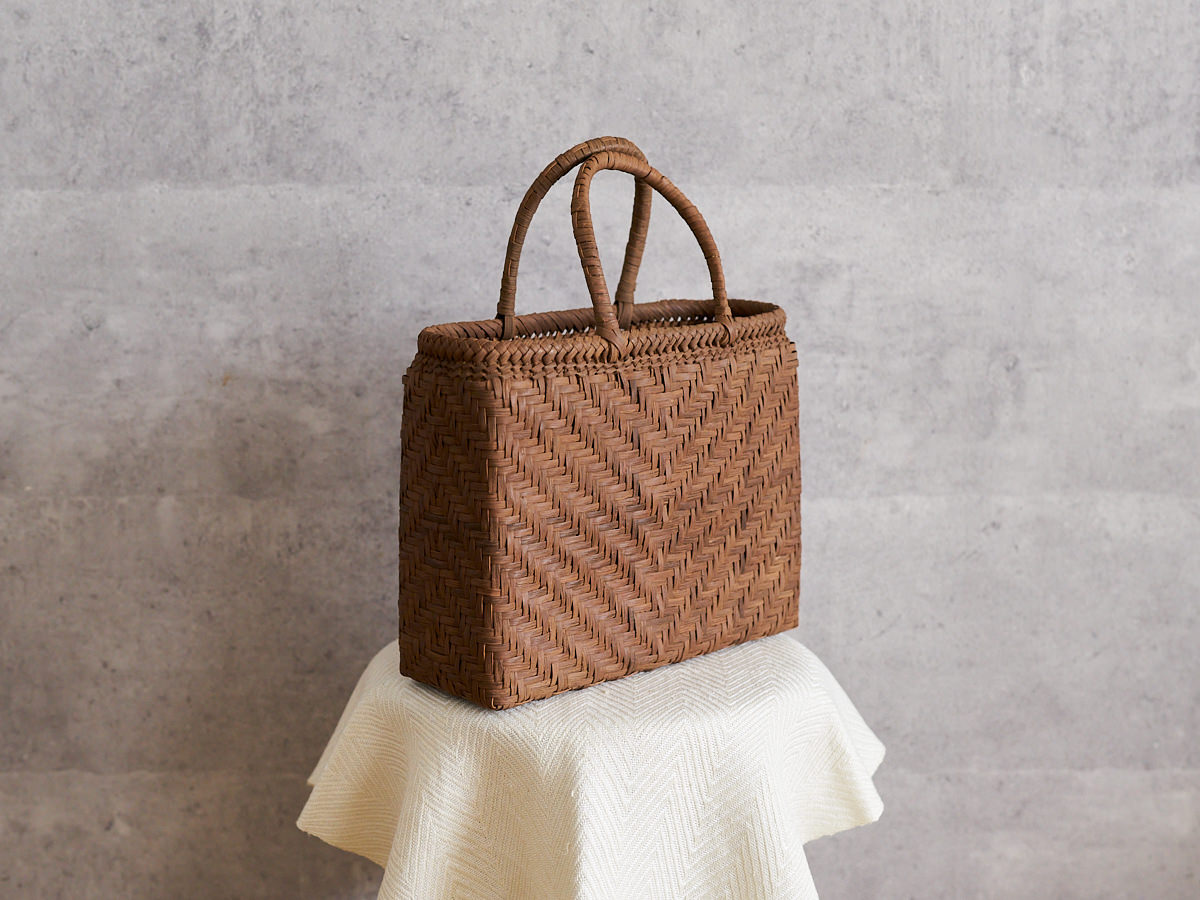
This is a hand basket woven from Grapevine. It is made from Grapevine harvested in the Azuma mountain range, located between Yamagata and Fukushima Prefectures.
Grapevine can only be harvested during a very short period in June, when the humidity is high.
Among the many kinds of vines used in basketry, Grapevine is especially valued for its exceptional durability. It can be used for many years, and one of its most distinctive qualities is that it gradually develops a rich luster from the natural oils of your hands.
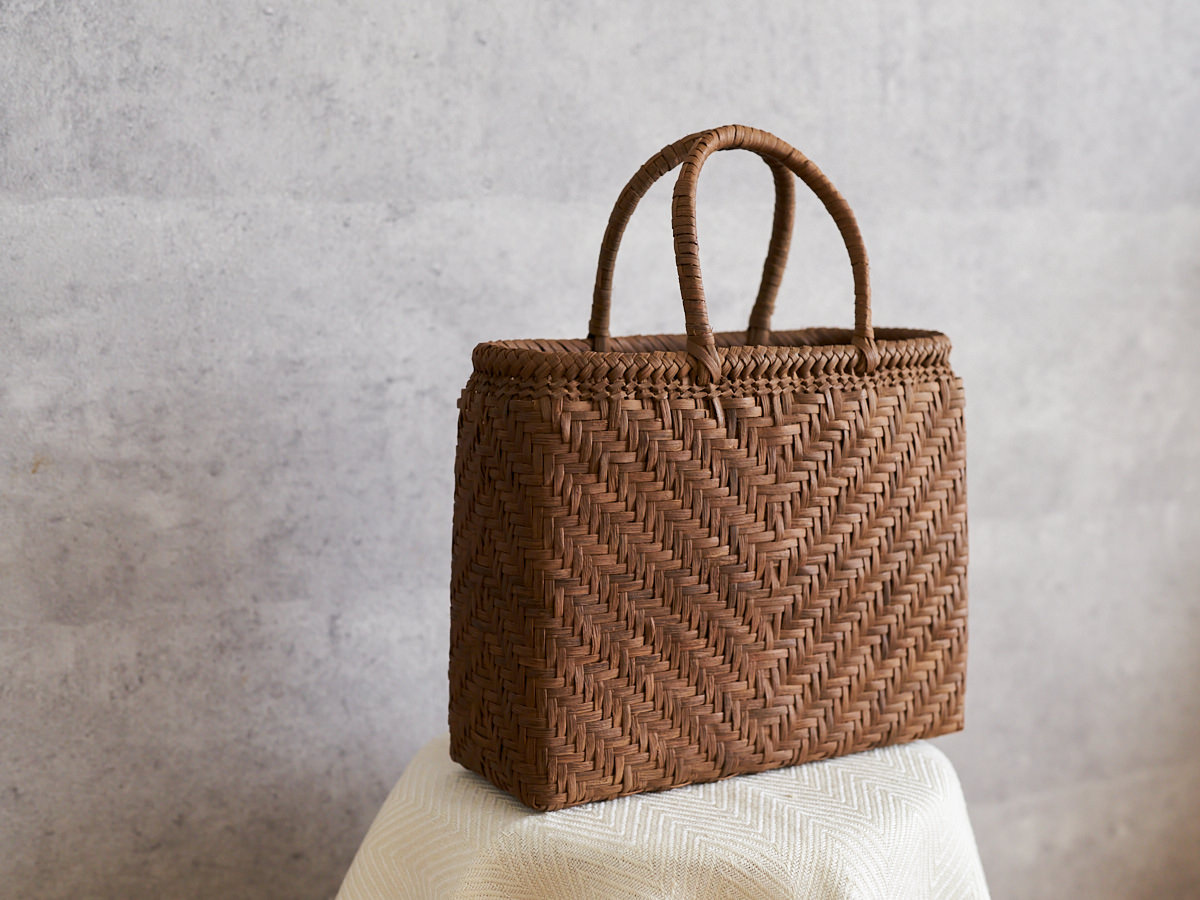
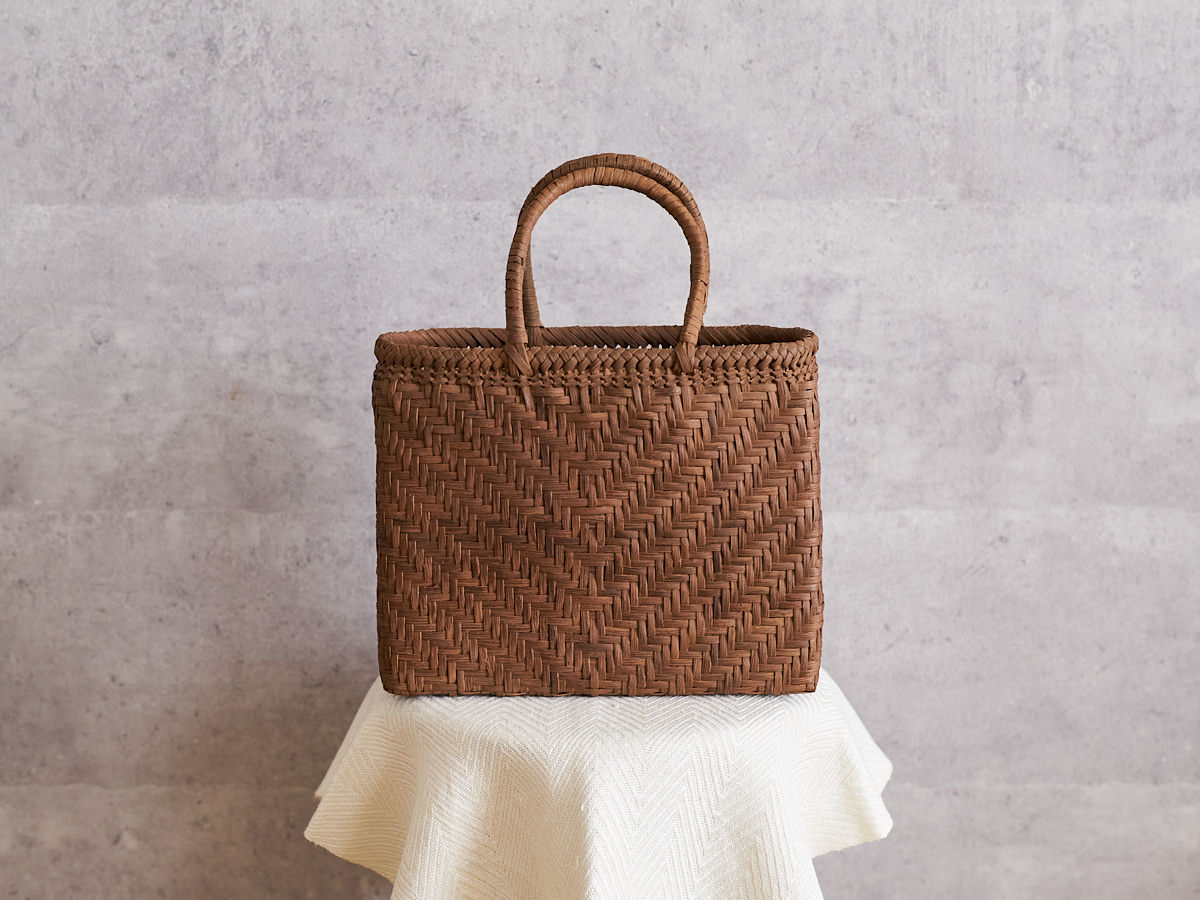
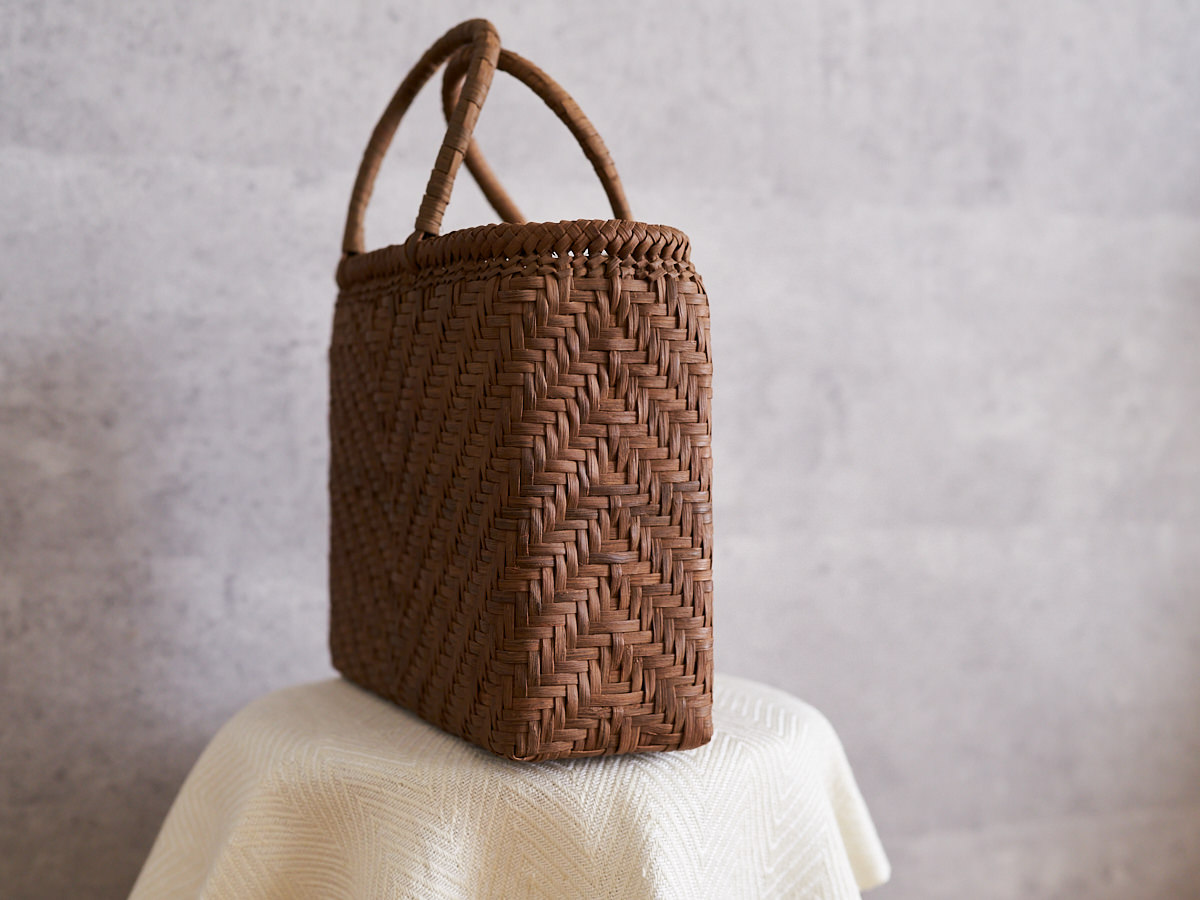
Although this basket is woven in the ajiro-ami technique, the direction of the weave changes from side to side, creating a series of V-shaped patterns that resemble the feathers of a bird. Inspired by this distinctive pattern, we named it “Feather.”
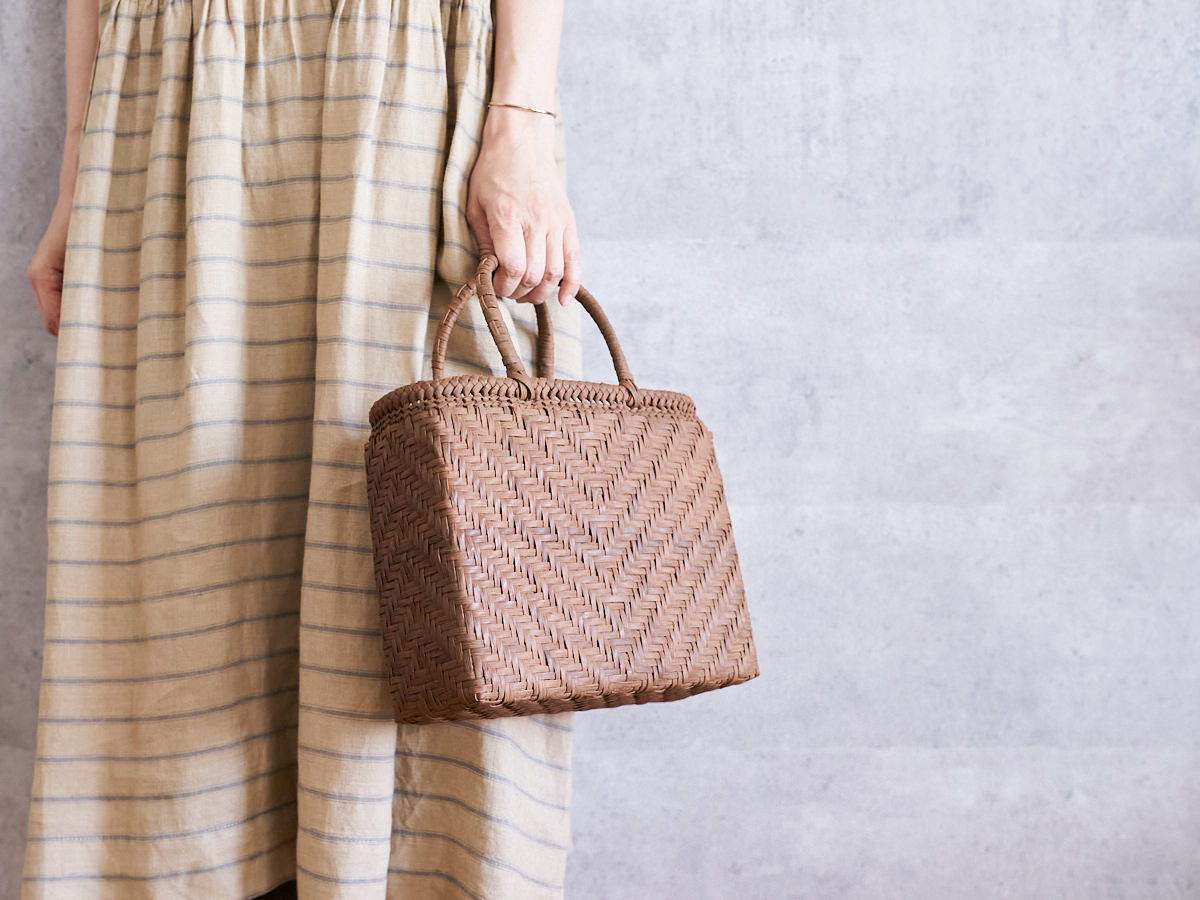
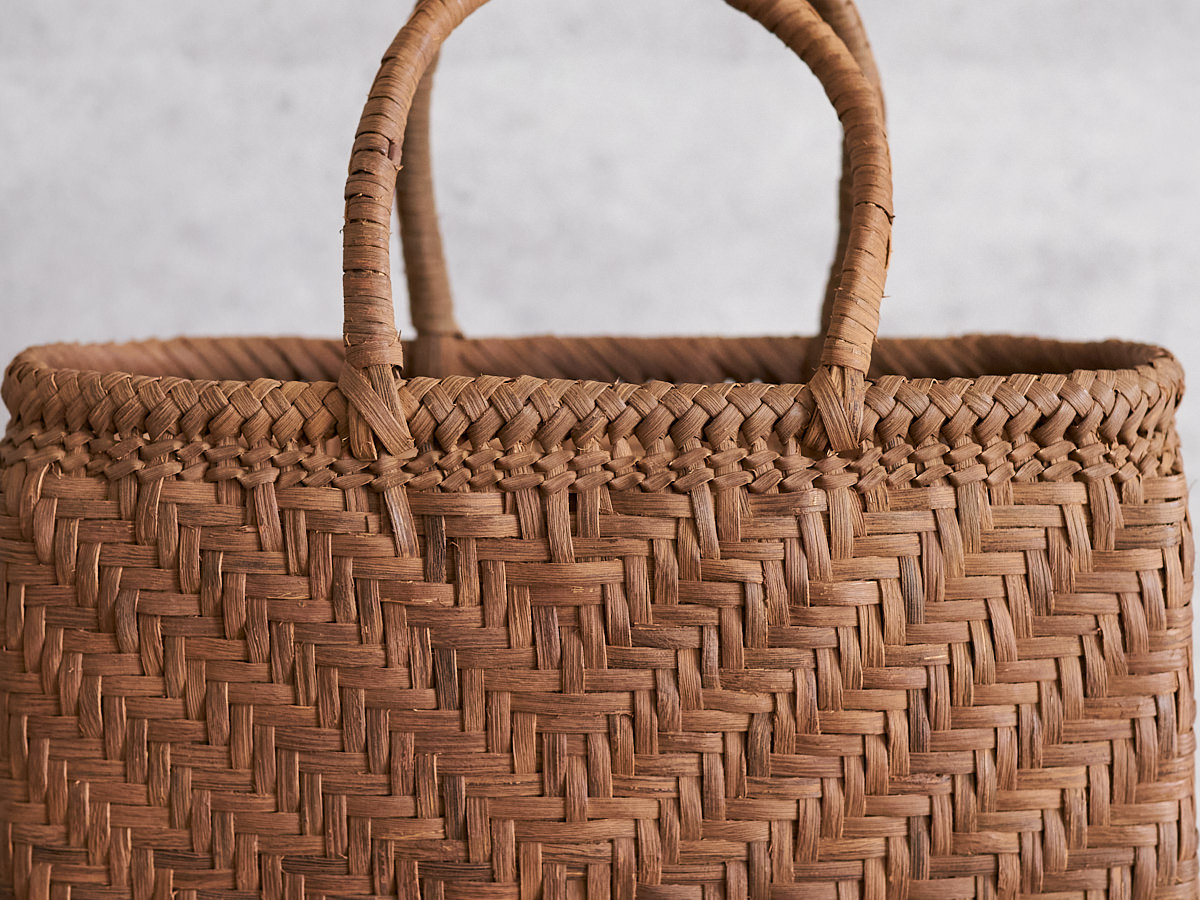
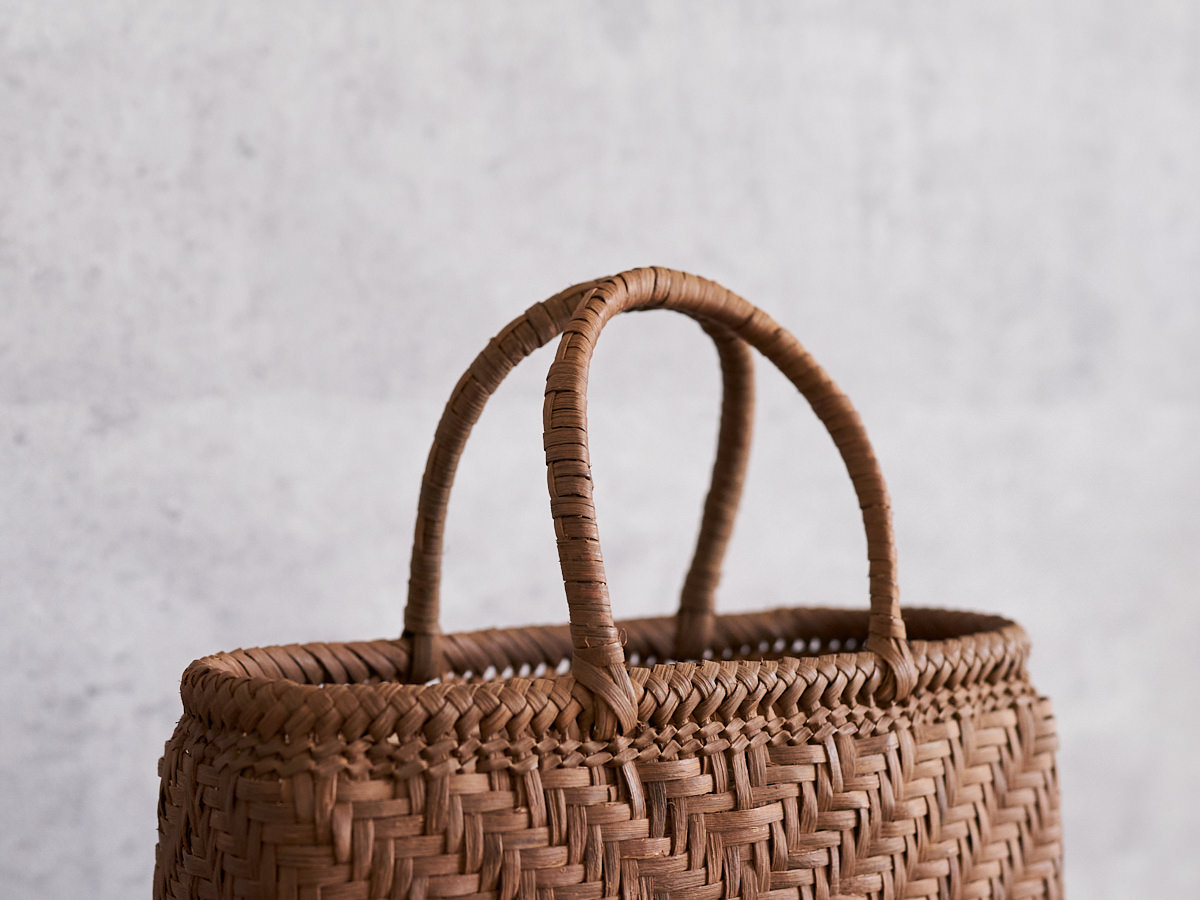
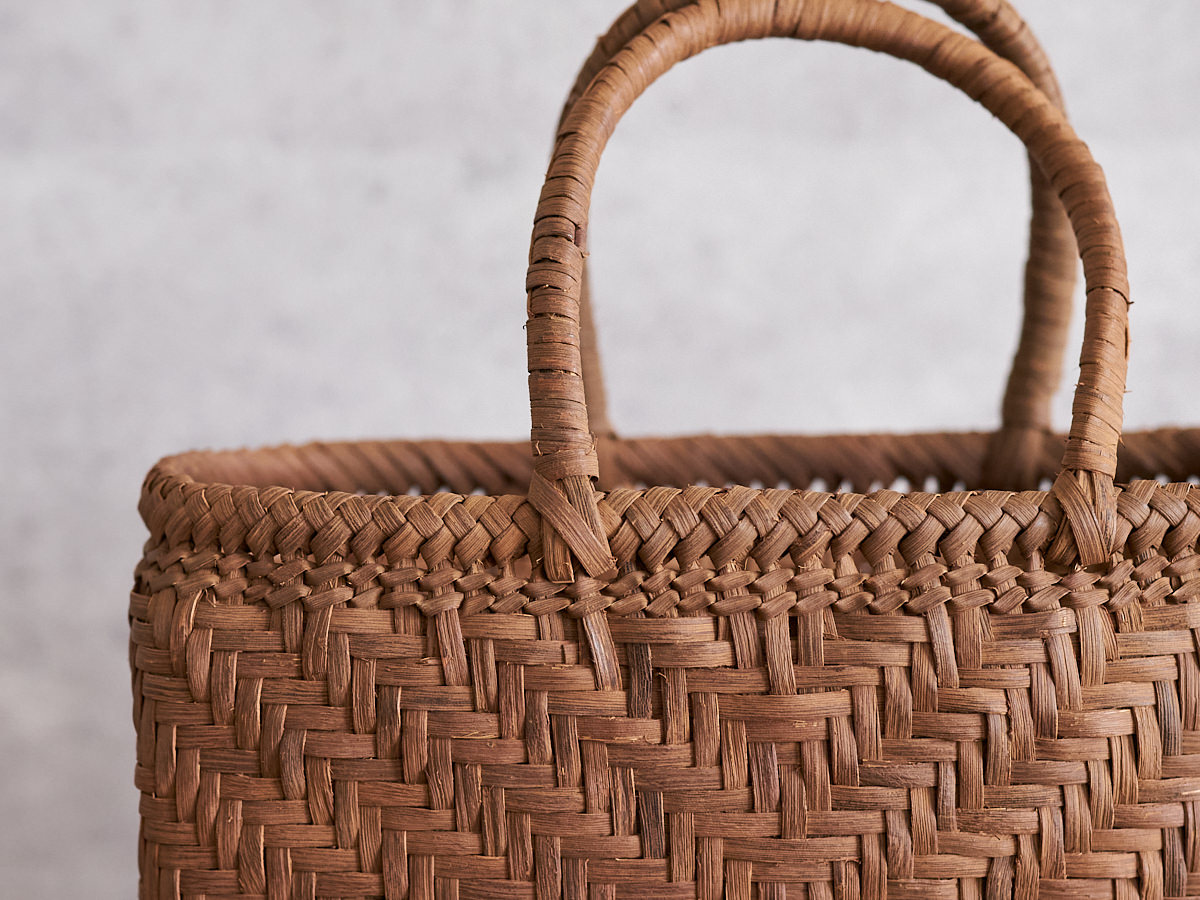
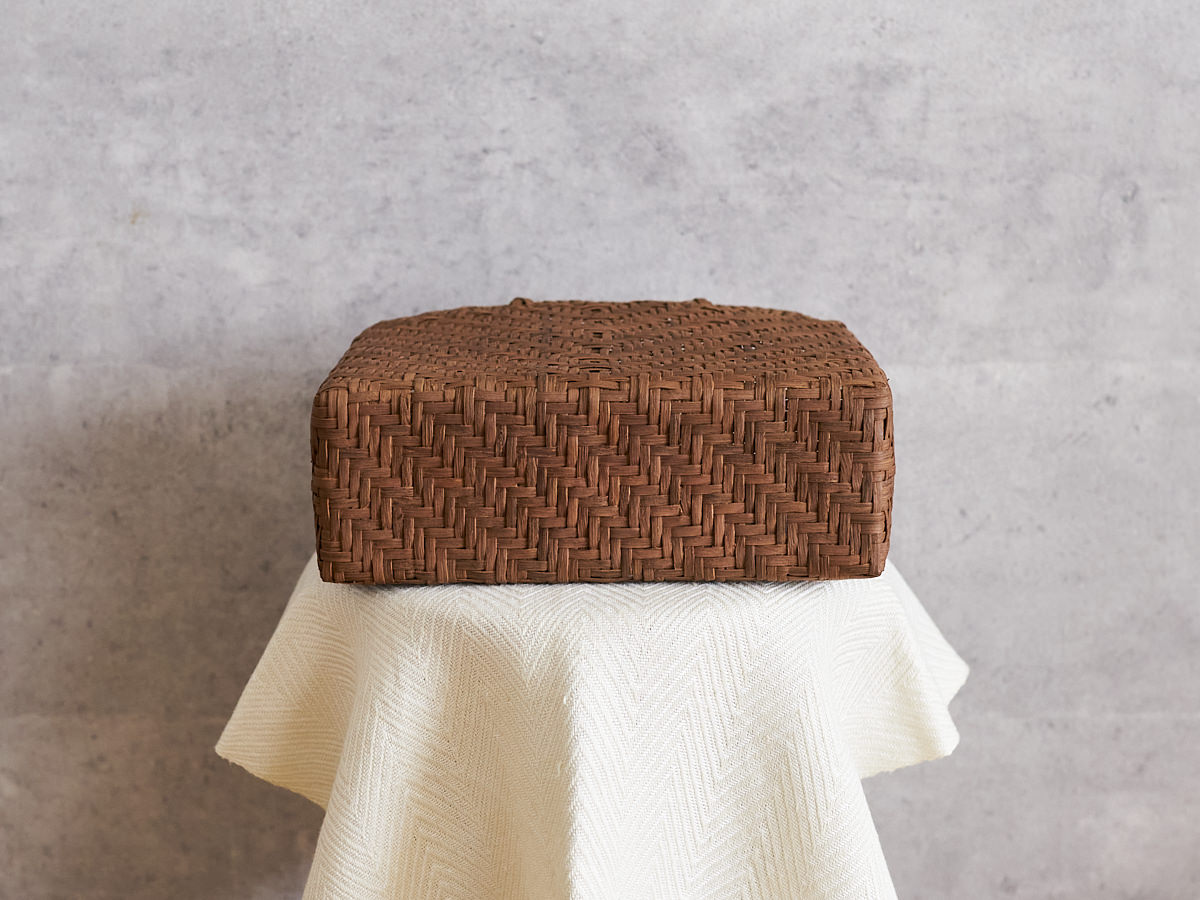
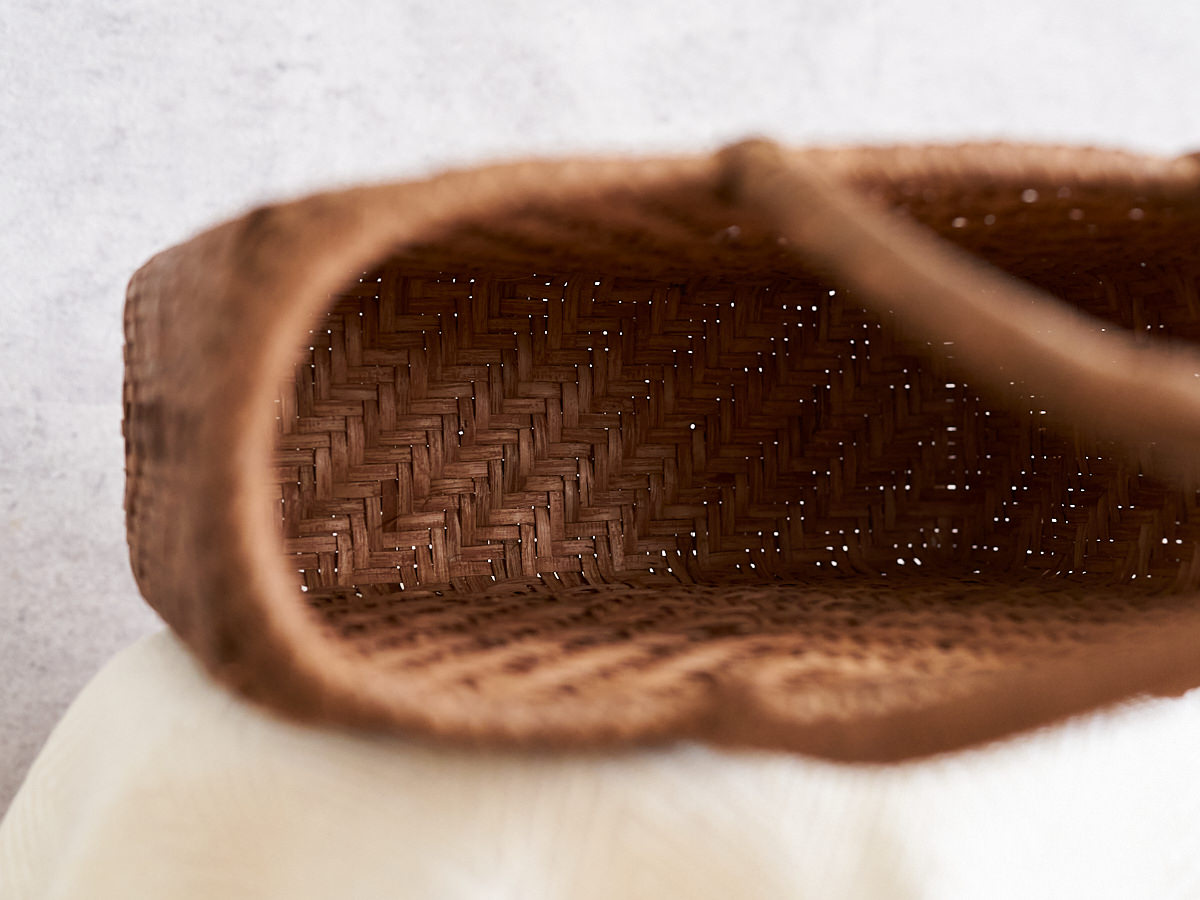
Some Grapevine baskets are woven from wide, thick strips that retain the vine’s natural curves and texture. In contrast, this basket is made from exceptionally fine strips, carefully woven in the ajiro-ami technique. As you view it from different angles, the pattern changes dramatically in appearance.The rim is finished by wrapping Grapevine tightly around it without any gaps. Many baskets are finished with a rim wrapping technique in which the vine is wound in a single direction. This basket, however, is finished with a kaeshi-makibuchi, in which the vine is first wrapped in one direction, then wrapped again in the opposite direction, overlapping the first layer.The handle is also carefully wrapped with Grapevine. It is neither too thin nor too thick, making it a comfortable size that fits naturally in the hand.The connection between the body of the basket and the rim is also firmly secured with a simple, well-crafted construction.This is the underside of the basket. It is also neatly woven in the ajiro-ami technique, with a clean and well-balanced finish.It is just the right size to hold a long wallet, a key case, a mobile phone, a small pouch, a handkerchief, and a small bottle of water.It is compact enough to fit comfortably on your lap while seated. You can carry it with confidence when traveling by train or bus.One of the most distinctive features of this basket is the way the Feather pattern gradually emerges through the interplay of light and shadow as the viewing angle changes.Although ajiro-ami is one of the most common weaving techniques used for Grapevine basket bags, simply changing the direction of the weave creates a pattern that is both distinctive and enjoyable to look at.Its slim profile gives the basket a clean and refined appearance without being too wide.
The vertical weave also creates a pattern that appears to flow in from both sides toward the center.
This is a practical size that many people picture when they think of a basket bag.
Whether you take it with you on outings or use it at home as a storage basket, it is a piece meant to be enjoyed in everyday life. Rather than putting it away, keep it where you can see and use it every day. Over time, it will gradually develop a beautiful luster and become even more attractive.
The smooth texture makes it easy to carry in spring and summer, while its rich, deep color pairs beautifully with autumn and winter clothing. It is a basket that can be enjoyed throughout the year.
With proper care, it can be used for many years—long enough to be passed on to the next generation. Its appearance changes with the angle, the light, and the place where it is used. Over time, the natural oils from your hands will gradually become part of the basket, giving it a character that is uniquely yours. We hope you will enjoy watching its appearance change over the years.
Handwoven Grapevine Baskets from Southern Yamagata
Yamagata Prefecture faces the Sea of Japan on the western side of the southern Tohoku region.
Its southern area, however, lies inland, surrounded by mountains rather than the sea. Towns have long been established in the mountain valleys, and in this landscape, where mountains cover most of the land, heavy snowfall in winter gave rise to a tradition of bark and vine craftsmanship as winter work for farming families.
In this region, materials gathered from the mountains—such as walnut bark, Grapevine, Akebi vine, and Matatabi vine— have long been used to make everyday tools and household items. Even today, there are people working to preserve and pass on these valuable skills.
Grapevine has long been valued as a material for basketry. The vines can only be harvested during a very short period in June, when the humidity is high. Its fibers are so strong that they were once used as rope, and among the many kinds of vines used in basketry— such as Akebi vine and Matatabi vine—it is especially prized for its exceptional durability.
The Grapevine baskets made in this region are woven from vines that have been carefully split and thinned into fine strips, resulting in baskets that are both lightweight and remarkably durable. As they are used day after day, the natural oils from your hands gradually enrich the surface with a beautiful luster—a unique quality of Grapevine. We hope you will also enjoy the way it changes with age over the years.
Please note: This item ships from Japan. As the buyer, you are responsible for any import duties, customs fees, or local taxes that may be charged in your country. These costs are not included in the item price or shipping cost. Please check with your local customs authority if you are unsure about any potential charges before placing your order.
This is a hand basket woven from Grapevine. It is made from Grapevine harvested in the Azuma mountain range, located between Yamagata and Fukushima Prefectures.
Grapevine can only be harvested during a very short period in June, when the humidity is high.
Among the many kinds of vines used in basketry, Grapevine is especially valued for its exceptional durability. It can be used for many years, and one of its most distinctive qualities is that it gradually develops a rich luster from the natural oils of your hands.
Although this basket is woven in the ajiro-ami technique, the direction of the weave changes from side to side, creating a series of V-shaped patterns that resemble the feathers of a bird. Inspired by this distinctive pattern, we named it “Feather.”
Some Grapevine baskets are woven from wide, thick strips that retain the vine’s natural curves and texture. In contrast, this basket is made from exceptionally fine strips, carefully woven in the ajiro-ami technique. As you view it from different angles, the pattern changes dramatically in appearance.The rim is finished by wrapping Grapevine tightly around it without any gaps. Many baskets are finished with a rim wrapping technique in which the vine is wound in a single direction. This basket, however, is finished with a kaeshi-makibuchi, in which the vine is first wrapped in one direction, then wrapped again in the opposite direction, overlapping the first layer.The handle is also carefully wrapped with Grapevine. It is neither too thin nor too thick, making it a comfortable size that fits naturally in the hand.The connection between the body of the basket and the rim is also firmly secured with a simple, well-crafted construction.This is the underside of the basket. It is also neatly woven in the ajiro-ami technique, with a clean and well-balanced finish.It is just the right size to hold a long wallet, a key case, a mobile phone, a small pouch, a handkerchief, and a small bottle of water.It is compact enough to fit comfortably on your lap while seated. You can carry it with confidence when traveling by train or bus.One of the most distinctive features of this basket is the way the Feather pattern gradually emerges through the interplay of light and shadow as the viewing angle changes.Although ajiro-ami is one of the most common weaving techniques used for Grapevine basket bags, simply changing the direction of the weave creates a pattern that is both distinctive and enjoyable to look at.Its slim profile gives the basket a clean and refined appearance without being too wide.
The vertical weave also creates a pattern that appears to flow in from both sides toward the center.
This is a practical size that many people picture when they think of a basket bag.
Whether you take it with you on outings or use it at home as a storage basket, it is a piece meant to be enjoyed in everyday life. Rather than putting it away, keep it where you can see and use it every day. Over time, it will gradually develop a beautiful luster and become even more attractive.
The smooth texture makes it easy to carry in spring and summer, while its rich, deep color pairs beautifully with autumn and winter clothing. It is a basket that can be enjoyed throughout the year.
With proper care, it can be used for many years—long enough to be passed on to the next generation. Its appearance changes with the angle, the light, and the place where it is used. Over time, the natural oils from your hands will gradually become part of the basket, giving it a character that is uniquely yours. We hope you will enjoy watching its appearance change over the years.
Handwoven Grapevine Baskets from Southern Yamagata
Yamagata Prefecture faces the Sea of Japan on the western side of the southern Tohoku region.
Its southern area, however, lies inland, surrounded by mountains rather than the sea. Towns have long been established in the mountain valleys, and in this landscape, where mountains cover most of the land, heavy snowfall in winter gave rise to a tradition of bark and vine craftsmanship as winter work for farming families.
In this region, materials gathered from the mountains—such as walnut bark, Grapevine, Akebi vine, and Matatabi vine— have long been used to make everyday tools and household items. Even today, there are people working to preserve and pass on these valuable skills.
Grapevine has long been valued as a material for basketry. The vines can only be harvested during a very short period in June, when the humidity is high. Its fibers are so strong that they were once used as rope, and among the many kinds of vines used in basketry— such as Akebi vine and Matatabi vine—it is especially prized for its exceptional durability.
The Grapevine baskets made in this region are woven from vines that have been carefully split and thinned into fine strips, resulting in baskets that are both lightweight and remarkably durable. As they are used day after day, the natural oils from your hands gradually enrich the surface with a beautiful luster—a unique quality of Grapevine. We hope you will also enjoy the way it changes with age over the years.
Please note: This item ships from Japan. As the buyer, you are responsible for any import duties, customs fees, or local taxes that may be charged in your country. These costs are not included in the item price or shipping cost. Please check with your local customs authority if you are unsure about any potential charges before placing your order.
This is a hand basket woven from Grapevine. It is made from Grapevine harvested in the Azuma mountain range, located between Yamagata and Fukushima Prefectures.
Grapevine can only be harvested during a very short period in June, when the humidity is high.
Among the many kinds of vines used in basketry, Grapevine is especially valued for its exceptional durability. It can be used for many years, and one of its most distinctive qualities is that it gradually develops a rich luster from the natural oils of your hands.
Although this basket is woven in the ajiro-ami technique, the direction of the weave changes from side to side, creating a series of V-shaped patterns that resemble the feathers of a bird. Inspired by this distinctive pattern, we named it “Feather.”
Some Grapevine baskets are woven from wide, thick strips that retain the vine’s natural curves and texture. In contrast, this basket is made from exceptionally fine strips, carefully woven in the ajiro-ami technique. As you view it from different angles, the pattern changes dramatically in appearance.The rim is finished by wrapping Grapevine tightly around it without any gaps. Many baskets are finished with a rim wrapping technique in which the vine is wound in a single direction. This basket, however, is finished with a kaeshi-makibuchi, in which the vine is first wrapped in one direction, then wrapped again in the opposite direction, overlapping the first layer.The handle is also carefully wrapped with Grapevine. It is neither too thin nor too thick, making it a comfortable size that fits naturally in the hand.The connection between the body of the basket and the rim is also firmly secured with a simple, well-crafted construction.This is the underside of the basket. It is also neatly woven in the ajiro-ami technique, with a clean and well-balanced finish.It is just the right size to hold a long wallet, a key case, a mobile phone, a small pouch, a handkerchief, and a small bottle of water.It is compact enough to fit comfortably on your lap while seated. You can carry it with confidence when traveling by train or bus.One of the most distinctive features of this basket is the way the Feather pattern gradually emerges through the interplay of light and shadow as the viewing angle changes.Although ajiro-ami is one of the most common weaving techniques used for Grapevine basket bags, simply changing the direction of the weave creates a pattern that is both distinctive and enjoyable to look at.Its slim profile gives the basket a clean and refined appearance without being too wide.
The vertical weave also creates a pattern that appears to flow in from both sides toward the center.
This is a practical size that many people picture when they think of a basket bag.
Whether you take it with you on outings or use it at home as a storage basket, it is a piece meant to be enjoyed in everyday life. Rather than putting it away, keep it where you can see and use it every day. Over time, it will gradually develop a beautiful luster and become even more attractive.
The smooth texture makes it easy to carry in spring and summer, while its rich, deep color pairs beautifully with autumn and winter clothing. It is a basket that can be enjoyed throughout the year.
With proper care, it can be used for many years—long enough to be passed on to the next generation. Its appearance changes with the angle, the light, and the place where it is used. Over time, the natural oils from your hands will gradually become part of the basket, giving it a character that is uniquely yours. We hope you will enjoy watching its appearance change over the years.
Handwoven Grapevine Baskets from Southern Yamagata
Yamagata Prefecture faces the Sea of Japan on the western side of the southern Tohoku region.
Its southern area, however, lies inland, surrounded by mountains rather than the sea. Towns have long been established in the mountain valleys, and in this landscape, where mountains cover most of the land, heavy snowfall in winter gave rise to a tradition of bark and vine craftsmanship as winter work for farming families.
In this region, materials gathered from the mountains—such as walnut bark, Grapevine, Akebi vine, and Matatabi vine— have long been used to make everyday tools and household items. Even today, there are people working to preserve and pass on these valuable skills.
Grapevine has long been valued as a material for basketry. The vines can only be harvested during a very short period in June, when the humidity is high. Its fibers are so strong that they were once used as rope, and among the many kinds of vines used in basketry— such as Akebi vine and Matatabi vine—it is especially prized for its exceptional durability.
The Grapevine baskets made in this region are woven from vines that have been carefully split and thinned into fine strips, resulting in baskets that are both lightweight and remarkably durable. As they are used day after day, the natural oils from your hands gradually enrich the surface with a beautiful luster—a unique quality of Grapevine. We hope you will also enjoy the way it changes with age over the years.
Please note: This item ships from Japan. As the buyer, you are responsible for any import duties, customs fees, or local taxes that may be charged in your country. These costs are not included in the item price or shipping cost. Please check with your local customs authority if you are unsure about any potential charges before placing your order.