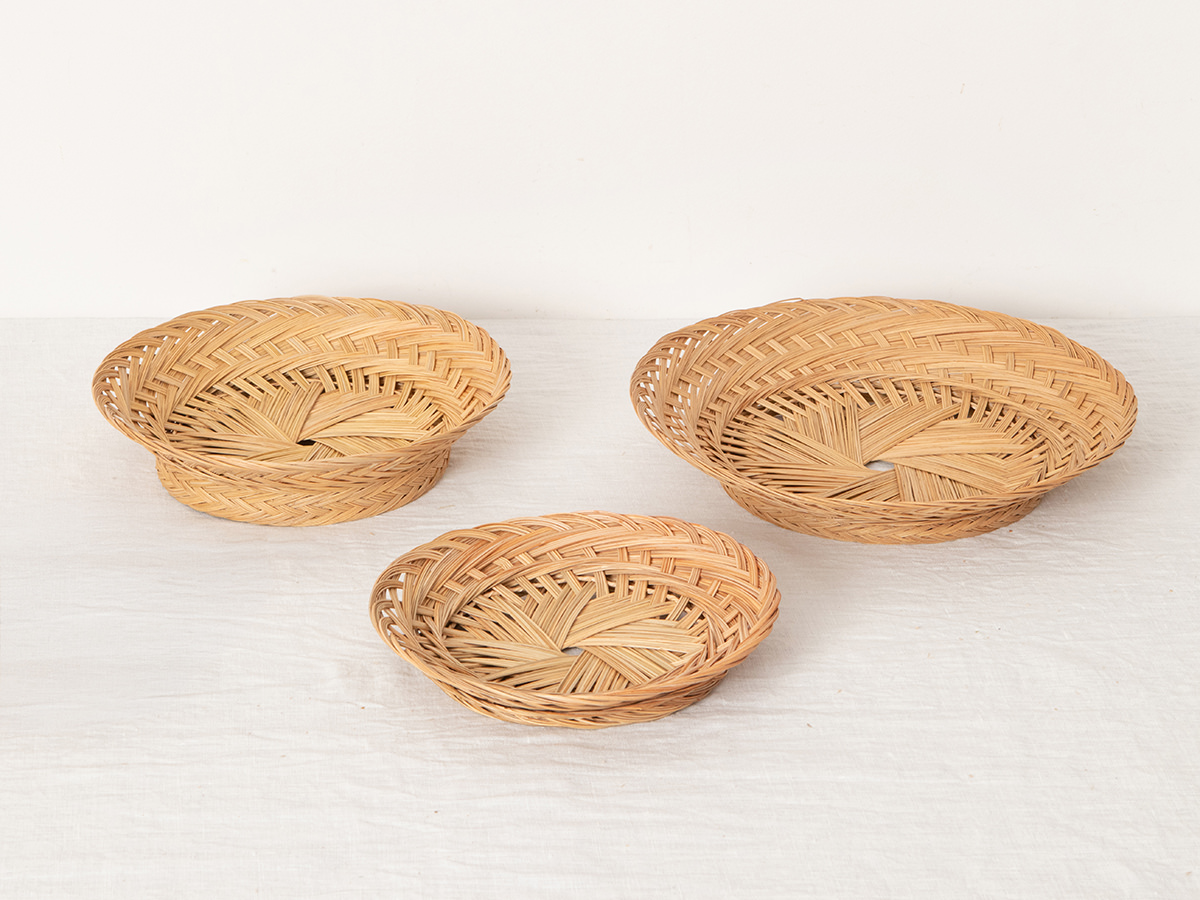
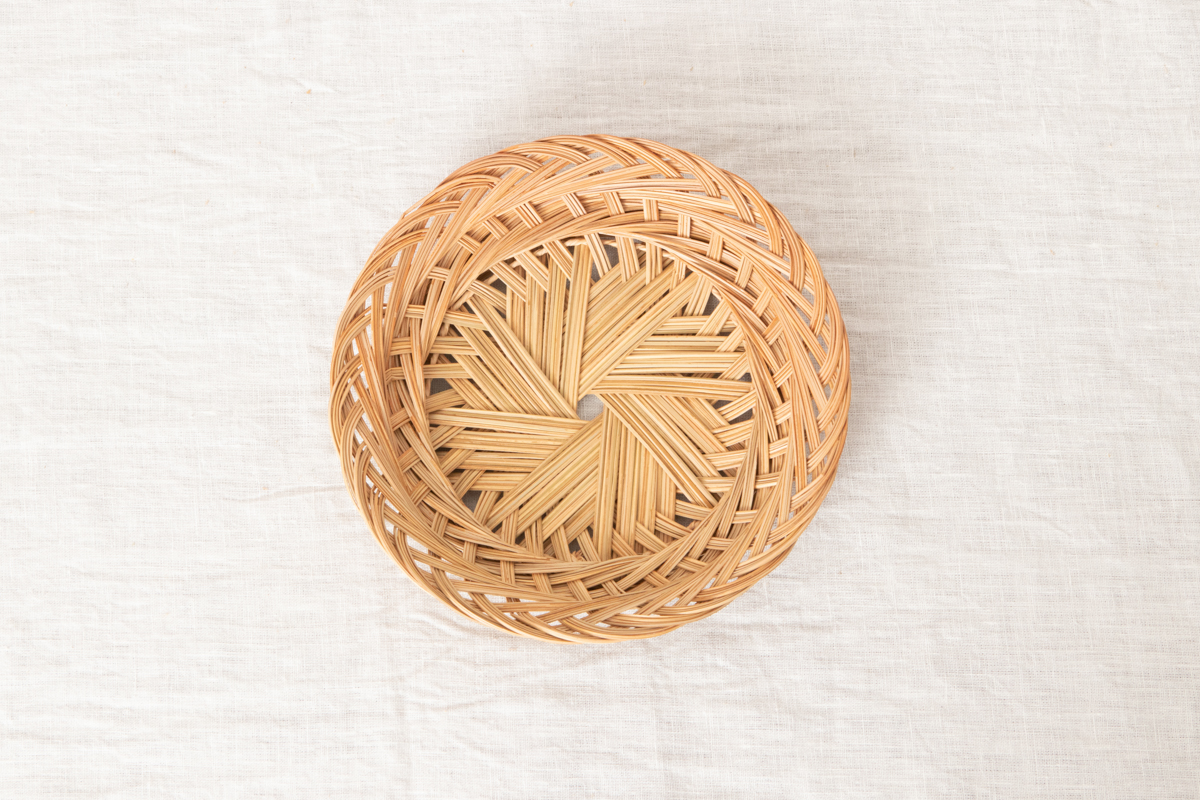
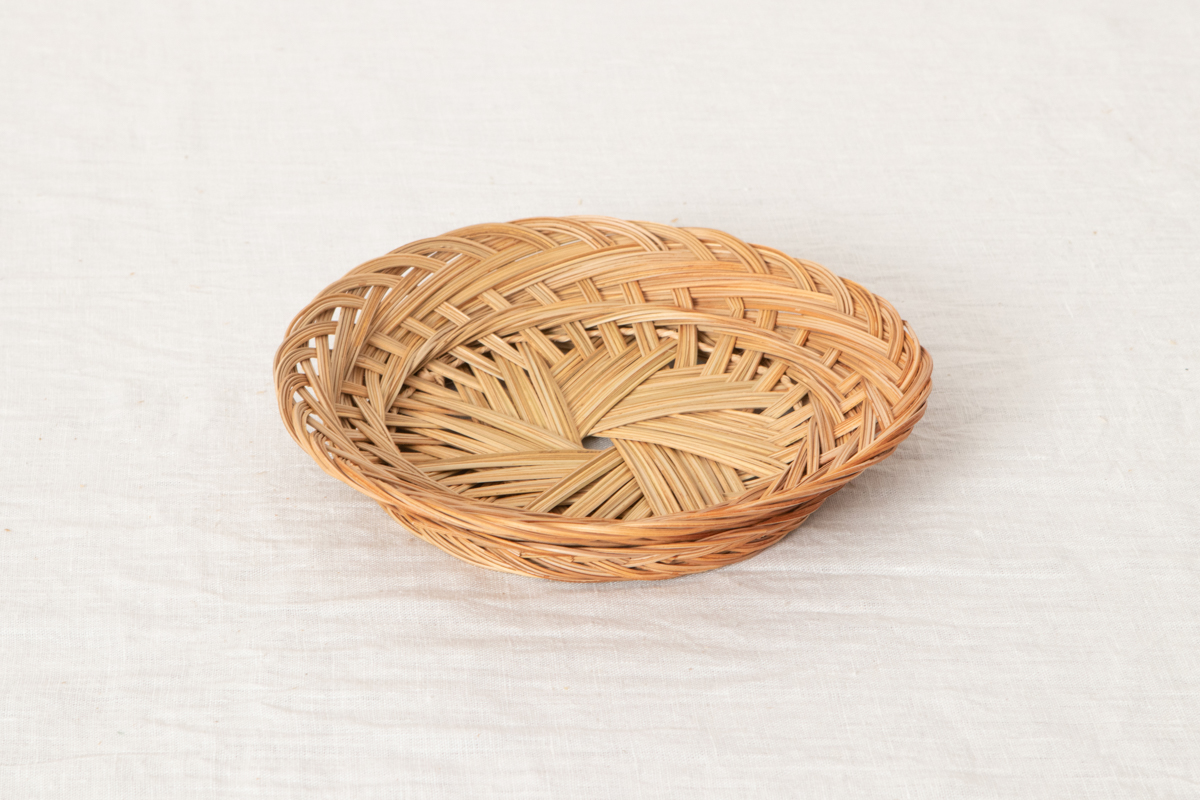
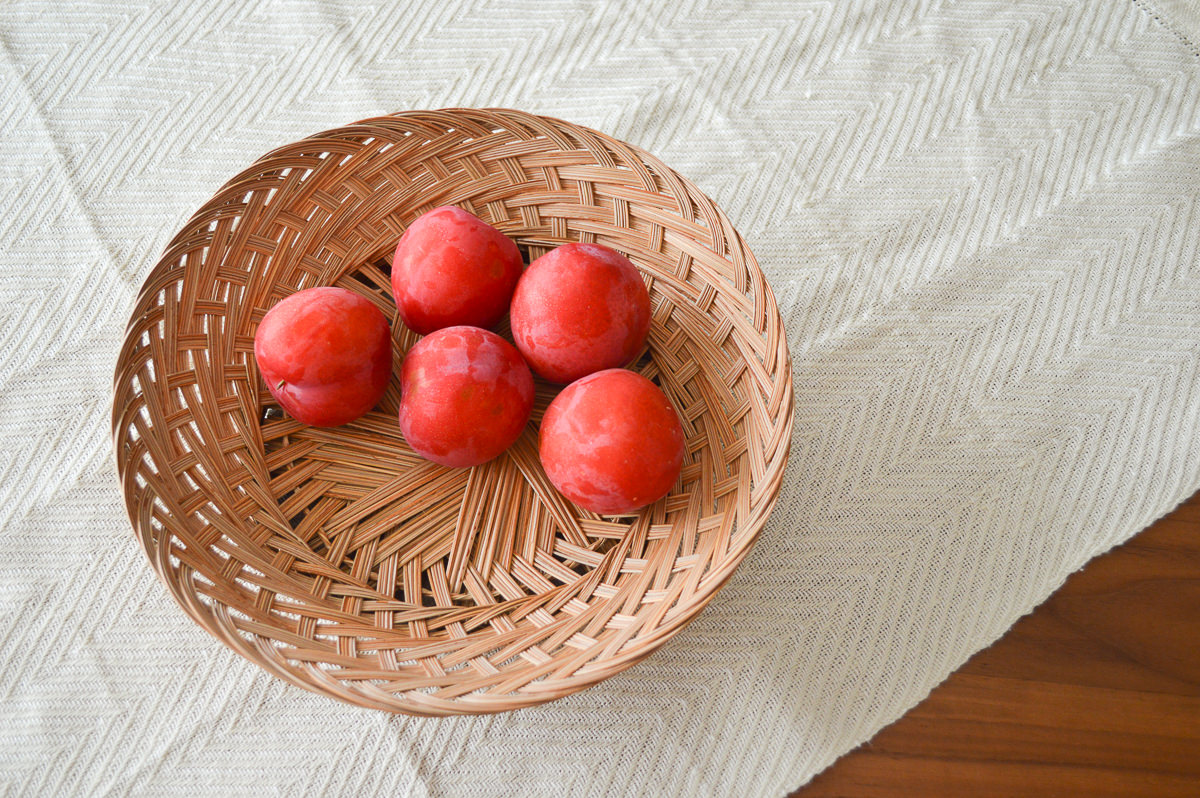
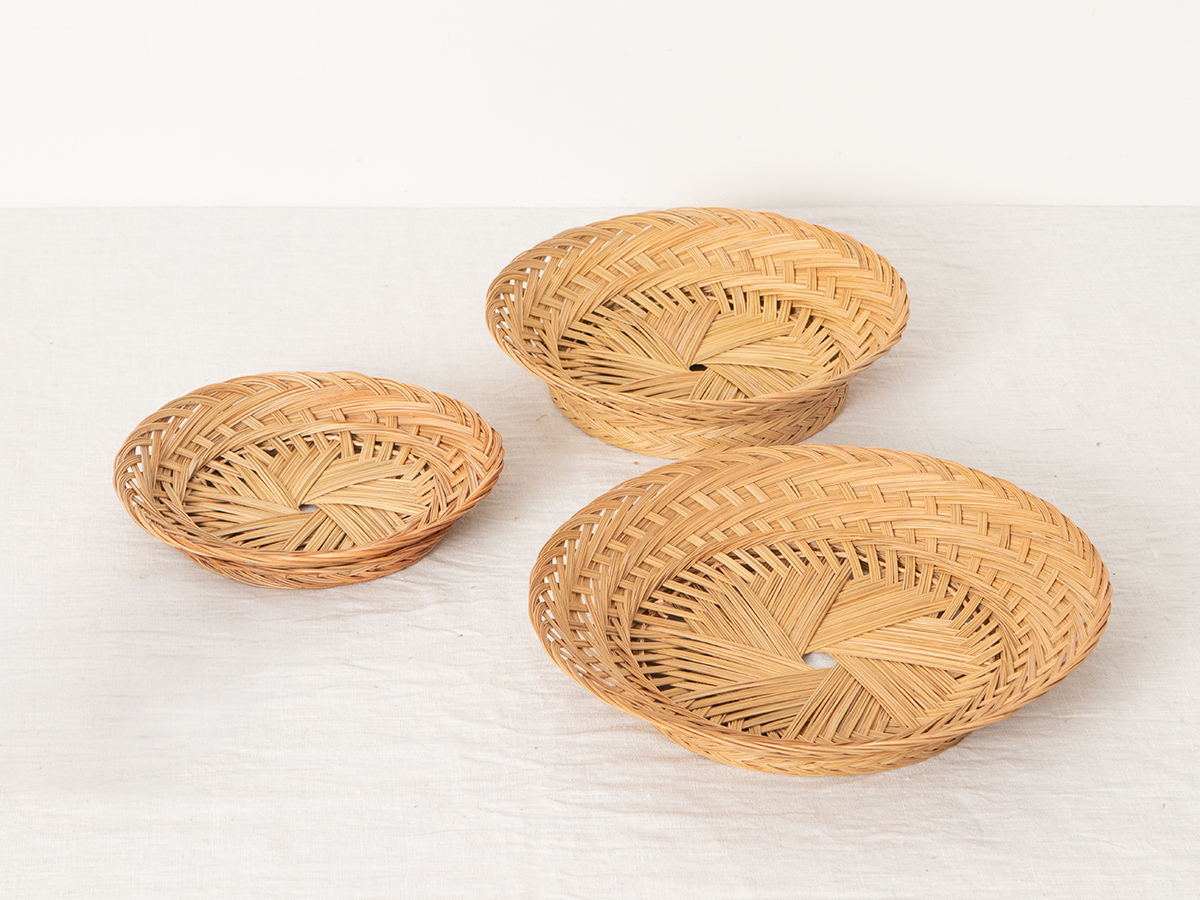
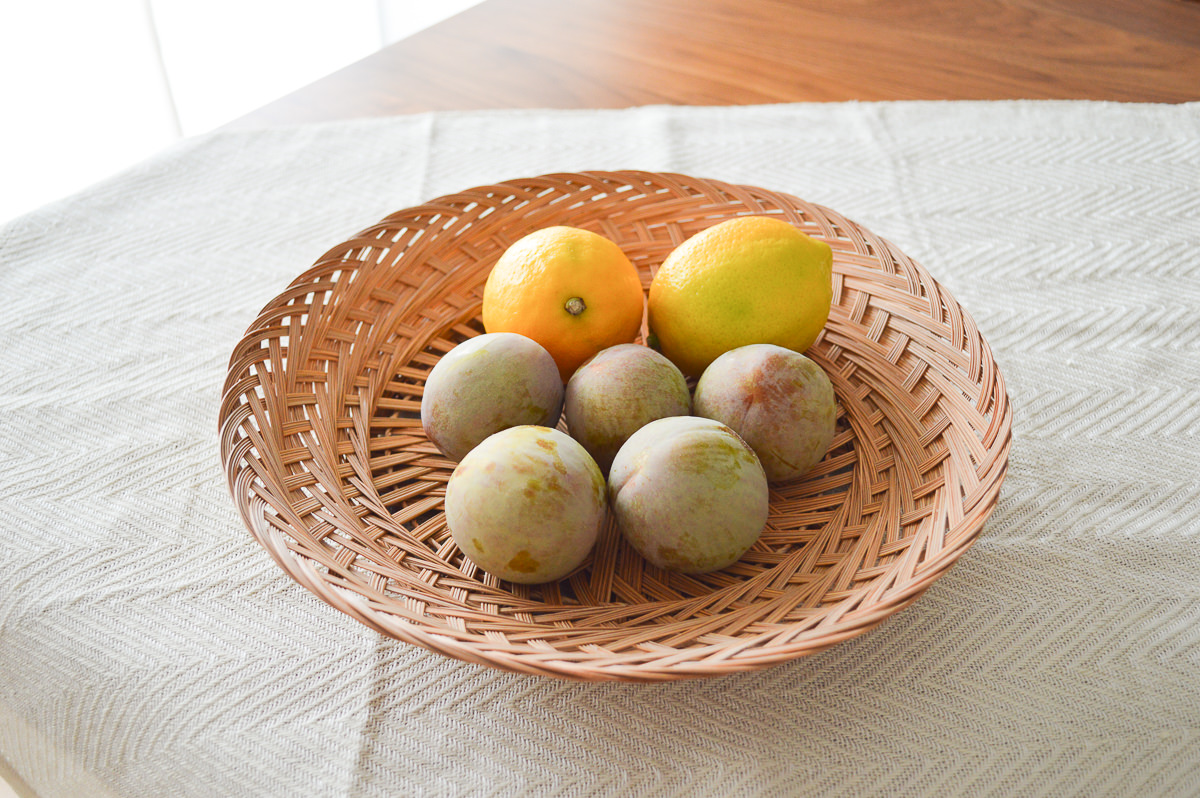
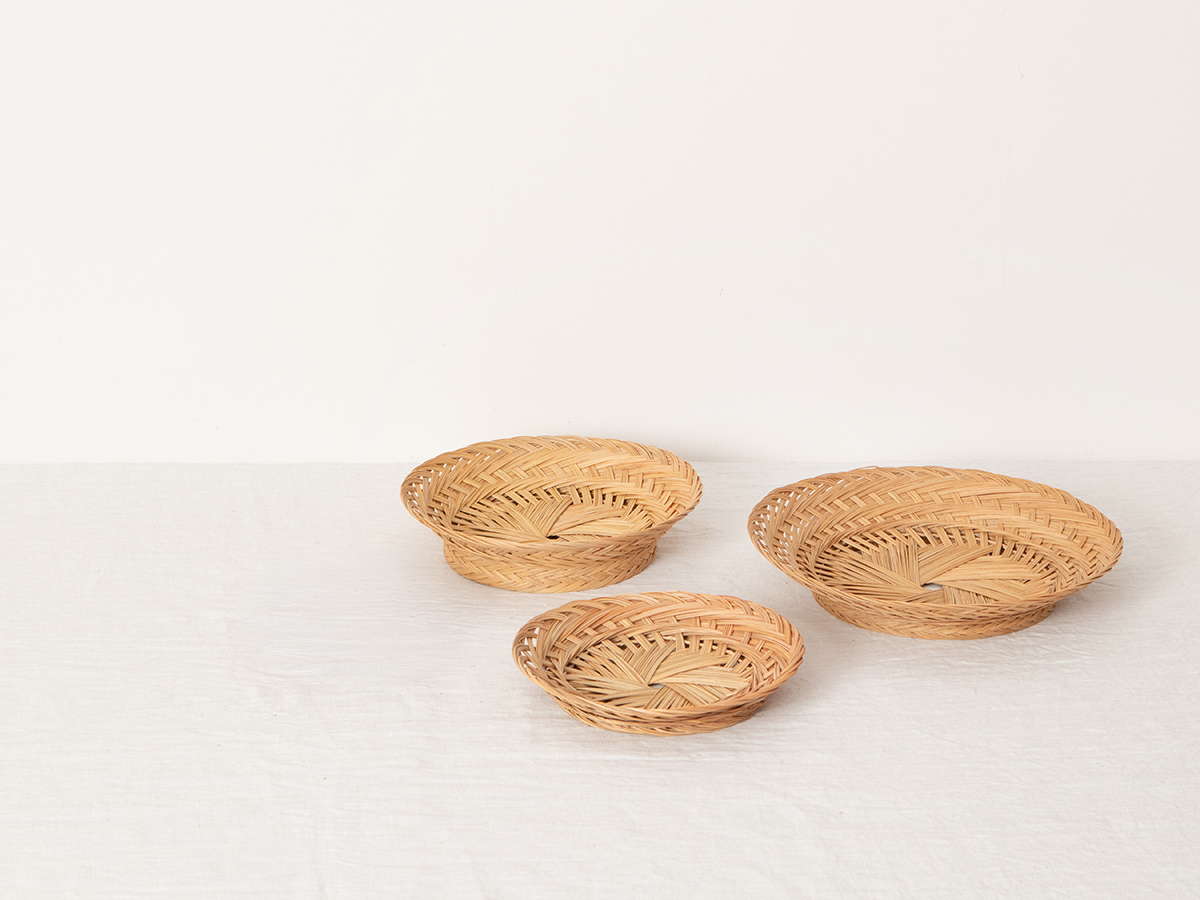
These trays are woven from nypa palm, a plant that grows in the mangrove forests of Thailand. We introduce a round tray in three sizes: 20 cm, 24 cm, and 29 cm in diameter.
Many of the weavers are women in their 40s to 70s, though a few men are also involved.
As with Krajood basketry, although young weavers remain few, there is a renewed appreciation within Thailand for natural material products, and it seems that more young people are starting to take an interest in basketry.
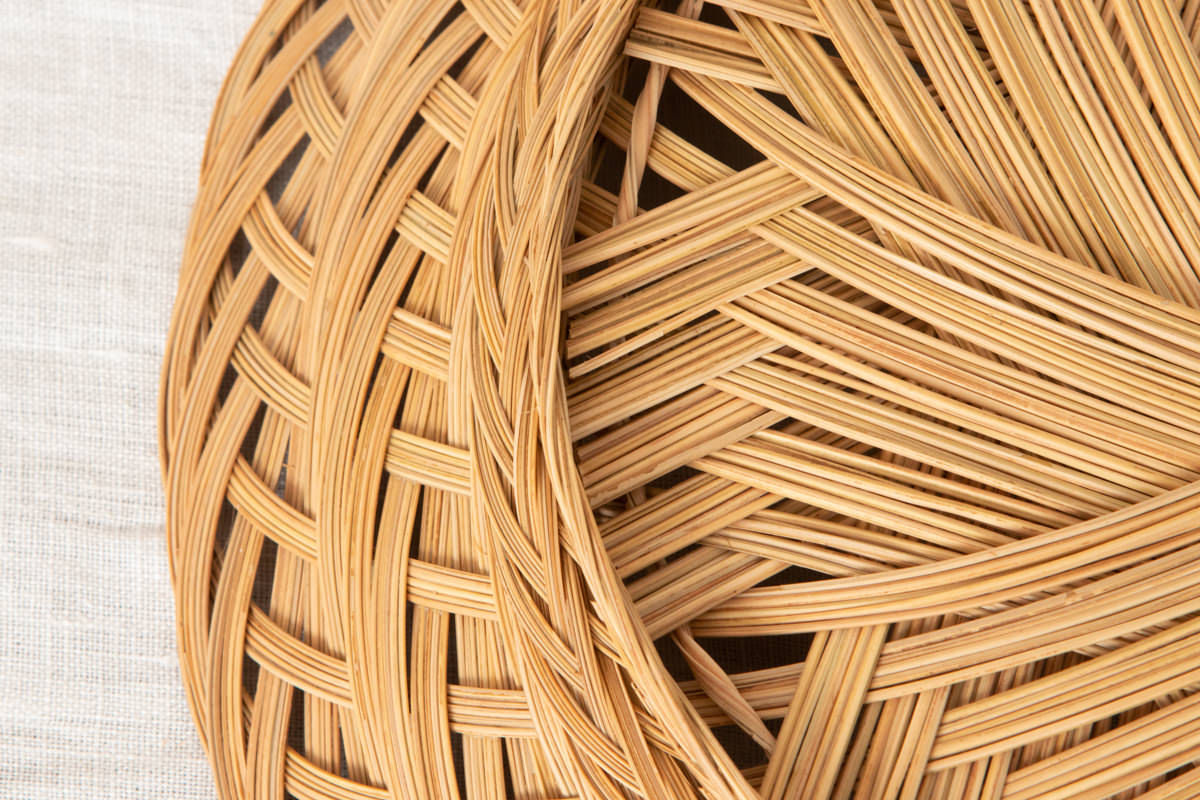
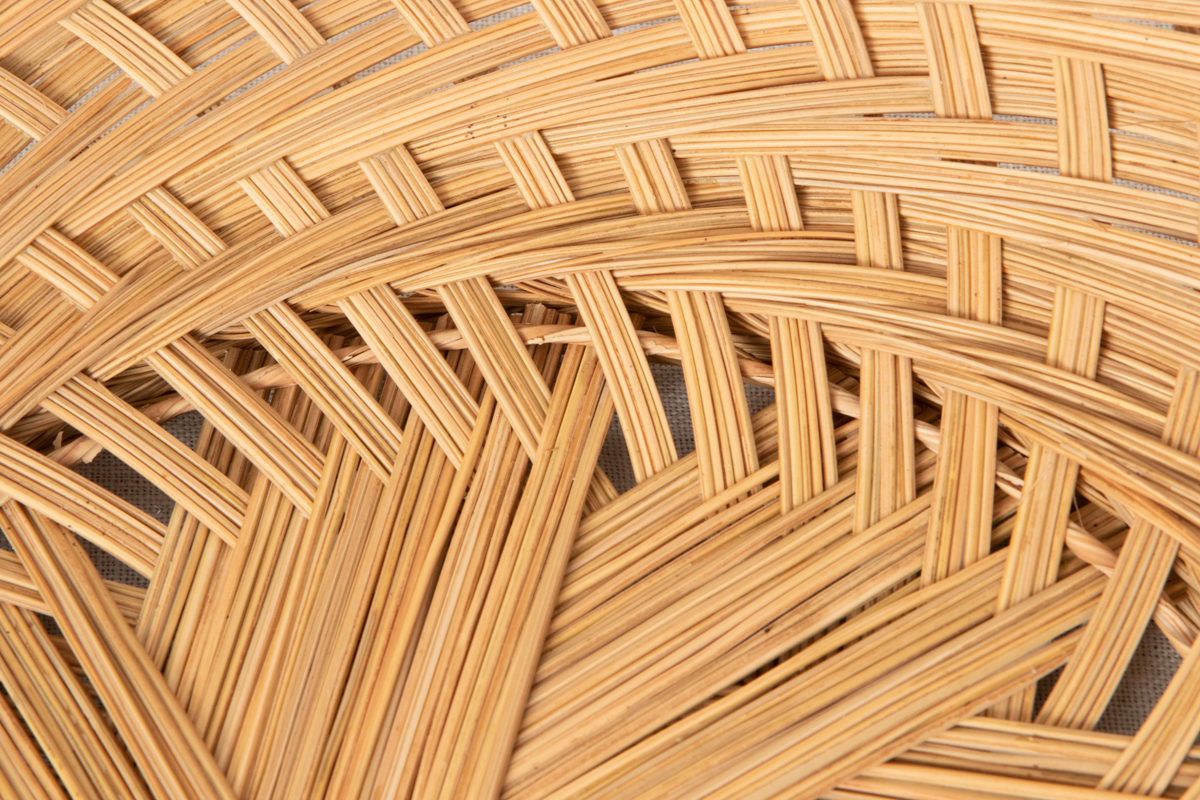
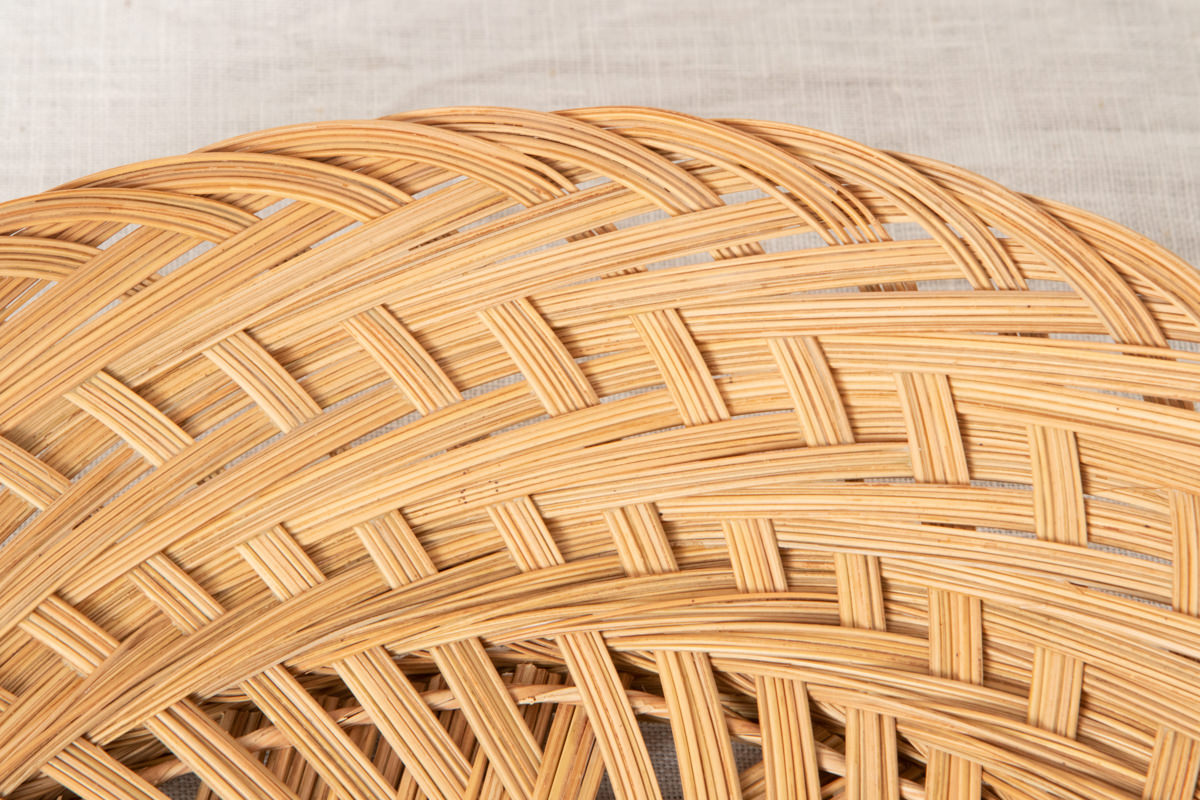
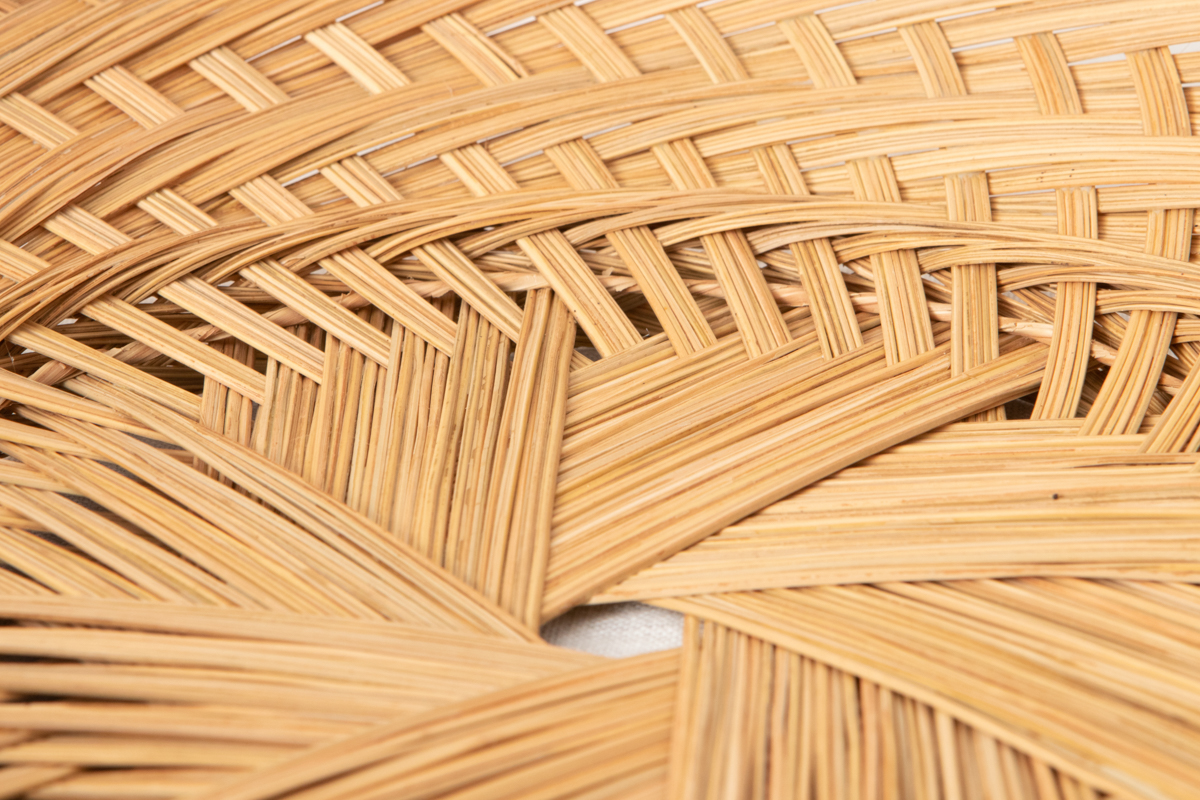
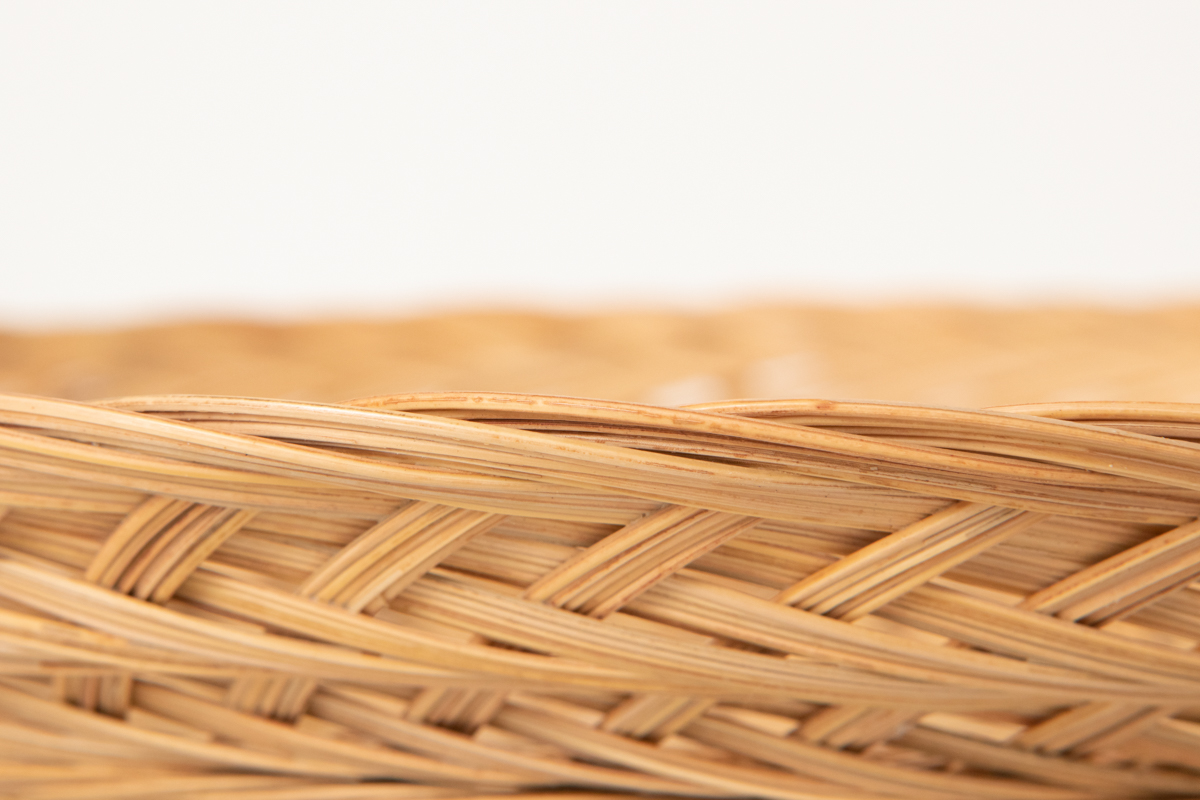
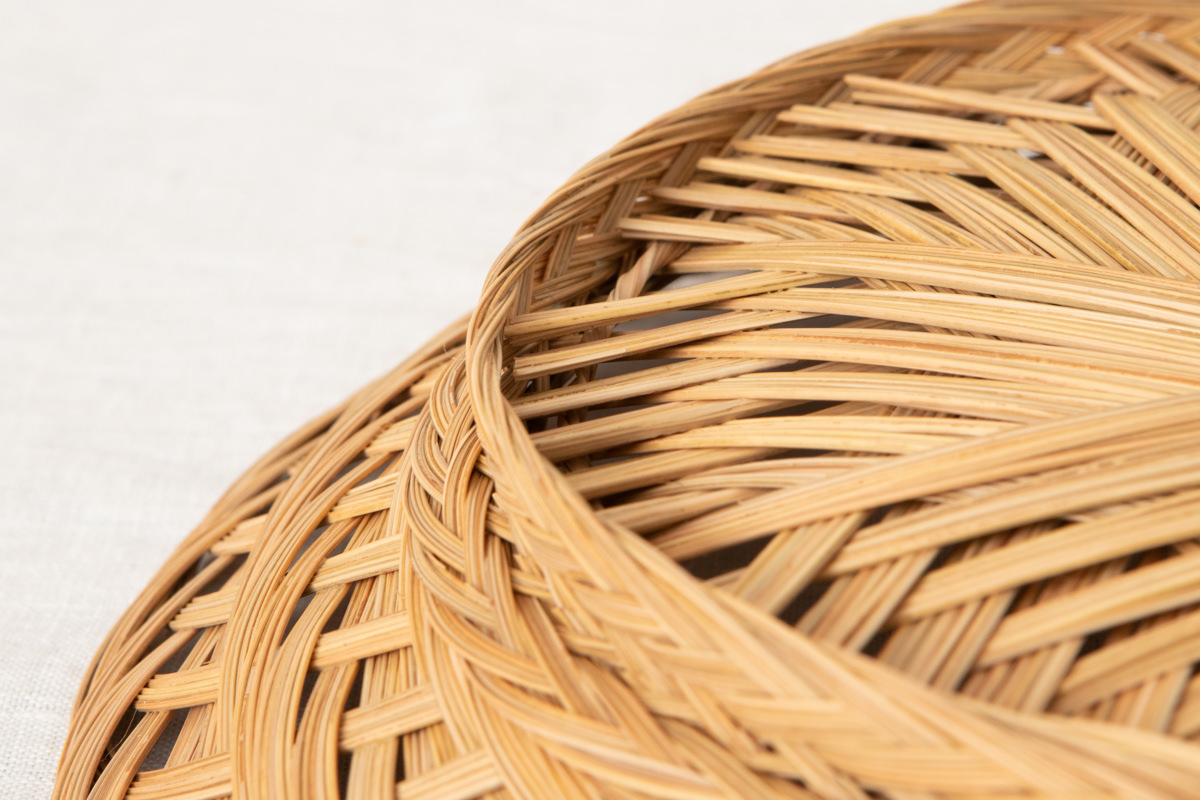
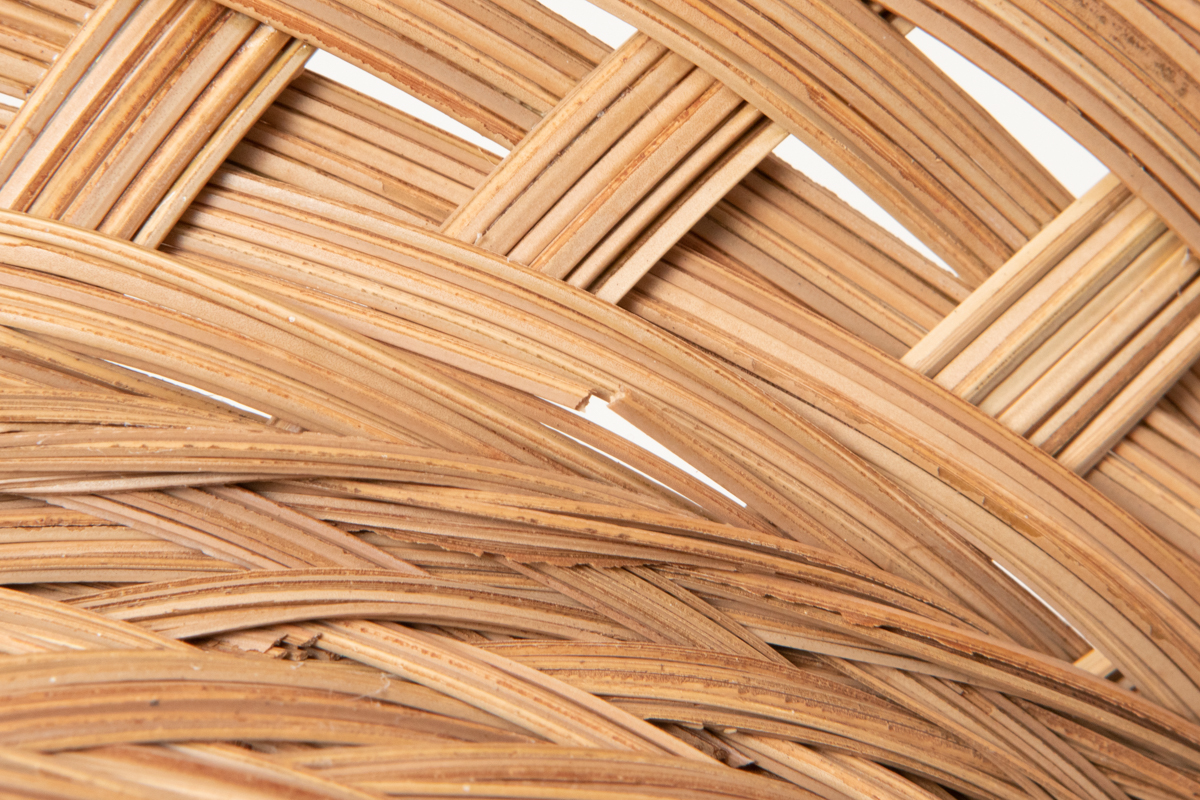
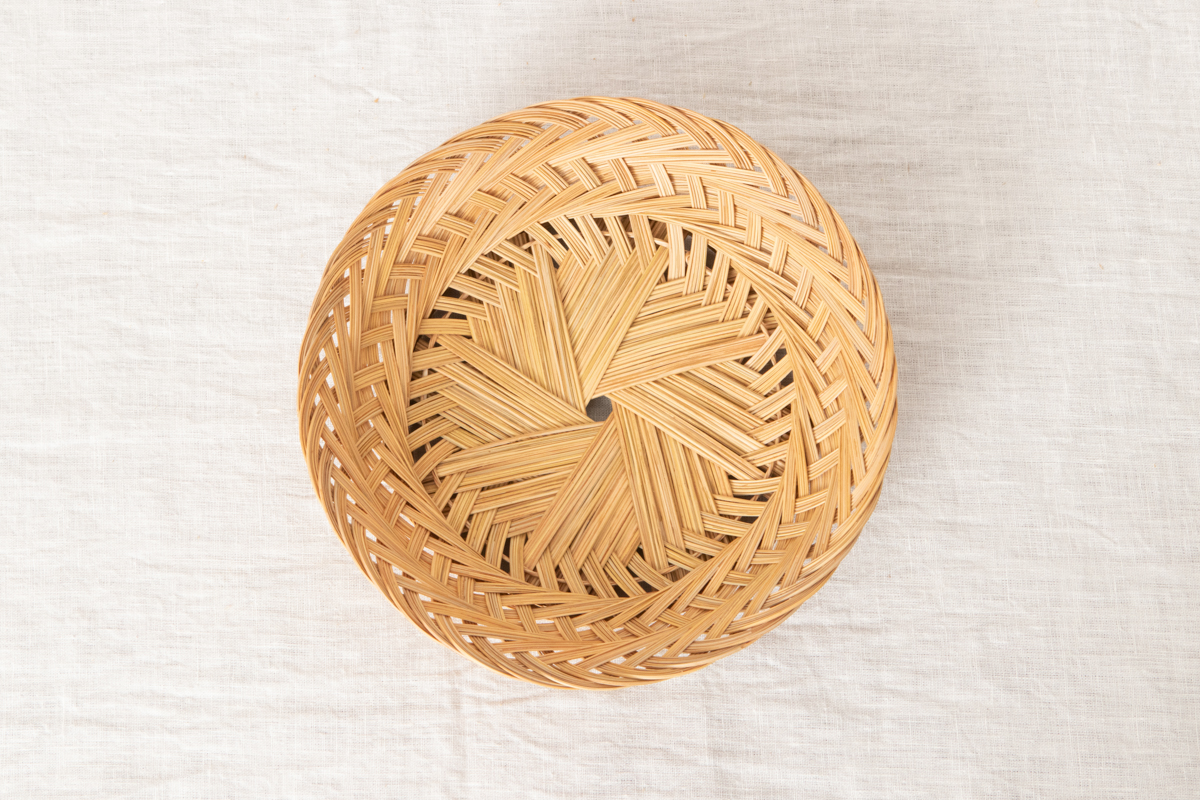
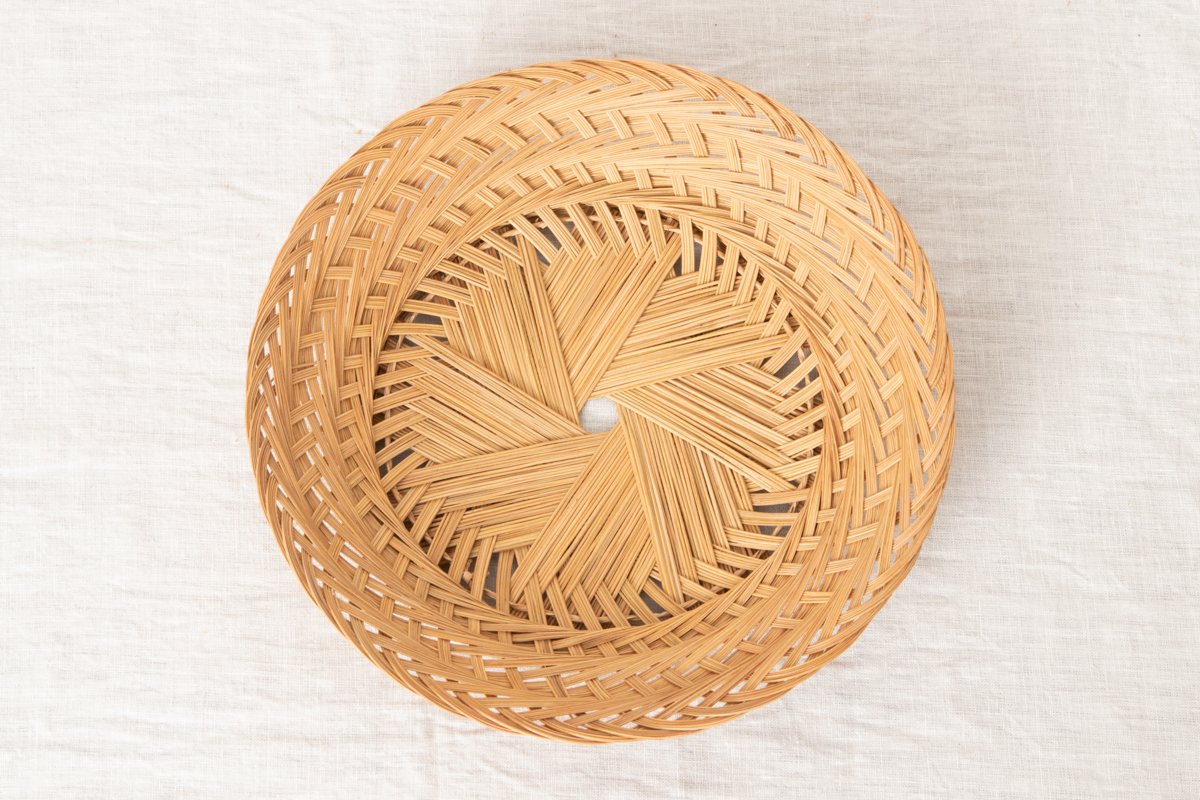
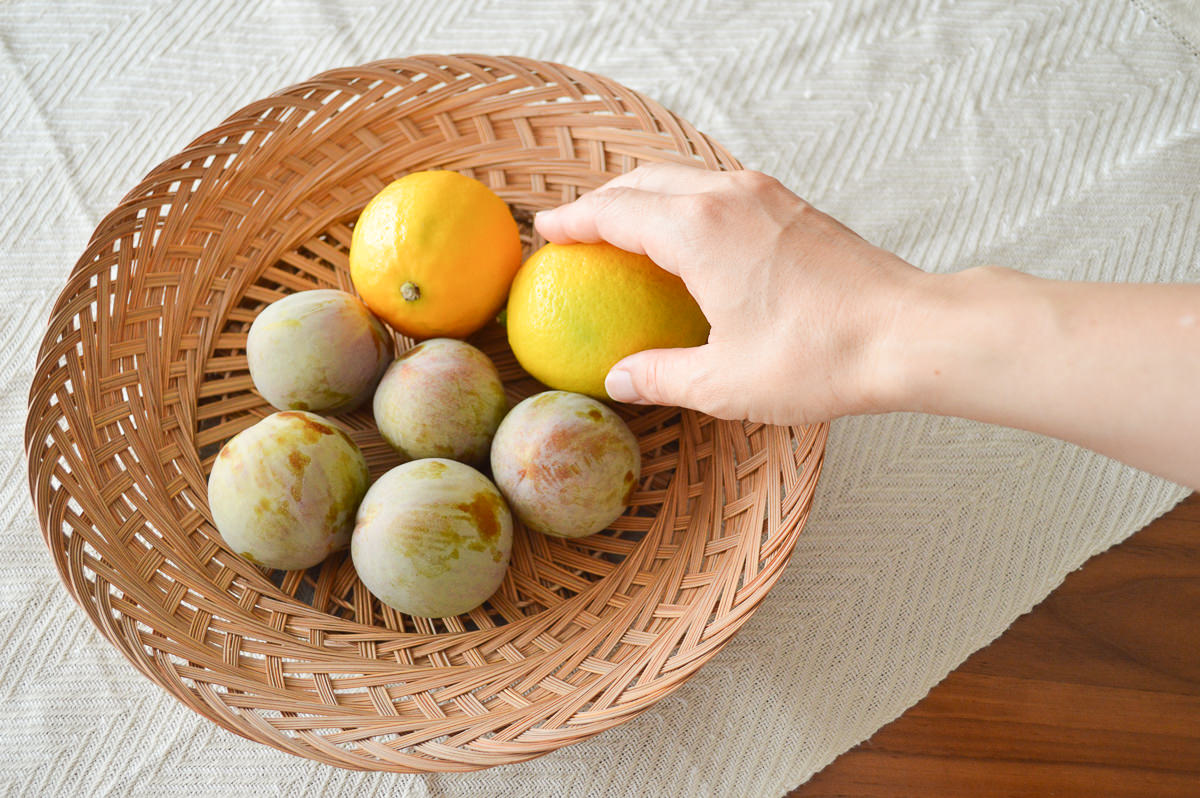
After harvesting, nypa palm is thoroughly sun-dried. It needs at least three full days of good weather to dry properly under the sun.After being thoroughly dried, the stalks and leaves are used differently depending on what is being made. For these trays, the stalks are used—shaved thin and woven by hand, guided by the feel of the artisan’s fingers.Bundles of six narrow stalks are grouped together, then woven from the base upward to form the sides.This is the rim. To reinforce the tray, adhesive is used in certain areas. We appreciate your understanding.The bottom of the tray has a raised base.You may also notice occasional splits or cracks in the stalks like those shown here, but they do not affect usability. We hope you’ll understand.This is the S size.It can be used as a serving basket for small treats such as cookies and chocolates.This is the M size.It can be used as a fruit basket for keeping bananas, mandarins, and other fruit at room temperature.This is the L size.It’s also just the right size for serving or displaying a variety of items.
Nypa palm is a well-ventilated material, and the open weave adds a breezy feel. That makes it especially suitable for storing fruits and root vegetables.
It can also be used to hold snacks or a tea set, or as a stationery tray for a notepad and pen. It also seems useful as a temporary place for incoming mail, such as postcards and letters.
We also recommend it for shop displays or as a basket for displaying merchandise. The raised base helps whatever is placed on it stand out.
Photo: L size
While nypa palm is relatively resistant to moisture, please avoid placing it in damp environments. We recommend keeping it in a well-ventilated indoor space.
This nypa palm tray is light and airy. Please enjoy it in many different settings.
About Nypa Palm Craft in Southern Thailand
Along the western coast of the Malay Peninsula in southern Thailand, there are many soft, muddy wetlands. There are also numerous mangrove forests that have developed in the brackish zones where river water and seawater mix.
Nypa palm, a member of the palm family, grows along the landward edge of these mangrove zones. Compared to other freshwater palms, it is superior in strength and flexibility.
Nypa palm is fibrous, lightweight, and strong. Its breathability and weather resistance make it a useful natural material in vegetation-rich regions, where it is often used for roofing and walls.
The name “Nypa” comes from a Filipino word for this palm. In local regions, it is commonly used to weave roofs and walls by combining its leaves with bamboo frameworks.
In Thailand, Nypa palm can be harvested year-round, and is used to create baskets, trays, scoops, and more. The pieces introduced here are made in Trang Province, located on the western coast of the Malay Peninsula in southern Thailand.
Please note: This item ships from Japan. As the buyer, you are responsible for any import duties, customs fees, or local taxes that may be charged in your country. These costs are not included in the item price or shipping cost. Please check with your local customs authority if you are unsure about any potential charges before placing your order.
These trays are woven from nypa palm, a plant that grows in the mangrove forests of Thailand. We introduce a round tray in three sizes: 20 cm, 24 cm, and 29 cm in diameter.
Many of the weavers are women in their 40s to 70s, though a few men are also involved.
As with Krajood basketry, although young weavers remain few, there is a renewed appreciation within Thailand for natural material products, and it seems that more young people are starting to take an interest in basketry.
After harvesting, nypa palm is thoroughly sun-dried. It needs at least three full days of good weather to dry properly under the sun.After being thoroughly dried, the stalks and leaves are used differently depending on what is being made. For these trays, the stalks are used—shaved thin and woven by hand, guided by the feel of the artisan’s fingers.Bundles of six narrow stalks are grouped together, then woven from the base upward to form the sides.This is the rim. To reinforce the tray, adhesive is used in certain areas. We appreciate your understanding.The bottom of the tray has a raised base.You may also notice occasional splits or cracks in the stalks like those shown here, but they do not affect usability. We hope you’ll understand.This is the S size.It can be used as a serving basket for small treats such as cookies and chocolates.This is the M size.It can be used as a fruit basket for keeping bananas, mandarins, and other fruit at room temperature.This is the L size.It’s also just the right size for serving or displaying a variety of items.
Nypa palm is a well-ventilated material, and the open weave adds a breezy feel. That makes it especially suitable for storing fruits and root vegetables.
It can also be used to hold snacks or a tea set, or as a stationery tray for a notepad and pen. It also seems useful as a temporary place for incoming mail, such as postcards and letters.
We also recommend it for shop displays or as a basket for displaying merchandise. The raised base helps whatever is placed on it stand out.
Photo: L size
While nypa palm is relatively resistant to moisture, please avoid placing it in damp environments. We recommend keeping it in a well-ventilated indoor space.
This nypa palm tray is light and airy. Please enjoy it in many different settings.
About Nypa Palm Craft in Southern Thailand
Along the western coast of the Malay Peninsula in southern Thailand, there are many soft, muddy wetlands. There are also numerous mangrove forests that have developed in the brackish zones where river water and seawater mix.
Nypa palm, a member of the palm family, grows along the landward edge of these mangrove zones. Compared to other freshwater palms, it is superior in strength and flexibility.
Nypa palm is fibrous, lightweight, and strong. Its breathability and weather resistance make it a useful natural material in vegetation-rich regions, where it is often used for roofing and walls.
The name “Nypa” comes from a Filipino word for this palm. In local regions, it is commonly used to weave roofs and walls by combining its leaves with bamboo frameworks.
In Thailand, Nypa palm can be harvested year-round, and is used to create baskets, trays, scoops, and more. The pieces introduced here are made in Trang Province, located on the western coast of the Malay Peninsula in southern Thailand.
Please note: This item ships from Japan. As the buyer, you are responsible for any import duties, customs fees, or local taxes that may be charged in your country. These costs are not included in the item price or shipping cost. Please check with your local customs authority if you are unsure about any potential charges before placing your order.
These trays are woven from nypa palm, a plant that grows in the mangrove forests of Thailand. We introduce a round tray in three sizes: 20 cm, 24 cm, and 29 cm in diameter.
Many of the weavers are women in their 40s to 70s, though a few men are also involved.
As with Krajood basketry, although young weavers remain few, there is a renewed appreciation within Thailand for natural material products, and it seems that more young people are starting to take an interest in basketry.
After harvesting, nypa palm is thoroughly sun-dried. It needs at least three full days of good weather to dry properly under the sun.After being thoroughly dried, the stalks and leaves are used differently depending on what is being made. For these trays, the stalks are used—shaved thin and woven by hand, guided by the feel of the artisan’s fingers.Bundles of six narrow stalks are grouped together, then woven from the base upward to form the sides.This is the rim. To reinforce the tray, adhesive is used in certain areas. We appreciate your understanding.The bottom of the tray has a raised base.You may also notice occasional splits or cracks in the stalks like those shown here, but they do not affect usability. We hope you’ll understand.This is the S size.It can be used as a serving basket for small treats such as cookies and chocolates.This is the M size.It can be used as a fruit basket for keeping bananas, mandarins, and other fruit at room temperature.This is the L size.It’s also just the right size for serving or displaying a variety of items.
Nypa palm is a well-ventilated material, and the open weave adds a breezy feel. That makes it especially suitable for storing fruits and root vegetables.
It can also be used to hold snacks or a tea set, or as a stationery tray for a notepad and pen. It also seems useful as a temporary place for incoming mail, such as postcards and letters.
We also recommend it for shop displays or as a basket for displaying merchandise. The raised base helps whatever is placed on it stand out.
Photo: L size
While nypa palm is relatively resistant to moisture, please avoid placing it in damp environments. We recommend keeping it in a well-ventilated indoor space.
This nypa palm tray is light and airy. Please enjoy it in many different settings.
About Nypa Palm Craft in Southern Thailand
Along the western coast of the Malay Peninsula in southern Thailand, there are many soft, muddy wetlands. There are also numerous mangrove forests that have developed in the brackish zones where river water and seawater mix.
Nypa palm, a member of the palm family, grows along the landward edge of these mangrove zones. Compared to other freshwater palms, it is superior in strength and flexibility.
Nypa palm is fibrous, lightweight, and strong. Its breathability and weather resistance make it a useful natural material in vegetation-rich regions, where it is often used for roofing and walls.
The name “Nypa” comes from a Filipino word for this palm. In local regions, it is commonly used to weave roofs and walls by combining its leaves with bamboo frameworks.
In Thailand, Nypa palm can be harvested year-round, and is used to create baskets, trays, scoops, and more. The pieces introduced here are made in Trang Province, located on the western coast of the Malay Peninsula in southern Thailand.
Please note: This item ships from Japan. As the buyer, you are responsible for any import duties, customs fees, or local taxes that may be charged in your country. These costs are not included in the item price or shipping cost. Please check with your local customs authority if you are unsure about any potential charges before placing your order.